Why This Camera & Lens Are Great for Panoramas
The Nikon Zf is a 24.5 MP full-frame mirrorless body with excellent color depth and dynamic range for panoramas. Its back-illuminated sensor (approx. 35.9 × 23.9 mm, pixel pitch ~5.9 µm) delivers strong shadow recovery, while in-body image stabilization (IBIS) helps hand-held capture and low-light scouting. The Olympus M.Zuiko Digital ED 8mm f/1.8 PRO is a fast, optically excellent diagonal fisheye that reaches a 180° diagonal field of view on Micro Four Thirds, reducing shot count for 360° work and offering bright f/1.8 for dim interiors.
Important compatibility note: the Olympus 8mm f/1.8 PRO is a Micro Four Thirds lens and is not natively compatible with Nikon Z-mount full-frame bodies. Adapting it to Zf while maintaining infinity focus is not practical without complex optical adapters, and the lens’s smaller image circle won’t cover full-frame. In practice you have two proven paths:
- Use the Olympus 8mm on a Micro Four Thirds body for acquisition, then process on your usual workflow.
- Use a functionally equivalent fisheye on the Nikon Zf (e.g., AF-S Fisheye Nikkor 8–15mm f/3.5–4.5G via FTZ or a Z-mount 7.5–9 mm fisheye), and apply the same shooting methods below.
Everything in this guide assumes a diagonal fisheye workflow. Where shot counts differ between Micro Four Thirds and full-frame, both are listed so Zf owners can apply the correct numbers with a comparable fisheye.
Quick Setup Overview
- Camera: Nikon Zf — full-frame (FX) 24.5 MP BSI sensor; approx. 14 EV base dynamic range; strong color depth; IBIS. Best results at ISO 100–800.
- Lens: Olympus 8mm f/1.8 PRO Fisheye — diagonal fisheye for Micro Four Thirds; very sharp by f/4–f/5.6; fast at f/1.8; well-controlled CA; close-focus 12 cm. Note: not native to Nikon Z.
- Estimated shots & overlap:
- Micro Four Thirds + 8mm diagonal fisheye: 6 around (60° yaw steps) at 0° pitch, +1 zenith, +1 nadir. Overlap: 25–30%.
- Full-frame + diagonal fisheye (e.g., Nikkor 8–15 at 8–10 mm): 4–6 around (90°–60° steps) + zenith + nadir. Overlap: 25–30%.
- At 12–15 mm FF: 6–8 around + zenith + nadir for cleaner edges.
- Difficulty: Moderate. A calibrated panoramic head makes it easy and repeatable.
Planning & On-Site Preparation
Evaluate Shooting Environment
Scan the location for moving subjects, reflective surfaces (glass, polished floors), bright windows, and tight spaces that may introduce parallax challenges. If shooting through glass, keep the lens as close as possible (1–2 cm) and shade it to reduce reflections and ghosting. In city rooftops, check wind conditions and vibration sources; in interiors, check mixed lighting (tungsten + LEDs + daylight) that can cause white balance inconsistency.
Match Gear to Scene Goals
The Nikon Zf’s clean ISO up to ~1600 and its ~14 EV dynamic range give you flexibility for interiors and blue-hour panoramas. With a fisheye, you’ll need fewer frames per 360°, reducing stitch seams and time spent shooting — a big win for real estate or event coverage. The trade-off: stronger fisheye distortion, which is normal and handled in stitching. For indoor real estate, aim for ISO 100–400 on a tripod; for dusk exteriors, ISO 100–800. If using the Olympus 8mm, pair it with an MFT body; if staying with the Zf, select a comparable Z/FTZ fisheye to match shot counts and overlap.
Pre-shoot Checklist
- Fully charged batteries and ample storage; panoramas with bracketing multiply file count quickly.
- Clean lens, sensor, and use a microfiber cloth; grease or dust becomes obvious in ultra-wide edges.
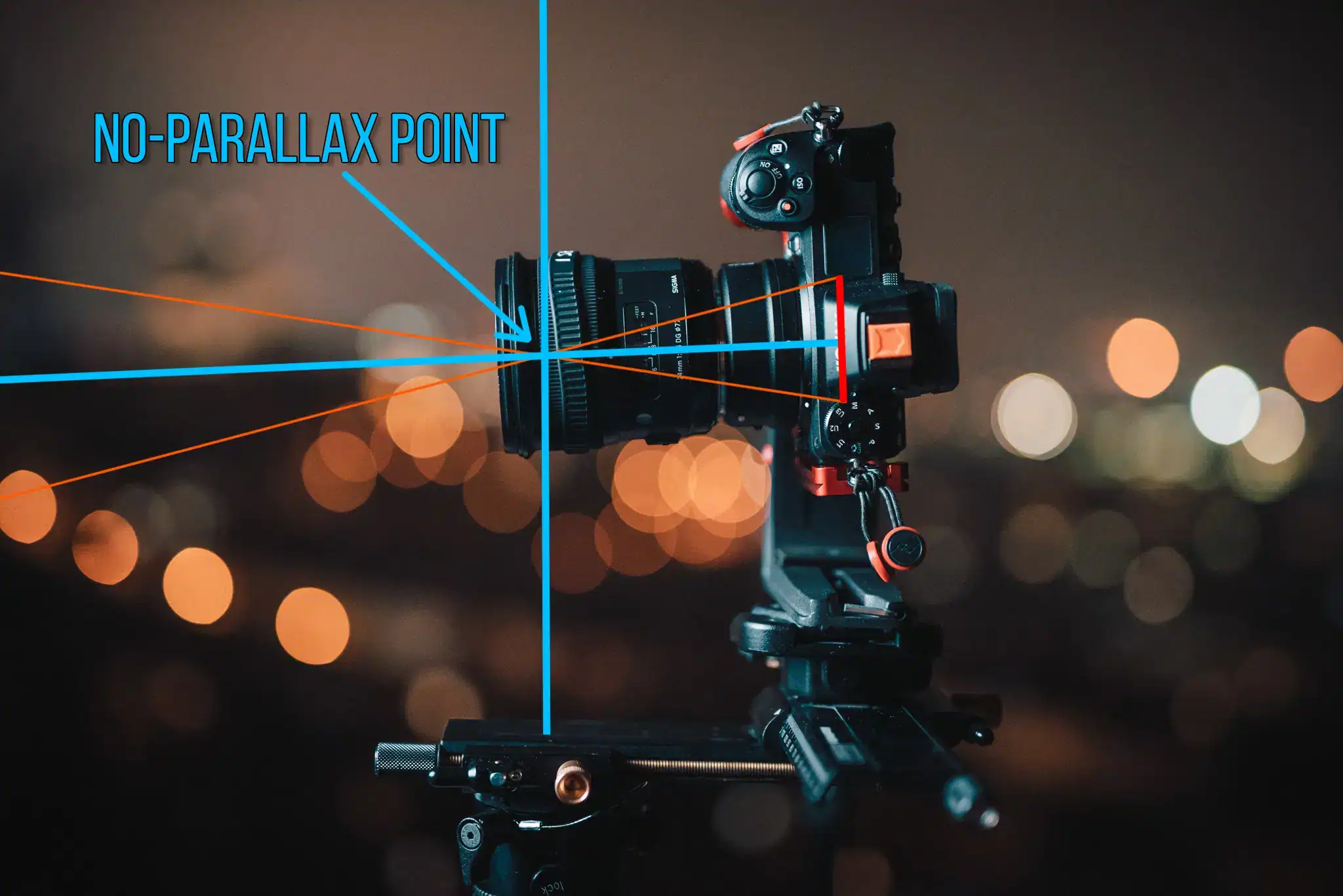
- Tripod leveled and panoramic head calibrated to the lens’s no-parallax point.
- Safety checks: wind, rooftop railings, pole tethers, car mounts’ torque. Use a secondary tether for elevated rigs.
- Backup workflow: shoot a second 360° pass after the first, especially for client work or outdoor light changes.
Essential Gear & Setup
Core Gear
- Panoramic head: Lets you rotate around the lens’s entrance pupil (nodal point) to minimize parallax. Calibrate once for your lens and mark the rails for speed.
- Stable tripod with leveling base: A half-ball or dedicated leveling base makes fast, precise leveling without adjusting leg lengths.
- Remote trigger or app: Fire the camera without touching it to avoid micro-vibrations, especially for HDR brackets and long exposures.
Optional Add-ons
- Pole or car mount: For elevated or vehicle-based 360s. Always use a safety tether; mind wind load and speed-induced vibrations. Reduce rotation speed to minimize blur.
- Lighting aids: Small LED panels for dim interiors; use consistent color temperature to avoid WB mismatch across frames.
- Weather protection: Rain cover and lens hood shading. Water droplets on a fisheye front element are very hard to retouch.
Step-by-Step Shooting Guide
Standard Static Scenes
- Level the tripod, then align the nodal point. Slide the camera on the panoramic head’s rails until foreground and background objects stay aligned during a yaw test. Mark this position for future use.
- Set manual exposure and lock white balance. Use a consistent WB preset (e.g., Daylight or 4000K indoor). Manual mode eliminates exposure flicker that breaks stitches.
- Capture the main ring with the tested overlap:
- MFT + 8mm fisheye: 6 shots around at 0° pitch, 60° yaw increments.
- FF + diagonal fisheye (Zf with 8–10 mm equivalent): 4–6 shots around, 90°–60° yaw increments.
Tilt up ~10–15° if you need more sky for the zenith; keep overlap 25–30%.
- Nadir shot: Tilt down to capture the ground/tripod area. Consider an extra off-center handheld nadir for easier patching.
- Zenith shot: Tilt up to fill the small “cap” of sky or ceiling missed in the main ring.
HDR / High Dynamic Range Interiors
- Enable exposure bracketing at ±2 EV (3 or 5 frames). This balances bright windows and shadowy interiors.
- Lock WB and focus. Any variation across brackets causes color shifts and alignment errors.
- Use a 2-second delay or remote. For bracketed bursts, use continuous bracketing with minimal time between frames to reduce ghosting from moving curtains or foliage outside.
Low-Light / Night Scenes
- Use longer exposures on a tripod. On the Zf, keep ISO as low as practical (ISO 100–800 ideal; ISO 1600–3200 acceptable when necessary).
- Disable IBIS when on a tripod to prevent micro-corrections that can blur long exposures across frames.
- Prefer mechanical shutter under LED or mixed lighting to avoid banding from electronic shutter readout.
Crowded Events
- Shoot two passes of the main ring: one “fast” for coverage, one waiting for gaps. You can mask moving subjects later.
- Consider 6–8 around for extra seam placement options; more frames give you more flexibility in post.
Special Setups (Pole / Car / Elevated)
- Use a rigid pole, clamp, or suction mount rated for your total rig weight. Add a safety tether and check all fasteners.
- Shoot at faster shutter speeds to counter vibration (1/250–1/500 if possible). Rotate slower to minimize motion blur.
- Avoid windy conditions; fisheye domes catch gusts easily. If unavoidable, reduce the pole height and add guy-lines.
Recommended Settings & Pro Tips
Exposure & Focus
| Scenario | Aperture | Shutter | ISO | Notes |
|---|---|---|---|---|
| Daylight outdoor | f/8–f/11 | 1/100–1/250 | 100–200 | Lock WB (Daylight); watch flare near sun |
| Low light/night | f/4–f/5.6 | 1/30–1/60 (tripod) | 100–800 (1600–3200 if needed) | Use remote; IBIS off on tripod; mechanical shutter to avoid banding |
| Interior HDR | f/8 | Bracket ±2 EV | 100–400 | Balance windows and lamps; keep WB fixed |
| Action / moving subjects | f/5.6–f/8 | 1/200+ | 400–800 | Freeze motion; consider two-pass strategy |
Critical Tips
- Manual focus at or near hyperfocal. With an 8mm fisheye, focusing ~0.5–0.7 m at f/8 brings near-to-infinity into acceptable focus on both MFT and FF.
- Nodal point calibration: Use a near object (~0.5–1 m) and a far object in the same line. Rotate and adjust rail position until their alignment remains constant through yaw.
- White balance lock: Choose a single Kelvin value per scene; do not leave on Auto WB when shooting multi-frame panoramas or brackets.
- RAW over JPEG: RAW preserves highlight detail and color latitude for seamless blending and sky/ceiling recovery.
- Stabilization: Turn off IBIS/lens VR on a tripod. Keep it on only for handheld scouting or emergency handheld panoramas.
Stitching & Post-Processing
Software Workflow
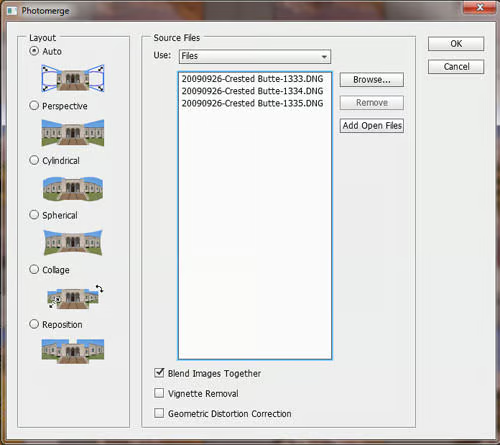
Import your RAW files and pre-process them consistently: same camera profile, WB, and exposure baseline for all frames. For stitching, PTGui is the industry workhorse for fisheye panoramas, with Hugin as a capable open-source alternative. Fisheye sets typically use 25–30% overlap; rectilinear needs 20–25% but more frames. After stitching, export an equirectangular 2:1 master (typically 12,000 × 6,000 px or higher, depending on your capture). See a PTGui review and workflow insights at the end of this section.
Cleanup & Enhancement
- Nadir patching: Use content-aware fill, clone stamp, or AI tools. A dedicated offset nadir shot makes this faster.
- Color and noise: Apply global color correction first, then targeted noise reduction on shadow zones from HDR merges.
- Horizon level: Ensure roll/yaw/pitch are corrected so the horizon is level and verticals are straight in rectilinear views.
- Export: For web VR, export high-quality JPEG equirectangular; for further grading or 32-bit pipelines, export 16-bit TIFF or EXR.
For a foundational overview of DSLR/mirrorless 360 capture and stitching steps, Meta’s Creator guide is concise and practical. For in-depth control point strategy and head setup, the 360 Rumors panoramic head tutorial is excellent. PTGui’s power and speed are also covered in Fstoppers’ review. Using a DSLR or mirrorless camera to shoot and stitch a 360 photo • Panoramic head setup and theory • Why PTGui is a top panorama tool
Video: A Quick Visual Primer
Sometimes seeing the flow helps more than words. The video below complements the concepts above with a hands-on overview.
Disclaimer: confirm each software’s current UI and features; updates can modify specific menus and steps.
Useful Tools & Resources
Software
- PTGui panorama stitching
- Hugin (open-source)
- Adobe Lightroom / Photoshop (RAW prep and retouch)
- AI tripod/nadir removal tools (content-aware or ML-based)
Hardware
- Panoramic heads: Nodal Ninja, Leofoto, Sunwayfoto
- Carbon fiber tripods for stiffness-to-weight
- Leveling bases or half-ball systems
- Wireless remote shutters or app control
- Pole extensions and vehicle-rated mounts with safety tethers
Disclaimer: brand names are provided as search references; check official sites for specs and compatibility.
Common Mistakes & How to Avoid Them
- Parallax error: Always rotate around the lens’s entrance pupil and re-check nodal alignment if you change camera height.
- Exposure flicker: Use manual exposure and fixed WB; avoid Auto ISO, Auto WB, and varying picture profiles.
- Tripod shadows and clutter: Shoot a clean nadir and plan your seam placement away from problem areas.
- Ghosting from movement: Mask moving subjects during stitching; shoot extra coverage frames when crowds are present.
- Night noise: Prefer longer shutter at low ISO on a tripod rather than pushing ISO too high.
- Flare at wide angles: Shield the front element from direct sun or strong lights with your hand or a flag outside the frame.
Real-World Case Studies
Indoor Real Estate (Mixed Light)
On a tripod, set the Zf to ISO 100, f/8, and bracket ±2 EV (5 frames). Shoot 6 around + zenith + nadir with your fisheye. Lock WB to a fixed Kelvin (e.g., 4000–4500K) to tame tungsten/LED variability. In PTGui, choose Exposure/HDR fusion to blend windows and interiors cleanly. Finish with a targeted warm tint for cozy ambience.
Sunset Landscape 360
Level on solid ground. Manual mode, ISO 100–200, f/8, shutter 1/60–1/125 for the main ring; capture the zenith slightly quicker to avoid blown highlights near the sun. If there’s intense contrast, do a three-shot bracket for only the frames facing the sun. In post, gradient-mask the sky for smooth tonality and ensure horizon leveling is spot-on.
Rooftop or Pole Capture
Use a rigid pole with a compact panoramic head. Keep shutter speed at 1/250–1/500 to combat wind. Shoot 6–8 around for extra redundancy and later pick the least-blurry frames. Always tether the rig and check torque on clamps before lifting the pole.
Frequently Asked Questions
- Can I shoot handheld panoramas with Nikon Zf?
Yes, in a pinch. Use 1/250+ shutter, IBIS on, and shoot extra overlap (35–40%). Expect some stitching cleanup. For client work, a tripod and panoramic head remain the reliable standard.
- Is the Olympus 8mm f/1.8 wide enough for single-row 360?
On Micro Four Thirds, yes: 6 around + zenith + nadir is typical. On full-frame Zf, the Olympus 8mm isn’t practical to adapt; use a comparable diagonal fisheye (e.g., Nikkor 8–15 at the wide end) for similar shot counts.
- Do I need HDR for interiors with bright windows?
Usually. Bracketing ±2 EV (3–5 frames) retains window detail and clean mid-tones. Keep WB and focus locked across brackets to avoid stitching mismatches.
- How do I avoid parallax issues?
Rotate around the entrance pupil using a calibrated panoramic head. Perform a near–far alignment test and mark your rail settings so you can set up fast next time.
- What ISO range is safe on the Zf in low light?
For critical quality, ISO 100–800 is ideal. ISO 1600–3200 is workable for events or when you must freeze motion, with modest noise reduction in post.
Safety, Limitations, and Trustworthy Workflow
Always tether elevated or vehicle-mounted rigs and respect wind limits; a fisheye’s bulbous front element is both exposed and expensive. The Olympus 8mm f/1.8 PRO is superb on Micro Four Thirds, but it’s not a practical match for the Nikon Zf without optical compromises; use a native Z/FTZ diagonal fisheye to achieve identical panoramic results. Back up on-site: after the first 360 pass, do a second. In post, keep project files and export versions; document your nodal settings for reproducibility and team hand-offs. For deeper technical grounding and field-proven advice, see the panoramic head and DSLR/mirrorless 360 guides referenced earlier. DSLR/virtual tour lens and camera guide