
Why This Camera & Lens Are Great for Panoramas
Here’s the straight truth before we dive in: the Nikon Zf (a full-frame Nikon Z-mount mirrorless) and the Fujifilm XF 10–24mm f/4 OIS WR (an APS‑C Fujifilm X‑mount rectilinear zoom) are not natively compatible. There’s no practical adapter to mount an X‑mount lens on a Nikon Z body while retaining infinity focus and electronic control. That said, photographers often search for how to shoot panorama with Nikon Zf & Fujifilm XF 10-24mm f/4 OIS WR because they like the Nikon Zf’s image quality and the XF 10–24’s field of view for panoramas. So, we’ll do two things:
- Explain an equivalent Nikon Zf setup (e.g., Z 14–30mm f/4 S or any rectilinear ~14–16mm on full-frame) that matches the 10mm XF’s 15mm full-frame FoV.
- Provide settings and stitching advice that apply equally if you instead use a Fujifilm X body (e.g., X‑T5) with the XF 10–24mm f/4 OIS WR.
The skills, overlap strategy, nodal alignment, and HDR workflow are identical. You’ll get reliable, high‑resolution 360° panoramas whether you use a Nikon Zf with a comparable Z‑mount wide zoom or shoot the XF 10–24 on a Fujifilm X body.
Why the Nikon Zf is an excellent pano body: it has a 24.5MP full-frame BSI sensor with strong dynamic range (~14 EV at base ISO) and very clean ISO 100–800 files. The pixel pitch (~5.94 μm) delivers forgiving noise performance for multi-exposure brackets. Its in-body stabilization (IBIS) is great for handheld sequences, though you should switch stabilization off when on a tripod to prevent micro‑blur during long exposures.
Why the XF 10–24mm f/4 OIS WR is a great pano lens (on an X body): it’s a sharp, rectilinear ultra‑wide with constant f/4 and optical stabilization, weather sealing, and well‑controlled distortion at 10–12mm after profile correction. At 10mm on APS‑C, the field of view is equivalent to approximately 15mm on full‑frame—excellent for multi‑row 360° work with manageable overlap and minimal edge stretching compared with a fisheye.
Quick Setup Overview
- Camera: Nikon Zf — Full-Frame 24.5MP BSI CMOS; ~14 EV DR at base ISO; excellent ISO 100–800 performance for panoramas.
- Lens: Fujifilm XF 10–24mm f/4 OIS WR — Rectilinear APS‑C zoom; sharp around f/5.6–f/8; moderate barrel distortion at 10mm (easily corrected); OIS helpful when handheld. Note: not mountable on Zf; use on Fujifilm X bodies, or use a comparable Nikon Z lens (e.g., NIKKOR Z 14–30mm f/4 S at 14–16mm) for the Nikon Zf.
- Estimated shots & overlap (rectilinear UWA, ~15mm FF equivalent):
- Single-row pano (not full 360): 8–12 shots around at 30% overlap.
- Full 360×180 multi‑row:
- Option A (higher quality): 10 shots at +45°, 10 shots at 0°, 10 shots at −45°, plus 2–3 zenith and 2 nadir shots (≈34–35 total).
- Option B (faster): 8 shots at +45°, 8 at 0°, 8 at −45°, plus 2 zenith and 1–2 nadir (≈27–30 total).
- Difficulty: Moderate — rectilinear multi‑row requires careful overlap and nodal alignment, but yields clean straight lines (great for real estate).
Planning & On-Site Preparation
Evaluate Shooting Environment
Scan for moving elements (people, trees in wind, traffic), specular highlights (glass, chrome), and mixed lighting. If shooting through glass, press a lens hood or cloth close to the glass to reduce reflections; keep the lens 1–3 cm from the surface and avoid direct bright light behind you. Indoor scenes with large windows require HDR bracketing to control blown highlights and noisy shadows.
Match Gear to Scene Goals
For how to shoot panorama with Nikon Zf & Fujifilm XF 10-24mm f/4 OIS WR, use equivalent field of view to plan coverage. On Nikon Zf, choose 14–16mm on a Z‑mount rectilinear (e.g., Z 14–30mm f/4 S) to match 10–11mm on the XF lens. The Zf’s DR lets you safely bracket ±2 EV for interiors. Outdoors at sunset, the Zf files remain robust up to ISO 800–1600 with careful exposure, but for best stitch quality keep ISO ≤800. If you’re using the XF 10–24 on a Fujifilm X body, the same advice applies—just note that at 10mm APS‑C you’ll need multi‑row coverage to close the zenith and nadir.
Pre-shoot Checklist
- Charge batteries; carry spares. Format fast cards. Clean lens and sensor.
- Level the tripod; verify panoramic head calibration for the chosen focal length.
- Safety: check wind on rooftops, tether camera on poles/cars, avoid overhangs and crowds. Don’t extend a pole near power lines.
- Backup workflow: for critical jobs, shoot a second pass (or a safety row) and consider bracketed exposure sets.
Essential Gear & Setup
Core Gear
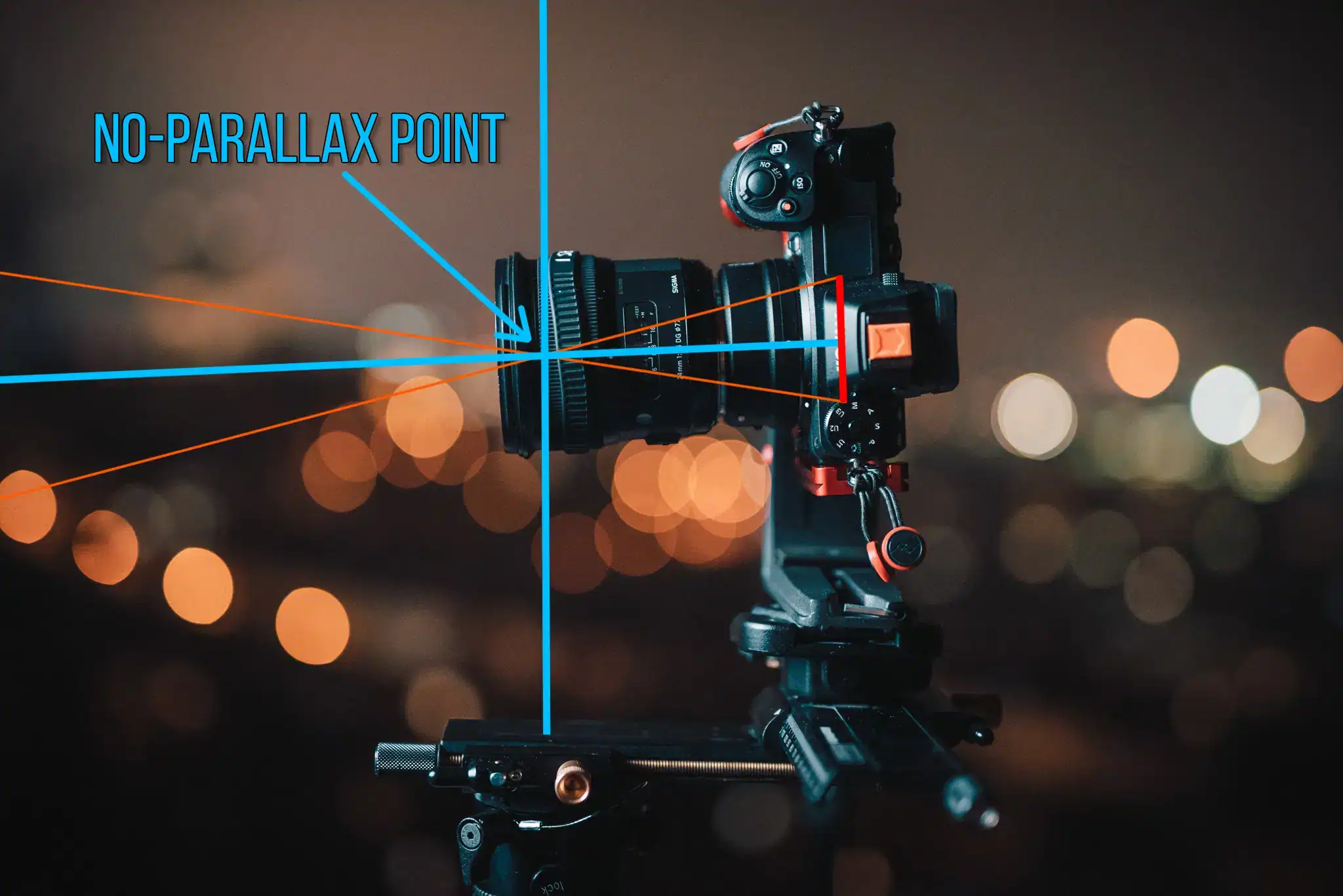
- Panoramic head: Align the lens’s entrance pupil (often called the nodal point) over the rotation axis to eliminate parallax. This is essential for interiors with near objects.
- Stable tripod with leveling base: Rapid leveling saves time and avoids horizon tilt in stitches.
- Remote trigger or app: Prevents vibration; use a 2–s timer if a remote isn’t available.
Optional Add-ons
- Pole/car mount: Great for elevated or vehicle-based capture. Use safety tethers, consider wind loading, and keep speeds low to minimize vibration.
- Lighting: Small LED panels for dim interiors; bounce light to avoid hot spots.
- Weather gear: Rain covers, microfiber cloths, and silica packets for condensation.
Step-by-Step Shooting Guide
Standard Static Scenes
- Level and nodal alignment:
- Mount the camera in portrait orientation on the pano head.
- Use two vertical reference objects (near and far). Rotate the camera left/right and adjust the rail until near/far alignment doesn’t shift.
- Mark the rail position for key focal lengths (e.g., 10, 12, 14, 24mm) to speed future setups.
- Manual exposure and white balance:
- Switch to M mode. Meter the brightest part of the scene and set exposure to preserve highlights (especially through windows).
- Lock WB (Daylight for outdoor sun, Tungsten/Custom indoors). Consistent WB prevents color seams during stitching.
- Capture sequence and overlap:
- For ~15mm FF equivalent: shoot a 3‑row grid: +45°, 0°, −45° with 8–10 frames per row at ~30–35% overlap.
- Pause a second between shots if using IBIS/OIS; better yet, switch stabilization off on a tripod.
- Zenith and nadir:
- Zenith: tilt up to +75–90°; take 2–3 overlapping frames to close the top.
- Nadir: take 1–2 frames after shifting the tripod slightly or shoot a handheld nadir plate for clean tripod removal.
HDR / High Dynamic Range Interiors
- Bracket ±2 EV (3–5 frames) at each yaw position to handle bright windows and dim corners.
- Lock WB and focus. If your camera supports exposure bracketing with self‑timer, enable it to fire a burst hands‑free.
- Merge brackets to HDR before stitching (PTGui can handle bracketed stacks automatically) or stitch first and HDR later—test which works best for your scene.
Low-Light / Night Scenes
- Use a sturdy tripod; turn off IBIS/OIS. Start around f/4–f/5.6, 1–5 s, ISO 100–400. On the Nikon Zf, ISO 100–800 remains very clean; avoid pushing beyond 1600 unless needed.
- Use a remote or 2–s timer to avoid shake. Enable EFCS (if available) to reduce shutter shock.
- Take an extra pass if lights flicker (LEDs) to ensure clean frames for masking.
Crowded Events
- Two-pass method: first pass quickly for coverage, second pass waiting for gaps in walking traffic.
- Use shorter shutter (1/125–1/250) at f/5.6–f/8, ISO 400–800 to reduce motion blur on people you plan to keep.
- Mask moving elements in post using the cleaner frame from either pass.
Special Setups (Pole / Car / Drone)
- Pole: Use a lightweight pano head with a rigid carbon pole. Keep rotations slow and deliberate. Always tether gear and be mindful of wind gusts.
- Car: Mount low and rigid; avoid highways. Shoot at stops to keep frames sharp. Be cautious with legal and safety considerations.
- Drone: If using a drone for the zenith or background plate, match focal lengths/FoV and light as closely as possible.
Field Case Studies
Indoor Real Estate
At 15mm FF equivalent: f/8, ISO 100–200, bracket ±2 EV. Three rows (8–10 each), plus zenith and a handheld nadir. Lock WB to “Daylight” for consistency across mixed lighting; correct color casts in post with selective HSL.
Outdoor Sunset Overlook
Expose for the sky (protect highlights) and bracket for the foreground. Expect fast light changes—work quickly and consider two passes. ISO 100–400, f/8, 1/60–1/250, depending on brightness.
Event Crowds
Pre-visualize seams to avoid cutting through faces. A faster shutter and slightly higher ISO helps. Consider a second pass to capture clean background plates for masking.
Recommended Settings & Pro Tips
Exposure & Focus
| Scenario | Aperture | Shutter | ISO | Notes |
|---|---|---|---|---|
| Daylight outdoor | f/8–f/11 | 1/100–1/250 | 100–200 | Lock WB (Daylight); manual exposure |
| Low light/night | f/4–f/5.6 | 1/30–4 s | 100–800 | Tripod, remote, stabilization OFF |
| Interior HDR | f/8 | Bracket ±2 EV | 100–400 | Merge HDR stacks consistently across yaw positions |
| Action / moving subjects | f/5.6–f/8 | 1/200+ | 400–800 | Use two-pass strategy for clean masks |
Critical Tips
- Focus: Use manual focus at the hyperfocal distance. Approximate hyperfocal guides:
- FF 14–16mm at f/8: ~0.8–1.0 m (everything ~0.4 m to infinity is sharp).
- APS‑C 10mm at f/8: ~0.6–0.7 m (everything ~0.3 m to infinity is sharp).
- Nodal alignment: Calibrate once per focal length and mark your rail. Re-check if you change filters or focus distance significantly.
- White balance: Lock WB to avoid patchwork color. In mixed lighting, shoot a grey card and create a custom WB if possible.
- RAW vs JPEG: Always shoot RAW for pano work. You’ll need the dynamic range and color latitude.
- Stabilization: Turn off IBIS/OIS on a tripod. If handholding, leave stabilization on and increase overlap to 35–40%.
Stitching & Post-Processing
Software Workflow
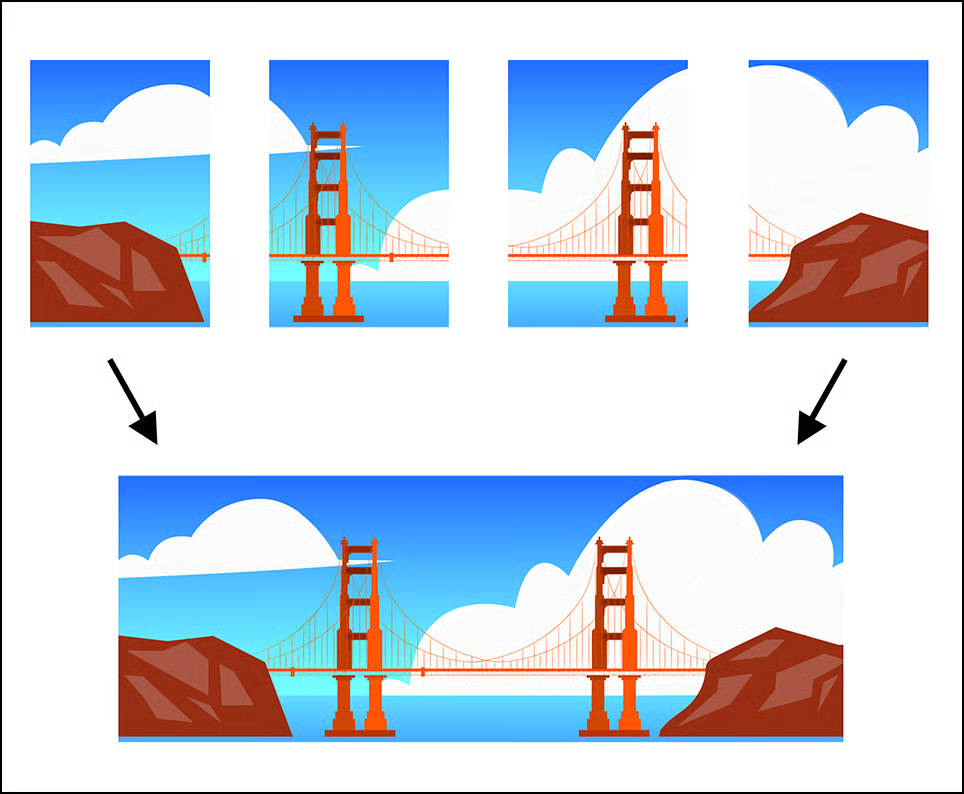
PTGui is the industry standard for robust control points, bracketed HDR stacks, and equirectangular output. Hugin is an excellent open-source alternative. Lightroom/Photoshop can stitch simple single-row panoramas, but for full 360×180 spheres, PTGui or Hugin is more reliable. For rectilinear lenses, plan 20–35% overlap; fisheyes can use ~25–30% but require defishing. For how to shoot panorama with Nikon Zf & Fujifilm XF 10-24mm f/4 OIS WR (or an equivalent Nikon Z ultra‑wide), PTGui’s template workflow saves lots of time across rooms or tour stops. Review of PTGui and why it excels for complex panoramas.
Cleanup & Enhancement
- Nadir patch: Shoot a handheld nadir frame or use a logo patch. Many editors and AI tools can fill tripod areas cleanly.
- Color and noise: Apply lens profiles, remove color casts, and use moderate noise reduction for high‑ISO brackets.
- Level horizon: Set pitch/roll/yaw so the horizon is level and verticals are vertical.
- Export: For VR, export an equirectangular JPEG/TIFF (2:1 aspect). Common outputs: 12K–16K on a 24MP base if multi‑row coverage was used.
For a deeper dive into panoramic head setup and spherical theory, see these authoritative resources: Panoramic head setup best practices and Oculus: set up a panoramic head for high-end 360 photos.
Useful Tools & Resources
Software
- PTGui panorama stitching
- Hugin (open source)
- Lightroom / Photoshop
- AI tripod/nadir removal tools
Hardware
- Panoramic heads: Nodal Ninja, Leofoto
- Carbon fiber tripods with leveling base
- Wireless remote shutters
- Pole extensions and vehicle mounts (with safety tethers)
Disclaimer: product names are provided as search references. Check official sites for current specs and compatibility.
Common Mistakes & How to Avoid Them
- Parallax seams from near objects → precisely align to the lens’s entrance pupil and keep consistent focus.
- Exposure flicker → use manual exposure and lock white balance.
- Tripod shadows or legs in frame → capture a clean nadir or plan a logo patch.
- Ghosting from moving subjects → shoot two passes and mask selectively in post.
- High ISO noise at night → use a tripod, longer shutter, and keep ISO ≤800 when possible.
- Stabilization blur on tripod → turn off IBIS/OIS for long exposures.
Frequently Asked Questions
-
Can I mount the Fujifilm XF 10–24mm f/4 OIS WR on the Nikon Zf?
No. X‑mount lenses are not practically adaptable to Nikon Z bodies due to flange distance and electronic control differences. Use a comparable Nikon Z wide zoom (e.g., Z 14–30mm f/4 S) to replicate the 10mm APS‑C (~15mm FF) field of view.
-
Is the XF 10–24mm wide enough for a single-row 360°?
At 10mm APS‑C (~15mm FF eq.), a single row won’t cover the zenith and nadir fully. Use a multi‑row capture: typically 8–10 around per row at +45°, 0°, and −45°, then add zenith/nadir shots.
-
What ISO range is safe on the Nikon Zf for pano work?
For critical 360° stitches, ISO 100–800 is very clean, 1600 is usable with careful noise reduction. Prioritize tripod use and longer shutters over pushing ISO.
-
How do I avoid parallax issues indoors with furniture and railings?
Use a panoramic head and align the entrance pupil. Calibrate at your chosen focal length and focus distance, and avoid reframing between rows. Keep overlap consistent (~30%).
-
Do I need HDR for interiors with bright windows?
Usually yes. Bracket ±2 EV (3–5 frames). Merge exposure stacks consistently (either pre‑ or post‑stitch) so window highlights and interior shadows both retain detail.
-
Can I shoot handheld panoramas with the Nikon Zf?
Yes for single-row panos. For full 360×180, it’s possible but risky due to parallax. If you must, keep IBIS on, use 35–40% overlap, and avoid near foreground elements.
-
What’s the best tripod head for this setup?
A multi‑row panoramic head with fore–aft and lateral rails (e.g., Nodal Ninja or Leofoto) that lets you place the entrance pupil precisely over the rotation axis. Add a leveling base to speed setup.

Further learning and standards-based guidance: Oculus: DSLR/Mirrorless capture for 360 photos.
Final Notes on This Mixed-Brand Pairing
If your goal is specifically how to shoot panorama with Nikon Zf & Fujifilm XF 10-24mm f/4 OIS WR, the key takeaway is compatibility. Since the XF lens won’t mount on the Zf, either:
- Use the Nikon Zf with a comparable Z‑mount UWA (e.g., NIKKOR Z 14–30mm f/4 S) and follow the capture recipe here; or
- Use the XF 10–24mm on a Fujifilm X body and apply the same overlap and nodal techniques.
Everything else—planning, nodal alignment, HDR strategy, overlap discipline, and PTGui/Hugin stitching—remains identical and will get you to professional, reliable 360° results.