
Why This Camera & Lens Are Great for Panoramas
If you’re researching how to shoot panorama with Nikon Zf & Canon RF 14-35mm f/4L IS USM, you’re clearly aiming for sharp, immersive 360 photos with minimal headaches in post. The Nikon Zf is a 24.5MP full-frame mirrorless camera with a back-illuminated sensor (approx. 36×24 mm, pixel pitch around 5.9 µm) that delivers excellent low-light performance and around 14+ stops of dynamic range at base ISO. Its 5-axis in-body stabilization (IBIS), tactile controls, and modern AF tracking make it a pleasure to use in the field. The Canon RF 14-35mm f/4L IS USM is a top-tier rectilinear ultra-wide zoom known for edge-to-edge sharpness (especially from f/5.6–f/8), weather sealing, and controlled chromatic aberration. On paper, it’s an attractive pairing for architectural and landscape panoramas.
Important compatibility note: Canon RF lenses cannot be mounted natively on Nikon Z bodies due to flange distance and mount communication differences. As of this writing, there is no practical, quality-preserving RF-to-Z adapter. You have two realistic routes:
- Use a native Nikon Z ultra-wide, such as the NIKKOR Z 14-30mm f/4 S (optically strong, light, filter-friendly). This keeps full IBIS cooperation and electronic communication.
- Use an EF-mount ultra-wide (e.g., Canon EF 16-35mm f/4L IS USM or similar) with a smart EF-to-Z adapter. You’ll retain electronic aperture and often IS, and the Nikon Zf’s IBIS will stabilize pitch/yaw/roll.
The techniques below are written for the Nikon Zf with a full-frame rectilinear ultra-wide in the 14–16mm range. Optical behavior at 14mm rectilinear—wide horizontal field of view with straight lines preserved—suits architecture and scenes where fisheye distortion is undesirable, though it does require more shots than a fisheye to cover a full 360×180 sphere.
Quick Setup Overview
- Camera: Nikon Zf — Full-frame 24.5MP BSI sensor; ~14 EV base DR; excellent high-ISO to 1600–3200 when needed; 5-axis IBIS.
- Lens: Canon RF 14-35mm f/4L IS USM — rectilinear ultra-wide zoom; sharpest around f/5.6–f/8; controlled CA; noticeable barrel distortion at 14mm corrected via profiles. Note: not mountable on Zf; use a native NIKKOR Z 14-30mm f/4 S or EF 16-35mm f/4L + EF-to-Z adapter for an equivalent field of view.
- Estimated shots & overlap (tested targets with a 14mm rectilinear on FF):
- Two-row 360: 8 shots at +30°, 8 shots at -30°, plus 1–2 zenith and 2–3 nadir frames (≈19–21 images, 30–35% overlap).
- Single-row compromise: 12 shots at +15° tilt, plus 2 zenith and 3 nadir frames (≈17 images). Best for outdoor scenes without tight ceilings.
- At 16mm: add 1–2 frames per row to keep 30% overlap.
- Difficulty: Intermediate (nodal calibration + multi-row capture).
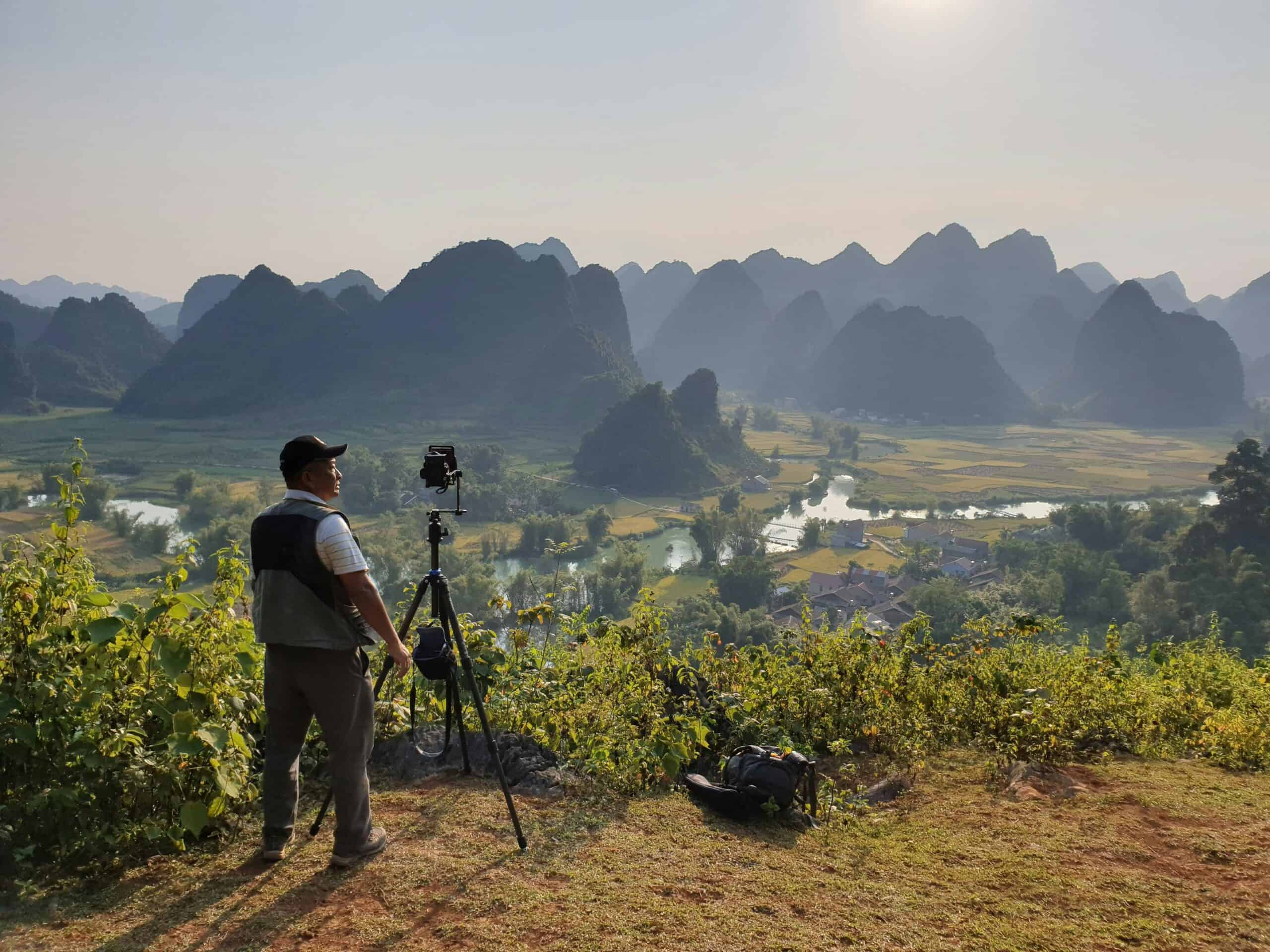
Planning & On-Site Preparation
Evaluate Shooting Environment
Before you set up, scan the scene for moving elements (people, cars, trees in high wind), reflective surfaces (glass, glossy floors), and direct light sources. In interiors, avoid pressing the lens against glass; keep a few centimeters of distance and shoot slightly off-axis to minimize reflections and flare. In exteriors, note sun position—direct sun in the frame often requires bracketing and careful lens shading to prevent veiling glare. For 360 photo work, also watch for objects very close to the camera; these amplify parallax errors and complicate stitching.
Match Gear to Scene Goals
For detailed architecture and straight lines, a rectilinear 14–16mm lens on the Nikon Zf is ideal. The Zf’s DR at ISO 100 helps retain window highlights in interiors, while IBIS can stabilize handheld sequences in a pinch (though a tripod is strongly preferred). Safe ISO ranges for clean results: ISO 100–400 in daylight/interiors with tripod, 800–1600 at night with careful exposure. If you truly require the Canon RF 14-35 f/4, use a Canon RF-mount body instead; otherwise, go with the native NIKKOR Z 14-30 f/4 S or an EF 16-35 f/4 on a smart EF→Z adapter for similar results.
Pre-shoot Checklist
- Battery fully charged; spare batteries for long sessions.
- Large, fast memory card; consider RAW only for maximum flexibility.
- Clean front/rear elements and the sensor; spots are obvious in sky/ceilings.
- Tripod legs inspected and tightened; leveling base checked.
- Panoramic head calibrated for nodal point (recorded rail marks).
- Safety: secure straps, tether on rooftops, avoid edges; be mindful of wind on poles/car mounts.
- Backup workflow: shoot a second full pass if time permits; it saves reshoots when people/traffic ruin a frame.
Essential Gear & Setup
Core Gear
- Panoramic head: A proper panoramic head allows you to rotate around the lens’s no-parallax point (nodal point), eliminating parallax between foreground and background so software can stitch cleanly.
- Stable tripod with a leveling base: Leveling makes your rows consistent and reduces roll/pitch corrections in post.
- Remote trigger or app control: Minimizes vibration; on the Zf, the SnapBridge app or a wired release works well.
Optional Add-ons
- Pole or car mount: Use a safety tether. Wind-induced vibration increases blur—use higher shutter speeds and fewer brackets.
- Lighting aids: Small LEDs for dark corners in interiors; keep light soft and indirect to avoid hotspots.
- Protective covers/weather gear: Rain sleeves for gear; sand/sea spray protection when shooting coastlines.
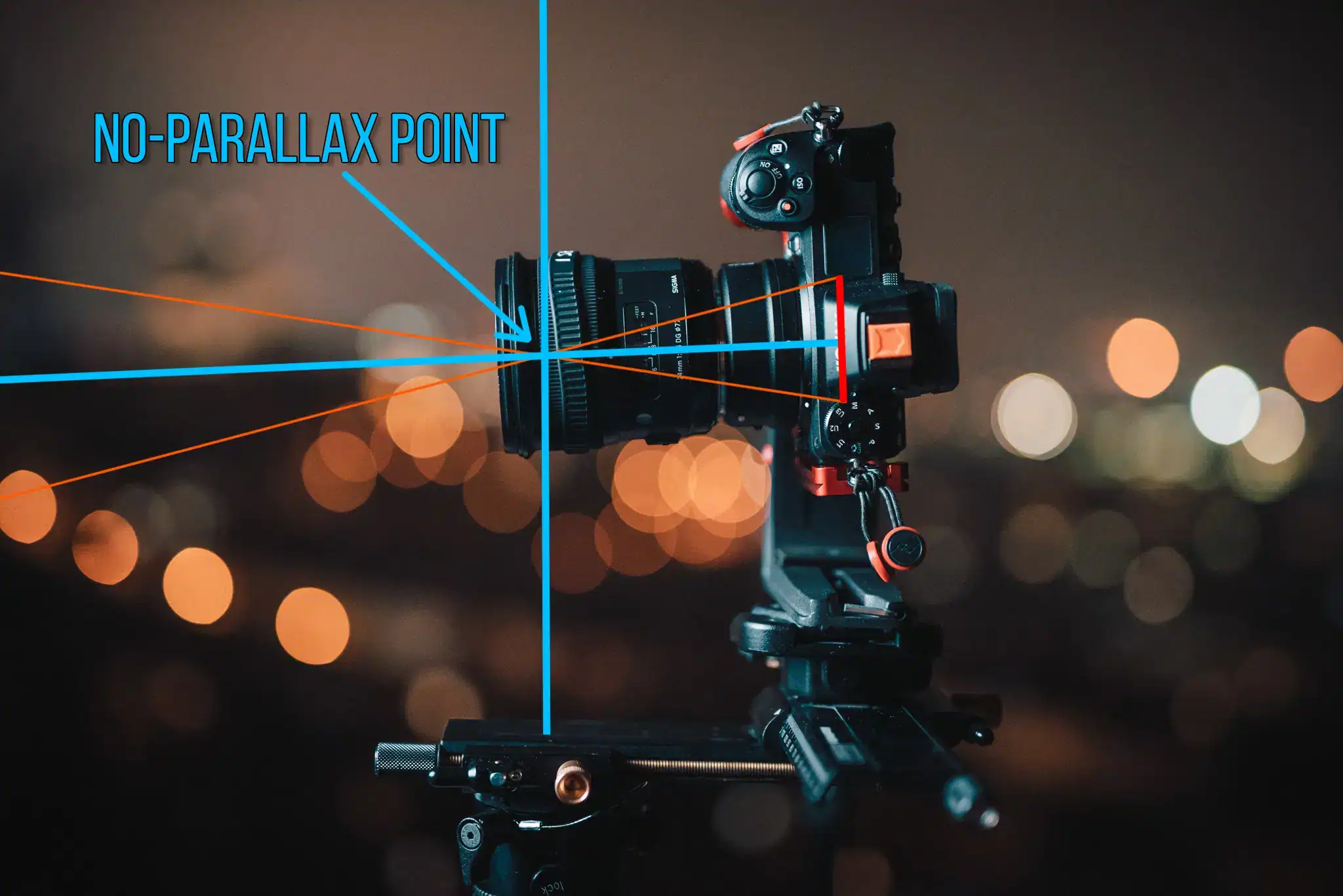
Video: A practical walk-through for precise panoramic head setup.
Step-by-Step Shooting Guide
Standard Static Scenes
- Level the tripod: Use the leveling base, spirit level, or in-camera horizon. A level rig keeps rows even and reduces software corrections.
- Align the nodal point: On your pano head, slide the camera forward/back until foreground and background elements don’t shift relative to each other during a small pan. Mark this position for 14mm and again for 16/20/24mm if you use multiple focal lengths.
- Manual exposure and white balance: Set the Zf to M mode, meter a mid-tone, and lock exposure. Choose a fixed white balance (Daylight/Tungsten/Custom). Locking both prevents exposure flicker and color shifts across frames.
- Focus: Use manual focus and set near the hyperfocal distance at the chosen aperture (f/8 is a strong starting point). Confirm at 100% magnification on the LCD.
- Capture sequence with tested overlap:
- Two-row method at 14mm: 8 shots at +30°, rotate ~45° between frames; 8 shots at -30°. Then 1–2 zenith shots and 2–3 nadirs (offset the tripod or do a plate shot for easy patching).
- Keep 30–35% overlap; increase slightly if objects are closer than 1–2 meters.
- Nadir (ground) shot: Tilt down and take extra frames around the tripod. A separate handheld nadir “patch” shot from the same position (without the tripod) speeds up removal.
HDR / High Dynamic Range Interiors
- Bracket ±2 EV (3 frames) or ±2 EV 5-frame if windows are extremely bright. The Zf’s auto bracketing makes this quick.
- Keep white balance fixed to avoid color shifting across brackets; turn off flicker reduction lights if possible.
- Merge HDR per position before stitching, or let PTGui merge during stitching for consistent geometry.
Low-Light / Night Scenes
- Use a tripod, turn off IBIS to avoid sensor micro-movements on long exposures. Start at f/4–f/5.6, 1/10–1/30 s, ISO 400–800.
- Enable exposure delay or use a remote trigger to prevent shake. If stars or moving lights are present, keep shutter fast enough to avoid trails in each frame.
Crowded Events
- Shoot two passes: a primary pass for geometry and a second pass waiting for gaps in crowds for key frames.
- In post, mask between passes to remove ghosted people. Use more overlap (35–40%) for better control point matching in dynamic scenes.
Special Setups (Pole / Car / Drone)
- Pole: Tether equipment, use higher shutter speeds (1/250–1/500), and limit brackets. A rectilinear 14mm still needs multi-row; wind will reduce success rate—take extra passes.
- Car mount: Secure with rated suction mounts plus safety lines. Avoid highways; shoot at low speed and pull over safely for the pano capture.
- Drone: For spherical panos, rely on the drone’s native multi-row pano mode. Manual multi-row is possible but requires careful overlap and gimbal control.
Recommended Settings & Pro Tips
Exposure & Focus
| Scenario | Aperture | Shutter | ISO | Notes |
|---|---|---|---|---|
| Daylight outdoor | f/8–f/11 | 1/100–1/250 | 100–200 | Lock WB (Daylight); keep overlap ~30% |
| Low light/night | f/4–f/5.6 | 1/10–1/60 | 400–800 | Tripod & remote; IBIS OFF on tripod |
| Interior HDR | f/8 | Bracket ±2 EV | 100–400 | Balance windows/lights; merge HDR first or in PTGui |
| Action/motion | f/5.6–f/8 | 1/200+ | 400–800 | Short shutter to freeze moving subjects |
Critical Tips
- Manual focus at hyperfocal (e.g., at 14mm f/8, focus roughly a couple of meters out). Check corners at 100% on the Zf’s screen.
- Nodal calibration: Place a nearby vertical object and a distant background line up; pan slightly and adjust the rail until there’s no relative shift. Mark the rail position for each focal length you use.
- White balance lock: Set a fixed Kelvin or preset. Mixed lighting? Create a custom WB from a gray card before shooting.
- RAW over JPEG: RAW maximizes dynamic range for HDR panorama work and improves color consistency across frames.
- IBIS and lens IS: On tripod, turn IBIS/IS off. Handheld or pole capture can benefit from IBIS; test to confirm no warping with multi-frame stitches.
Stitching & Post-Processing
Software Workflow
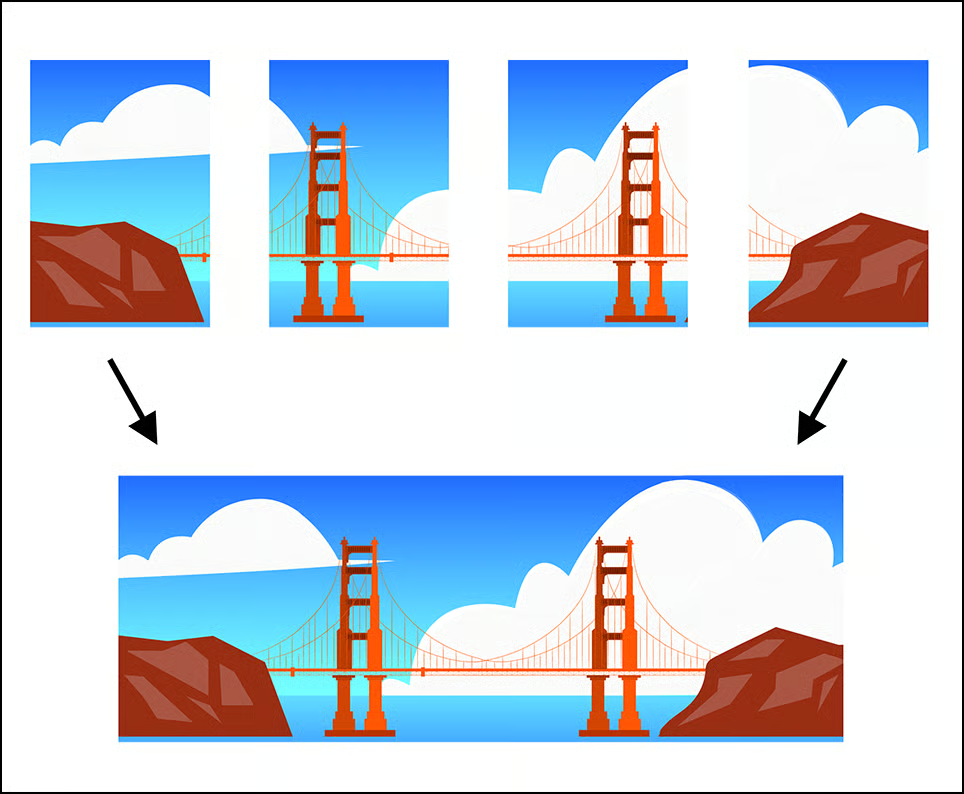
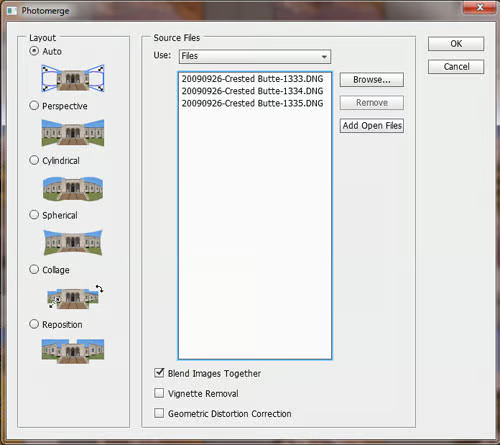
For professional results, PTGui is a gold standard for spherical and gigapixel panoramas, followed by Hugin (open source) and Lightroom/Photoshop for simpler stitches. With a rectilinear 14–16mm, aim for 30% overlap. Import your sequence, generate control points, and optimize. If you bracketed, either pre-merge HDR per angle (consistent tonality) or let PTGui handle exposure fusion. Rectilinear lenses need more frames than fisheyes but preserve straight architecture lines without heavy de-fishing. After stitching, export as an equirectangular 2:1 file (JPEG/TIFF) for VR platforms. For a deeper dive on PTGui, see this review and workflow guidance at the end of this paragraph. PTGui review and best practices
Cleanup & Enhancement
- Nadir patch: Use a handheld plate shot or AI/content-aware fill to remove the tripod.
- Color and tone: Apply global color correction, then local dodging/burning for visual balance.
- Noise reduction: Apply modest NR only to deep shadows to preserve detail.
- Leveling: Correct roll, yaw, and pitch to keep horizons straight and verticals vertical.
- Export: Save a master 16-bit TIFF and a web-friendly 8-bit JPEG for virtual tour upload.
For fundamentals and industry-standard checklists on capturing and stitching 360 photos with mirrorless cameras, refer to these guides. DSLR/mirrorless 360 capture overview
Useful Tools & Resources
Software
- PTGui panorama stitching
- Hugin open-source panorama maker
- Lightroom / Photoshop for RAW and retouching
- AI tripod removal tools for nadir patching
Hardware
- Panoramic heads: Nodal Ninja, Leofoto, Really Right Stuff
- Carbon fiber tripods with leveling bases
- Wireless remote shutters
- Pole extensions and robust car mounts with safety tethers
For an illustrated panoramic head setup primer, this tutorial is a solid reference. Panoramic head setup tutorial
Disclaimer: software/hardware names provided for search reference; check official sites for details.
Common Mistakes & How to Avoid Them
- Parallax error: Always align the nodal point before shooting; mark rail positions for your focal lengths.
- Exposure flicker: Use manual exposure and fixed white balance.
- Tripod shadows and footprints: Shoot a proper nadir or capture a patch shot to fill the gap.
- Ghosting from moving people/trees: Increase overlap, shoot two passes, and mask in post.
- High ISO noise: Use a tripod and keep ISO at 100–400 when possible; expose to the right and pull back in post.
- Compatibility oversight: Remember, Canon RF lenses do not adapt to Nikon Zf; choose a native Z lens or EF lens with a smart EF→Z adapter.
Field-Proven Scenarios
Indoor Real Estate
Use a two-row 14mm workflow (8 up/8 down + zenith/nadir) at f/8, ISO 100–200. Bracket ±2 EV to hold bright windows. Keep the camera high enough to see over furniture but not so high that ceilings clip; 1.3–1.6 m is a good range. Use a custom white balance to reduce mixed light casts. The Nikon Zf’s IBIS can stay off because you’re on a tripod, and you’ll get the cleanest files at base ISO.
Outdoor Sunset
Set manual exposure for the sky and bracket for shadows. Work fast as light changes, capturing the sun-facing sector first. If flare appears at 14mm, shade the lens with your hand just outside the frame. The Zf’s DR lets you protect highlights at ISO 100 and lift shadows later.
Event Crowds
Shoot a geometry pass first. Then wait for crowd gaps to re-shoot troublesome frames. Keep shutter 1/200+ to minimize subject blur. In PTGui, prioritize control points on static architecture and mask moving people.
Rooftop/Pole
Wind safety first—limit the pole’s height in gusts. Increase shutter speed to 1/250–1/500 and reduce brackets to keep the sequence short. Consider shooting fewer, wider-tilt rows to minimize time aloft while maintaining sufficient overlap.
Car-Mounted Capture
Use slow, safe speeds and stop when possible. Align the nodal point carefully before mounting. Record a second pass for safety and use masking to remove passing cars/people. After shooting, verify all screws are tight before you hit the road again.
For deeper background on DSLR/mirrorless 360 workflows and best practices, this resource consolidates key questions and gear advice. Virtual tour camera/lens guide
Frequently Asked Questions
-
Can I shoot handheld panoramas with the Nikon Zf?
Yes, for simple single-row panos outdoors. Use IBIS ON, 1/200+ shutter, and 30–40% overlap. For 360×180 multi-row work, a tripod with a panoramic head is strongly recommended to avoid parallax and stitching errors.
-
Is the Canon RF 14-35mm f/4L wide enough for a single-row 360?
At 14mm rectilinear, a single row will not cover zenith and nadir. Plan for two rows plus dedicated zenith and nadir shots. Note: this RF lens cannot be practically adapted to the Nikon Zf; use a native NIKKOR Z 14-30mm f/4 S or an EF 16-35mm f/4 on a smart EF→Z adapter for the same approach.
-
Do I need HDR for interiors with bright windows?
Often yes. Bracket ±2 EV (3 or 5 frames) to retain window detail and clean interior shadows. Merge HDR per position or let PTGui fuse exposures during stitching.
-
How do I avoid parallax issues?
Use a calibrated panoramic head and rotate around the lens’s nodal point. Keep nearby objects at least 1–2 meters away when possible, and increase overlap in tight spaces.
-
What ISO range is safe on the Nikon Zf in low light?
On a tripod, keep ISO 100–400 and lengthen shutter. For handheld or windy pole work, ISO 800–1600 is acceptable with light noise reduction. ISO 3200 can work for emergency frames, but expect more grain.
-
Can I save a custom panorama setup?
Yes. Use the Nikon Zf’s My Menu and recall settings, or save user banks (if available on your body’s firmware) with manual exposure, fixed WB, single-point MF, bracketing OFF/ON as needed, and IBIS OFF (tripod). If you’re using a Canon RF-mount body with the RF 14-35mm, store pano settings to C1/C2/C3.
-
Should I keep stabilization on?
On tripod: turn IBIS and lens IS OFF. Handheld/pole: IBIS can help; test to ensure no subtle warping between frames.
-
What’s the best tripod head for this setup?
A multi-row panoramic head with fore-aft and lateral adjustments (e.g., Nodal Ninja or RRS) makes nodal alignment quick and repeatable. A leveling base speeds workflow dramatically.
Safety, Limitations & Trust Notes
Compatibility honesty: Canon RF lenses do not natively mount to Nikon Z bodies. If your project requires the RF 14-35 f/4, pair it with an RF-mount camera. Otherwise, choose a native NIKKOR Z lens or use EF glass with a smart EF→Z adapter. This ensures reliable communication, aperture control, and better stabilization behavior.
Safety first: On rooftops, use tethers and maintain distance from edges. In public spaces, get permissions where needed and mind privacy. When using poles or car mounts, double up with safety lines and re-check fasteners between passes. Always carry a microfiber cloth and rain cover; one raindrop on a 14mm can ruin a sequence.
Backup and verification: After each pano, review frames for exposure consistency, motion blur, and coverage gaps. If in doubt, shoot a second pass. Keep redundant copies on separate cards or devices before leaving the location.
For additional fundamentals on creating high-end 360s with panoramic heads, this principle-based guide is helpful. High-end 360 pano head setup principles