
Why This Camera & Lens Are Great for Panoramas
The Nikon Z9 paired (via adapter) with the Sony FE 16–35mm f/2.8 GM is a surprisingly strong combo for panoramic and 360 photo workflows. The Z9’s 45.7 MP full-frame stacked CMOS sensor delivers exceptional detail, low rolling-shutter artifacts (thanks to the stacked design and all-electronic shutter), and class-leading dynamic range at base ISO 64—roughly 14 stops. Its pixel pitch (~4.35 µm), robust buffer, and accurate live-view exposure tools make it ideal for precise, multi-frame capture. The 5-axis IBIS is excellent for handheld panos or low light, and can be turned off on a tripod to avoid micro-jitters.
The Sony FE 16–35mm f/2.8 GM is a rectilinear ultra-wide zoom. For panorama work, rectilinear rendering reduces fisheye-style bowing, producing edges that stitch cleanly. The lens is optimally sharp by f/5.6–f/8, controls lateral CA well, and offers a flexible focal range for everything from quick single-row panos at 35mm to high-resolution, multi-row spherical panos at 16–24mm. Note: because this is a Sony E-mount lens on a Nikon Z-mount camera, you’ll need an electronic adapter (e.g., Techart TZE-02 series). Autofocus and EXIF typically work, but for panoramas you’ll use manual focus and manual exposure anyway. Expect some AF limitations and be sure to confirm aperture control and focal length reporting are consistent.
Quick Setup Overview
- Camera: Nikon Z9 — Full-frame (FX) 45.7 MP stacked BSI CMOS, base ISO 64–25,600 (expand 32–102,400), ~14 stops DR at base, pixel pitch ≈ 4.35 µm, in-body 5-axis stabilization, electronic shutter only.
- Lens: Sony FE 16–35mm f/2.8 GM — Rectilinear zoom, excellent center-to-edge sharpness by f/5.6–f/8, mild barrel distortion and vignetting at 16mm (profile-correctable), low lateral CA; great contrast and flare resistance for a zoom.
- Estimated shots & overlap (full spherical 360×180):
- 16mm: 30 shots (3 rows of 10 at pitch +45°, 0°, −45°) + zenith + nadir, 25–30% overlap.
- 24mm: 36 shots (3×12) + zenith + nadir, 25–30% overlap.
- 35mm: 64 shots (4×16) + zenith + nadir, 25–30% overlap; excellent for gigapixel detail.
- Difficulty: Intermediate — rectilinear wide-angles stitch beautifully, but multi-row capture and nodal alignment are key.
Planning & On-Site Preparation
Evaluate Shooting Environment
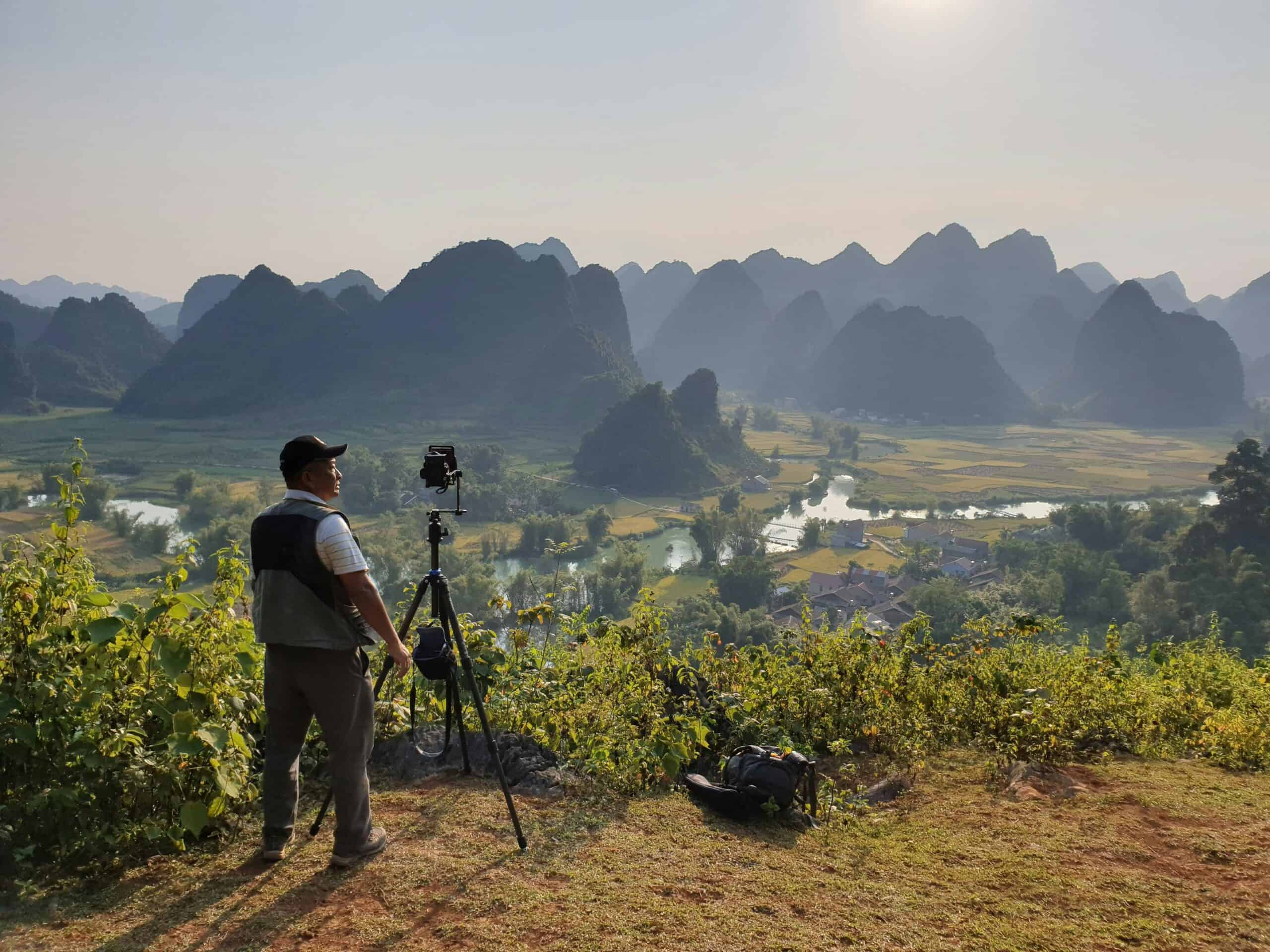
Start by analyzing light direction, contrast, and motion. For glass-heavy interiors, stand as close as possible (a few centimeters) and shoot perpendicular to the glass to reduce flare and double-reflections. Outdoors, note the sun’s path and consider whether you’ll need HDR for extreme contrast (e.g., sunsets). Check for moving elements—traffic, waves, people—and decide if you’ll time shots between motion or plan masking during stitching. Wind is critical on rooftops or poles: high wind magnifies vibration, especially with the Z9’s weight.
Match Gear to Scene Goals
This combo excels in dynamic range and detail. The Z9’s ISO 64–400 is pristine; ISO 800–1600 is still very clean if you need faster shutter speeds. The 16–35mm rectilinear lens means more frames than a fisheye, but cleaner lines for architecture and less distortion at the frame edges. If your priority is speed and minimal frames, a fisheye is faster; if you want maximum resolution and straight lines, this 16–35mm is a superb choice.
Pre-shoot Checklist
- Power & storage: Fully charged batteries and high-speed cards. The Z9 is efficient, but multi-row HDR sets can be heavy on storage.
- Optics: Clean front/rear elements; check sensor for dust (stops down to f/8–f/11 will show specks).
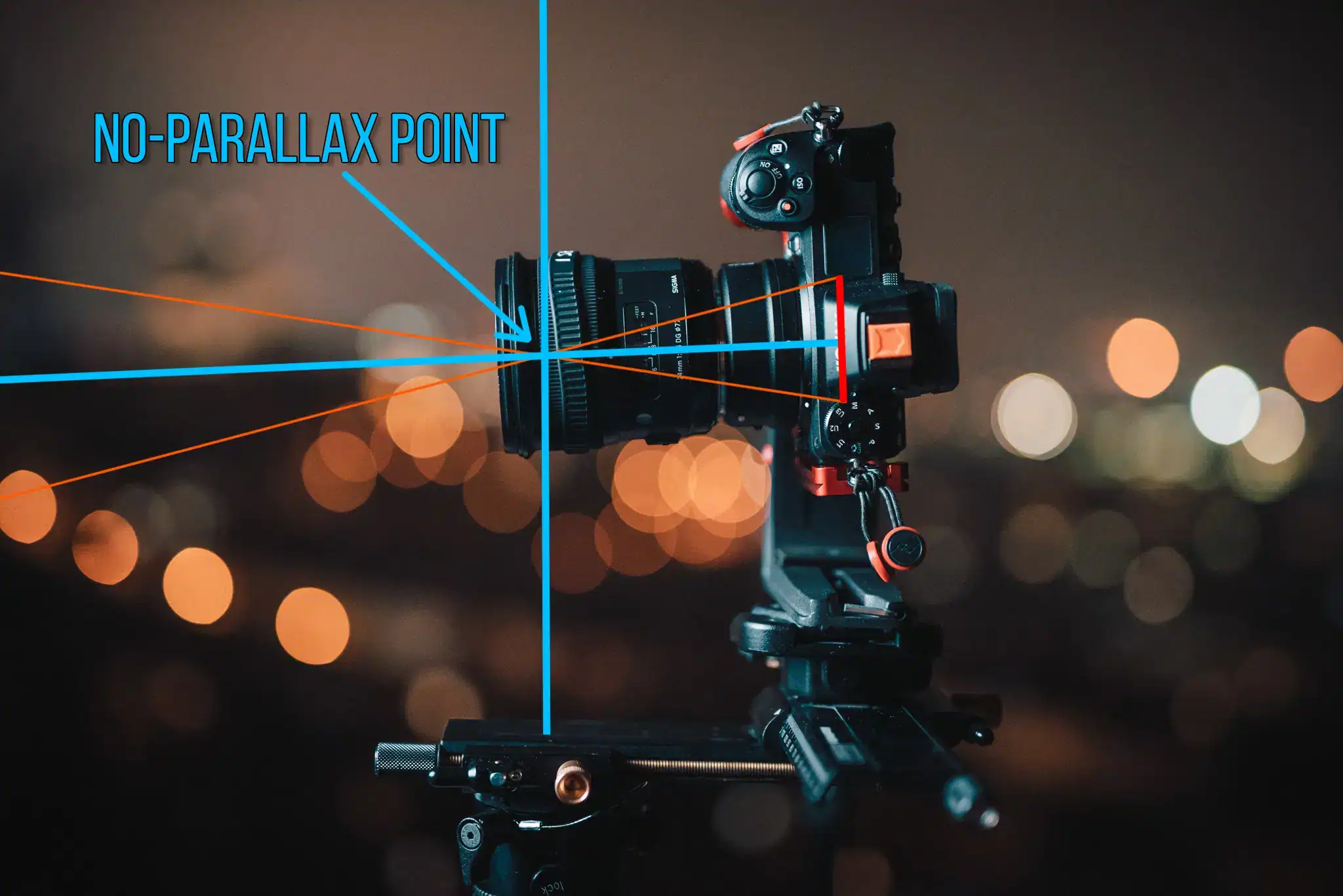
- Support: Level the tripod; verify your panoramic head is calibrated to the lens’s no-parallax (entrance pupil) point at the chosen focal length.
- Safety: On rooftops/poles/cars, tether your gear. The Z9 + 16–35 GM + adapter is ~2+ kg—don’t risk it overhead without redundant safety.
- Backup workflow: Shoot an extra full pass. If crowds or wind ruin one sweep, you’ll be grateful for the insurance.
Field-Proven Micro Case Studies
Indoor real estate
Shoot at 16–20mm for minimal distortion of walls and to limit frame count. Use HDR bracketing (±2 EV, 3–5 frames) to balance windows and interior. Lock WB (e.g., 4000–4500K for mixed LED + daylight) and shoot from a consistent nodal point to avoid misalignment on reflective floors.
Outdoor sunset
Set manual exposure based on the brightest zone you want to preserve, then bracket if needed. Wind often rises near sunset—hang a small weight under the tripod and use the Z9’s exposure delay to settle vibrations.
Events/crowds
Do two passes: a fast pass to secure geometry, then a second pass waiting for gaps in movement. You’ll mask people later in PTGui/Hugin.
Rooftop/pole
Because the rig is heavy, keep pole height moderate and rotate slowly. A safety tether is non-negotiable. Avoid gusty conditions.
Car-mounted capture
Use a multi-suction mount and safety lines. Park and shoot stationary for best stitch quality. Rolling capture can introduce vibration and parallax changes from moving foregrounds.
Essential Gear & Setup
Core Gear
- Panoramic head: Allows precise rotation around the lens’s entrance pupil to prevent parallax. Use a rail to slide the camera fore/aft until foreground and background align during yaw.
- Stable tripod with leveling base: A leveling base speeds setup and keeps rows consistent. A center hook for weight helps in wind.
- Remote trigger or app: Use the Nikon SnapBridge app, a wired remote, or the Z9’s self-timer/exposure delay to eliminate shake.
Optional Add-ons
- Pole or car mount: Use redundant safety lines and monitor wind. The Z9’s mass makes vibration control critical.
- Lighting aids: Small LED panels for interiors can lift shadow corners and smooth HDR transitions.
- Weather protection: A rain cover and microfiber cloths keep optics clear. Avoid wiping dust—blow first, then wipe.
Adapter Notes (Sony FE lens on Nikon Z9)
Use a quality electronic adapter (e.g., Techart TZE-02 series). Confirm aperture control, focal length EXIF, and AF. For panoramas, switch to manual focus and manual exposure. If IBIS doesn’t read focal length correctly, either zoom to a fixed focal length and stick with it, or set Non-CPU Lens Data (if needed) for proper stabilization. On tripod, turn IBIS off.
For a deep dive on panoramic heads and alignment fundamentals, see this panoramic head tutorial. Panoramic head fundamentals
Step-by-Step Shooting Guide
Standard Static Scenes
- Level and align: Level the tripod using a leveling base or the Z9’s virtual horizon. Mount the pano head and set the lens at your chosen focal length (e.g., 16mm). Align the entrance pupil using foreground/background alignment while yawing the head.
- Manual exposure and WB: Switch to M mode. For daylight, start at ISO 64–100, f/8, 1/125 s. Set WB manually (e.g., 5600K) to avoid color shifts between frames.
- Manual focus: Use magnified live view to focus at or near the hyperfocal distance. At 16mm and f/8, focusing ~1 m keeps near-to-infinity sharp. At 35mm and f/8, use ~5 m.
- Capture sequence: Rotate at fixed yaw increments to ensure ~25–30% overlap. For 16mm, 10 shots around per row works well. Then shoot the zenith (tilt up) and a nadir (tilt down). If the tripod intrudes, shoot a separate handheld nadir for patching.
- Vibration control: Use the Z9’s exposure delay or a remote. Turn IBIS off when on a tripod. The Z9’s electronic shutter eliminates shutter shock.
HDR / High Dynamic Range Interiors
- Bracket ±2 EV: Use 3–5 frames per angle. The Z9 supports up to 9-frame bracketing; for interiors, 5 frames at 2 EV steps covers windows and deep shadows.
- Lock WB and aperture: Keep f/8 constant; vary shutter only. This ensures consistent depth of field and clean merges.
- Avoid flicker: Under LED lighting, enable High Frequency Flicker Reduction to minimize banding, or choose shutter speeds that avoid pulse frequencies.
Low-Light / Night Scenes
- Use low ISO when possible: Start at ISO 64–400 and extend shutter length (e.g., 1–8 s on tripod). If motion is an issue, ISO 800–1600 on the Z9 is still very clean.
- Stability first: Remote trigger, exposure delay, and wind mitigation are more important than squeezing 1 stop of ISO.
- Long exposure NR: Many pano shooters disable it to keep timing consistent; do noise reduction in post for uniformity.
Crowded Events
- Two-pass method: First pass prioritizes coverage; second pass waits for gaps in motion. Note frame numbers for easier masking later.
- Faster shutter: Use 1/200 s or faster at ISO 800–1600 to minimize ghosting, especially at 35mm.
Special Setups (Pole / Car / Drone)
- Pole: Keep height moderate with a heavy rig. Add a guy line and rotate slowly. Always tether camera and verify clamp tightness.
- Car: Use multi-suction mounts and a safety cable. Shoot static when possible. If moving, expect stitching challenges from parallax and vibration.
- Drone: This rig is not drone-friendly; use a dedicated aerial platform instead. Consider shooting a cylindrical pano from a high vantage point instead of flying.
Recommended Settings & Pro Tips
Exposure & Focus
| Scenario | Aperture | Shutter | ISO | Notes |
|---|---|---|---|---|
| Daylight outdoor | f/8–f/11 | 1/100–1/250 | 64–200 | Manual WB (≈5600K); maximize detail at base ISO |
| Low light/night | f/4–f/5.6 | 1/4–8 s (tripod) | 64–800 (1600 if needed) | Turn IBIS off on tripod; use exposure delay or remote |
| Interior HDR | f/8 | Bracket ±2 EV | 64–400 | 3–5 frames; lock WB around room’s dominant Kelvin |
| Action / moving subjects | f/5.6–f/8 | 1/200+ | 400–1600 | Minimize ghosting; do a second pass for masking |
| Gigapixel detail | f/6.3–f/8 | 1/125–1/250 | 64–200 | Shoot at 24–35mm, 3–4 rows; tighter increments |
Critical Tips
- Manual focus at hyperfocal: At 16mm f/8, ~1 m; at 24mm f/8, ~2 m; at 35mm f/8, ~5 m. Use live view magnification to confirm.
- Nodal calibration: Slide the camera on the rail until a near and far vertical object stay aligned as you pan. Mark the rail position for 16mm, 24mm, and 35mm for repeatability.
- White balance lock: Use a fixed Kelvin to prevent tonal banding across the stitched panorama.
- RAW capture: Shoot 14-bit RAW for maximum DR; apply lens profile corrections during or after stitching as needed.
- IBIS management: On tripod, turn IBIS off. Handheld or monopod panos can keep IBIS on, but be consistent within a sequence.
- Z9-specific: Use Exposure Delay (e.g., 0.2–1 s) and the virtual horizon. The stacked sensor’s electronic shutter avoids mechanical shock, but delay still helps settle the rig.
Curious about theoretical pano resolution with different lenses and sensors? The Panotools wiki provides excellent background. Spherical resolution basics
Stitching & Post-Processing
Software Workflow
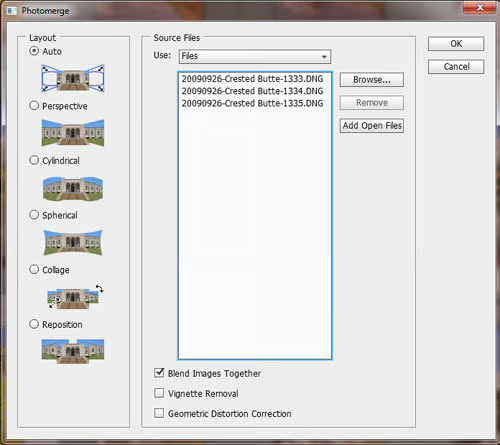
Import your sequences into PTGui or Hugin. For rectilinear lenses like the 16–35mm GM, set the lens type to “Rectilinear” in project settings. Aim for ~25–30% overlap per frame, and ensure consistent pitch/yaw increments across rows. If you bracketed, PTGui can merge HDR per viewpoint and then stitch, or you can fuse exposures after stitching depending on your preference. Expect more frames than with fisheye but cleaner architectural lines and higher detail per pixel. For many shooters, PTGui’s optimizer and masking tools are worth the cost; Hugin is a powerful open-source alternative.
Cleanup & Enhancement
- Tripod/nadir patch: Export a nadir patch shot; use PTGui’s Viewpoint correction or retouch later in Photoshop. AI content-aware fill can work well for uniform textures.
- Color and noise: Sync color correction across the set in Lightroom before stitching or work on the stitched equirectangular afterward. Apply calibrated noise reduction for night scenes.
- Leveling: Use horizon and vertical line constraints in PTGui/Hugin. Correct roll/yaw/pitch for a stable horizon.
- Export: For VR, export as 2:1 equirectangular JPEG/PNG (e.g., 16,384 × 8,192 px). For archival edits, save 16-bit TIFF.
For an in-depth tool overview, see this review and tutorial on PTGui’s capabilities. PTGui review and tips
Helpful Video Tutorials
These videos walk through shooting and stitching panoramas, including head setup and software steps:
Useful Tools & Resources
Software
- PTGui panorama stitching
- Hugin (open source)
- Lightroom / Photoshop for global edits and masking
- AI tools for tripod/nadir removal
Hardware
- Panoramic heads (Nodal Ninja, Leofoto, Sunwayfoto)
- Carbon fiber tripods with leveling bases
- Wireless remotes or tethered triggers
- Pole extensions and redundant safety tethers
For a broader DSLR/mirrorless 360 overview, this guide is helpful. DSLR/Mirrorless 360 capture basics
Disclaimer: software/hardware names provided for search reference; check official sites for current features and compatibility.
Common Mistakes & How to Avoid Them
- Parallax error: Always rotate around the lens’s entrance pupil. Calibrate for the exact focal length you use.
- Exposure flicker: Use manual exposure and fixed WB. In HDR, vary shutter only.
- Tripod shadows and footprints: Shoot a dedicated nadir and patch later.
- Ghosting from moving subjects: Do a second pass and mask in PTGui/Hugin.
- Night noise and banding: Favor low ISO with longer exposures. Use the Z9’s flicker tools under LED lighting.
- Adapter surprises: Verify aperture reporting and IBIS behavior before critical shoots. Prefer manual focus and fixed focal length per sequence.
Frequently Asked Questions
- Can I shoot handheld panoramas with the Nikon Z9?
Yes, especially for single-row or cylindrical panos. Activate IBIS, use high shutter speeds (1/200 s+), and overlap generously (30–40%). For full spherical 360s or interiors, a leveled tripod and pano head are strongly recommended for perfect alignment.
- Is the Sony FE 16–35mm f/2.8 GM wide enough for single-row 360?
Not for full spherical coverage. At 16mm, you’ll still need multiple rows (typically three) plus zenith and nadir. Single-row at 16–24mm can make excellent cylindrical panoramas, but not full 360×180 spheres.
- Do I need HDR for interiors with bright windows?
Usually yes. Bracket ±2 EV with 3–5 frames to preserve outdoor views while keeping interiors clean. Merge HDR per angle in PTGui or pre-merge in Lightroom, then stitch. Lock WB and aperture to maintain consistency.
- How do I avoid parallax issues with this lens?
Mount on a panoramic head and calibrate the entrance pupil for your working focal length. Slide the rail until a near and far vertical line stay aligned during yaw. Mark that position on the rail for 16, 24, and 35mm to speed field work.
- What ISO range is safe on the Z9 in low light?
ISO 64–800 is superb; ISO 1600 is very usable; ISO 3200 is workable with modern noise reduction. On a tripod, prefer longer exposures at ISO 64–400 for the cleanest files.
- Can I set up custom presets for pano on the Z9?
The Z9 uses Shooting Menu Banks (A–D) instead of U1/U2. Create a “Pano” bank with M mode, fixed WB, IBIS off (tripod), exposure delay on, and RAW. Save a second bank for “Pano HDR” with bracketing enabled.
- Any special concerns using a Sony FE lens on the Z9 with an adapter?
Confirm electronic aperture control and focal length reporting. AF-C may be less reliable; use manual focus for panos. Test IBIS behavior; if in doubt, keep a fixed focal length per sequence and turn IBIS off on tripod.
- What’s the best tripod head for this setup?
A multi-row panoramic head with a vertical arm and fore/aft rail (e.g., Nodal Ninja, Leofoto) provides entrance pupil alignment and precise increments. Ensure load capacity exceeds 2.5 kg for the Z9 + lens + adapter.
Safety, Limitations & Trust Notes
The Z9 + 16–35 GM + adapter is a professional-grade yet heavy rig. Always secure your gear, especially on rooftops, poles, or car mounts. Use redundant safety lines. Verify local regulations for elevated and vehicle-mounted photography. In low temperatures, keep spare batteries warm; in dusty locations, avoid lens changes mid-shoot.
Be transparent with clients about practical limits: multi-row panos at 16–24mm take time; crowds and wind can complicate stitching; reflective surfaces may need extra masking. Maintain a backup workflow: duplicate cards, a second capture pass, and off-site backups. For more strategy on DSLR/mirrorless 360 workflows, see this overview. DSLR/Virtual tour guide