
Why This Camera & Lens Are Great for Panoramas
If you want to learn how to shoot panorama with Nikon Z9 & Sony FE 14mm f/1.8 GM, you’re combining a flagship full-frame mirrorless body with one of the sharpest ultra-wide rectilinear primes available. The Nikon Z9’s 45.7MP stacked full-frame sensor (approx. 8256×5504 pixels, ~4.3 μm pixel pitch) offers exceptional dynamic range at base ISO 64, robust color depth, and class-leading AF/IBIS—all ideal for precision multi-row 360° work. The Sony FE 14mm f/1.8 GM delivers a sweeping rectilinear 114° diagonal field of view with excellent corner-to-corner sharpness, low coma, and minimal lateral CA. Together, you can capture ultra-detailed spherical panoramas, dramatic cylindrical stitches, and flawless gigapixel interiors.
Mount compatibility note: because this is a Sony E-mount lens on a Nikon Z-mount camera, you’ll need an electronic adapter such as the Megadap ETZ21 (Pro) or Techart TZE-01. These adapters can provide AF and aperture control for many Sony E lenses on Nikon Z bodies. For panoramas, AF speed is less critical (you’ll typically lock focus), but do verify firmware compatibility and test for reliable aperture reporting and EXIF. If stabilization metadata isn’t passed, manually set focal length for IBIS (or disable IBIS on a tripod). As always with adapted lenses, test thoroughly before paid work.
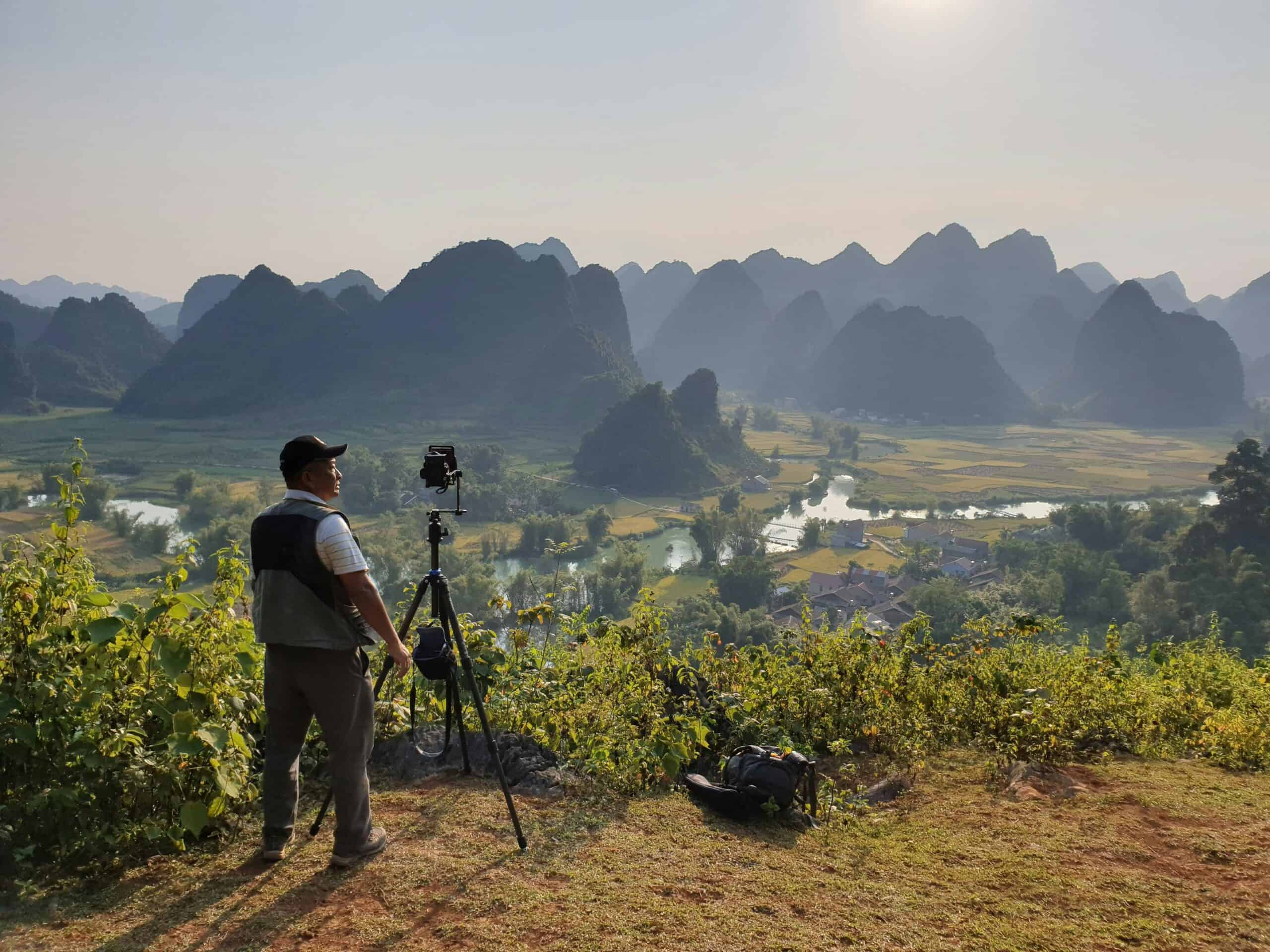
Rectilinear vs fisheye: The 14mm GM is rectilinear (straight lines stay straight), which is excellent for architectural and real estate panoramas. Compared to fisheyes, you’ll shoot more frames for a full sphere, but you’ll benefit from more natural geometry and reduced edge stretching. The trade-off is time on site versus the clean, realistic look of rectilinear images.
Quick Setup Overview
- Camera: Nikon Z9 — Full-frame 45.7MP stacked CMOS, base ISO 64, 14-bit RAW, 5-axis IBIS, dual CFexpress Type B slots.
- Lens: Sony FE 14mm f/1.8 GM — Rectilinear ultra-wide prime; extremely sharp from f/2.8–f/11, low coma/CA, bulbous front element (rear gel filters only).
- Estimated shots & overlap (full 360×180):
- “Safe” quality set: 8 shots around × 3 rows (pitch +45° / 0° / −45°) + zenith + nadir ≈ 26 frames at ~25–30% overlap.
- “Minimal” coverage: 6 around × 3 rows + zenith + nadir ≈ 20 frames (requires careful overlap and nodal alignment).
- Cylindrical pano (single-row): 8–10 shots around at 0° tilt for a classic wide banner (not a full sphere).
- Difficulty: Intermediate (multi-row alignment and careful nodal calibration).
Planning & On-Site Preparation
Evaluate Shooting Environment
Assess light, wind, traffic, and reflectivity. For interiors with bright windows, expect high dynamic range; plan to bracket ±2 EV (or ±3 EV if windows are extremely bright). Around glass or glossy surfaces, keep the lens 30–50 cm from the surface and shoot at an angle to reduce self-reflections and ghosting—then patch any remaining tripod reflections in post. Outdoors, check wind gusts, which can vibrate a pole or light tripod. For sunsets and cityscapes, note that light changes quickly; capture the sky first for consistent color.
Match Gear to Scene Goals
The Z9’s excellent dynamic range and low base ISO 64 helps preserve sky highlights while keeping shadows clean when you lift them later. It’s very usable up to ISO 1600–3200 in a pinch, but for multi-row panoramas on a tripod, aim for ISO 64–400 whenever possible. The Sony 14mm GM’s rectilinear rendering is perfect for architecture and interiors where straight lines matter. While a fisheye requires fewer shots, this 14mm offers cleaner lines and less curvature, yielding a more natural result after stitching.
Pre-shoot Checklist
- Charge batteries (EN-EL18 series) and carry spares; high-res brackets consume power.
- Format fast CFexpress Type B cards; maintain redundant storage if possible.
- Clean front element gently (exposed bulbous element) and the sensor; dust becomes very visible in sky gradients.
- Level your tripod; calibrate your panoramic head for this camera/lens combo.
- Verify adapter firmware and lens communication (aperture control, EXIF, IBIS focal length).
- Safety checks: tether on rooftops, avoid overhangs in wind, use a strap when leaning over rails or mounting on vehicles.
- Backup workflow: after the primary pass, shoot a fast second pass in case of stitching problems.
Essential Gear & Setup
Core Gear
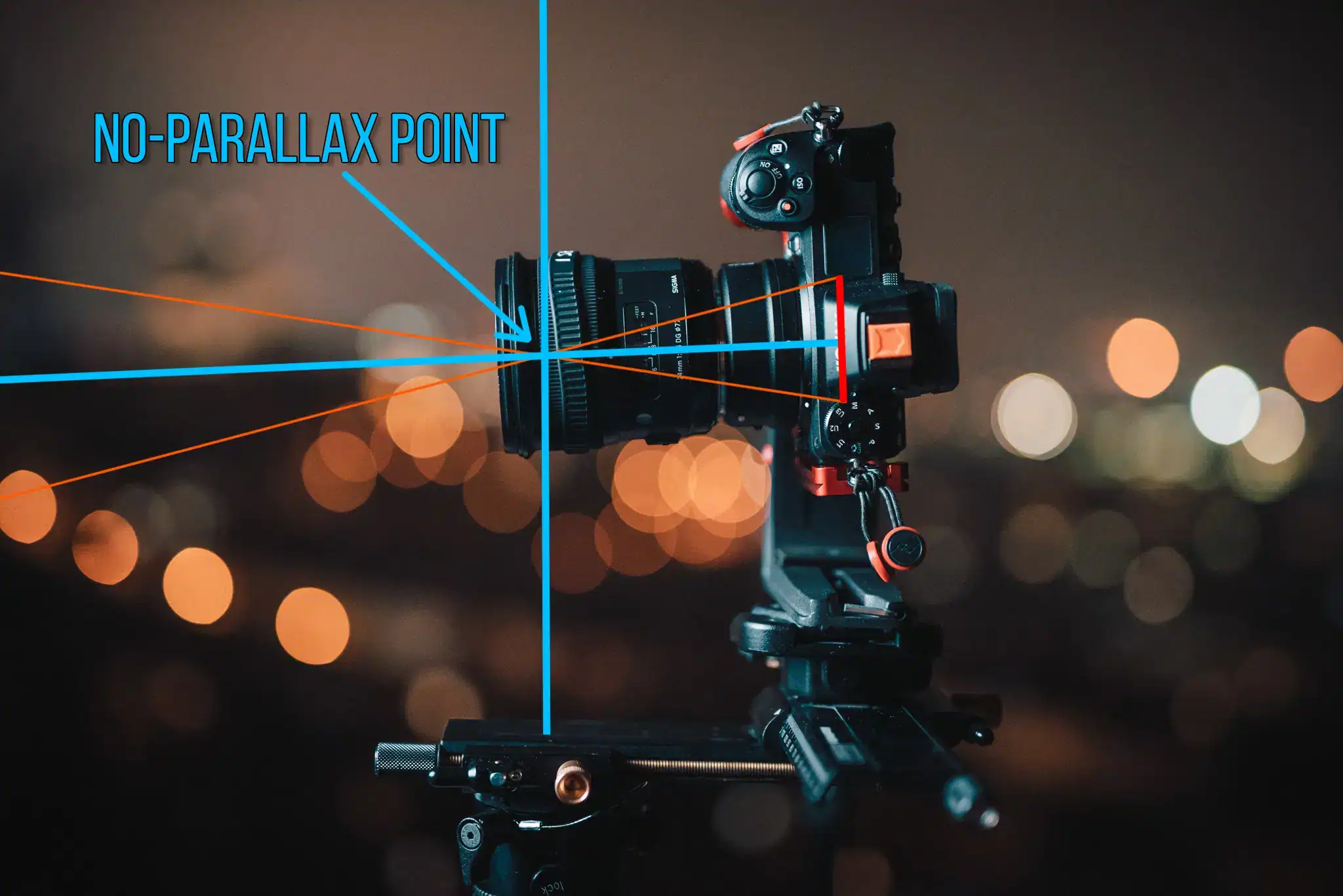
- Panoramic head: Use a multi-row panoramic head (e.g., Nodal Ninja NN6, Leofoto PF/NR series) to align the entrance pupil (no-parallax point) precisely over the rotation axes, preventing parallax errors when objects are near the camera.
- Stable tripod with leveling base: A leveling base lets you level the head once and pan perfectly level, speeding up multi-row capture.
- Remote trigger or app: Trigger via Nikon app, wired release, or self-timer to keep vibrations off the camera.
Optional Add-ons
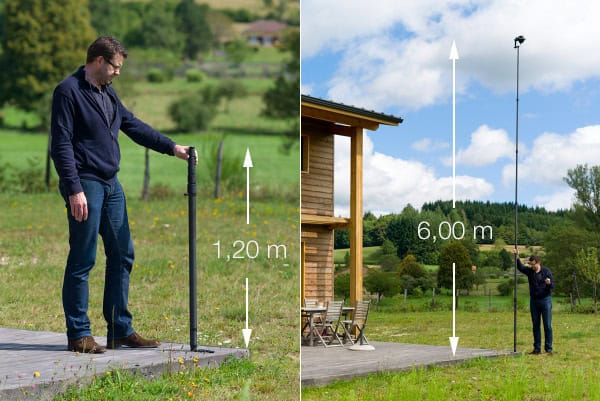
- Pole or car mount: Use a carbon-fiber pole for elevated points or a vibration-damped car mount. Always add tethers and check wind limits before extending.
- Lighting aids: Small LED panels (high CRI) or bounced flash to balance interior lighting; set consistent color temperature.
- Protective covers/weather gear: A rain cover and microfiber cloths are essential with the 14mm’s exposed front element.
Entrance Pupil Calibration (Quick Method)
Set up two light stands (or vertical objects) with one near and one far behind it. Frame both and rotate the camera on your panoramic head. If the near object shifts relative to the far one, adjust the fore-aft rail. Repeat until the relative position stays constant through rotation. Record your rail measurements for fast setup next time. This process matters more with rectilinear lenses and scenes that include close foreground elements.
For a deeper dive into panoramic head setup and why the entrance pupil matters, see this panoramic head tutorial. Panoramic head setup explained (360 Rumors)
Step-by-Step Shooting Guide
Standard Static Scenes
- Level tripod and align nodal point: Use the leveling base; ensure your panoramic head’s vertical and horizontal axes intersect at the lens’s entrance pupil.
- Manual exposure and locked white balance: Set Manual mode, pick a fixed WB (Daylight for sun, Tungsten for warm interiors, or Kelvin value). Locking exposure and WB keeps color and brightness consistent across frames.
- Capture with tested overlap: With the 14mm GM, shoot 8 images around per row with 25–30% overlap; do three rows (pitch +45°, 0°, −45°) plus a dedicated zenith and a nadir frame.
- Take a nadir shot: Tilt the camera straight down and capture the ground plate for later tripod removal. If your head allows, offset the tripod slightly or shoot an extra handheld nadir patch.
HDR / High Dynamic Range Interiors
- Bracket ±2 EV (3–5 frames): The Z9’s dynamic range is excellent, but bright windows often need bracketing to preserve highlight detail.
- Lock WB and keep the bracket order consistent: Many stitching apps expect consistent bracket order (e.g., 0, −2, +2 EV) for batch alignment.
- Use a remote trigger and keep ISO low (64–200): Increasing ISO raises noise across the entire panorama; rely on longer shutter times on a sturdy tripod.
Low-Light / Night Scenes
- Use longer exposures at ISO 64–400 when possible: The Z9 excels at base ISO; push to 800–1600 only if necessary and plan for noise reduction in post.
- Turn off IBIS on a tripod: On the Z9, disable VR to prevent micro-blur from stabilization drift during long exposures.
- Watch for LED banding: The Z9’s stacked sensor reduces rolling shutter, but under certain LED lighting, enable anti-flicker or use shutter speeds synced to local mains frequency (1/50, 1/60, 1/100, 1/120).
Crowded Events
- Two-pass method: Shoot a fast complete pass for coverage, then a second pass where you wait for gaps in the crowd. This gives you clean areas to mask during stitching.
- Higher shutter speeds: Use 1/200 s or faster, f/5.6–f/8, and ISO 400–800 to freeze motion. Be prepared to mask moving subjects in post.
Special Setups (Pole / Car / Drone)
- Secure mounting: For poles, use a rigid carbon-fiber pole with safety tether; for car rigs, use suction mounts rated for your payload and a secondary leash.
- Plan rotation: Rotate slowly between frames; wind-induced sway is your enemy. If the pole flexes, increase overlap to 35% and take extra frames.
- Capture nadir alternatives: Elevated shots often lack a clean nadir. Shoot an extra ground plate from the same location afterward for patching.
Recommended Settings & Pro Tips
Exposure & Focus
| Scenario | Aperture | Shutter | ISO | Notes |
|---|---|---|---|---|
| Daylight outdoor | f/8–f/11 | 1/100–1/250 | 64–200 | Lock WB (Daylight or 5200–5600K); maintain 25–30% overlap |
| Low light/night | f/4–f/5.6 | 1/5–1/30 | 64–800 | Tripod + remote; IBIS OFF; enable anti-flicker near LEDs |
| Interior HDR | f/8 | Bracket ±2 EV | 64–400 | Balance windows and practical lights; keep bracket order consistent |
| Action / moving subjects | f/5.6–f/8 | 1/200+ | 400–800 | Freeze motion; consider two-pass capture for clean masks |
Critical Tips
- Focus: Use manual focus and set near the hyperfocal distance. At 14mm and f/8 on full-frame, hyperfocal is roughly 0.8 m; focusing there keeps everything from ~0.4 m to infinity acceptably sharp.
- Nodal calibration: Perform a quick parallax test and record your rail values for the Z9 + adapter + 14mm GM; repeat if you change your L-bracket or plate.
- White balance lock: Choose a preset or Kelvin value; avoid Auto WB shifts between frames and brackets.
- RAW capture: Shoot 14-bit RAW for maximum dynamic range and color fidelity; this is critical for HDR and challenging mixed lighting.
- IBIS/VR: Turn off on a tripod. If shooting handheld (emergency), keep IBIS on and increase overlap to 35–40% to help stitching.
- Lens handling: The 14mm GM’s bulbous front element is vulnerable—use the cap when moving and watch for flare; shade the lens with your hand or body if needed.
Stitching & Post-Processing
Software Workflow
Import RAW files into Lightroom or Capture One for base adjustments (white balance fine-tune, lens profile if appropriate, exposure balancing across rows). Export to your stitching tool—PTGui, Hugin, or Photoshop’s Photomerge. Rectilinear lenses generally require more frames than fisheyes but produce very natural geometry. Industry guidance: use ~25–30% overlap for ultra-wides; with rectilinear edges, err on the higher side for robust control point matching.
PTGui is a top choice for complex multi-row and HDR workflows, with excellent control point editing, masking, and template saving. See a detailed review here: Why PTGui excels for complex panoramas (Fstoppers review)
If you’re targeting VR platforms, export a 2:1 equirectangular JPEG or TIFF (e.g., 16,384×8,192 px for high-detail delivery), then preview in a viewer. Oculus provides a solid overview of DSLR/mirrorless 360 workflows. Using a DSLR or mirrorless to shoot and stitch a 360 photo (Oculus)
Cleanup & Enhancement
- Nadir patch: Use PTGui’s Viewpoint Correction + masking, or clone/AI fill in Photoshop. Capture a clean ground plate for best results.
- Color consistency: Match exposure and WB between rows before stitching. Apply global color grading after stitching to avoid seams.
- Noise reduction: Use minimal NR on base ISO captures; apply stronger NR to bracket shadows or night skies while preserving detail.
- Leveling & metadata: Set horizon and verticals in your stitcher. Confirm correct yaw/pitch/roll and inject 360 metadata for viewers.
- Output formats: For web/VR, export high-quality JPEG; for archival or client grade, export 16-bit TIFF and a JPEG derivative.
For more on planning focal lengths and panorama strategy, this overview from B&H is helpful context: Panoramas, focal lengths, and approaches (B&H)
Disclaimer: Software evolves—always check the latest documentation for workflow changes and optimal settings.
Useful Tools & Resources
Software
- PTGui panorama stitching
- Hugin (open source)
- Lightroom / Photoshop
- AI tripod/nadir removal tools
Hardware
- Panoramic heads (Nodal Ninja NN6, Leofoto multi-row systems)
- Carbon fiber tripods with leveling bases
- Wireless remote shutters
- Pole extensions and vibration-damped car mounts
Disclaimer: product names for research only—verify compatibility and specs on manufacturer sites.
Common Mistakes & How to Avoid Them
- Parallax error: Not aligning the entrance pupil causes stitching ghosts—calibrate once and mark your rail settings.
- Exposure flicker: Auto exposure or Auto WB will produce seams—use Manual exposure and fixed WB.
- Tripod shadows and gaps: Always shoot a dedicated nadir and consider a handheld patch if the tripod blocks detail.
- Motion ghosting: Crowds, flags, or trees in wind—take multiple passes and mask the cleanest elements in post.
- Night noise: Over-reliance on high ISO—use longer exposures, keep ISO low, and blend brackets.
- Adapter surprises: With E-to-Z adapters, verify aperture, EXIF, and IBIS behavior before critical jobs.
Frequently Asked Questions
- Can I shoot handheld panoramas with the Nikon Z9?
Yes for quick cylindrical panos, but for full 360×180 quality work, use a tripod and panoramic head. If you must go handheld, enable IBIS, shoot fast (1/250 s+), and increase overlap to 35–40% to help the stitcher.
- Is the Sony FE 14mm f/1.8 GM wide enough for single-row 360?
Single-row at 14mm produces a cylindrical panorama, not a full sphere. For 360×180 coverage, plan on multi-row captures (e.g., 3 rows of 6–8 shots plus zenith and nadir).
- Do I need HDR for interiors with bright windows?
Often yes. Even with the Z9’s strong dynamic range, windows can clip. Bracket ±2 EV (3 or 5 frames) to retain both window highlights and interior shadows, then merge and stitch.
- How do I avoid parallax issues with this setup?
Use a calibrated multi-row panoramic head and align rotation at the lens’s entrance pupil. Perform a near/far parallax test; record your rail measurements and keep them consistent.
- What ISO range is safe on the Z9 in low light?
For tripod-based panoramas, aim for ISO 64–400 whenever possible. ISO 800–1600 is fine if you need faster shutter speeds, but expect to apply selective noise reduction in post.
- Can I set up Custom Modes to speed up pano shooting on the Z9?
The Z9 uses Shooting Menu Banks (A–D) rather than U1–U3. Create a “Pano” bank with Manual exposure, fixed WB, RAW, IBIS OFF (tripod), and a standard bracket (+/-2 EV) as needed. Save it for instant recall.
- How can I reduce flare with the 14mm GM’s bulbous front element?
Avoid strong backlight in-frame when possible, shade the lens with your hand or body just outside the frame, and clean the element frequently. Take extra frames if the sun crosses a seam so you can pick the cleanest frame during masking.
- What’s the best tripod head type for this combo?
A two-axis multi-row panoramic head (with fore-aft and vertical rails) is ideal. It allows exact entrance pupil alignment and precise pitch increments for reliable multi-row coverage at 14mm.
Want to go further into DSLR/mirrorless 360 workflows and best practices? This guide offers an excellent foundation. Set up a panoramic head for high-end 360 photos (Oculus)