
Why This Camera & Lens Are Great for Panoramas
The Nikon Z9 paired with the Sony FE 12–24mm f/4 G is an unconventional but powerful combo for panoramic and 360 photo work—especially if you value straight lines, low distortion, and high resolution. The Z9’s 45.7MP full-frame stacked CMOS sensor (approx. 4.35µm pixel pitch) delivers excellent detail and around 14 stops of dynamic range at base ISO, which is ideal for capturing high-contrast scenes and for stitching large multi-row panoramas without banding or noise issues. Its 5-axis IBIS is superb for handheld work, but should be disabled on a tripod for best stitch consistency.
The Sony FE 12–24mm f/4 G is a rectilinear ultra-wide zoom with a 122° diagonal field of view at 12mm. Rectilinear lenses preserve straight lines—great for architecture and real estate—at the cost of requiring more frames than a fisheye for a full spherical capture. Optically, the 12–24 G is sharp from f/5.6–f/8, with mild lateral CA that’s easy to correct in post and well-controlled distortion for an ultra-wide zoom.
Mount compatibility note: Because this is a Sony E-mount lens on a Nikon Z body, you’ll need an electronic adapter such as the Megadap ETZ21 or Techart TZE-01/TZE-02. For panoramas, this is usually fine because we shoot with manual focus and fixed aperture. Still, confirm that your adapter reliably controls aperture and does not introduce wobble. Always test focus, aperture changes, and lens EXIF passing before critical jobs. When in doubt, set and lock focus/aperture manually.
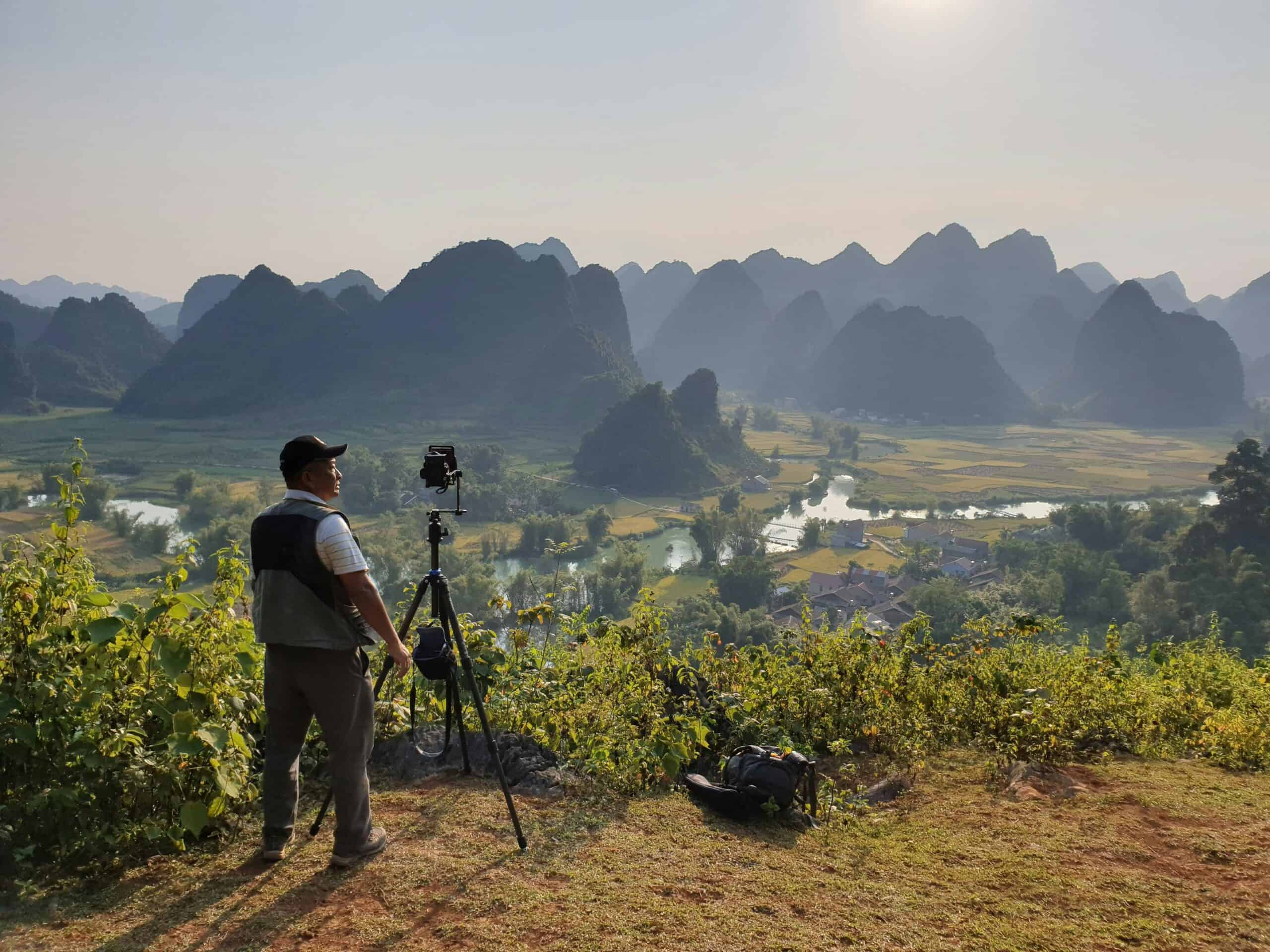
Quick Setup Overview
- Camera: Nikon Z9 — 45.7MP full-frame stacked CMOS; ~14 EV dynamic range at base ISO; excellent buffer; 5-axis IBIS.
- Lens: Sony FE 12–24mm f/4 G — Rectilinear ultra-wide zoom; best at f/5.6–f/8; mild lateral CA; focuses close; 12mm offers 122° diagonal FOV.
- Estimated shots & overlap (tested targets):
- At 12mm (full spherical 360): 3 rows of 6 frames (yaw steps 60°) at -45°, 0°, +45° + zenith + nadir = ~20 shots. For extra safety/complex interiors: 3 rows of 8 (45° steps) + Z + N = ~26 shots.
- Cylindrical 360 (single-row horizon at 12mm): 6–7 shots around with 25–30% overlap.
- At 16mm: typically 8 around per row × 3 rows + Z + N ≈ 26 shots.
- At 24mm: more rows required; expect 4 rows of ~10 + Z + N (40+ shots).
- Difficulty: Intermediate — rectilinear ultra-wide requires careful nodal alignment and multi-row discipline, but rewards you with straight lines and high stitching accuracy.
Planning & On-Site Preparation
Evaluate Shooting Environment
Identify light direction, high-contrast elements (bright windows, sun), and moving subjects (people, traffic, foliage). Watch for reflective surfaces like glass, polished floors, and metal railings—position yourself perpendicular to glass and keep 5–15 cm distance to reduce flare and double reflections. Check for wind that could shake a pole or tall tripod. For rooftop and car-mounted setups, assess safety first and avoid edges or unsecured heights.
Match Gear to Scene Goals
The Z9’s wide dynamic range and low noise up to ISO 1600 make it strong for interiors and dusk cityscapes. For interiors with windows, plan HDR brackets (±2 EV) at a consistent white balance. The Sony 12–24mm’s rectilinear rendering keeps walls straight—but you’ll capture more frames compared to using a fisheye. If time is limited, stay at 12mm to minimize shot count while preserving straight lines, and rely on the Z9’s robust RAW files for clean stitching.
Pre-shoot Checklist
- Power and storage: fully charge batteries and bring spares; use fast, reliable cards (the Z9 benefits from CFexpress Type B for deep buffers).
- Optics and sensor: clean lens elements and sensor—dust becomes very obvious in sky and wall gradients.
- Tripod leveling and pano head calibration: level the base and verify nodal alignment marks for 12mm, 16mm, and 24mm.
- Safety checks: wind, rooftop edge distance, crowd flow, and any tethering points if using poles or car mounts.
- Backup workflow: shoot at least one full safety pass—even if you think you have it.
Field Scenarios You’ll Encounter
- Indoor real estate: low ISO (64–200), f/8, HDR ±2 EV; lock white balance; protect straight lines with careful head leveling.
- Outdoor sunset: bracket 3–5 exposures; shoot fastest row first to lock the sky; return for foreground/Nadir.
- Event crowds: plan two passes—capture structure first, then wait for gaps in moving people; mask later.
- Rooftop/pole: keep exposures short (1/125–1/250), use strap/tether; settle vibrations before each shot.
- Car-mounted: slow speed, short shutter (1/250+), and consider shorter rotations (6 around per row at 12mm).
Essential Gear & Setup
Core Gear
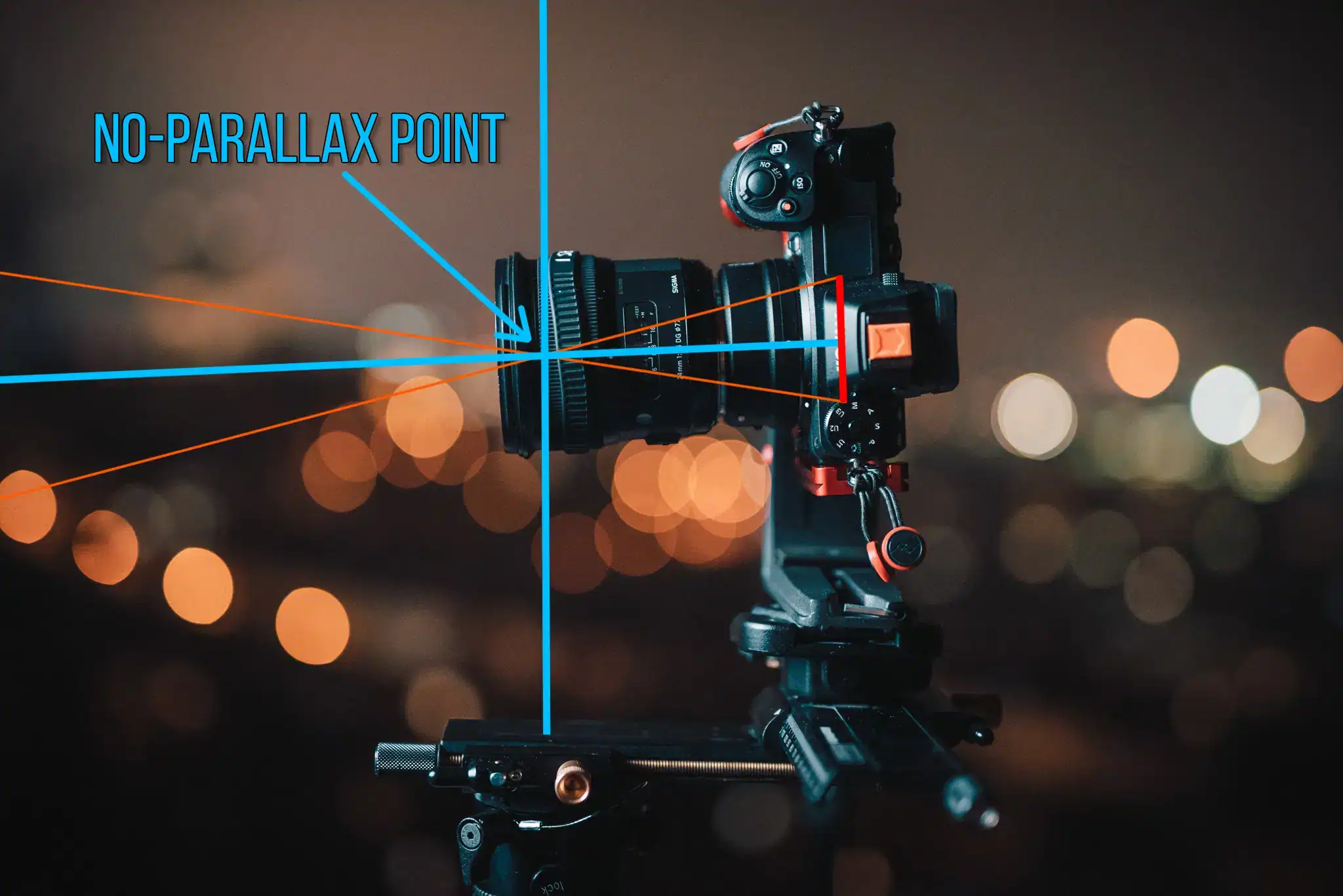
- Panoramic head: a two-axis panoramic head with fore/aft and lateral adjustments is essential to align the lens’s no-parallax (nodal) point over the rotation axis. This eliminates parallax between near and far objects, which is critical for clean stitches.
- Stable tripod with leveling base: a leveling base speeds setup and keeps horizons straight—massively helpful when doing multi-row work.
- Remote trigger or app: use Nikon SnapBridge or a wired/wireless remote to avoid vibration.
Optional Add-ons
- Pole or car mount: only with safety tethers; beware of wind, flex, and vibration. Keep exposures fast and rotation deliberate.
- Lighting aids: small LED panels to lift shadows in deep interiors, or bounce cards to control glare.
- Weather protection: rain covers and silica packs; keep the adapter-lens-body junction dry.
Want a deeper dive into panoramic head setup and theory? See this panoramic head tutorial that walks through alignment principles and field use. Panoramic head tutorial
Watch: Panoramic Head Setup
This video expands the fundamentals of setting up a panoramic head for clean, repeatable results.
Step-by-Step Shooting Guide
Standard Static Scenes
- Level the tripod and align the nodal point: Set your panoramic head so the lens’s entrance pupil is directly above the rotation axis. Use two light stands or a near/far test to fine-tune changes—rotate left/right and ensure near and far objects don’t shift relative to each other.
- Manual exposure and locked white balance: Switch to M mode. Set a fixed WB (e.g., Daylight 5200K outdoors, 3000–4000K indoors), fixed ISO (64–200 outdoors; 100–800 indoors), and a consistent aperture (f/8 is a sweet spot for the 12–24 G).
- Capture with tested overlap: At 12mm, shoot three rows (-45°, 0°, +45°) at 6 frames per row (60° yaw steps). Add a zenith and a nadir frame. For difficult scenes (tight spaces, lots of near objects), use 8 frames per row for more overlap.
- Nadir (ground) shot: After the main capture, lift the camera off the head and shoot a clean ground patch (or rotate the head off-axis) to make tripod removal easier in post.
HDR / High Dynamic Range Interiors
- Bracket ±2 EV (3–5 frames): This balances bright windows and interior shadows. For the Z9, use exposure bracketing with constant aperture and ISO—only shutter changes.
- Lock white balance: Keep WB fixed across all brackets to avoid color shifts when merging and stitching.
- Merge then stitch, or stitch then merge: PTGui can handle bracketed sets natively, but many prefer merging per view (to 32-bit or HDR DNG) then stitching for consistent tonality.
Low-Light / Night Scenes
- Use longer exposures on tripod: f/4–f/5.6, 1/10–1/60 s, ISO 64–800. The Z9 handles ISO 1600 well, but keep it lower where possible for cleaner gradients.
- Disable IBIS: Turn off stabilization on a tripod to prevent micro-drift that can complicate stitching.
- Remote or self-timer: Use a 2s timer or remote release to avoid shake.
Crowded Events
- Two-pass strategy: First pass to capture the structure without worrying about people; second pass timed for gaps in motion.
- Mask in post: In PTGui or Photoshop, use masks to blend the “cleanest” areas from multiple passes.
- Faster shutter: 1/200–1/500 s to freeze motion if needed; accept slightly higher ISO on the Z9—it copes well up to ISO 1600.
Special Setups (Pole / Car / Drone)
- Secure gear and tether: Use an approved pole/car mount rated for your load, and always add a secondary safety tether.
- Account for wind and vibration: Shorter exposures (1/125–1/250), shoot fewer frames per row (e.g., 6) and check for micro-blur at 100%.
- Pre-focus and lock: Manual focus at the hyperfocal distance avoids focus pumping due to vibrations.
Recommended Settings & Pro Tips
Exposure & Focus
| Scenario | Aperture | Shutter | ISO | Notes |
|---|---|---|---|---|
| Daylight outdoor | f/8–f/11 | 1/100–1/250 | 64–200 | Lock WB (Daylight ~5200K); disable IBIS on tripod |
| Low light/night | f/4–f/5.6 | 1/30–1/60 | 200–800 | Tripod & remote; consider longer exposures at lower ISO |
| Interior HDR | f/8 | Bracket ±2 EV | 64–400 | Balance windows & lamps; consistent WB |
| Action / moving subjects | f/5.6–f/8 | 1/200+ | 400–1600 | Freeze motion; do a second pass for cleanup |
Critical Tips
- Manual focus and hyperfocal: At 12mm and f/8 on full frame, set focus around 1–1.2 m to keep everything from ~0.5 m to infinity acceptably sharp. Confirm on the Z9’s magnified live view.
- Nodal point calibration: The entrance pupil shifts across the 12–24mm zoom range. Calibrate at 12mm (your most-used focal length) by sliding the camera on the rail until near and far objects stay aligned when rotating. Mark rail positions for 12, 16, and 24mm.
- White balance lock: Mixed lighting? Pick a neutral WB and stick to it across the set. Correct globally in RAW later.
- RAW workflow: Shoot 14-bit RAW to exploit the Z9’s dynamic range—especially for gradient skies and interior shadows.
- IBIS off on tripod: Stabilization can introduce micro-shifts between frames. Disable IBIS for tripod-based panoramas.
- Adapter discipline: Ensure the Sony 12–24 is tight in the adapter; any play can cause alignment drift across rows.
Stitching & Post-Processing
Software Workflow
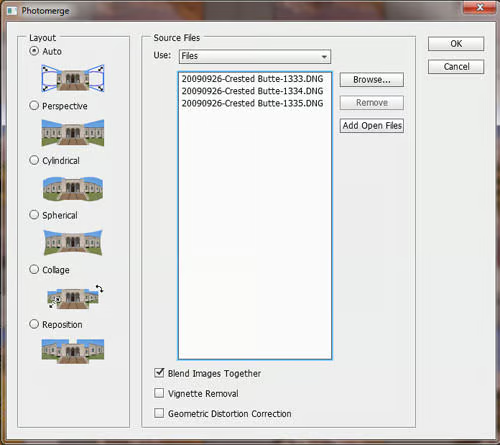
PTGui is the industry standard for multi-row, high-resolution stitches. Hugin is a solid open-source alternative. Rectilinear ultra-wides like the 12–24mm often stitch cleanly if overlap is sufficient and nodal alignment is correct. Typical industry guidance: 20–25% overlap for rectilinear, 25–30% for fisheye. With multi-row rectilinear panos, more overlap (30–40%) can reduce errors on complex interiors and speed up control point generation.
Basic flow: ingest RAW, apply consistent lens profile and WB, optionally merge HDR brackets (or use PTGui’s HDR workflow), then stitch to equirectangular. Level the horizon, set a clean center view, patch the nadir, and export a 16-bit TIFF or high-quality JPEG for publication. For virtual tour platforms, export 2:1 equirectangular at appropriate resolutions (e.g., 12k–16k longest edge for high-end tours).
For an overview of why many pros choose PTGui, this review offers a practical perspective. PTGui review and workflow notes
Cleanup & Enhancement
- Nadir patch: Shoot a clean ground plate and use PTGui’s Viewpoint Correction or retouch in Photoshop. Some AI tools can remove tripods quickly.
- Color and noise: Apply global color correction, then selective noise reduction on shadow areas. The Z9’s files handle moderate NR very well.
- Level and orientation: Use the horizon tool; correct yaw/pitch/roll so lines are true, especially for architecture.
- Export formats: Save a 16-bit master TIFF and a web-ready JPEG. For VR/360 hosting, export equirectangular (2:1) with appropriate metadata.
If you are new to end-to-end DSLR/mirrorless 360 workflows, Meta’s overview is concise and up-to-date. How to shoot and stitch a 360 photo with a DSLR/mirrorless
Useful Tools & Resources
Software
- PTGui (pro-grade panorama stitching)
- Hugin (open source alternative)
- Lightroom / Photoshop (RAW prep and retouching)
- AI tools for tripod removal and cleanup
Hardware
- Panoramic heads (Nodal Ninja, Leofoto, Sunwayfoto)
- Carbon fiber tripods with leveling base
- Wireless remotes or intervalometers
- Pole extensions / car suction mounts (with safety tethers)
- Megadap ETZ21 or Techart TZE-01/TZE-02 adapter (Sony E to Nikon Z)
Disclaimer: Names provided for search reference; confirm compatibility and current firmware with manufacturers.
For more panoramic shooting principles and examples, this Q&A thread compiles field-tested advice from many photographers. Techniques to take 360 panoramas
Common Mistakes & How to Avoid Them
- Parallax error: Always align the entrance pupil over the rotation axis and lock your rails.
- Exposure flicker: Manual mode and locked WB across all frames (and brackets).
- Tripod shadows and nadir mess: Plan a nadir shot and patch cleanly.
- Ghosting from movement: Shoot multiple passes and mask in post.
- Noise in night skies: Favor longer exposures over high ISO; the Z9’s base ISO is extremely clean.
- Adapter slop: Ensure the E-to-Z adapter is snug to avoid frame-to-frame alignment drift.
Frequently Asked Questions
-
Can I shoot handheld panoramas with the Nikon Z9?
Yes, especially single-row cylindrical panoramas. Use 12mm, overlap 30–40%, and shoot a fast shutter (1/200+) with IBIS on. For full 360 multi-row work, a tripod and panoramic head deliver far better stitching consistency.
-
Is the Sony FE 12–24mm f/4 G wide enough for a single-row 360?
For a full spherical 360, a single row at 12mm won’t cover the zenith and nadir. Plan on three rows (-45°, 0°, +45°) and add zenith/nadir shots. If you only need a cylindrical panorama (horizon band), one row at 12mm with 6–7 frames works well.
-
Do I need HDR for interiors with bright windows?
Usually yes. Bracket ±2 EV (3–5 frames) to protect window highlights and interior shadows. Merge to 32-bit or HDR DNG before or inside PTGui. The Z9’s base ISO files handle highlight recovery gracefully, but bracketing is safer for clean results.
-
How do I avoid parallax issues with this zoom lens?
Use a panoramic head and find the lens’s entrance pupil for each focal length you use. Calibrate at 12mm with a near/far alignment test, then mark the rail position. Because a zoom’s entrance pupil shifts, keep consistent focal length across your set.
-
What ISO range is safe on the Z9 in low light?
ISO 64–800 is ideal for critical work; ISO 1600 remains very usable. For night skies and interiors, favor tripod and longer shutter over pushing ISO too high.
-
Can I set up Custom Shooting Modes on the Z9 for pano?
Use the Z9’s Photo Shooting Menu Banks (A–D) and Custom Settings Banks to store a “Pano” configuration: Manual exposure, fixed WB, RAW, IBIS off, self-timer/remote, and your preferred bracketing. This speeds up repeatable field work.
-
Any concerns using an E-to-Z adapter for panoramas?
Ensure firmware is current. Confirm that aperture control is reliable and there’s no mechanical play. For panoramas, manual focus is recommended; disable AF to prevent shift. Re-check nodal alignment after any adapter change.
-
What’s the best panoramic head for this setup?
Choose a two-axis head with precise rails and a solid clamp (e.g., Nodal Ninja or Leofoto). You need fore/aft and lateral adjustment, degree markings, and a stable vertical arm to hold the Z9’s weight.
Expert Notes & References
Field-tested guidance here aligns with established panoramic practices and tools. For a structured, professional overview on setting up a head and shooting high-end 360s, this guide is excellent: Set up a panoramic head for high-end 360 photos. For additional angles on workflow and software, refer to the PTGui review linked above and community-proven methods.
Visual Examples
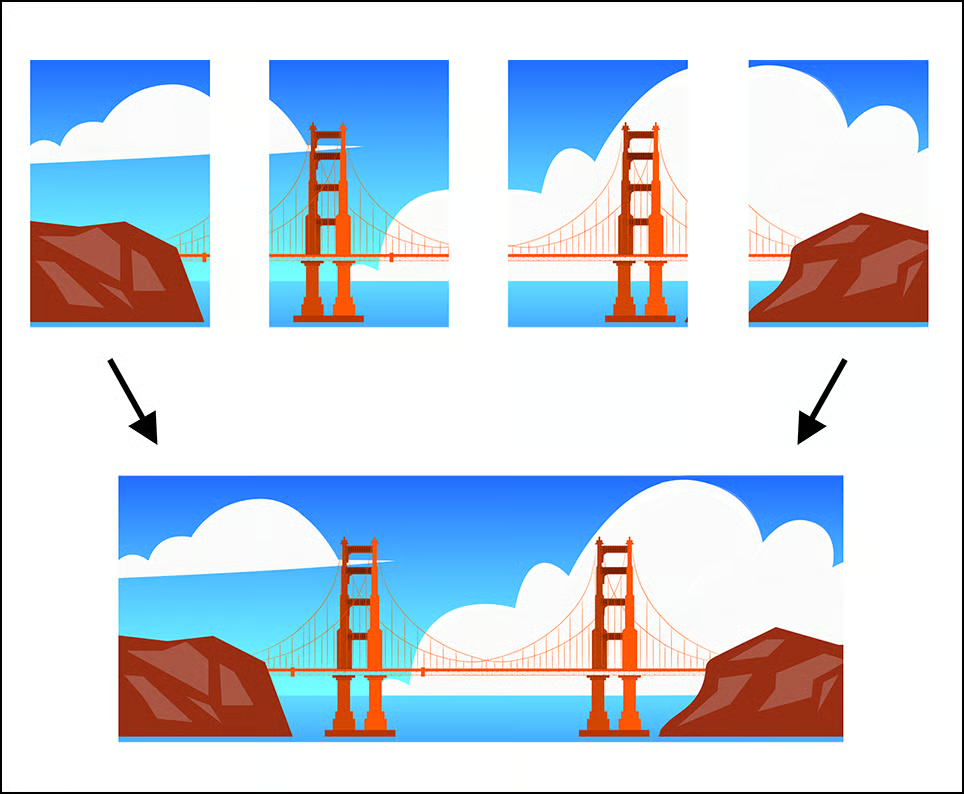
These visuals illustrate concepts mentioned above—gear alignment, field use, and post-production.
Final Thoughts
If you need straight lines, high resolution, and professional control, learning how to shoot panorama with Nikon Z9 & Sony FE 12–24mm f/4 G is a strong path. It takes more frames than a fisheye, but the clean rectilinear rendering is worth it—especially for architecture and real estate. Calibrate your nodal point, lock exposure and white balance, use solid overlap, and rely on robust stitching tools. With a careful workflow and the Z9’s superb sensor, you’ll produce seamless 360 photos ready for tours, prints, or VR platforms.