Why This Camera & Lens Are Great for Panoramas
If you want to learn how to shoot panorama with Nikon Z9 & Sigma 8mm f/3.5 EX DG Circular Fisheye, you’ve picked a pro-grade combo that captures full 360° scenes with minimal shots and excellent image quality. The Nikon Z9 is a 45.7MP full-frame mirrorless flagship with a stacked CMOS sensor (approx. 35.9 × 23.9 mm), base ISO 64, and roughly 14+ stops of dynamic range at base for superb highlight retention. Its pixel pitch is about 4.35 µm, which provides high detail while keeping noise controlled at moderate ISOs. The Z9 also brings fast, silent electronic-only shutter, robust IBIS, a big battery, and a bright EVF—great for precise leveling and manual exposure.
The Sigma 8mm f/3.5 EX DG Circular Fisheye is a circular fisheye that projects a full 180° field of view in all directions on full-frame, creating a circular image. For 360 photos, that translates into fewer shots, faster capture, and fewer stitching seams. Expect some lateral chromatic aberration and strong fisheye distortion (by design), both of which modern stitching software handles well. Mounted to the Z9 via the Nikon FTZ II adapter (the lens is Nikon F-mount), you get reliable compatibility, EXIF flow, and a sturdy connection. Together, this kit is ideal for interior virtual tours, outdoor landscapes, and quick 360 captures in dynamic environments.
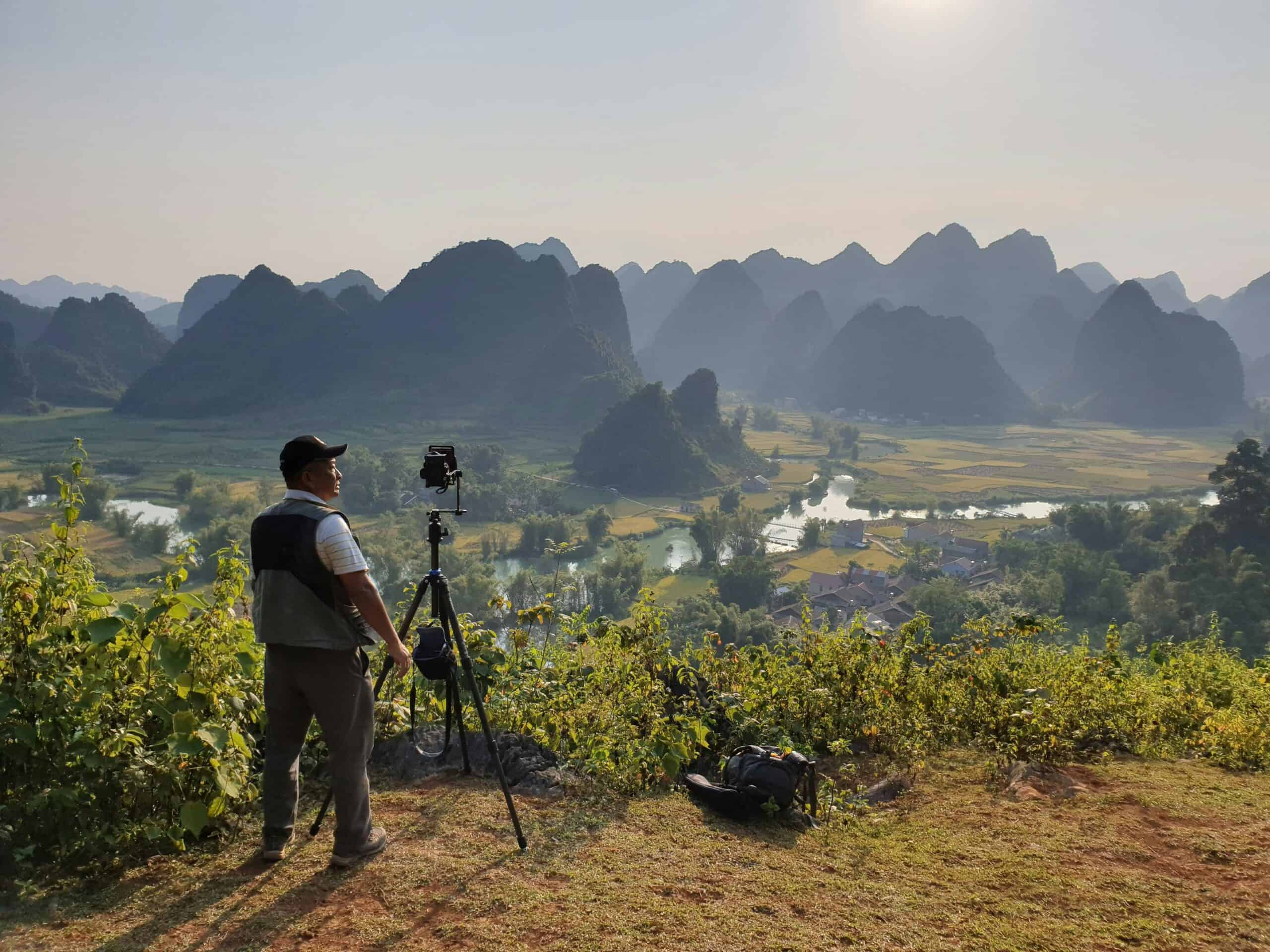
Quick Setup Overview
- Camera: Nikon Z9 — full-frame 45.7MP stacked CMOS, base ISO 64, excellent DR and low rolling shutter, 5-axis IBIS.
- Lens: Sigma 8mm f/3.5 EX DG Circular Fisheye — circular fisheye with 180° FOV; sharpest around f/5.6–f/8; mild CA that’s easy to fix.
- Mounting: Use Nikon FTZ II adapter for Nikon F-mount lens compatibility on Z-mount bodies.
- Estimated shots & overlap (tested):
– Minimal: 3 shots around at 120° yaw + nadir.
– Safe: 4 shots around at 90° yaw (0° pitch) + nadir.
– Overlap guide: 30–35% between frames for robust stitching. - Difficulty: Easy to Moderate — the circular fisheye reduces shot count, but nodal alignment still matters for clean seams.
Planning & On-Site Preparation
Evaluate Shooting Environment
Start by reading the light and movement. Check for reflective surfaces (glass, polished floors, cars) and plan your position to avoid strong backlight hitting the fisheye’s bulbous front element, which is prone to flare. If you must shoot through glass, place the lens as close as possible (1–2 cm) to reduce reflections and ghosting. Look for moving elements (people, leaves, traffic) and note wind direction if you’re using a pole or on rooftops.
Match Gear to Scene Goals
The Z9’s dynamic range at base ISO 64–100 lets you preserve highlight detail in bright windows or sunsets, while the Sigma 8mm circular fisheye means fewer frames and faster coverage—ideal when crowd movement or changing light would otherwise ruin consistency. The Z9 handles ISO 100–800 cleanly; for interiors, 100–400 is a sweet spot, with HDR bracketing used for bright windows. The fisheye’s advantage is speed and overlap; the trade-off is optical distortion, which stitching software will remap into an equirectangular format later.
Pre-shoot Checklist
- Charge EN-EL18d battery, bring a spare; format fast cards (CFexpress recommended).
- Clean the Sigma’s front element—fisheye flare shows every smudge; check the Z9 sensor for dust.
- Level the tripod, verify panoramic head calibration (nodal alignment), and confirm FTZ II is secure.
- Safety first: evaluate wind loads on rooftops, use a safety tether, keep away from edges; for car mounts, use redundant straps and test at low speeds first.
- Backup workflow: if time allows, shoot an extra safety round—small time cost, big insurance.
Essential Gear & Setup
Core Gear
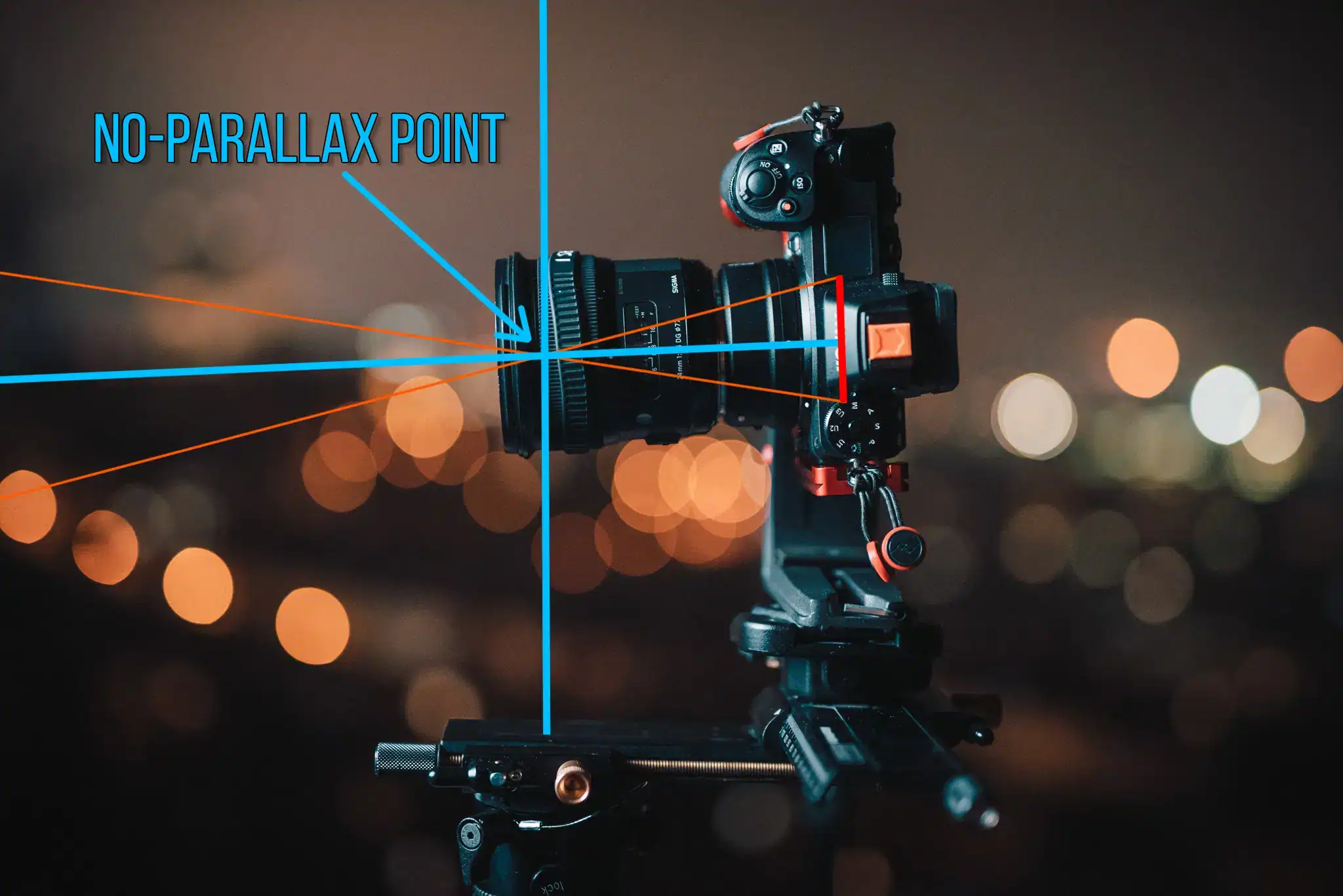
- Panoramic head: A rotator with both vertical and horizontal rails lets you place the lens’s no-parallax point over the rotation axis, minimizing parallax for clean stitches.
- Stable tripod with leveling base: A leveling bowl or base speeds setup and keeps horizons straight.
- Remote trigger or SnapBridge app: Trigger without touching the camera to avoid vibrations; the Z9’s touchy electronic shutter and high resolution reveal small shakes.
Optional Add-ons
- Pole or car mount: Great for elevated or moving perspectives. Use a guy-line and tether for poles; verify suction mounts and safety lines for car rigs. Beware wind and vibration.
- Lighting aids: Small LED panels can lift shadows in dark interiors. Keep light consistent across frames.
- Weather protection: Rain cover, microfiber cloths, and a lens hood ring (when compatible) to manage flare; shield the fisheye from direct sun when possible.
For a deeper primer on aligning a panoramic head, this guide is concise and practical. Panoramic head setup tutorial (360 Rumors)
Step-by-Step Shooting Guide
Standard Static Scenes
- Level tripod and align nodal point. Use the Z9’s Virtual Horizon to get perfectly level. With the Sigma 8mm, slide the camera on your pano head’s rail until foreground and background features overlap consistently during yaw rotation. Record your rail measurements for this lens + FTZ II.
- Set manual exposure and lock white balance. Use M mode and a fixed WB (e.g., Daylight 5200–5600K outdoors; 3000–3400K under tungsten). This avoids exposure and color shifts that cause stitching artifacts.
- Capture the sequence with proper overlap. For this combo, 4 shots at 90° yaw (pitch 0°) is reliably clean. If you’re in a rush and the scene is simple (even sky, minimal foreground), 3 shots at 120° can work. Rotate in the same direction each time, waiting a second after each movement.
- Take a nadir shot for tripod removal. Tilt the camera down or shoot a handheld nadir plate while keeping the rotation point roughly over the tripod’s position. Mark the ground if possible for accurate repositioning.
HDR / High Dynamic Range Interiors
- Bracket for windows vs. interior shadows. Start with 3 frames at ±2 EV around a base exposure (Z9 Automatic Bracketing makes this easy). If the contrast is extreme, consider 5 frames.
- Lock WB and turn off auto ISO. Manual ISO 100–200 preserves DR; bracket exposure via shutter speed while keeping aperture and ISO fixed.
- Sequence order matters. Shoot all brackets at each yaw position before rotating to the next, to keep shadows and highlights aligned.
Low-Light / Night Scenes
- Stabilize everything. Use a solid tripod; disable IBIS on the Z9 when locked on a tripod to prevent micro-drift. Enable Electronic Front Curtain is irrelevant on Z9 (e-shutter only), but still use a remote and self-timer.
- Use f/4–f/5.6, shutter 1/10–1/30s on tripod, and ISO 100–400 when possible to keep noise low. If wind is moving the rig, shorten shutter and raise ISO modestly to 800–1600.
- Manual focus and confirm with magnified live view. With an 8mm, set focus slightly beyond 0.4 m at f/8 to cover near-to-infinity.
Crowded Events
- Shoot two passes. First pass captures structure and lighting; second pass waits for gaps in movement at key seams.
- Use faster shutter (1/200s or faster) and ISO 400–800 to freeze motion. Consider 4 shots around for extra overlap to help masking moving subjects later.
Special Setups (Pole / Car / Drone)
- Pole: Use a lightweight carbon pole and a compact panoramic head. Keep shutter at 1/250s+ and ISO 400–800 to fight vibrations. Always tether the rig and avoid gusty conditions.
- Car mount: Short exposures (1/500s+), IBIS on, and a rigid suction/vacuum mount with safety straps. Avoid busy traffic backgrounds that change too quickly between frames.
- Drone: The Z9 is heavy; consider a specialized heavy-lift platform or use a smaller system. When in doubt, ground-based poles are safer and simpler.
Recommended Settings & Pro Tips
Exposure & Focus
| Scenario | Aperture | Shutter | ISO | Notes |
|---|---|---|---|---|
| Daylight outdoor | f/8–f/11 | 1/100–1/250 | 100–200 | Lock WB (Daylight/Kelvin 5200–5600) |
| Low light/night | f/4–f/5.6 | 1/10–1/60 | 100–800 | Tripod and remote; disable IBIS on tripod |
| Interior HDR | f/8 | Bracket ±2 EV | 100–400 | 3–5 frames per angle to balance windows and lamps |
| Action / moving subjects | f/5.6–f/8 | 1/200+ | 400–800 | Freeze motion; consider two passes for masking |
Critical Tips
- Manual focus at hyperfocal: At 8mm and f/8 on full-frame, setting focus ~0.4 m keeps near-to-infinity acceptably sharp.
- Nodal calibration: Place two vertical objects (near/far) in frame, rotate around yaw, and adjust the rail until their relative alignment doesn’t shift. Mark your rail settings for the Z9 + FTZ II + Sigma 8mm combo.
- White balance lock: Mixed lighting will vary between frames. Use fixed Kelvin; you can fine-tune in RAW later.
- RAW over JPEG: The Z9’s 14-bit RAW maximizes DR for HDR merges and color correction.
- IBIS: Turn it off on a tripod to avoid micro-motions. Turn it on for handheld or pole work.
- Diffraction: On 45.7MP, diffraction softening creeps in past f/11; aim for f/5.6–f/8 when possible.
For a practical look at choosing focal lengths and understanding pano geometry, this explainer is helpful context. Panoramas, focal lengths, and stitching considerations (B&H Explora)
Stitching & Post-Processing
Software Workflow
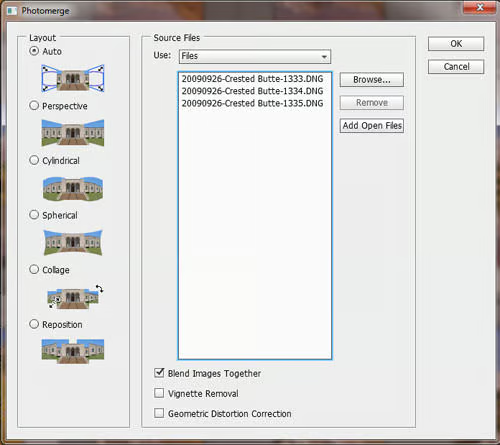
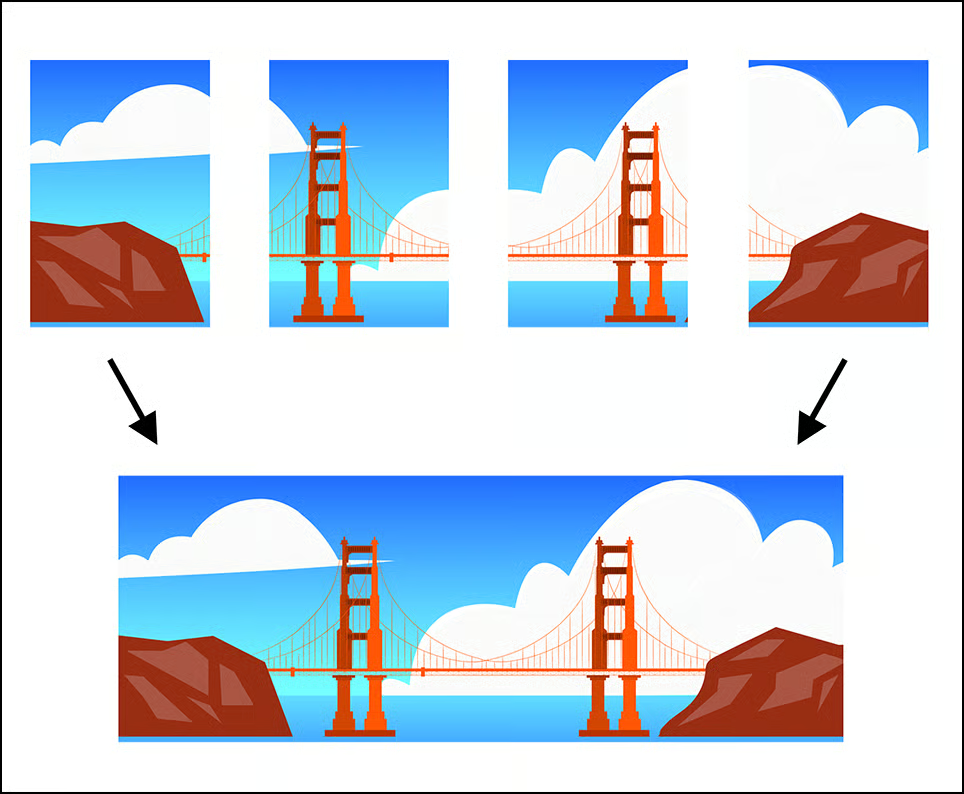
Import all frames and, if necessary, first create HDR merges per angle (in Lightroom, Photomatix, or HDR Merge in other apps). Then stitch the set in PTGui or Hugin. With a circular fisheye like the Sigma 8mm, you’ll typically select “Fisheye” as lens type and let the software find control points. Since you’re shooting fewer frames, stitching is faster and less error-prone than with rectilinear lenses, though you’ll pay attention to nadir cleanup.
Export an equirectangular panorama at the maximum resolution your sequence supports. With the Z9’s 45.7MP files and 4-around workflow, expect a high-resolution 360 that’s clean and detailed. Industry guidelines recommend roughly 30% overlap for fisheye and 20–25% for rectilinear sequences. PTGui is the gold standard for speed and control; Hugin is a great open-source alternative. Why PTGui is favored for complex panoramas (Fstoppers review)
Cleanup & Enhancement
- Nadir patch: Export a layered panorama from PTGui, patch the tripod using a logo disk or content-aware fill. Many tools now automate this step using AI.
- Color and noise: Balance color casts from mixed lights. Apply gentle noise reduction if you used higher ISOs.
- Horizon leveling: Use pitch/roll/yaw controls in PTGui or metadata tools to ensure a level horizon in the equirectangular output.
- Export for platforms: 2:1 equirectangular JPEG at 10,000–16,000 px width is a practical range for web; keep a 16-bit TIFF master for archival.
If you’re new to VR publishing pipelines, Meta’s guide is a good overview of the DSLR-to-360 workflow. Using a mirrorless camera to shoot and stitch a 360 photo (Meta)
Useful Tools & Resources
Software
- PTGui panorama stitching
- Hugin (open-source panorama stitcher)
- Lightroom / Photoshop (RAW, HDR, cleanup)
- AI tripod/nadir removal tools
Hardware
- Panoramic heads (Nodal Ninja, Leofoto, Sunwayfoto)
- Carbon fiber tripods with leveling bases
- Wireless remote shutters or smartphone triggers
- Pole extensions / robust car mounts with safety tethers
Disclaimer: Product names are for reference; check official sites for current specs and compatibility.
Common Mistakes & How to Avoid Them
- Parallax error: Misaligned nodal point causes seam ghosts. Recalibrate your rail and confirm with near/far objects before a real shoot.
- Exposure flicker: Auto exposure or auto WB leads to visible seams. Lock both in manual.
- Tripod shadows: Expect them, then patch with a nadir shot or post-production clone work.
- Ghosting from movement: Take two passes and use masks to pick clean areas.
- High ISO noise: Prefer HDR bracketing at ISO 100–400 over pushing to ISO 3200+.
- Flare: Shield the fisheye from the sun with your hand or body (keep your shadow out of view) and clean the front element often.
Frequently Asked Questions
- Can I shoot handheld panoramas with the Nikon Z9?
Yes, but expect more stitching challenges. Use 1/250s+ shutter, IBIS on, and shoot 4-around for extra overlap. Keep elbows in, rotate around your body’s center, and accept you may need more post-production cleanup compared to tripod work.
- Is the Sigma 8mm f/3.5 circular fisheye wide enough for single-row 360?
Absolutely. Three shots around at 120° can cover the sphere, but most pros shoot 4-around at 90° for stronger overlap and easier stitching. Add a nadir shot for tripod removal.
- Do I need HDR for interiors with bright windows?
Usually yes. The Z9 has great DR, but windows can exceed it. Bracket ±2 EV (3–5 frames) at each yaw angle, merge to HDR first, then stitch. This preserves window detail and clean wall tones.
- How do I avoid parallax issues with this combo?
Use a proper panoramic head with fore-aft and lateral adjustment. Calibrate the no-parallax point by aligning near/far objects and minimizing relative shift while rotating. Record your rail measurements once dialed in.
- What ISO range is safe on the Z9 for low light?
For top image quality, keep ISO 100–400 on a tripod and rely on longer exposure or HDR. If you must go higher (events/pole/car), ISO 800–1600 remains workable—expose to the right and denoise lightly in post.
- Can I speed up pano setup with Custom Shooting Modes?
Yes. Assign a custom mode for pano/HDR work with Manual exposure, fixed WB, RAW, self-timer or remote, and stabilization off (for tripod) so you can recall those settings instantly.
- How can I reduce flare with a fisheye?
Avoid direct sun crossing the frame edges; block it with your hand just outside the image circle if needed. Clean the front element often. Recompose so the sun sits consistently in one frame and mask carefully during stitching.
- What panoramic head should I get for the Z9 + Sigma 8mm?
Choose a compact, sturdy head rated for the Z9’s weight. Look for an indexed rotator (every 90° for 4-around), dual rails for precise NPP alignment, and a quick-release system. Nodal Ninja, Leofoto, and similar brands are widely used.
For a broader FAQ on DSLR/mirrorless 360 shooting, this resource is well-regarded. DSLR/virtual tour camera & lens FAQ (360 Rumors)
Field Notes: Real-World Scenarios
Indoor Real Estate
Mount the Z9 on a leveling base, set f/8, ISO 100–200, and bracket ±2 EV at each angle. Use 4 shots around + nadir. Keep the camera centered in doorways to minimize geometry distortions and keep lines straight while stitching. Turn off any flickering lights or use a faster shutter to avoid banding from LED drivers.
Outdoor Sunset
Base ISO 64–100 with 4-around sequence. If the sun is in frame, make it fall in a single frame for easier masking. Consider a 5-frame bracket to retain sky color and shadow detail. Watch for lens flare—shade the lens briefly if needed.
Event Crowds
Use f/5.6–f/8, 1/200–1/500s, ISO 400–800. Shoot two passes. Place seams where there are fewer faces or moving elements (e.g., empty floor space) to simplify masks in PTGui. Be mindful of privacy and permissions for commercial use.
Rooftop / Pole Shooting
Safety first. Tether everything and avoid wind gusts. Use faster shutter (1/250s+) and ISO 400–800. Keep the pole vertical using a bubble level. The circular fisheye minimizes the time spent rotating, which helps with movement and vibration.
Car-Mounted Capture
Proceed carefully, preferably on private roads. Lock exposure, use 1/500s+, and shoot 4-around quickly with IBIS on. Expect some stitching difficulty if the background changes too much between frames; plan for quiet streets or stop-and-go capture at set points.
Trust & Safety Tips
- Use a safety tether on rooftops, poles, and car mounts. Protect people and property first.
- Mind heat and weather. The Z9 is rugged, but extended sun or rain on the fisheye can damage coatings.
- Bring a microfiber cloth and blower for the front element; fisheyes magnify smudges.
- Backup on-site. If possible, duplicate cards or offload to a drive before leaving the location.
- Respect privacy and property rules. Get releases if shooting commercially.
For additional fundamentals and community-tested methods, the Q&A here is a solid supplement. Techniques to take 360 panoramas (Stack Exchange)
Visual Aids
These visual cues help reinforce the key steps—nodal alignment, careful planning, and stitching choices—so your 360 workflow stays consistent from shoot to delivery.