
Why This Camera & Lens Are Great for Panoramas
The Nikon Z9 paired with the Samyang 8mm f/3.5 UMC Fish-Eye CS II is a strong, budget-friendly route into high‑quality 360° panoramas. The Z9 is a 45.7MP full-frame, stacked CMOS mirrorless body with outstanding dynamic range at base ISO 64, robust weather sealing, 5-axis IBIS, and an all-electronic shutter that eliminates shutter shock. The Samyang 8mm is a manual-focus, diagonal fisheye designed for APS‑C. On the Z9, it is best used in DX crop mode (about 19.5MP) to avoid black corners; or, advanced users can remove the hood to exploit a near‑circular image on full frame for minimal shot counts.
Why this combo works: the Z9’s clean low-ISO files and deep buffer make bracketing and multi-frame capture effortless. Its excellent live view tools (focus peaking, magnification, virtual horizon) simplify manual focusing and leveling. The Samyang 8mm’s 180° diagonal field of view (on DX) means fewer shots to cover a sphere—great for speed and minimizing stitch seams. As a fisheye, it introduces strong geometric distortion, but modern stitchers handle this well when you set the correct lens model. For Z-mount use, mount the F‑mount Samyang via the FTZ/FTZ II adapter; enter non‑CPU lens data on the Z9 so EXIF and IBIS are correct.
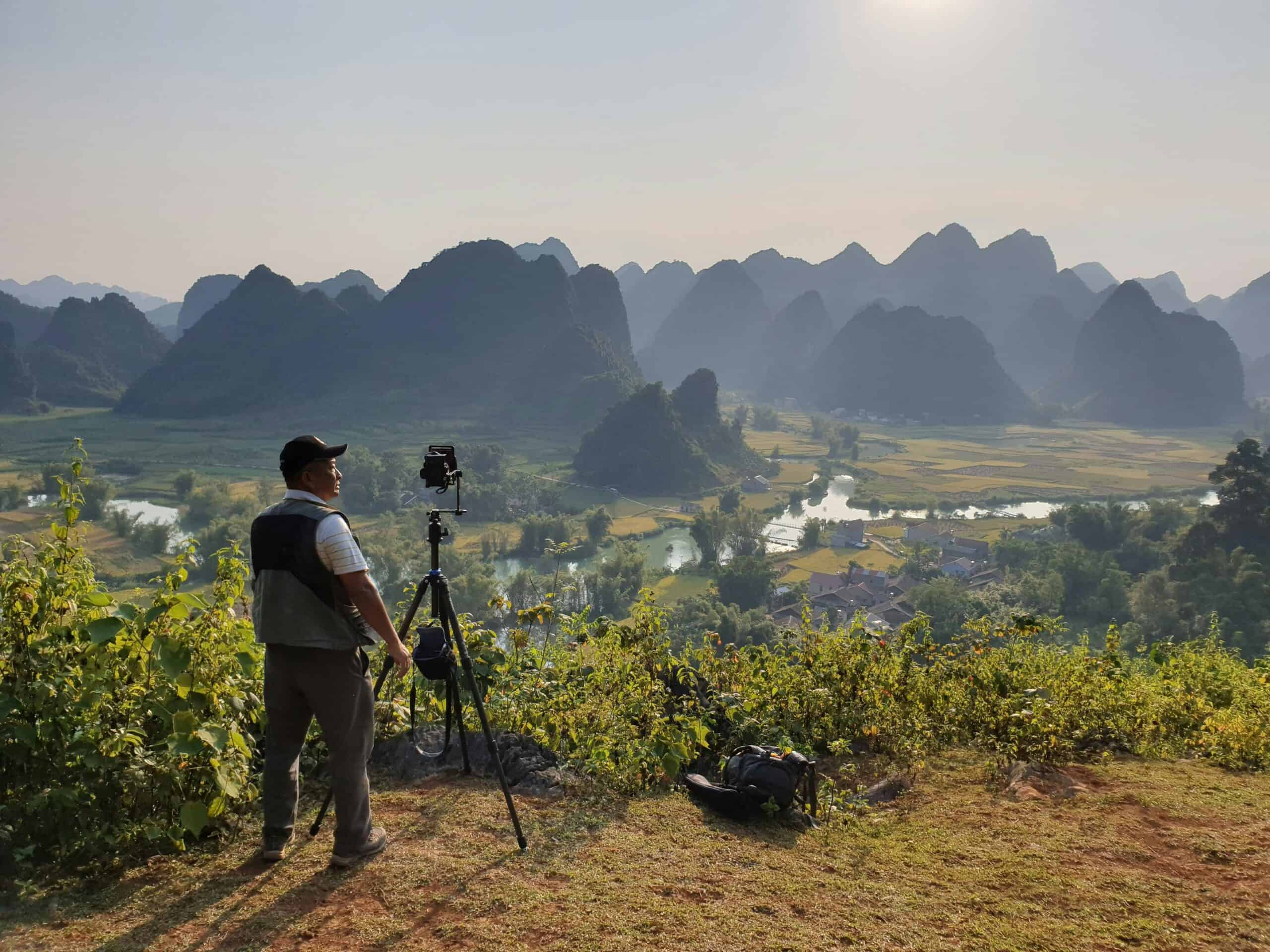
Quick Setup Overview
- Camera: Nikon Z9 — Full frame (36×24 mm), 45.7MP (8256×5504), ~4.35 µm pixel pitch, base ISO 64. In DX crop with this lens: ~19.5MP.
- Lens: Samyang 8mm f/3.5 UMC Fish-Eye CS II — diagonal fisheye for APS‑C; manual focus/aperture; best sharpness around f/5.6–f/8; moderate CA that’s easily corrected in post; removable petal hood.
- Estimated shots & overlap (tested, DX crop):
- Conservative 360°: 6 shots around at 60° yaw spacing (+ zenith + nadir) with ~30% overlap.
- Faster 360°: 5 around (+ zenith + nadir) if you’re careful with nodal alignment and have clean edges.
- Advanced (FX with hood removed, near-circular projection): 3–4 around (+ zenith + nadir), but plan for extra cleanup at edges.
- Difficulty: Intermediate (manual lens; nodal point alignment required).
Planning & On-Site Preparation
Evaluate Shooting Environment
Look for moving subjects (crowds, trees, traffic), reflective surfaces (glass, glossy floors), and light direction. For interiors, note mixed color temperatures and bright windows that may require HDR brackets. Outdoors at sunrise/sunset, expect extreme dynamic range—shoot fast to keep sky color consistent. If shooting through glass, press a rubber lens hood to the pane and keep the front element perpendicular to reduce flare and ghosting; stepping back 10–20 cm can also help.
Match Gear to Scene Goals
The Z9’s base ISO 64 and ~14+ stops of dynamic range deliver clean tonality in skies and interiors. It tolerates ISO 400–1600 well for night scenes, though for 360 work it’s usually better to keep ISO 64–400 on a tripod and extend shutter time. The Samyang 8mm’s fisheye coverage reduces shot count—ideal for speed (events, outdoor scouting) and minimizing parallax risk. In exchange, edges can show stretching, so keep important subjects away from the frame boundaries.
Pre-shoot Checklist
- Power & storage: Two CFexpress Type B cards for redundancy; extra batteries (cold weather drains faster).
- Optics: Clean front/rear elements; check for dust on the sensor—f/8 is revealing.
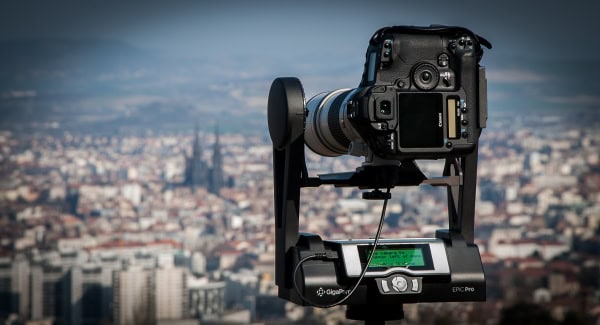
- Tripod & head: Leveling base; panoramic head calibrated to the lens’s no‑parallax point; quick release plates tight.
- Camera setup: DX crop enabled (unless you’re doing advanced hood‑removed FX); Non‑CPU lens data set to 8mm f/3.5; IBIS off for tripod; RAW capture; manual exposure; manual WB.
- Safety: Evaluate wind and foot traffic; tether pole/rig on rooftops; use sandbags where possible; avoid shooting under loose signage or near edges.
- Backup: If time allows, shoot a second full rotation; it’s the cheapest insurance against stitching gaps.
Essential Gear & Setup
Core Gear
- Panoramic head: Allows precise nodal/entrance pupil alignment to eliminate parallax. With a fisheye, a small two‑axis head (e.g., compact Nodal Ninja or Leofoto multi‑row) is sufficient.
- Stable tripod with leveling base: Guarantees a level yaw axis. A leveling bowl or base saves time and reduces stitch errors.
- Remote trigger or SnapBridge app: Avoids vibration. With the Z9’s electronic shutter, vibration is minimal, but it’s still smart to trigger hands‑off for long exposures.
Optional Add-ons
- Pole or car mount: Great for crowds/rooftops or moving shots; always use a safety tether, balance the system properly, and avoid high winds.
- Lighting aids: Small LED panels for dim interiors; keep them out of the frame or use them only for the nadir shot.
- Weather protection: Rain covers for sudden showers; lens hood to fight flare; microfiber cloth for sea spray.
Step-by-Step Shooting Guide
Standard Static Scenes
- Level and align: Use a leveling base and the Z9’s virtual horizon. Mount the Z9+Samyang on the pano head with the entrance pupil aligned over the rotation axis (see nodal calibration below).
- Set exposure and WB: Manual exposure across all frames; disable Auto ISO; set WB to Daylight (outdoors) or a fixed Kelvin value (interiors). Shoot RAW.
- Focus: Manual focus at or near the hyperfocal distance. With 8mm at f/8 on DX, hyperfocal is around 0.4–0.5 m—focus slightly past 0.5 m and check peaking.
- Capture sequence:
- DX crop, 6-around at 60° yaw increments, then zenith (tilt up) and nadir (tilt down, or shoot later after moving the tripod).
- Optionally, 5-around if you verified overlap in your stitcher.
- Nadir clean shot: After the main set, lift the camera off the tripod and shoot a handheld nadir plate, or use a nadir adapter to offset the tripod for a clear floor frame.
HDR / High Dynamic Range Interiors
- Bracket for windows: Capture ±2 EV (or more) across each yaw position. On the Z9, use exposure bracketing with 3–5 frames per position and keep WB fixed.
- Sequence method: Shoot all brackets at one yaw, then rotate; or continuous round‑robin if your head locks robustly. Keep the camera perfectly still during each bracket.
- De-ghost later: When stitching, choose HDR merge first (or use exposure fusion in PTGui), then stitch. Mask moving items like fans or people.
Low-Light / Night Scenes
- Use a tripod and remote. Favor ISO 64–400 where possible; extend shutter time to 1–10 seconds as needed. Long exposure noise on Z9 is well controlled at base ISO.
- Turn off IBIS on tripod to avoid micro‑movement. Use the Z9’s Exposure Delay/Self Timer if your setup is prone to vibrations.
- Consider multi-shot averaging for noise reduction (capture 2–3 frames per yaw and median blend before stitching).
Crowded Events
- Two passes: First pass for coverage; a second pass where you wait for gaps. Capture extra frames where people block overlaps.
- Masking in post: In PTGui or similar, use masks to prefer frames without people at the seams.
Special Setups (Pole / Car / Drone)
- Pole: Use a carbon pole, guy lines, and a safety tether. Keep shutter speeds higher (1/250+) and shoot more overlap (6–8 around) to mitigate wobble.
- Car mount: Avoid highways; shoot at low speed in open areas. Expect to mask moving foregrounds; shoot burst brackets to catch clean frames.
- Drone: The Z9 is too heavy; use drone-specific workflows instead. But you can suspend a small pole from rooftops for elevated viewpoints.
Recommended Settings & Pro Tips
Exposure & Focus
| Scenario | Aperture | Shutter | ISO | Notes |
|---|---|---|---|---|
| Daylight outdoor | f/8–f/11 | 1/100–1/250 | 64–200 | Lock WB to Daylight; shoot 6-around + Z + N for clean seams |
| Low light/night | f/4–f/5.6 | 1/10–1/60 (tripod) | 64–400 | Remote trigger; IBIS off on tripod; consider averaging |
| Interior HDR | f/8 | Bracket ±2 EV | 64–400 | Merge HDR first, then stitch; keep WB fixed |
| Action / moving subjects | f/5.6–f/8 | 1/200+ | 200–800 | Two passes and mask moving people later |
Critical Tips
- Manual focus: Use focus peaking + magnification; set around the hyperfocal (~0.4–0.5 m at f/8 in DX) and don’t touch the focus ring thereafter.
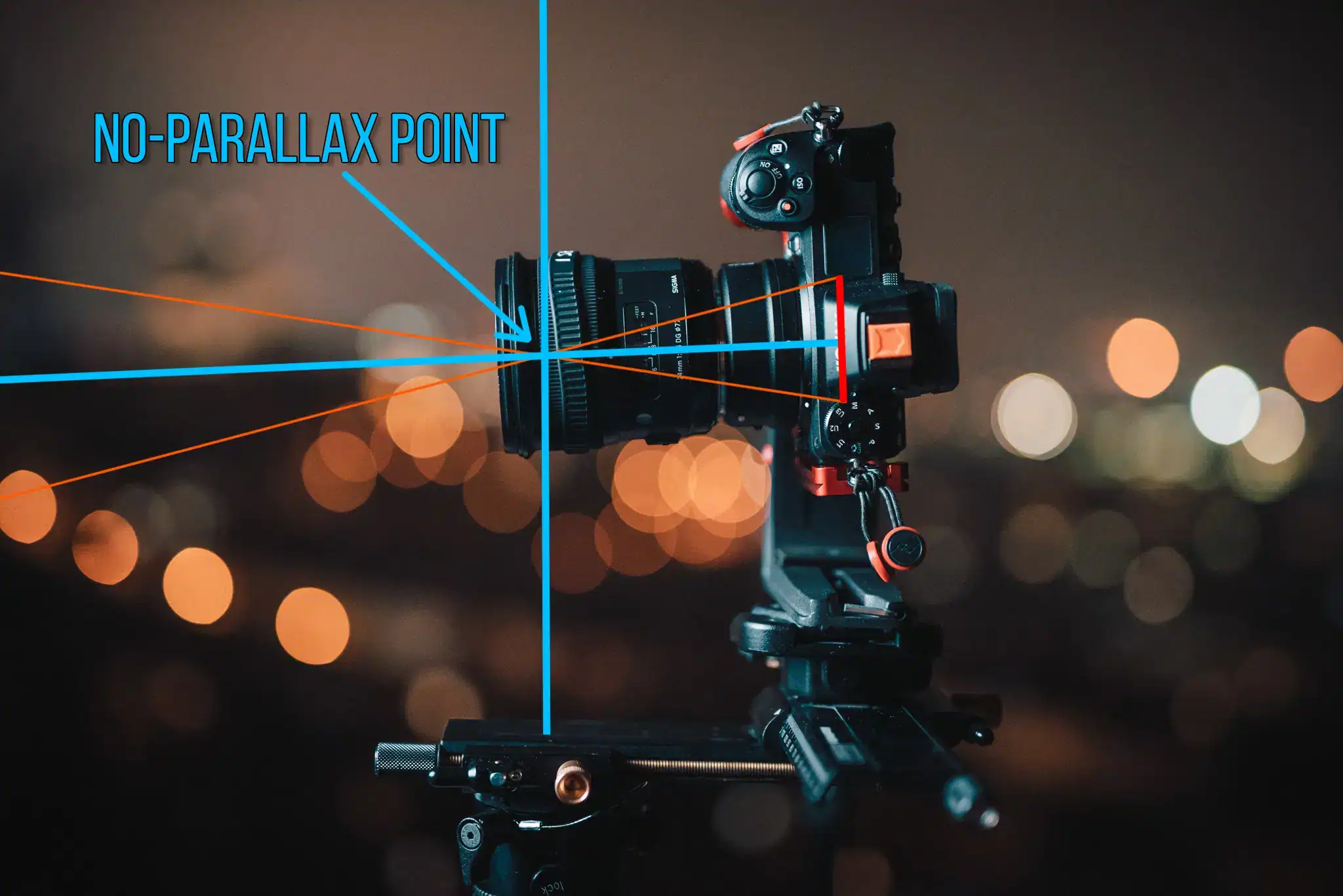
- Nodal calibration: Start with the camera plate so the front element rests roughly above the head’s rotation axis. Slide fore‑aft until foreground and background elements don’t shift relative to each other as you pan. Mark the rail position for future shoots.
- White balance lock: Fix WB to a known value to avoid color stitching issues, especially across HDR brackets.
- RAW over JPEG: Gives better highlight recovery (the Z9 excels at ISO 64) and cleaner color blending in panos.
- IBIS: Turn off on tripod. If you must shoot handheld, turn IBIS on and use faster shutter speeds; expect some stitching compromises.
- Z9 helpers: Assign a custom function to toggle DX crop; use the virtual horizon; consider a dedicated “Pano” Photo Shooting Bank with RAW, M mode, DX crop, WB preset, bracketing settings, and focus peaking enabled.
Stitching & Post-Processing
Software Workflow
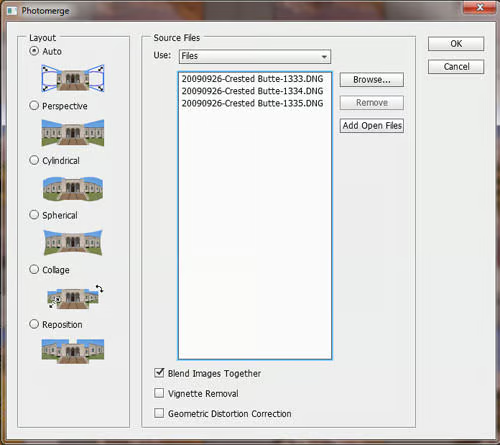
For this fisheye workflow, PTGui is fast and reliable: load images, set lens type to Fisheye, set crop factor to 1.5 (DX), and let the optimizer estimate field of view. Hugin and other tools can produce excellent results too, but PTGui’s masking, viewpoint correction, and exposure fusion are big time savers. As a rule of thumb, use ~25–30% overlap with fisheyes and ~20–25% with rectilinear lenses. For a Z9 in DX with 6-around + Z + N, equirectangular outputs around 10–16K pixels wide are typical depending on overlap and your optimization. For theory on spherical resolution versus lens and shot count, the PanoTools wiki is an excellent reference. See a pro review of PTGui. Dive deeper into spherical resolution math.
Cleanup & Enhancement
- Nadir patch: Use PTGui Viewpoint Correction, or export the pano and clone/heal the tripod in Photoshop. There are AI tools that can auto‑fill the nadir convincingly.
- Color & noise: Match white balance across brackets; reduce color noise in shadows; fine‑tune contrast to prevent haloing.
- Level the horizon: Most stitchers can set yaw/pitch/roll interactively to nail a level horizon and upright verticals.
- Export: For web/VR, 8K (8192×4096) JPEG is broadly supported; for archival or high‑end delivery, 12K–16K 16‑bit TIFF is common.
For end‑to‑end 360 photo workflow guidance tailored to DSLRs/mirrorless cameras, Oculus’ developer documentation is surprisingly practical and current. Read the DSLR/mirrorless 360 guide.
Prefer a walkthrough? This video complements the step‑by‑step process above.
Note: Software evolves—verify current versions, features, and best practices in the official docs of your chosen tools.
Useful Tools & Resources
Software
- PTGui panorama stitching
- Hugin (open source)
- Lightroom / Photoshop for RAW and cleanup
- AI tools for tripod/nadir removal
Hardware
- Panoramic heads (Nodal Ninja, Leofoto) with fore‑aft adjustment
- Carbon fiber tripods + leveling bases
- Wireless remote shutters or app control
- Pole extensions / car mounts with safety tethers
For a primer on panoramic heads and entrance pupil alignment, this tutorial is a solid starting point. Panoramic head tutorial
Common Mistakes & How to Avoid Them
- Parallax errors: Not aligning the entrance pupil. Calibrate once and mark the rail; re‑check after bumps.
- Exposure flicker: Shooting auto exposure or auto WB. Use manual exposure and a fixed WB for all frames.
- Tripod shadows and legs: Plan a dedicated nadir shot and patch it, or choose times with softer overhead light.
- Ghosting from movement: For people or leaves, shoot two passes and mask; consider faster shutter speeds.
- High ISO noise: Keep ISO low (64–400) on tripod; extend shutter time; stack/average if necessary.
- Lens flare with fisheye: Shade the lens; avoid pointing directly at strong light sources or bracket strategically and mask.
Real-World Setups & Field Advice
Indoor Real Estate (Bright Windows)
Use ISO 64–100, f/8, and a shutter for the mid exposure around 1/2–1/15 s depending on light. Set 5‑frame bracketing at 1 EV steps or 3 frames at 2 EV (manual adjustments between sets if needed). Shoot 6-around + Z + N, keep people out of frame edges, and avoid touching the focus ring. Merge HDR first, then stitch. For clean nadirs, remove the tripod and shoot a plate with identical exposure, then use viewpoint correction/masking.
Outdoor Sunset
Sunset changes fast; work efficiently. Manual exposure favors preserving highlight color: Slightly underexpose the sky (−0.7 EV from mid). Shoot 6-around quickly, then a zenith, then nadir. If clouds move rapidly, consider 5-around to reduce total time. Blend foreground frames for brightness if needed in post. The Z9’s highlight headroom at ISO 64 is excellent; keep ISO down and stabilize the rig.
Event Crowds
Raise camera height to reduce nearby moving subjects; a short pole on a sturdy stand helps. Use 1/250 s at ISO 400–800, f/5.6–f/8. Shoot two passes and use masks to remove people at seams. The fisheye’s broad coverage reduces the number of frames that can be compromised by motion.
Rooftop or Pole Shooting
Wind is the enemy. Attach a safety tether. Use a lighter head and keep the camera centered over the pole. Increase shot count (6–8 around) to hedge against motion blur. Test rotations at ground level first and verify overlap in PTGui before committing on the rooftop.
Frequently Asked Questions
- Can I shoot handheld panoramas with the Nikon Z9?
Yes, but expect compromises. Turn IBIS on, use 1/250 s or faster, lock manual exposure/WB, and shoot extra overlap (8–10 around). Handheld 360s are fine for quick social or scouting, but tripod + pano head is best for production‑quality results.
- Is the Samyang 8mm f/3.5 wide enough for single‑row 360 on the Z9?
In DX crop, absolutely. Use 6-around + Z + N for a robust stitch; careful shooters can manage 5-around. Advanced users who remove the lens hood and shoot in FX can attempt 3–4 around, but expect more edge cleanup and potential coverage gaps at the zenith/nadir.
- Do I need HDR for interiors with bright windows?
Usually, yes. Bracketing ±2 EV (3–5 frames) preserves both exterior views and interior shadows. Merge HDR first (or use exposure fusion), then stitch. The Z9’s low‑ISO DR helps, but HDR maintains natural contrast without noisy shadows.
- How do I avoid parallax issues with this combo?
Mount on a panoramic head and align the entrance pupil: slide the camera fore‑aft until near/far objects stay aligned as you pan. Mark your rail for the Z9 + FTZ + Samyang so you can repeat it. Use a leveling base so the pan axis stays vertical.
- What ISO range is safe on the Z9 for low light panoramas?
For tripod work, ISO 64–400 is the sweet spot. ISO 800–1600 is usable if you need faster shutter speeds (events/pole), but stitching multiple frames benefits from the cleanest possible noise floor.
- Can I create a custom “Pano” mode on the Z9?
Yes—use Photo Shooting Banks. Save RAW, DX crop, manual exposure, fixed WB, bracketing, focus peaking, and IBIS off (for tripod) so you can recall a ready‑to‑shoot pano setup instantly.
- How can I reduce flare when using a fisheye?
Avoid pointing directly at the sun or bright fixtures; shade with your hand or a flag just out of frame; clean the front element; and consider capturing an extra frame to mask in a cleaner sky area during post.
- What’s the best panoramic head for this setup?
A compact, two‑axis head with fine fore‑aft adjustment (e.g., Nodal Ninja, Leofoto, or similar) is perfect. You don’t need a heavy multi‑row gimbal for an 8mm fisheye, but a leveling base is strongly recommended. For fundamentals on setup and technique, see this practical guide. DSLR virtual tour camera/lens guide.
Safety, Limitations & Trustworthy Practices
The Z9 is rugged and weather‑sealed, but the Samyang 8mm is not fully sealed—avoid rain directly on the lens, and keep a microfiber handy. On rooftops or poles, always tether your rig and avoid winds that push the setup off balance. For car mounts, drive slow, avoid pedestrians, and obey local laws. Back up cards daily and maintain a simple file naming convention (e.g., location_date_set#_yaw#) so you can match frames if something goes wrong. The Z9’s dual CFexpress slots are ideal for redundant capture. When time permits, shoot a second full rotation as a safety copy.
Extra Technical Notes for Power Users
- Non‑CPU lens data: On the Z9, register 8mm f/3.5 so IBIS and EXIF are correct. IBIS should be off on tripod; on for handheld attempts.
- Entrance pupil location: Expect the no‑parallax point to be somewhere near the front half of the lens. Use a simple near/far alignment test to dial it in; avoid guessing exact millimeter values from the internet—tolerances and adapters vary.
- Resolution expectations: In DX crop at ~19.5MP, a 6-around spherical typically lands around 10–16K px equirect width (rough guide; depends on overlap and optimizer). If you need bigger deliverables, consider a multi‑row or a higher‑resolution fisheye/rectilinear workflow.
- Lens hood removal: Removing the Samyang’s hood for FX coverage is possible but advanced. Test for coverage gaps at zenith/nadir and plan masks/patches accordingly.