Why This Camera & Lens Are Great for Panoramas
If you want to learn how to shoot panorama with Nikon Z9 & Samyang 12mm f/2.8 ED AS NCS Fish-Eye, you’ve picked a powerhouse combo. The Nikon Z9’s 45.7MP full-frame stacked CMOS sensor (approx. 35.9 × 23.9 mm) combines outstanding detail with robust dynamic range—around 14 stops at base ISO 64—so your panoramas hold texture in bright skies and deep shadows. The stacked design and electronic shutter give you blackout-free shooting and zero mechanical shutter shock. Add 5-axis in-body stabilization (IBIS) for handheld or pole work, and you’ve got a flexible platform tailored to demanding 360° capture.
The Samyang 12mm f/2.8 ED AS NCS Fish-Eye is a full-frame diagonal fisheye with approximately 180° diagonal field of view. Compared with rectilinear ultrawide lenses, a fisheye dramatically reduces the number of shots required for a full spherical panorama—boosting speed, consistency, and stitch reliability—while keeping interiors spacious and outdoor scenes immersive. It’s a fully manual lens, which is actually an advantage for panorama work: once you set aperture and focus, nothing changes from frame to frame. On the Z9, you’ll typically mount the Nikon F version via the FTZ II adapter and register lens data so EXIF and IBIS work correctly.
Distortion from a fisheye is expected and handled in stitching software. In practice, the Samyang’s center sharpness is strong at f/5.6–f/8, and lateral CA is easily corrected in post. With careful nodal alignment, this setup is fast for real estate, landscapes, cityscapes, and even event coverage when crowds are moving.
Quick Setup Overview
- Camera: Nikon Z9 — full-frame 45.7MP stacked CMOS, base ISO 64, excellent DR and noise control, 5-axis IBIS, electronic-only shutter, pixel pitch ~4.35 µm.
- Lens: Samyang 12mm f/2.8 ED AS NCS Fish-Eye — diagonal fisheye (≈180° diagonal FOV), manual focus, manual aperture, good center sharpness at f/5.6–f/8, manageable lateral CA.
- Estimated shots & overlap (full spherical 360×180):
- Standard: 6 shots around at 60° yaw increments (30–35% overlap) + 1 zenith + 1 nadir.
- High-precision interiors: 8 around for extra overlap + zenith + nadir for cleaner seams.
- Handheld safety pass: add an extra round for backup.
- Difficulty: Intermediate. Fast once nodal point is calibrated; very forgiving exposure latitude thanks to the Z9.
Planning & On-Site Preparation
Evaluate Shooting Environment
Assess light level, direction, and contrast. For glass-heavy spaces (offices, lobbies, condos), watch for reflections; increase distance to glass and shade the lens with your hand or body to reduce flare and ghosting. Outdoors, note sun angle and wind—fisheye front elements are bulbous and flare-prone; wind affects pole/tripod stability. On rooftops or bridges, identify safe positions and anchor points for tethers. Indoors, look for overhead fixtures and narrow corridors where a fisheye may introduce stretch—plan more overlap for cleaner stitching.
Match Gear to Scene Goals
The Z9’s low ISO performance and wide DR make it superb for sunset skylines and high-contrast architecture. Base ISO 64 delivers maximum dynamic range, but ISO 100–400 remains very clean; ISO 800–1600 is usable in low light when you need to shorten exposures. The fisheye’s advantage is speed: fewer frames to shoot and stitch—useful for real estate schedules, event turnover, and windy poles. Trade-off: edges will stretch; keep important lines near the center of each frame and give yourself enough overlap to let the stitcher optimize geometry.
Pre-shoot Checklist
- Power & storage: Fully charge batteries, carry a spare; use fast, reliable CFexpress cards; enable dual-card backup if your workflow prefers redundancy.
- Optics clean: Wipe the front element carefully; fisheye domes show dust and smudges easily.
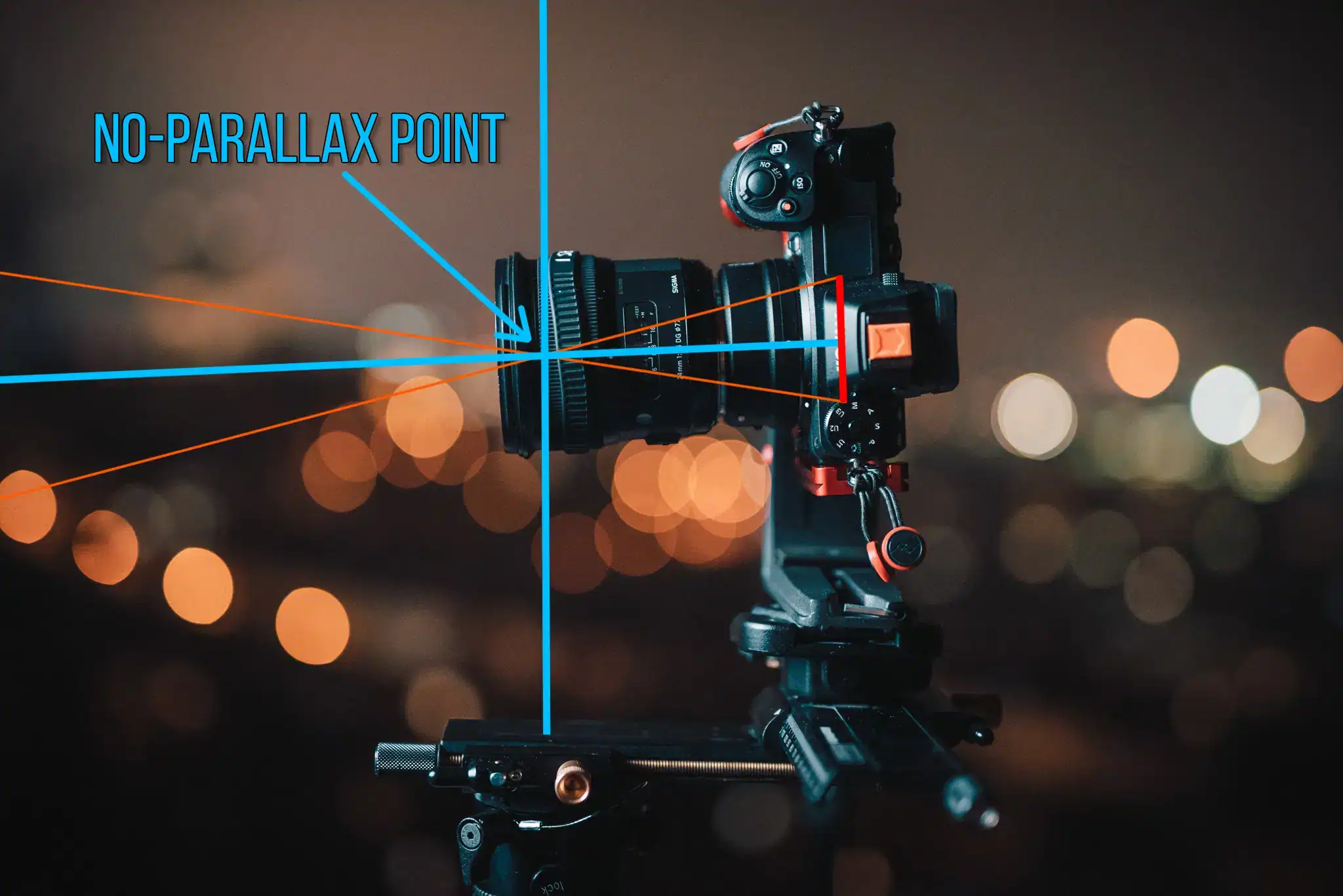
- Tripod & head: Level the tripod. Verify your panoramic head’s nodal (no-parallax) setup for this lens.
- Camera prep:
- On Z9, register Non-CPU Lens Data: 12mm, f/2.8. Assign IBIS focal length = 12 mm.
- Disable Auto ISO and set white balance to a fixed preset or Kelvin.
- For tripod shots, turn IBIS off for consistency; leave it on only for handheld/pole work.
- Safety: In high wind or on rooftops, tether the camera and head to the tripod/mast. For car mounts, follow local laws and use secondary safety lines.
- Backup workflow: Shoot a second pass if time allows—small investment for huge insurance.
Essential Gear & Setup
Core Gear
- Panoramic head: A proper pano head lets you rotate around the lens’s no-parallax point (NPP), preventing foreground/background misalignment. This is critical with ultra-wide fisheyes in tight interiors.
- Stable tripod with leveling base: Level the base; then the pano head remains level as you rotate.
- Remote trigger or SnapBridge app: Trigger shots without touching the camera. Z9’s electronic shutter eliminates shutter shock, but a hands-off release still reduces micro-movements.
Optional Add-ons
- Pole or car mount: Great for elevated or vehicle-based 360s. Use a safety tether. Beware of wind loads—slow your rotation and increase shutter speeds.
- Lighting aids: Small LED panels or bounced flash can tame dark corners in interiors (shoot bracketing to blend ambient and artificial light).
- Weather protection: Rain covers, microfibers, and lens hoods (even partial shading helps reduce flare on the Samyang’s bulbous front element).
Want a deeper primer on panoramic heads and alignment? See this practical panoramic head tutorial. Panoramic head basics and setup (360 Rumors)
Step-by-Step Shooting Guide
Standard Static Scenes
- Level and align:
- Level the tripod using the leveling base. Confirm with the Z9’s virtual horizon.
- Align the pano head to the lens’s NPP. For the Samyang 12mm f/2.8 on Nikon Z9 (via FTZ), a good starting NPP offset is around 60–65 mm from the sensor plane; fine-tune with a foreground object test. Mark your rail for repeatability.
- Set manual exposure:
- Exposure mode M; meter the brightest part you want detail in (e.g., sky), then raise exposure until shadows are acceptable or plan to bracket.
- White balance fixed (Daylight, Tungsten, or Kelvin). Avoid Auto WB to prevent color shifts across frames.
- Use RAW (NEF) 14-bit for maximum latitude.
- Focus:
- Manual focus. At f/8, the hyperfocal for 12mm on full frame is roughly 0.6 m; set focus slightly short of infinity (≈0.6–1 m) to keep near-to-far focus sharp.
- Enable focus peaking and magnify to check a mid-distance subject.
- Capture sequence:
- 6 shots around at 60° yaw increments with 30–35% overlap. Shoot clockwise or counterclockwise consistently.
- 1 zenith shot (tilt up). You can often capture it without re-leveling thanks to the fisheye coverage.
- 1 nadir shot (tilt down). Consider offsetting the camera slightly and shooting an extra nadir for a cleaner patch in post.
HDR / High Dynamic Range Interiors
- Bracket ±2 EV (3–5 frames) at each yaw position to balance bright windows with interior shadows. Use the Z9’s bracketing mode.
- Lock WB and exposure settings per bracket series. Avoid any Auto exposure/WB that varies across the panorama.
- Consider f/8, ISO 100–200, and longer shutter speeds to keep noise minimal; use a remote trigger.
Low-Light / Night Scenes
- Open aperture to f/4–f/5.6. Start with ISO 200–800; ISO 1600 is still usable on the Z9, but aim to keep it lower for cleaner skies.
- Longer exposures are fine on a tripod. Use the Z9’s 2–3 s self-timer or remote. Electronic shutter has no vibration.
- Turn off IBIS on a locked-down tripod for consistent framing between shots. If on a pole or in wind, leave IBIS on.
Crowded Events
- Shoot two passes:
- Pass 1: general coverage.
- Pass 2: wait for gaps to reduce ghosting. More overlap (8 around) gives you more masking options in post.
- Keep the lens hood area oriented away from strong backlight to minimize flare from stage lights.
Special Setups (Pole / Car / Rooftop)
- Pole: Use a carbon-fiber pole and a lightweight rotator. Tighten all clamps, tether the camera, and keep exposures short (1/200 s+ if possible). Expect some parallax if the pole flexes—use more overlap.
- Car mount: Only in safe, legal scenarios. Secure a secondary tether and avoid highways. Use faster shutter speeds and consider shooting at stops to minimize motion blur.
- Rooftop/windy: Add weight to the tripod, lower leg extensions, and reduce sail area. Shoot extra frames for safety.
Recommended Settings & Pro Tips
Exposure & Focus
| Scenario | Aperture | Shutter | ISO | Notes |
|---|---|---|---|---|
| Daylight outdoor | f/8–f/11 | 1/100–1/250 | 64–200 | Lock WB (Daylight/K), maximize DR at ISO 64–100 |
| Low light/night | f/4–f/5.6 | 1/30–1/60 (tripod) | 200–800 (1600 if needed) | Remote trigger; IBIS off on tripod |
| Interior HDR | f/8 | Bracket ±2 EV | 64–400 | 3–5 bracketed frames to balance windows/lamps |
| Action / moving subjects | f/5.6–f/8 | 1/200+ | 400–800 | Short shutter to freeze movement; do a second pass |
Critical Tips
- Manual focus at hyperfocal: At 12mm and f/8, set focus ~0.6–1 m. Everything from ~0.3 m to infinity stays sharp.
- Nodal calibration: With the camera on a pano head, line up a near pole and a far background edge in the frame. Rotate the camera; adjust the rail until near/far alignment doesn’t shift. Mark the rail for your FTZ + lens combo.
- White balance lock: Use a Kelvin setting (e.g., 5200K daylight) or a fixed preset to avoid frame-to-frame shifts that hamper stitching and color grading.
- RAW workflow: Shoot 14-bit NEF. The Z9’s DR at base ISO makes it easy to recover highlights/shadows; fisheye edges often need CA correction and sharpening—RAW gives headroom.
- IBIS usage: Off on solid tripods; On for handheld or pole. If IBIS introduces micro-shifts between frames, turn it off.
- Lens data on Z9: Register 12mm in Non-CPU lens data. This improves IBIS behavior and records correct EXIF.
Stitching & Post-Processing
Software Workflow
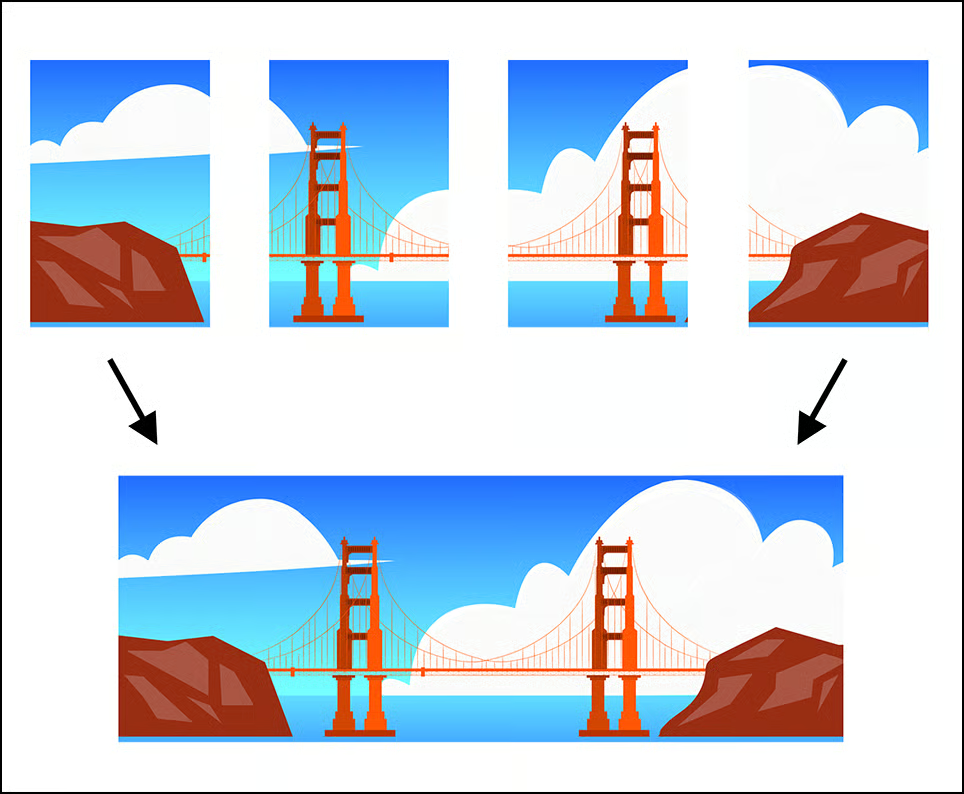
Fisheye panoramas stitch quickly in pro tools like PTGui, Hugin, or Photoshop/Lightroom. With a diagonal fisheye, you typically need 25–35% overlap around and a dedicated zenith/nadir. PTGui’s lens model recognizes fisheyes and makes optimization straightforward; Hugin is a capable free alternative once you learn the interface. Lightroom/Photoshop can stitch simpler sequences but offer less control over fisheye geometry and masking. For VR output, export equirectangular JPEG/TIFF at the Z9’s full resolution for crisp viewers.
For a deep-dive on PTGui’s capabilities, see this overview and review. Why PTGui excels for complex panoramas (Fstoppers)
If you’re building 360s for VR platforms, read the capture-to-stitch guidance tailored for mirrorless/DSLR workflows. Using a mirrorless camera to shoot and stitch a 360 photo (Meta/Oculus)
Cleanup & Enhancement
- Nadir patch: Use PTGui’s Viewpoint correction or export to Photoshop for clone/heal. Many editors now have AI-powered object removal which works well for tripod shadows.
- Color & tone: Fix fisheye edge fringing, apply lens profiles if available, and match white balance across brackets. Adjust contrast to taste but avoid clipping highlights in bright skies.
- Noise reduction: Apply luminance NR gently—Z9 files handle NR well; don’t smear fine textures.
- Leveling: Use automatic horizon tools in PTGui/Hugin or manually adjust pitch/roll/yaw. Verify level in equirectangular preview.
- Export: For virtual-tour platforms, export equirectangular at 2:1 aspect ratio (e.g., 15000×7500 px TIFF/JPEG). Keep a 16-bit master TIFF for archival.
Helpful walkthrough: panorama capture and stitching concepts explained in video.
For background on spherical resolution and coverage trade-offs with fisheyes and focal lengths, this technical note is useful. DSLR spherical resolution (PanoTools Wiki)
Disclaimer: software evolves; check each tool’s latest docs for current features and best practices.
Useful Tools & Resources
Software
- PTGui (Pro-grade stitching with fisheye support)
- Hugin (open-source alternative)
- Lightroom / Photoshop (basic stitch + finishing)
- AI retouch tools for tripod/nadir removal
Hardware
- Panoramic heads (Nodal Ninja, Leofoto, Sunwayfoto)
- Carbon fiber tripods with leveling bases
- Wireless remote shutter release
- Pole extensions and car mounts with safety tethers
Disclaimer: brand names are examples—verify compatibility for Nikon Z9 and your adapter setup.
Common Mistakes & How to Avoid Them
- Parallax error: Always rotate around the lens’s no-parallax point. Calibrate once, mark the rail, and recheck if you change adapters or plates.
- Exposure flicker: Use full manual exposure and fixed white balance. Disable Auto ISO.
- Tripod in frame: Capture a dedicated nadir (and optionally a second offset nadir) for clean patching later.
- Ghosting in crowds: Shoot two passes and mask moving subjects during stitching.
- Flare and veiling glare: Shade the fisheye with your hand or body, avoid pointing directly at the sun when possible, and clean the front element frequently.
- IBIS conflicts: Turn IBIS off on a solid tripod to prevent micro-shift between frames.
Field-Proven Scenarios
Indoor Real Estate (Bright Windows)
Mount the Z9 on a leveled pano head; set f/8, ISO 64–200. Bracket ±2 EV (3–5 frames) at 6 positions around + zenith + nadir. Keep the camera about 1 m from walls and avoid placing door frames at extreme edges. In PTGui, enable exposure fusion or HDR merge. Result: balanced windows and clean corners without stretching key lines.
Outdoor Sunset Skyline
At blue hour, shoot f/8, ISO 64–100, 1/4–1/2 s on a stable tripod. Lock WB around 5200–5600K or set a specific Kelvin for consistency. Take 6 around + zenith + nadir; consider a second rotation 10 minutes later as the sky deepens to pick the best moment in post. The Z9’s base ISO DR holds highlight color while revealing shadow detail across the city.
Event Crowds
Use f/5.6–f/8, ISO 400–800, 1/200 s if possible. Shoot 8 around for safety. Do a second pass where you wait for gaps. In post, use masks to select the least busy version of each area. The fisheye lets you complete a full pano quickly between stage moments.
Rooftop Pole Shot
With a carbon pole, keep the rig light. Use f/5.6, ISO 400–800, 1/250–1/500 s depending on wind. Rotate slower and add overlap. Expect to patch the nadir where the pole enters the frame—plan a clean texture shot of the rooftop surface for an easy clone in Photoshop.
Frequently Asked Questions
-
Can I shoot handheld panoramas with the Nikon Z9?
Yes, for quick coverage. Turn IBIS on, use 1/200 s or faster, and increase overlap (8–10 shots around). Keep the camera rotating around your body’s approximate center to reduce parallax. Tripod + pano head is still best for perfect stitches and clean nadirs.
-
Is the Samyang 12mm f/2.8 wide enough for a single-row 360?
Yes. On full frame, a diagonal fisheye at 12mm typically needs 6 shots around + zenith + nadir. For complex interiors, shoot 8 around for more seam placement options and easier masking.
-
Do I need HDR bracketing for interiors with bright windows?
Often, yes. The Z9 has strong DR, but bright windows still clip. Bracket ±2 EV (3–5 frames) at each yaw position to retain view detail outside and clean interior shadows. Merge in PTGui or Lightroom, then stitch.
-
How do I avoid parallax issues with this lens?
Use a panoramic head and calibrate the no-parallax point. With the 12mm fisheye on Z9 (FTZ), start around a 60–65 mm rail offset from the sensor plane and fine-tune with a near/far alignment test. Once dialed in, mark the position for future shoots.
-
What ISO range is safe on the Z9 in low light?
ISO 64–200 is pristine. ISO 400–800 remains very clean for most scenes. ISO 1600 is usable with careful noise reduction. When on a tripod, favor lower ISO and longer shutter speeds for best image quality.
Safety, Data Integrity & Trustworthy Workflow
Protect your gear and files. Use a tether on rooftops and poles, and never leave a rig unattended in wind. On the Z9, set dual-card backup (RAW to both) or periodically offload to a laptop/SSD. Keep a spare battery—long HDR sessions drain power. After each location, review a full 360° pass on the back screen to ensure you have coverage and consistent exposure. A reliable, repeatable process is your best insurance policy.
If you’re new to virtual tours and 360 capture, this overview of camera/lens choices and workflow provides helpful context. DSLR/Mirrorless virtual tour guide (360 Rumors)
Sample Output & What to Expect
You’ll see a characteristic fisheye rendering in individual frames, but the stitched panorama will be equirectangular and rectified. Expect minimal seams when overlap is consistent and the nodal point is correct. HDR merges preserve window detail and interior color; night scenes remain surprisingly clean from the Z9 at moderate ISOs.