
Why This Camera & Lens Are Great for Panoramas
If you’re wondering how to shoot panorama with Nikon Z9 & Pentax DA 10-17mm f/3.5-4.5 ED Fisheye, you’re pairing a flagship full‑frame mirrorless body with a compact, ultra‑wide fisheye zoom. The Nikon Z9’s 45.7MP stacked full‑frame sensor (35.9 × 23.9 mm) delivers class‑leading detail, excellent rolling‑shutter control via its all‑electronic shutter, and robust 5‑axis IBIS. It has a base ISO of 64 and a practical dynamic range around 14 stops at ISO 64, which is fantastic for high‑contrast scenes like sunsets or interiors with bright windows. Pixel pitch is roughly 4.35 µm, giving a strong balance of resolution and noise performance for 360 photo stitching.
The Pentax DA 10–17mm is a K‑mount APS‑C fisheye lens. On a full‑frame body like the Z9, you’ll want to enable DX crop mode (about 19.4MP on the Z9) to avoid heavy vignetting. In DX, at 10mm you get a diagonal fisheye with ~180° diagonal FOV—ideal for reducing shot count while still achieving solid stitch robustness. Expect pronounced native fisheye distortion—this is good for spherical panorama capture, but you’ll want to calibrate the lens profile in your stitching software. Note: this lens has no built‑in aperture ring and no native Nikon Z electronics, so use a K‑to‑Z adapter that provides mechanical aperture control; autofocus is not available, so focus manually.
Overall advantages of this combo: the Z9’s resolution and DR give you clean, flexible RAW files, while the 10–17mm fisheye minimizes the number of frames needed for a full sphere. Just remember the compatibility notes (DX crop, manual focus/aperture via adapter), and you’ll have a very capable 360‑panorama rig.
Quick Setup Overview
- Camera: Nikon Z9 — Full Frame 45.7MP stacked CMOS; base ISO 64; 5‑axis IBIS; electronic shutter only.
- Lens: Pentax DA 10–17mm f/3.5–4.5 ED Fisheye — diagonal fisheye zoom (APS‑C); best sharpness around f/8; some CA at edges that cleans up well in RAW.
- Estimated shots & overlap (DX crop mode strongly recommended):
- At 10mm DX: 6 shots around (60° steps) + 1 zenith + 1 nadir (25–30% overlap).
- At 12–14mm DX: 8 around + zenith + nadir (25–30% overlap).
- At 17mm DX: 10–12 around + zenith + nadir (30% overlap).
- Difficulty: Intermediate (manual aperture/focus via adapter + nodal alignment required).
Planning & On-Site Preparation
Evaluate Shooting Environment
Scan for reflective surfaces (glass, polished floors), moving elements (people, trees, traffic), and high‑contrast light (windows, sun). If you must shoot through glass, place the lens as close as possible to reduce reflections and ghosting, and shade the lens with your hand or a rubber hood. For outdoor work, check wind and tripod stability; even with IBIS, vibration will soften your brackets. At night, identify bright point light sources; a fisheye will catch them all, so plan your rotation to minimize flare angles.
Match Gear to Scene Goals
Why the Z9 and the DA 10–17mm work: the Z9’s dynamic range and low‑noise base ISO make it excellent for HDR panoramas. ISO 64–200 is the sweet spot; ISO 400–800 remains clean for interiors or dusk. The fisheye reduces frame count and speeds capture, important for crowds or changing light. The tradeoff is fisheye distortion (handled well by PTGui/Hugin) and the need for an adapter with manual aperture control.
Pre-shoot Checklist
- Power & storage: fully charged batteries; dual cards with backup strategy.
- Optics clean: front element and sensor; fisheye sees everything—dust and smears will show.
- Tripod/pano head: level the base and verify nodal (no‑parallax) calibration for this lens at your chosen focal length.
- Safety: tether gear on rooftops/poles; monitor wind; use sandbags if needed.
- Backup capture: after your first full sphere, do a quick safety pass in case of stitching issues.
Essential Gear & Setup
Core Gear
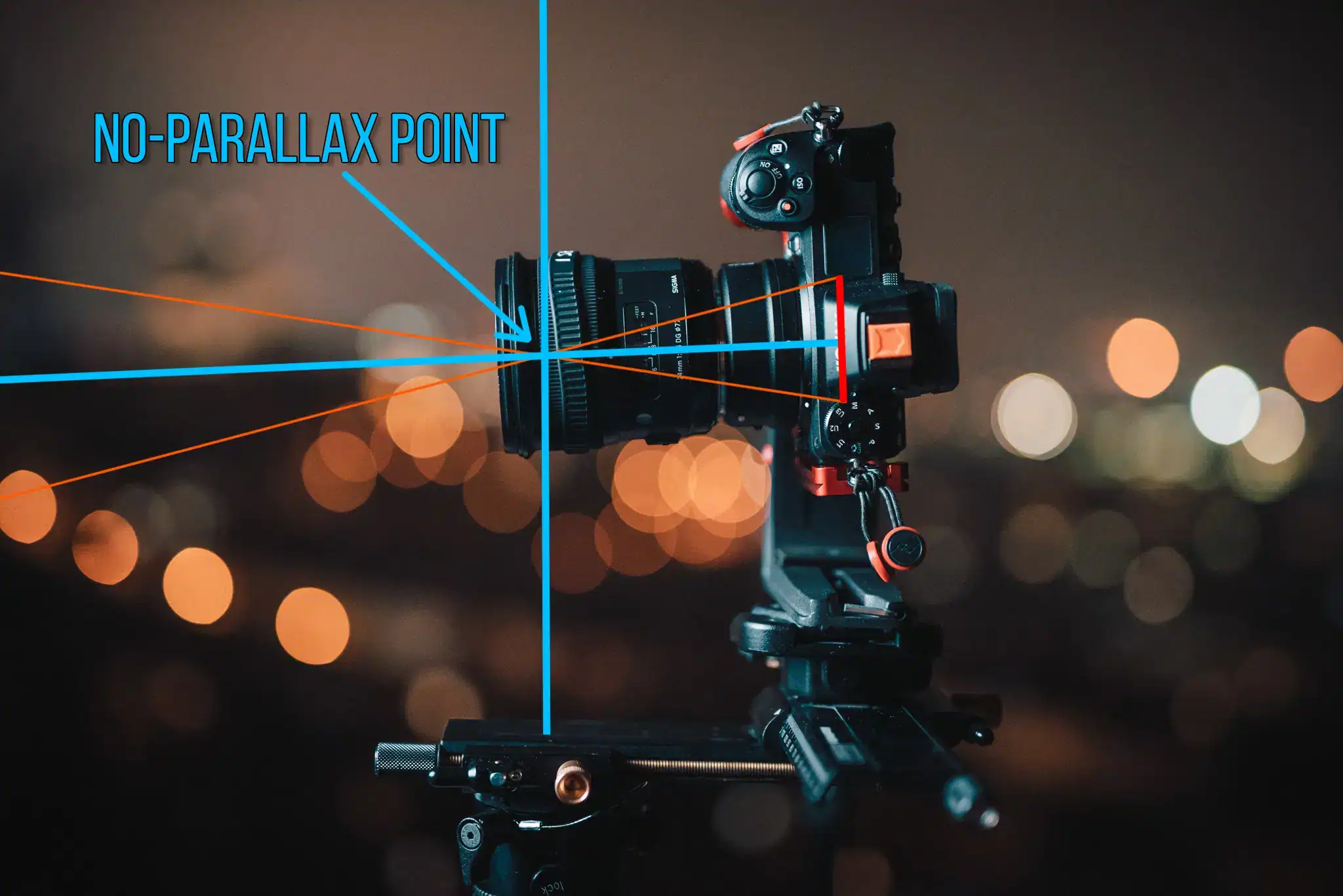
- Panoramic head: lets you rotate around the lens’ entrance pupil (nodal point) to eliminate parallax between near/far objects. Use a rail to shift the camera front/back until foreground and background elements stay aligned during yaw.
- Stable tripod with leveling base: speeds setup and keeps yaw rotation flat, reducing pitch/roll corrections later.
- Remote trigger or SnapBridge app: prevents vibrations during long exposures and HDR brackets.
Optional Add-ons
- Pole or car mount: capture elevated or moving views; always tether the rig and watch wind loads; the Z9 is heavy for poles—use carbon fiber and keep rotation gentle.
- Lighting aids: small LEDs for dark corners in interiors; avoid mixed color temperatures or gel to match ambient.
- Weather protection: rain covers; lens towel; keep the front element dry—fisheye flare gets worse with droplets.
Compatibility note: you’ll need a K‑to‑Z adapter with a mechanical aperture lever to control the DA 10–17mm’s diaphragm on the Z9. Focus is manual only; practice pulling focus to hyperfocal for speed and consistency.
Deep dive on panoramic heads and no‑parallax setup is covered well in this panoramic head tutorial. Practical panoramic head guide
Step-by-Step Shooting Guide
Standard Static Scenes
- Enable DX crop on the Z9 and set your focal length. For minimal frames, choose 10mm.
- Level the tripod and pano head. Use a leveling base or the Z9’s virtual horizon. A level yaw axis vastly improves stitching.
- Calibrate nodal point for your focal length. Place two vertical objects (one near, one far) and rotate; adjust the rail until their relative position doesn’t shift as you pan.
- Set manual exposure and lock white balance. For outdoor daylight, start around ISO 64–100, f/8–f/11, 1/100–1/250, WB Daylight.
- Focus: switch to manual; set at or just beyond the hyperfocal distance. At 10mm DX and f/8, hyperfocal is roughly 0.6–0.7 m; everything from ~0.35 m to infinity will be sharp.
- Shoot the round: at 10mm DX capture 6 shots around at 60° increments with 25–30% overlap. Aim for consistent framing and speed.
- Zenith and nadir: tilt up for 1–2 frames to cover the zenith; tilt down for a nadir shot to patch the tripod later.
HDR / High Dynamic Range Interiors
- Bracket ±2 EV (3 or 5 frames). Use the Z9’s bracketing with 2 EV steps, continuous low burst, and a remote trigger.
- Keep WB locked (e.g., 4000–5000K for mixed interiors) to avoid color shifts across brackets. Shoot RAW to balance mixed lighting in post.
- Maintain the same overlap and rotation steps; avoid touching the rig between brackets.
Low-Light / Night Scenes
- Open to f/4–f/5.6 if needed; keep ISO at 100–400 for clean skies; 800 is still usable on Z9 with good noise reduction.
- Use multi‑second exposures if required; turn IBIS OFF on tripod to avoid micro‑wobble. Use a 2s timer or remote.
- Watch for moving lights (cars/ships) that may streak; consider two passes to mask or embrace light trails creatively.
Crowded Events
- Do two passes: first fast for coverage; second slower, pausing for people to clear key seams.
- Keep the camera in the same position; later, use masks in PTGui/Hugin to choose clean areas and remove ghosting.
Special Setups (Pole / Car / Drone)
- Pole: tether the Z9; keep the footprint minimal; shoot 6 around + nadir if possible. Rotate slower, pause for damped oscillation.
- Car: rigid roof mount; avoid high speeds; time shots at stops; consider higher shutter speeds (1/250+) to freeze near objects.
- Drone: the Z9 is too heavy; use dedicated drones—then match your stitch workflow later.
Recommended Settings & Pro Tips
Exposure & Focus
| Scenario | Aperture | Shutter | ISO | Notes |
|---|---|---|---|---|
| Daylight outdoor | f/8–f/11 | 1/100–1/250 | 64–200 | Lock WB to Daylight; best sharpness and DR |
| Low light/night | f/4–f/5.6 | 1/30–multiple sec | 100–800 | Tripod + remote; IBIS off on tripod |
| Interior HDR | f/8 | Bracket ±2 EV | 100–400 | Windows and lamps balanced via HDR |
| Action / moving subjects | f/5.6–f/8 | 1/200+ | 400–800 | Freeze motion; do two passes for masking |
Critical Tips
- Manual focus at hyperfocal: with the 10mm DX and f/8, set around 0.6–0.7 m for front‑to‑back sharpness.
- Nodal calibration: mark your rail positions for 10mm, 12mm, 14mm. Keep a small card in your bag with these marks.
- White balance lock: avoid auto WB; use a fixed Kelvin or preset to prevent color shifts between frames.
- RAW over JPEG: you’ll need latitude for HDR merging and chromatic aberration correction; shoot 14‑bit lossless compressed.
- IBIS usage: on tripod, turn IBIS off; handheld or pole (with motion), IBIS can help at shorter shutter speeds.
- Adapter awareness: control aperture via the adapter’s lever; test that stopped‑down aperture is consistent across shots.
Stitching & Post-Processing
Software Workflow
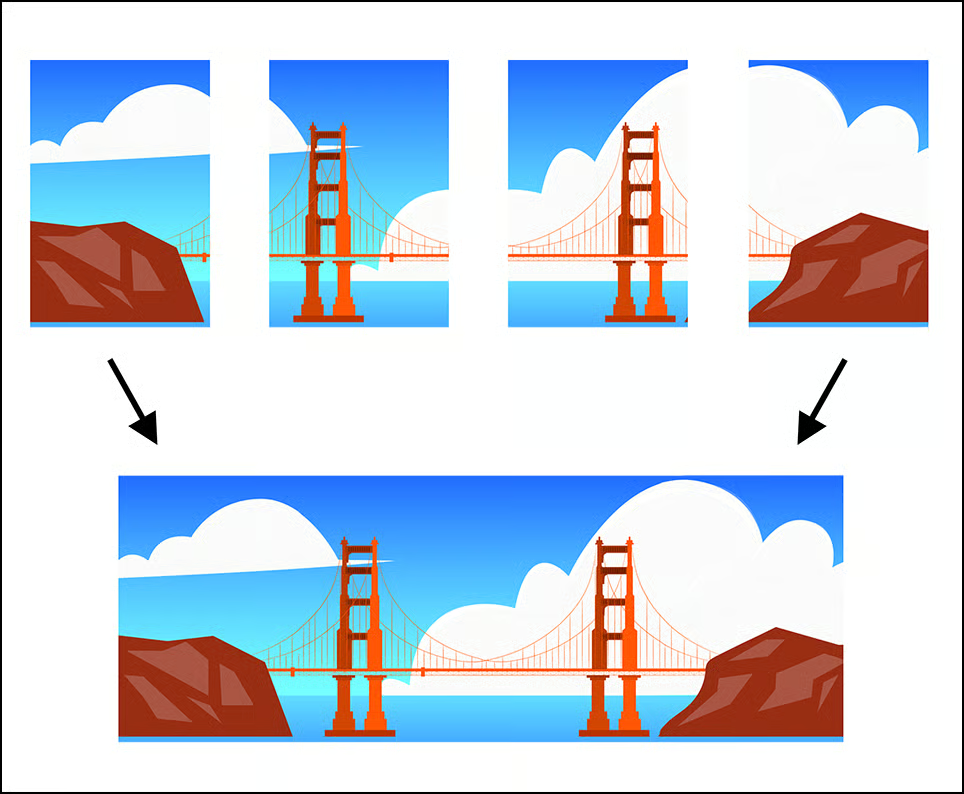
Import RAWs into your editor (Lightroom, Capture One) to apply lens corrections (especially CA), consistent WB, and modest noise reduction. Export 16‑bit TIFFs to your stitcher. PTGui and Hugin both handle fisheye projections well; fisheye shots typically need fewer frames but require accurate lens parameter estimation. Keep around 25–30% overlap for fisheye rows; rectilinear lenses typically use 20–25% overlap but many more frames. For Z9 + DA 10–17mm at 10mm DX, a robust baseline is 6 around + zenith + nadir.
PTGui offers reliable control points, HDR merge, and masking to remove moving subjects. Hugin is a strong open‑source alternative if you’re comfortable with its interface. For experimental AI‑assisted stitches or quick drafts, Lightroom/Photoshop can work, but dedicated tools usually yield cleaner equirectangulars and horizon control.
Why PTGui is favored in production is summarized well in this review. PTGui review for professional panoramas
Cleanup & Enhancement
- Nadir patch: capture an extra handheld nadir plate or use AI tools or clone stamp to remove the tripod.
- Color/unify: match tones between brackets, correct mixed lighting with local WB or HSL tools.
- Noise reduction: apply luminance NR to night skies; don’t over‑smear textures.
- Geometric refinements: level the horizon; correct roll/pitch/yaw in the stitcher; straighten verticals if delivering rectilinear crops.
- Export: for VR/equirectangular, export 16k–24k when source resolution allows; JPEG for web, TIFF/EXR for archival. Follow platform guidelines.
For an end‑to‑end DSLR/mirrorless 360 pipeline suitable for platforms like Quest/Meta, see this practical guide. DSLR/Mirrorless 360 photo workflow
Disclaimer: Always check your software’s latest documentation for updated features and best practices.
Useful Tools & Resources
Software
- PTGui panorama stitching
- Hugin open source
- Lightroom / Photoshop
- AI tripod removal tools
Hardware
- Panoramic heads (Nodal Ninja, Leofoto)
- Carbon fiber tripods
- Leveling bases
- Wireless remote shutters
- Pole extensions / car mounts
Disclaimer: software/hardware names provided for search reference; check official sites for details.
If you’re new to setting up a panoramic head, this step‑by‑step resource is a great refresher once you have your gear in hand. How to set up a panoramic head
Common Mistakes & How to Avoid Them
- Parallax error → ensure nodal alignment. Recalibrate if you change focal length on the 10–17mm.
- Exposure flicker → use manual exposure and lock WB; avoid auto ISO or auto WB mid‑series.
- Tripod shadows / missing nadir → shoot a dedicated nadir and patch later; avoid shooting at noon outdoors.
- Ghosting from motion → shoot a second pass and use masks to select clean frames in the stitcher.
- Night noise → keep ISO ≤800 on the Z9 when possible; use longer exposures and remote triggering.
- Adapter pitfalls → verify aperture lever position is repeatable; test at f/8 and confirm EXIF notes manually since the body won’t read the lens.
Field‑Tested Scenarios
Indoor Real Estate (Windows + Lamps)
Set 10mm DX, f/8, ISO 100–200. Use ±2 EV bracketing (3–5 frames), 6 around + zenith + nadir. Lock WB around 4500–5000K. Keep the rig centered in the room or doorway for symmetric seams. Mask in PTGui to preserve window detail from the underexposed bracket and interior from the mid/overexposed frames.
Sunset Outdoors
Leverage the Z9’s base ISO 64 for maximum DR. Manual exposure biased for the highlights (protect the sun), then recover shadows from RAW or do a subtle 3‑frame bracket. Expect flare from strong light; rotate so the sun falls between frames when possible, and cover the zenith carefully. A lens hood is minimal on fisheyes, so keep the front element immaculate.
Crowded Plaza
Do a fast first pass at 1/250, f/5.6, ISO 400. Then a slower second pass, waiting for gaps in traffic flow. In PTGui, use masks to favor the clean areas. The fisheye reduces frame count—critical when crowds don’t pause for you.
Rooftop / Pole Capture
Keep the lens at 10mm DX to minimize frames and rotation time. Tether the Z9, keep rotation slow to damp oscillation. Use 1/250–1/500 if the pole is moving; accept a slightly higher ISO (400–800). Consider skipping the zenith if your pitch coverage reaches it; you can blend a sky plate if needed.
Frequently Asked Questions
-
Can I shoot handheld panoramas with the Nikon Z9?
Yes, for partial panos or quick 360s in forgiving scenes. Use high shutter speeds (1/250+), IBIS ON, and generous overlap (35–40%). For precise 360 equirects—especially with foregrounds—use a tripod and panoramic head to avoid parallax.
-
Is the Pentax DA 10–17mm wide enough for single‑row 360?
In DX crop at 10mm, yes. Plan for 6 shots around plus zenith and nadir. If you zoom in (12–14mm), expect 8 around for comfort. With careful technique, some shooters manage 4 around at 10mm, but 6 around is safer for consistent stitching.
-
Do I need HDR for interiors with bright windows?
Usually yes. The Z9 has excellent DR, but strong window contrast benefits from ±2 EV bracketing (3–5 frames). Merge in PTGui or HDR first, then stitch, depending on workflow preference.
-
How do I avoid parallax issues?
Mount on a proper pano head and rotate around the entrance pupil. Calibrate front/back on the rail at your chosen focal length and mark the setting. Re‑check if you change zoom.
-
What ISO range is safe on the Z9 in low light?
ISO 64–200 is ideal; 400–800 remains very clean. For night HDR on tripod, keep ISO as low as possible and use longer shutter speeds rather than pushing to 1600+ unless motion forces it.
-
Can I set custom modes for pano?
Yes—use U1/U2/U3 on the Z9 for Pano‑Day (manual, ISO 64–100, f/8, daylight WB), Pano‑HDR (AEB ±2 EV, f/8, ISO 100–200), and Pano‑Night (manual, f/4–5.6, ISO 100–800, long exposure). It speeds up repeatability.
-
How do I reduce flare with a fisheye?
Keep the front element spotless, shade with your hand just outside the frame, avoid placing the sun dead center in a frame, and consider bracketing a “hand‑shade” frame to mask flare in post.
-
Which tripod head works best?
A two‑axis panoramic head with a fore‑aft rail (e.g., Nodal Ninja, Leofoto) is ideal. You need precise fore‑aft adjustment to hit the no‑parallax point, and indexed rotators help maintain consistent yaw steps.
Safety, Limitations & Honest Advice
The Nikon Z9 is robust, but the body + adapter + fisheye combination is front‑heavy on a slim pole. Always tether when elevated. In strong winds, lower your setup and shorten exposure or postpone the shot—reshoots beat broken gear.
Lens limitations: the DA 10–17mm is APS‑C; use DX crop on the Z9 to avoid extreme vignetting. Expect some edge CA and field curvature; stopping down to f/8–f/11 helps. The adapter will be manual; test your aperture repeatability and keep notes because EXIF won’t reflect the exact aperture.
Backup workflow: shoot a second round; verify on the Z9’s LCD using enlarged playback for edge overlap; if on a paid job, keep redundant cards (copy to both slots) and make a quick backup to a portable drive back at base.