Why This Camera & Lens Are Great for Panoramas
The Nikon Z9 is a flagship full-frame mirrorless camera that brings a robust 45.7MP stacked CMOS sensor, excellent dynamic range at base ISO (around 14 stops at ISO 64), deep buffer, and class-leading ergonomics. Its large sensor with ~4.35 µm pixel pitch delivers fine detail that really pays off in multi-frame stitches, especially when you want high-resolution 360 photos and gigapixel panoramas.
The Canon RF 14–35mm f/4L IS USM is a rectilinear ultra-wide zoom with a versatile range for landscape and architectural panoramas. At 14mm you get expansive coverage (approx. 104° horizontal FOV on full frame), and at 24–35mm you gain edge-to-edge sharpness ideal for high-resolution mosaics. It offers strong corner performance stopped down (f/5.6–f/8), controlled CA, and in-lens stabilization for handheld panos.
Important compatibility note: Canon RF lenses do not natively mount to Nikon Z bodies and there is no practical electronic adapter that maintains aperture/AF/IS between RF and Z. If you own a Z9 and this RF lens, use the lens on a Canon RF-mount body or choose a Nikon Z-mount equivalent (e.g., NIKKOR Z 14–30mm f/4 S) for the Z9. All techniques in this guide apply directly to the Z9 paired with a comparable rectilinear ultra-wide, and the field-of-view/overlap recommendations translate 1:1.
Quick Setup Overview
- Camera: Nikon Z9 — full-frame (FX) 45.7MP stacked CMOS; base ISO 64; excellent DR and color depth; 5-axis IBIS (effective with Z lenses); electronic shutter only.
- Lens: Canon RF 14–35mm f/4L IS USM — rectilinear ultra-wide zoom; best sharpness f/5.6–f/8; noticeable barrel distortion at 14mm (correctable with profiles); low CA; IS useful if handheld. For Z9, use a Z-mount counterpart in practice.
- Estimated shots & overlap (full-frame rectilinear):
- At 14mm: spherical 360×180 — 3 rows of 8 around (–45°, 0°, +45°) + 1 zenith + 1 nadir = 26 frames (25–35% overlap).
- At 24mm: 3 rows of 12 around + Z + N = ~38 frames (25–30% overlap).
- At 35mm (high-res): 3–4 rows of 16–20 around + Z + N = 50–80+ frames.
- Cylindrical single-row at 14–20mm: 8–12 frames (30% overlap).
- Difficulty: Intermediate (easier with a calibrated panoramic head).
Planning & On-Site Preparation
Evaluate Shooting Environment
First analyze light, movement, and reflective surfaces. Outdoors, watch sun position to avoid flare; indoors, note mixed lighting (tungsten + daylight) that can cause color inconsistencies. Around glass, keep the front element close (within a few centimeters) and shoot at a slight angle to reduce reflections and ghosting. For evening cityscapes, evaluate dynamic range (bright signs vs deep shadows) to decide if HDR bracketing is required.
Match Gear to Scene Goals
The Z9’s base ISO 64 and wide dynamic range excel in high-contrast scenes (sunsets, interiors with windows). For interiors, plan to shoot ISO 64–200 on a tripod and bracket ±2 EV to retain window detail. Outdoors, 14–24mm gives you broad coverage with fewer frames, while 24–35mm yields more resolution across the stitch. If you must shoot higher ISO, the Z9 remains clean up to roughly ISO 800–1600; for critical real estate work, prefer ISO 64–400.
The RF 14–35mm f/4L is rectilinear (not fisheye), so you’ll need more frames than with a fisheye, but lines remain straight—an advantage for architecture. Distortion at 14mm is corrected in software; stitching tools (PTGui/Hugin) handle this well when fed with sufficient overlap.
Pre-shoot Checklist
- Charge batteries, clear high-speed cards, and clean lens/sensor. Dust spots are very visible on skies and plain walls.
- Level your tripod and confirm panoramic head calibration (entrance pupil/nodal alignment). Mark your rails for repeatable setups.
- Safety: Wind checks for rooftops, secure tether lines for pole/car mounts, and avoid public obstructions.
- Backup workflow: Shoot a second pass around (especially critical frames facing the sun or window walls).
Essential Gear & Setup
Core Gear
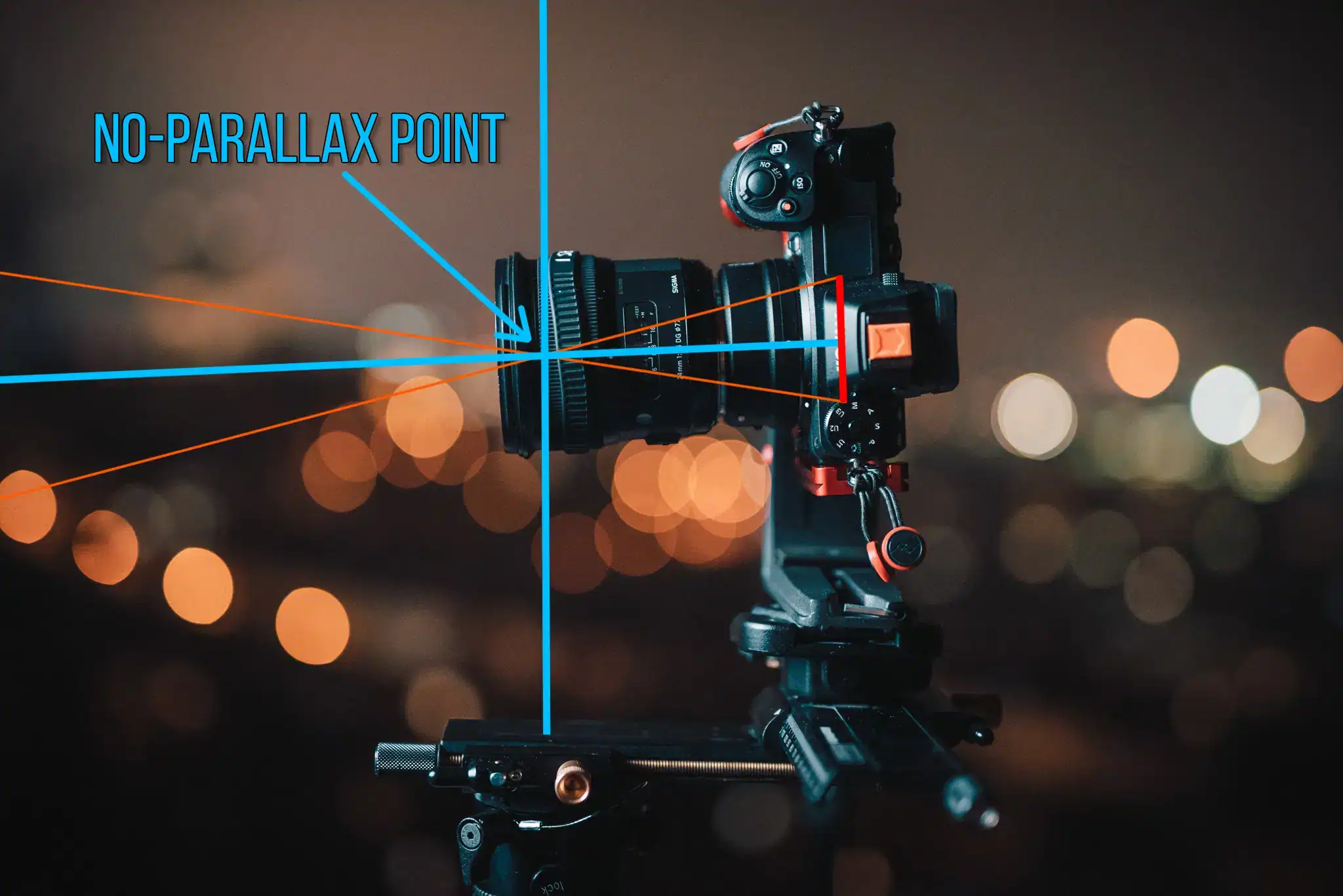
- Panoramic head: Lets you rotate the camera around the lens’s entrance pupil to eliminate parallax. This is critical for 360 photos in tight spaces (interiors, architecture).
- Stable tripod with leveling base: A leveling base speeds setup and keeps rows aligned, reducing post work.
- Remote trigger or app: Use Nikon SnapBridge or a remote to avoid vibrations, especially for long exposures.
Optional Add-ons
- Pole or car mount: Great for elevated or moving perspectives. Use guy lines, safety tethers, and plan for wind loads and vibration. Keep bystanders clear.
- Lighting for interiors: Small LED panels or bounced flash to lift shadows uniformly (avoid creating hot-spots).
- Weather covers: Protect against drizzle, sea spray, and dust. Keep microfiber cloths for quick wipe-downs.
For a deeper dive into panoramic head setup and why nodal alignment matters, see this panoramic head tutorial. Learn nodal alignment and head setup.
Video: Step-by-step panoramic head setup and shooting tips.
Step-by-Step Shooting Guide
Standard Static Scenes
- Level and align nodal point: Level the tripod with the bubble or leveling base. On the pano head, slide the camera until foreground and background objects stay aligned when you pan. Mark the rail positions for 14mm, 24mm, and 35mm—each differs slightly.
- Manual exposure and white balance: Set M mode. Meter the brightest view (sky or window) and the darkest (shadows), pick a middle exposure that doesn’t clip highlights. Lock WB to a Kelvin value (e.g., 5200–5600K daylight) or “Tungsten” indoors to avoid stitching color shifts.
- Capture with tested overlap:
- 14mm spherical: 8 shots each at –45°, 0°, +45° rows; add 1 zenith and 1 nadir.
- 24mm spherical: 12 shots per row (–45°, 0°, +45°) + zenith + nadir.
- 35mm high-res: 16–20 per row for 3–4 rows + zenith + nadir.
- Take a clean nadir: After the main set, move the tripod slightly and shoot a ground plate, or hold the camera over the tripod hole to patch later in post.
HDR / High Dynamic Range Interiors
- Bracket ±2 EV: Use 3–5 exposures per angle (e.g., –2/0/+2 EV or –4/–2/0/+2/+4 EV) to balance windows and interior shadows. Keep aperture constant and adjust shutter speed only.
- Lock WB across the bracket: If WB shifts between frames, you’ll see seams. Fix WB manually before bracketing.
- Keep the camera still: Use a remote and wait for any movement (curtains, plants) to settle before each bracket.
Low-Light / Night Scenes
- Use longer exposures: Prefer ISO 64–400 on the Z9 for cleaner results. Typical settings: f/4–f/5.6 at 1/10–2s depending on scene brightness.
- Stabilization: Turn off IBIS when on a tripod to prevent micro-drift. Use self-timer or remote to avoid shake.
- Watch flicker: With the Z9’s electronic shutter, enable flicker reduction under artificial lights to reduce banding.
Crowded Events
- Two-pass method: First pass for composition and exposure, second pass when gaps appear in the crowd. You’ll mask people in post for clean stitches.
- Select faster shutter: 1/200s or faster (raise ISO to 400–800) to reduce ghosting from moving subjects where needed.
Special Setups (Pole / Car / Drone)
- Pole: Secure a guy line, keep the camera close to the pole axis, and rotate slowly. Wind quickly amplifies sway—shoot shorter exposures or time shots in lulls.
- Car-mounted: Use suction mounts on clean glass and safety tethers. Expect vibration; use higher shutter speeds (1/250–1/500s) and cushion mounts to dampen shake.
- Drone: Not typical for this lens, but if doing aerial multi-row panos with a compatible system, keep overlap high and mind changing parallax at varying altitudes.
Recommended Settings & Pro Tips
Exposure & Focus
| Scenario | Aperture | Shutter | ISO | Notes |
|---|---|---|---|---|
| Daylight outdoor | f/8–f/11 | 1/100–1/250 | 64–200 | Lock WB (Daylight/Kelvin); preserve highlights |
| Low light/night | f/4–f/5.6 | 1/10–2s | 64–400 | Tripod + remote; IBIS off on tripod |
| Interior HDR | f/8 | Bracket ±2 EV | 64–400 | Balance windows and lamps; shutter-only bracketing |
| Action / moving subjects | f/5.6–f/8 | 1/200+ | 400–800 | Freeze motion; plan double pass for masking |
Critical Tips
- Focus once and lock: Use manual focus. At 14mm and f/8, a hyperfocal around ~1–1.2 m keeps most of the scene sharp; confirm with magnified live view.
- Entrance pupil (nodal) calibration: Place a near object (e.g., light stand) and a far object in line. Pan left/right and adjust the rail until the objects don’t shift relative to each other. Mark the rail for common focal lengths.
- White balance consistency: Set Kelvin or a fixed preset. Mixed lighting? Consider shooting a gray card for later reference.
- RAW over JPEG: You’ll need the latitude. RAW preserves highlight detail and allows cleaner color matching across frames.
- Stabilization behavior: On a tripod, turn off IBIS and lens IS. Handheld panos benefit from IS, but keep shutter speeds up to avoid stitching deformation.
- Silent electronic shutter on Z9: Great for zero vibration. Under LED lighting, enable anti-flicker to avoid banding.
Stitching & Post-Processing
Software Workflow
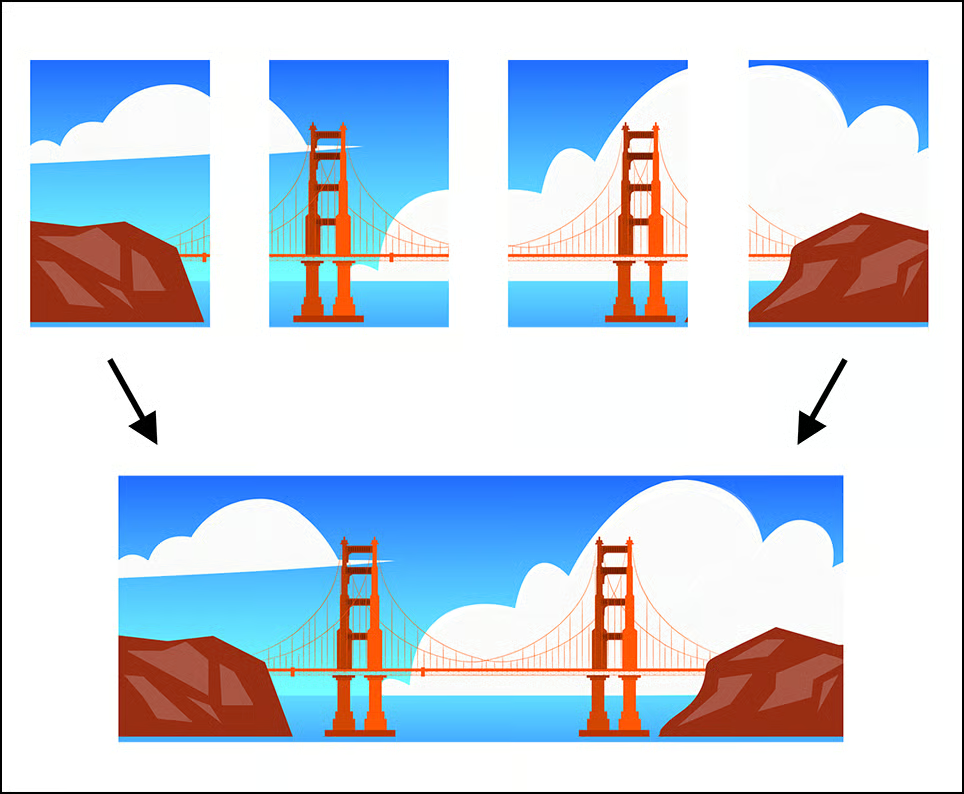
Import and organize by scene and focal length. If you bracketed, first merge HDR stacks (Lightroom/Photoshop/Affinity) or let PTGui handle exposure fusion. For stitching, PTGui remains a pro favorite for complex 360 photos, multiband blending, and robust control point detection; Hugin is an excellent open-source alternative. Rectilinear ultra-wide lenses need more frames than fisheyes but produce straighter lines—a plus for architecture. Aim for 25–35% overlap per frame and maintain consistent exposure/WB for best control-point matches. For a practical overview of PTGui’s capabilities, see this review. Why PTGui excels at complex panoramic stitching.
Cleanup & Enhancement
- Nadir patch: Use a separate ground shot, AI fill, or cloning to remove the tripod. Some tools automate tripod removal in equirectangular space.
- Color matching: Sync white balance and tone across all frames. Use selective HSL tweaks to equalize mixed lighting.
- Noise reduction: Apply luminance NR selectively to shadow regions—avoid smearing fine textures.
- Level the horizon: In PTGui, adjust roll/pitch/yaw; in Photoshop, use adaptive wide angle or spherical transformations.
- Export formats: For VR viewers, export equirectangular 2:1 JPEG/TIFF (e.g., 16k×8k or 8k×4k depending on target). For prints, render cylindrical or planar projections at high DPI.
For a concise, end-to-end DSLR/mirrorless 360 workflow (shoot to stitch), Oculus’s guide is a solid reference. Step-by-step 360 capture and stitching fundamentals.
Useful Tools & Resources
Software
- PTGui (pro-grade stitching, exposure fusion, viewpoint correction)
- Hugin (open-source panorama stitching)
- Lightroom / Photoshop / Affinity Photo (HDR merges, RAW development, cleanup)
- AI tripod removal tools and content-aware fill
Hardware
- Panoramic heads: Nodal Ninja, Leofoto, Fanotec
- Carbon-fiber tripods with leveling base
- Wireless remotes and intervalometers
- Pole extensions and car mounts with safety tethers
For broader system selection and virtual tour considerations, this overview is helpful. Camera/lens choices for virtual tours.
Disclaimer: software/hardware names are provided for search reference; check official sites for up-to-date specs and instructions.
Real-World Case Studies
Indoor Real Estate (Window Walls)
Use 14–20mm for fewer frames in tight rooms. On the Z9, set ISO 64–100, f/8, and bracket –2/0/+2 EV at each angle. Keep WB fixed (e.g., 5000–5200K), and do a two-pass approach for areas with moving curtains or ceiling fans—capture a second set when the fan stops. Stitch HDR stacks or let PTGui do exposure fusion, then patch the nadir. Expect about 26 frames at 14mm for a full 360×180.
Outdoor Sunset (High DR Skyline)
At 24mm, shoot 12 frames per row across three rows for impressive detail. Meter for highlights to protect the sunlit clouds, then bracket if needed. Lock WB around 5600–6000K. On the Z9, aim ISO 64–200 with 1/30–1/125s and use a remote. Blend with soft masks or exposure fusion to keep color transitions smooth.
Event Crowd (Minimal Ghosting)
At 14–20mm, raise shutter to 1/200–1/500s, ISO 400–800, f/5.6–f/8. Do two passes: first for coverage, second to capture clean background gaps. In post, mask in cleaner frames to remove overlapping moving subjects. Consider reducing FOV per frame (use 20–24mm) to maintain overlap without excessive distortion near edges.
Rooftop Pole (360 Perspective)
Mount a light camera setup on a carbon pole. Keep exposures short (1/125–1/500s), increase ISO as needed (Z9 is safe to ISO 1600 for social/web). Rotate slowly to let the system settle between shots. Always use a tether and avoid windy conditions or crowded areas underneath.
Safety & Gear Protection
For rooftops and poles, tether everything and watch wind loads. On cars, use multiple suction points on clean glass and safety straps. In public spaces, maintain situational awareness and avoid obstructing traffic. Keep silica gel packs in your bag for humid conditions and dry cloths to handle condensation when moving between A/C interiors and hot outdoor air.
Illustrative Examples
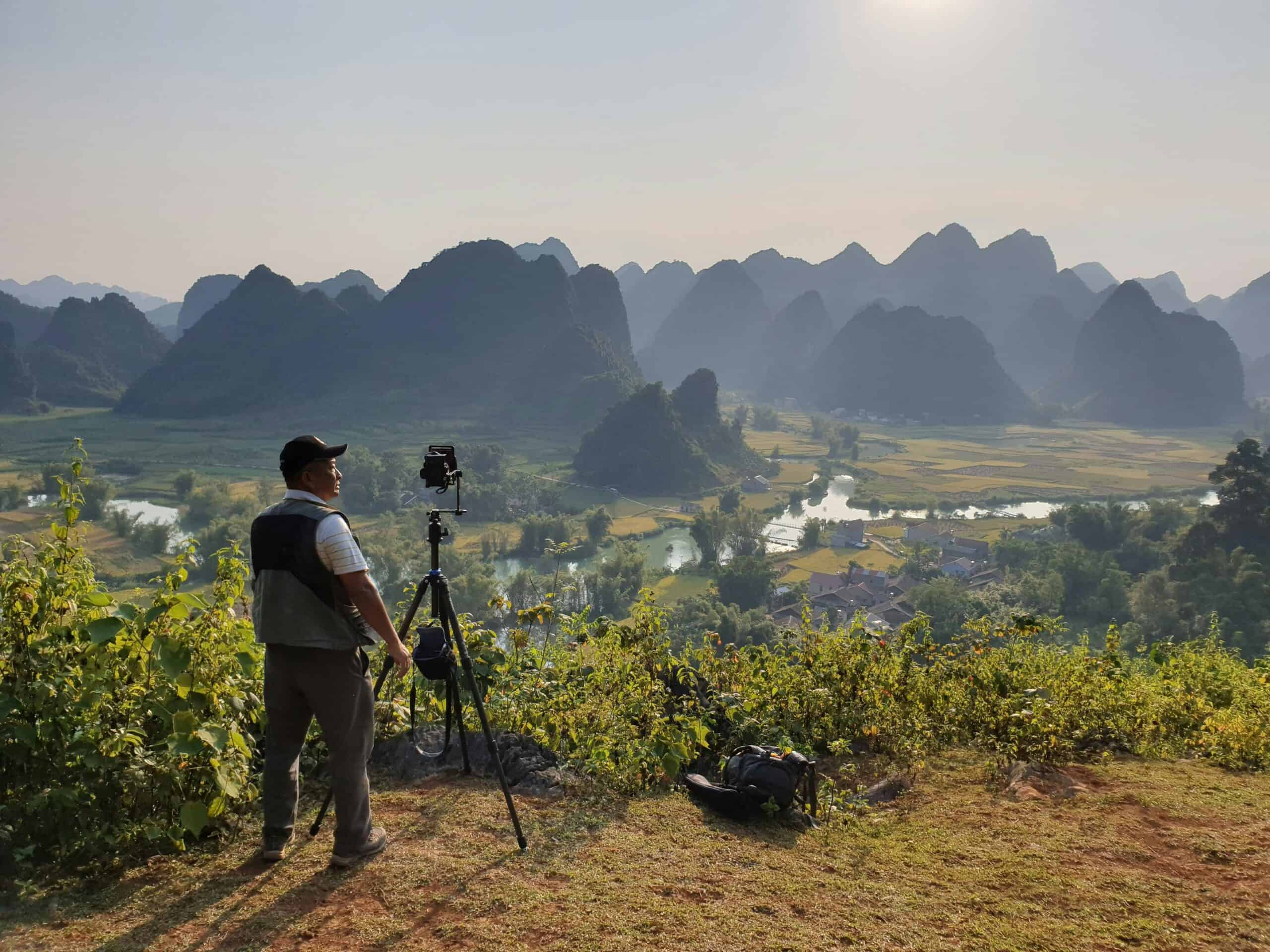
Common Mistakes & How to Avoid Them
- Parallax error: Always align the entrance pupil on a calibrated panoramic head before shooting.
- Exposure flicker: Use manual exposure and lock WB. Avoid auto ISO for critical work.
- Tripod shadows and footprints: Shoot nadir shots and patch later; reposition feet to reduce shadow overlap.
- Ghosting from moving subjects: Mask in post or use the two-pass method at events.
- High ISO noise at night: Keep ISO low and extend shutter on a stable tripod; apply selective noise reduction in post.
- Missed overlap: Use at least 25–35% overlap and keep a consistent rotation angle on your head.
Frequently Asked Questions
- Can I shoot handheld panoramas with the Nikon Z9?
Yes, for cylindrical and simple multi-frame stitches. Use faster shutter speeds (1/250s+), IS on (with Z lenses), and shoot extra overlap (35–40%). For 360×180 or interiors with close foregrounds, a panoramic head on a tripod is strongly recommended.
- Is the Canon RF 14–35mm f/4L wide enough for single-row 360?
At 14mm rectilinear, no—one row won’t cover the full vertical 180°. You’ll need multi-row capture (typically three rows plus zenith and nadir). For single-row spherical 360s, a fisheye lens is preferred.
- Do I need HDR for interiors with bright windows?
Usually yes. Bracket ±2 EV (3–5 exposures) to retain both window highlights and interior shadows. Merge HDR stacks before stitching or use exposure fusion in PTGui/Hugin.
- How do I avoid parallax issues in tight spaces?
Use a panoramic head aligned to the lens’s entrance pupil. Calibrate at the focal length you’ll use and mark the rail so you can set it quickly on location.
- What ISO range is safe on the Z9 for low light panoramas?
For critical quality, stay in the ISO 64–400 range on a tripod. ISO 800–1600 is usable for web/social or fast-moving scenes, but keep exposure consistent and apply noise reduction in post.
- Can I set custom modes to speed up pano shooting?
Yes. Program a “Pano” custom mode with Manual exposure, fixed WB, manual focus, silent shutter, and bracketing settings. This reduces setup time and prevents missed shots.
- What’s the best tripod head for this setup?
A multi-row panoramic head with fore-aft and lateral rail adjustments (e.g., Nodal Ninja/Fanotec, Leofoto) and a leveling base. For high-resolution mosaics, a geared head or gimbal + rails can help fine-tune pitch/yaw between rows.
- Can I really use the Canon RF 14–35mm on the Z9?
Practically, no—not with full electronic control. There’s no reliable RF-to-Z adapter. Use a Nikon Z-mount equivalent for the Z9, or pair the RF lens with a Canon RF body. The techniques and frame counts in this guide remain the same.
One More Reference Worth Saving
For a community-tested list of techniques and pitfalls across many camera/lens combos, this Q&A thread remains surprisingly timeless. Community techniques for shooting 360 panoramas.