
Why This Camera & Lens Are Great for Panoramas
If you want to know how to shoot panorama with Nikon Z8 & Sony FE 16-35mm f/2.8 GM, you’re pairing a state-of-the-art full-frame mirrorless body with one of the best ultra‑wide rectilinear zooms ever made. The Nikon Z8’s 45.7MP stacked BSI sensor delivers superb detail and dynamic range (about 14+ stops at base ISO 64), while its robust build and excellent IBIS make it a powerhouse for tripod or pole-mounted 360 photos. The Sony FE 16‑35mm f/2.8 GM (rectilinear, not fisheye) brings crisp edges, strong control of flare and CA, and predictable distortion profiles—ideal for architectural and landscape panoramas where straight lines matter.
Compatibility note: the Sony FE 16‑35mm f/2.8 GM is a Sony E‑mount lens. To use it on the Nikon Z8, you’ll need a smart adapter such as the Megadap ETZ21 Pro. AF and aperture control typically work well, but for panoramas you’ll often switch to manual focus and manual exposure anyway. IBIS generally functions through the adapter, though confirm stable operation with your specific firmware. On a tripod, turn IBIS off for the sharpest, stitchable frames.
Quick Setup Overview
- Camera: Nikon Z8 — full-frame (35.9 × 23.9 mm), 45.7MP, stacked BSI CMOS, base ISO 64, electronic shutter only, 5‑axis IBIS.
- Lens: Sony FE 16‑35mm f/2.8 GM — rectilinear ultra‑wide zoom; excellent sharpness from f/5.6–f/8; moderate barrel distortion at 16mm; low lateral CA; no optical stabilization (rely on Z8 IBIS when handheld).
- Estimated shots & overlap (tested, rectilinear coverage):
- 16mm: 2-row minimal 360 — 6 shots around at +30°, 6 around at −30° + zenith + nadir = 14 total (≈35–40% overlap). Robust 3‑row: 6 around at +30°, 6 at 0°, 6 at −30° + zenith + nadir = 20 total.
- 24mm: 3-row robust — 8 around at +35°, 8 at 0°, 8 at −35° + zenith + nadir = 26 total.
- 35mm: high detail — 10 around × 3–4 rows + zenith + nadir = 32–42 total (for gigapixel detail).
- Difficulty: Intermediate (rectilinear lens requires careful nodal alignment and multi‑row capture).
Planning & On-Site Preparation
Evaluate Shooting Environment
Before you set up, scan the scene for light direction, reflections, moving elements (trees, people, cars), and obstacles that might block sweep angles. For interiors with glass or mirrors, position the camera at least 50–100 cm from reflective surfaces to minimize flare, double reflections, and parallax artifacts. Outdoors, note wind and tripod footing; on rooftops or cliffs, prioritize safety and stability over extreme vantage points.
Match Gear to Scene Goals
The Nikon Z8’s dynamic range and clean base ISO make it excellent for HDR panoramas and sunset cityscapes. Its electronic shutter can band with pulsing LEDs, so enable flicker reduction and choose shutter speeds synced to mains frequency (1/50 or 1/100; 1/60 or 1/120 depending on region) when under artificial lighting. The Sony 16‑35mm GM, being rectilinear, preserves straight lines—great for architecture—but you’ll need more frames than with a fisheye. For indoor panoramic tours, plan for bracketing at ISO 64–400 and f/8; for night cityscapes, ISO 100–800 with longer exposures is a sweet spot on the Z8.
Pre‑shoot Checklist
- Power & storage: fully charged battery, spare battery, and large/fast cards; shoot RAW (14‑bit lossless compressed).
- Optics: clean front/rear elements and sensor; remove protective filters (polarizers can create uneven skies in panoramas).
- Tripod & head: level base; verify panoramic head calibration; tighten all clamps.
- Safety: weigh down tripod in wind; use a tether on rooftops or when over railings; wear a harness as needed; avoid public walkways.
- Backup capture: shoot a second full round at the same settings to insure against stitching gaps or motion contamination.
Essential Gear & Setup
Core Gear
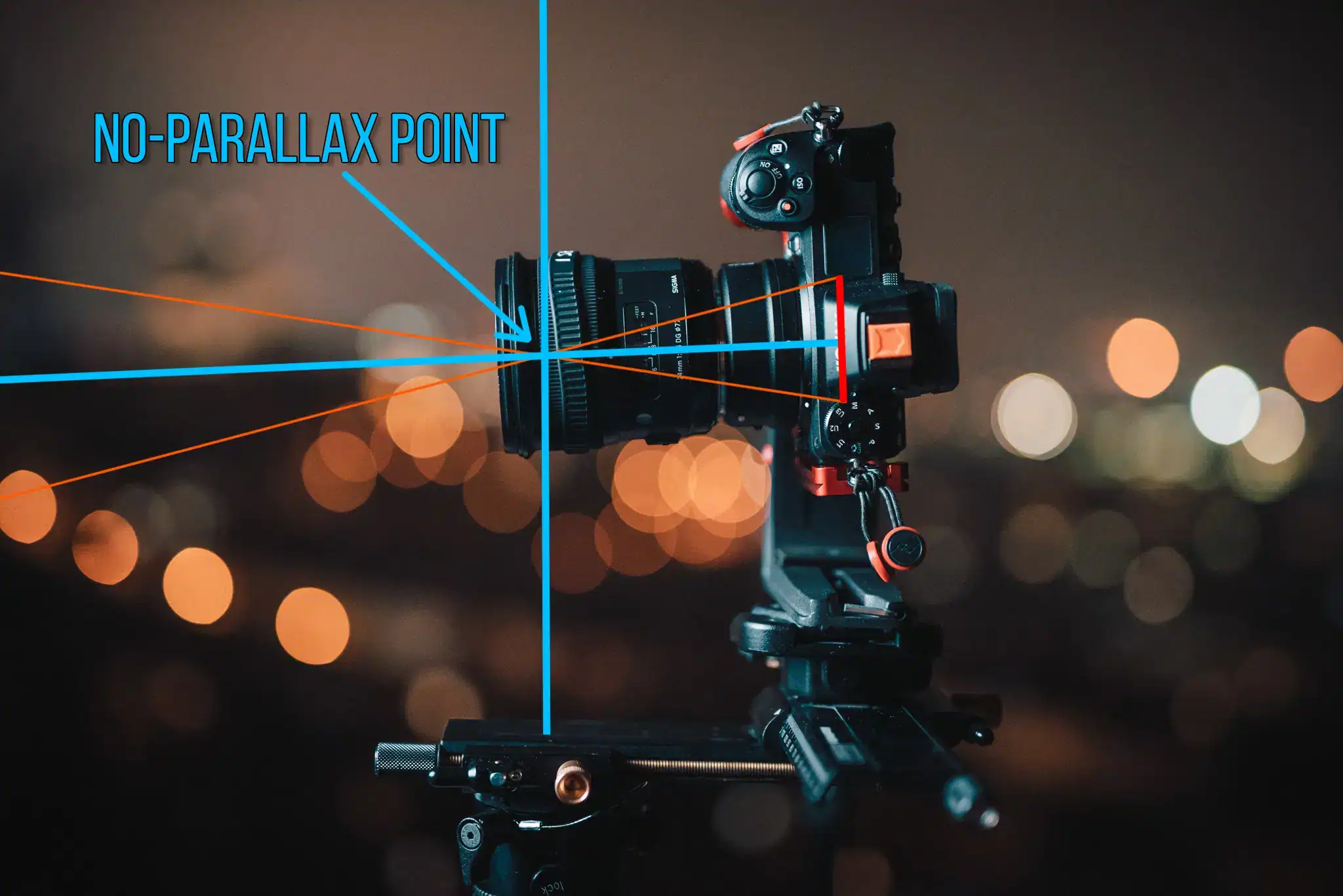
- Panoramic head: Use a multi‑row panoramic head so the camera rotates around the lens’s entrance pupil (often called the “nodal point”) to eliminate parallax. This is critical with a rectilinear 16–35mm, especially indoors with near/far objects.
- Stable tripod with leveling base: A leveling base speeds setup; keep the rotator plane perfectly level to avoid complex horizon corrections in post.
- Remote trigger or app: A remote release or SnapBridge app helps prevent micro-shake and keeps your hands off the rig during long exposures.
Optional Add-ons
- Pole or car mount: For overhead views, a carbon pole can be effective at 16mm—tether everything and beware wind. Car mounts demand redundant straps and safety lines; use faster shutters and higher ISO to counter vibration.
- Lighting: Small LED panels for dark interiors. Keep color temperatures consistent; lock white balance to avoid stitch seams.
- Weather protection: Rain covers and microfiber towels; salt spray or dust can ruin a set for stitching.
For a deeper refresher on the fundamentals of panoramic heads and parallax, see this practical panoramic head tutorial. Panoramic head tutorial (360 Rumors)
Recommended video: a clear walkthrough on panoramic capture fundamentals.
Step-by-Step Shooting Guide
Standard Static Scenes
- Level the tripod and align the entrance pupil (nodal point). Set two light stands or a stand and a wall edge—one near (1–2 m), one far (5–10 m). Pan left/right and slide the lens forward/back on the rail until the near and far objects do not shift relative to each other as you rotate. Mark this position for 16mm and again for 24/35mm.
- Manual exposure and white balance. Meter the brightest frame you’ll shoot and expose to protect highlights. Lock ISO, shutter, aperture, and WB (Daylight/Custom). On the Z8, also disable auto distortion/vignetting corrections for consistent RAWs; correct later in stitch/post.
- Capture with tested overlap. At 16mm:
- Minimal: +30° row 6 shots (yaw step 60°), −30° row 6 shots, then a dedicated zenith and nadir.
- Robust: add a 0° row of 6 for safer stitching in foliage or busy textures.
- Take the nadir (ground) shot. After your main sphere, tilt down and shoot a clean ground plate. If the tripod blocks the view, shift the rig slightly or capture a handheld nadir at the same focal length and exposure for patching.
HDR / High Dynamic Range Interiors
- Bracket ±2 EV, 3–5 frames per angle. The Z8 handles exposure bracketing quickly; keep a constant interval across the set. Use mirrorless silent capture but watch for LED banding—enable flicker reduction and choose flicker‑safe shutter speeds.
- Lock WB. Mixed lighting (tungsten, daylight, LED) causes panel‑to‑panel color shifts in the stitch. A custom WB set on a grey card can help.
Low-Light / Night Scenes
- Use longer shutter and lower ISO. On the Z8, ISO 64–400 is ideal for maximum dynamic range; ISO 800–1600 remains clean for night cityscapes when you need to freeze minor motion. Turn IBIS off on a tripod to avoid micro‑corrections during exposure.
- Remote trigger and delay. Use a 2‑sec self‑timer or remote. If it’s windy, add mass to the tripod or lower the center column.
Crowded Events
- Shoot two passes. The first establishes coverage; the second waits for gaps or better alignment of people. Keep yaw steps identical for easy masking later.
- Mask moving subjects in PTGui or Photoshop. Use the cleanest body parts from each pass and blend by seams; prioritize consistent shadows and reflections.
Special Setups (Pole / Car / Drone)
- Pole (rooftop/overlook). Keep 16mm, reduce shots per row, and rotate more slowly. Tether the pole and keep people away from the drop zone. Wind is the main failure point—don’t risk it.
- Car mount. Use redundant suction plus straps; shoot fast (1/200–1/500) and ISO 800–1600 as needed. Stabilize by timing rotations at stops rather than moving.
Recommended Settings & Pro Tips
Exposure & Focus
| Scenario | Aperture | Shutter | ISO | Notes |
|---|---|---|---|---|
| Daylight outdoor | f/8–f/11 | 1/100–1/250 | 64–200 | Lock WB (Daylight/Custom). Z8 DR is best at base ISO. |
| Low light/night | f/4–f/5.6 | 1/15–1/60 | 100–800 (up to 1600) | Tripod & remote; IBIS off on tripod; watch for LED flicker indoors. |
| Interior HDR | f/8 | Bracket ±2 EV | 64–400 | Protect window highlights; merge to 32‑bit before stitching if preferred. |
| Action / moving subjects | f/5.6–f/8 | 1/200+ | 400–1600 | Freeze motion; double pass for masking in post. |
Critical Tips
- Manual focus at the hyperfocal distance. At 16mm and f/8 on full frame, the hyperfocal distance is roughly 1.1 m; set focus there and switch to MF so all frames match.
- Nodal point calibration. Expect the entrance pupil to sit forward at 16mm. Mark rail positions for 16, 24, and 35mm on your panoramic head for fast repeatability.
- White balance lock. Changing WB mid‑set creates visible seams. Use a custom WB or stick to Daylight for consistency.
- RAW over JPEG. 14‑bit RAW from the Z8 preserves highlight latitude and shadow color—critical for HDR panorama blending.
- IBIS off on tripod. The Z8’s VR can introduce micro‑shake when the rig is perfectly stable. Keep it on only for handheld or pole scenarios.
Stitching & Post-Processing
Software Workflow
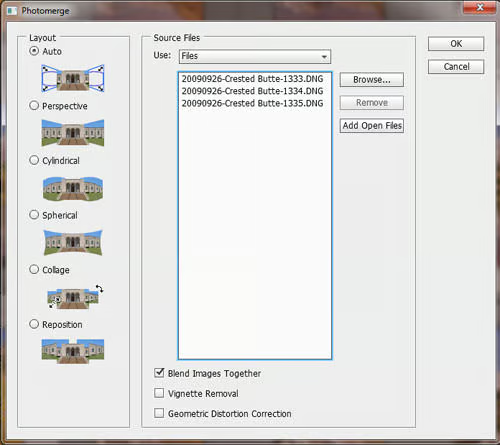
Import, sort, and sync metadata in Lightroom or Photo Mechanic, then stitch in PTGui or Hugin. Rectilinear lenses usually need more shots than fisheyes but yield straighter lines with less edge stretching. Maintain consistent overlap: ~25–30% for fisheye, 30–40% for rectilinear is safer. PTGui’s control point generation and masking tools excel for complex scenes, while Hugin is a capable open‑source alternative. For detailed guidance on high‑end DSLR/mirrorless 360 capture, the Oculus guide is a solid reference. DSLR/mirrorless 360 workflow (Meta/Oculus)
If you’re deciding on software, this review explains why PTGui remains a top choice for difficult panoramas. PTGui detailed review (Fstoppers)
Cleanup & Enhancement
- Nadir patch. Clone in Photoshop or use a clean plate shot; many virtual tour platforms allow quick nadir logo patches.
- Color and noise. Even with matched WB, blend seams can benefit from HSL fine tuning. Apply modest noise reduction to shadow panels (especially HDR merges).
- Leveling. Use horizon/vertical line optimization in PTGui or Hugin; correct roll/yaw/pitch until verticals are true.
- Export. Save an equirectangular 2:1 image (e.g., 10–16k width depending on your shot density). Use high‑quality JPEG for web or TIFF/EXR for archival.
For broader questions about focal lengths and stitching choices, this explainer is concise and practical. Panoramas, focal lengths, and Photoshop (B&H)
Disclaimer: workflows evolve; always check the latest PTGui/Hugin documentation for updated best practices.
Useful Tools & Resources
Software
- PTGui panorama stitching
- Hugin (open source) panorama suite
- Lightroom / Photoshop for RAW prep and retouching
- AI tripod/nadir removal tools in modern editors
Hardware
- Panoramic heads: Nodal Ninja, Leofoto, Sunwayfoto
- Carbon fiber tripods with leveling base
- Wireless remote shutters or interval timers
- Carbon pole extensions and certified car mounts (with safety tethers)
Disclaimer: product names are for search reference; verify compatibility (e.g., Megadap ETZ21 Pro) and safety ratings on official sites.
Common Mistakes & How to Avoid Them
- Parallax error → Calibrate the entrance pupil for each focal length and keep the panoramic head locked.
- Exposure or WB flicker → Use full manual exposure and locked white balance across the entire set.
- Tripod shadows/footprints → Capture a dedicated nadir or plan a later patch.
- Ghosting from moving subjects → Shoot two passes and mask in PTGui/Photoshop.
- Banding under LEDs with electronic shutter → Enable flicker reduction on the Z8 and choose mains‑friendly shutter speeds.
- Missed zenith/nadir coverage → Include dedicated frames or add a third row at 0° for safety.
Frequently Asked Questions
- Can I shoot handheld panoramas with the Nikon Z8?
You can, especially with IBIS and the 16mm end, but expect more stitching errors and soft edges. For 360 photos, a leveled tripod and panoramic head dramatically improve results. Handheld is fine for quick single‑row landscapes but not ideal for multi‑row 360s.
- Is the Sony FE 16‑35mm f/2.8 GM wide enough for a single‑row 360?
Not for a complete sphere. At 16mm, the vertical FOV (~74°) won’t cover zenith and nadir in one row. Plan two tilted rows at ±30° (6 shots each) plus dedicated zenith and nadir for a reliable full 360.
- Do I need HDR for interiors with bright windows?
Usually yes. Bracket ±2 EV (3–5 frames) to capture interior shadows and preserve window highlights, then fuse or merge HDR before or during stitching. The Z8’s base ISO 64 is excellent for highlight headroom.
- How do I avoid parallax issues with this setup?
Use a multi‑row panoramic head and slide the camera so rotation occurs around the lens’s entrance pupil. Calibrate at 16, 24, and 35mm and mark those rail positions. Keep the tripod level and tighten all clamps before rotating.
- What ISO range is safe on the Z8 for low light panoramas?
For tripod‑based 360s, ISO 64–400 is best. ISO 800–1600 remains clean when you need shorter shutters to counter wind or crowd motion. Favor longer exposures over pushing ISO whenever possible.
Field‑Tested Scenarios with the Z8 + 16‑35 GM
Indoor Real Estate (Bright Windows)
At 16mm, set f/8, ISO 64–200, and bracket ±2 EV (5 frames) with a 2‑sec delay. Shoot 2 rows (±30°) with 6 around each, plus zenith and nadir. Use a grey‑card custom WB. In PTGui, mask windows using the darkest exposure, and interior using the mid exposure for natural tonality.
Outdoor Sunset (High DR, Subtle Motion)
Use f/8, ISO 64–100, and a longer shutter around 1/2–1/15 sec depending on wind. Lock WB to Daylight to keep sky color consistent. If clouds move quickly, capture faster—consider a simple 2‑row set (12 + Z/N) to reduce total time. Blend with exposure fusion to keep skies luminous without halos.
Rooftop Pole Capture
At 16mm, keep the set short: 6 around at +15–20°, 6 around at −15–20°, plus a quick zenith; patch nadir later. Balance the pole with both hands, rotate slowly, and use 1/200 s or faster with ISO 400–800. Always tether the camera and keep the area below clear.
Expert Notes, Safety, and Trust
The Z8’s electronic shutter is superbly stable on a tripod, but under pulsing LEDs you may see banding; enable flicker reduction and choose safe shutter multiples. With the Sony 16‑35 GM via a Megadap ETZ21 Pro adapter, AF and aperture control usually work, but expect slower AF than native Z lenses—irrelevant for manual‑focus panorama capture. Always verify adapter firmware and test IBIS reporting; on a tripod, disable IBIS regardless.
Follow industry‑standard pano practices: calibrate nodal positions, lock exposure and WB, keep overlap consistent, and shoot a backup round. If you’re new to virtual tour workflows, this concise DSLR/mirrorless 360 guide is a useful reference alongside classic community techniques. Best techniques to take 360 panoramas (Stack Exchange)