Why This Camera & Lens Are Great for Panoramas
The Nikon Z8 paired with the Sony FE 14mm f/1.8 GM is an unconventional but powerful panorama combo for creators who demand high resolution and stellar optics. The Z8’s 45.7MP full-frame stacked BSI sensor (approx. 35.9 × 23.9 mm, ~4.35 µm pixel pitch) delivers excellent detail and dynamic range—up to roughly 14+ stops at base ISO 64—giving you flexible files for complex sky and interior blends. The Sony FE 14mm f/1.8 GM is an ultra-wide rectilinear prime (not fisheye), with an expansive field of view (approx. 114° diagonal / ~104° horizontal), superb sharpness from f/2 to f/8, minimal coma and low lateral CA. Together, they’re capable of museum-grade gigapixel tiles and clean, low-light 360 photos.
Compatibility note: to mount the Sony FE 14mm f/1.8 GM on a Nikon Z8, you’ll need a thin E-to-Z adapter such as the Techart TZE-01/TZE-02. AF and EXIF typically work, but always check compatibility, update firmware, and be prepared to focus manually for precision pano work. Because this is a rectilinear ultra-wide lens (not a fisheye), you’ll take more frames than with a circular fisheye, but enjoy straighter lines and less fisheye stretching on architecture.
Quick Setup Overview
- Camera: Nikon Z8 — full-frame 45.7MP stacked BSI CMOS, base ISO 64, excellent 14-bit RAW DR; strong AF; robust IBIS for handheld frames (turn off on tripod).
- Lens: Sony FE 14mm f/1.8 GM — ultra-wide rectilinear prime, weather-sealed, razor-sharp across the frame by f/4–f/8, low coma/CA; bulbous front element (no front filter thread), rear gel slot.
- Estimated shots & overlap (spherical 360×180):
- Single-row cylindrical pano: 5–6 shots around with ~30% overlap.
- Full 360×180: 6 shots around at +35°, 6 shots around at −35°, plus 1 zenith & 1 nadir (≈14 total). For very safe overlap: 8+8+2 (≈18 total).
- Difficulty: Intermediate (rectilinear ultra-wide requires careful nodal alignment and multi-row capture).
Planning & On-Site Preparation
Evaluate Shooting Environment
Assess light direction, contrast, reflective surfaces, and movement. For interiors with glass or polished floors, place the tripod away from reflective edges when possible and shoot perpendicular to large windows to reduce flare. If shooting through glass, keep the front element close (1–3 cm) to minimize reflections, and shield with a black cloth if needed. For sunsets or cityscapes, note the sun’s position and consider bracketing to protect highlights while preserving shadow detail. Wind and vibration are bigger concerns on rooftops or poles; plan for added stabilization.
Match Gear to Scene Goals
Why the Nikon Z8 & Sony 14mm f/1.8 GM excel: the Z8’s base ISO 64 files show excellent dynamic range for high-contrast scenes, and the sensor remains clean through ISO 1600—3200 with thoughtful noise reduction. The 14mm GM’s rectilinear rendering keeps architecture lines straight, ideal for real estate, interiors, and city skylines. For low-light exteriors, f/1.8 lets you preview composition and nail focus; then stop down to f/5.6–f/8 for best edge-to-edge sharpness. While fisheyes require fewer shots, the 14mm rectilinear yields more natural-looking lines and easier client approval for architectural work.
Pre-shoot Checklist
- Charge batteries and bring spares; the Z8 is power-hungry when reviewing many frames.
- Large, fast cards (UHS-II/CFexpress) for bracketing and burst sequences.
- Clean lens and sensor; the 14mm’s huge depth of field reveals dust easily at f/8–f/11.
- Level tripod; calibrate panoramic head for no-parallax rotation.
- Check adapter firmware (Techart TZE) and test AF/manual focus behavior.
- Safety: tether on rooftops and poles; watch wind gusts; never leave rig unattended.
- Backup plan: shoot an extra full rotation; if crowds or cars move, do two passes for masking.
Essential Gear & Setup
Core Gear
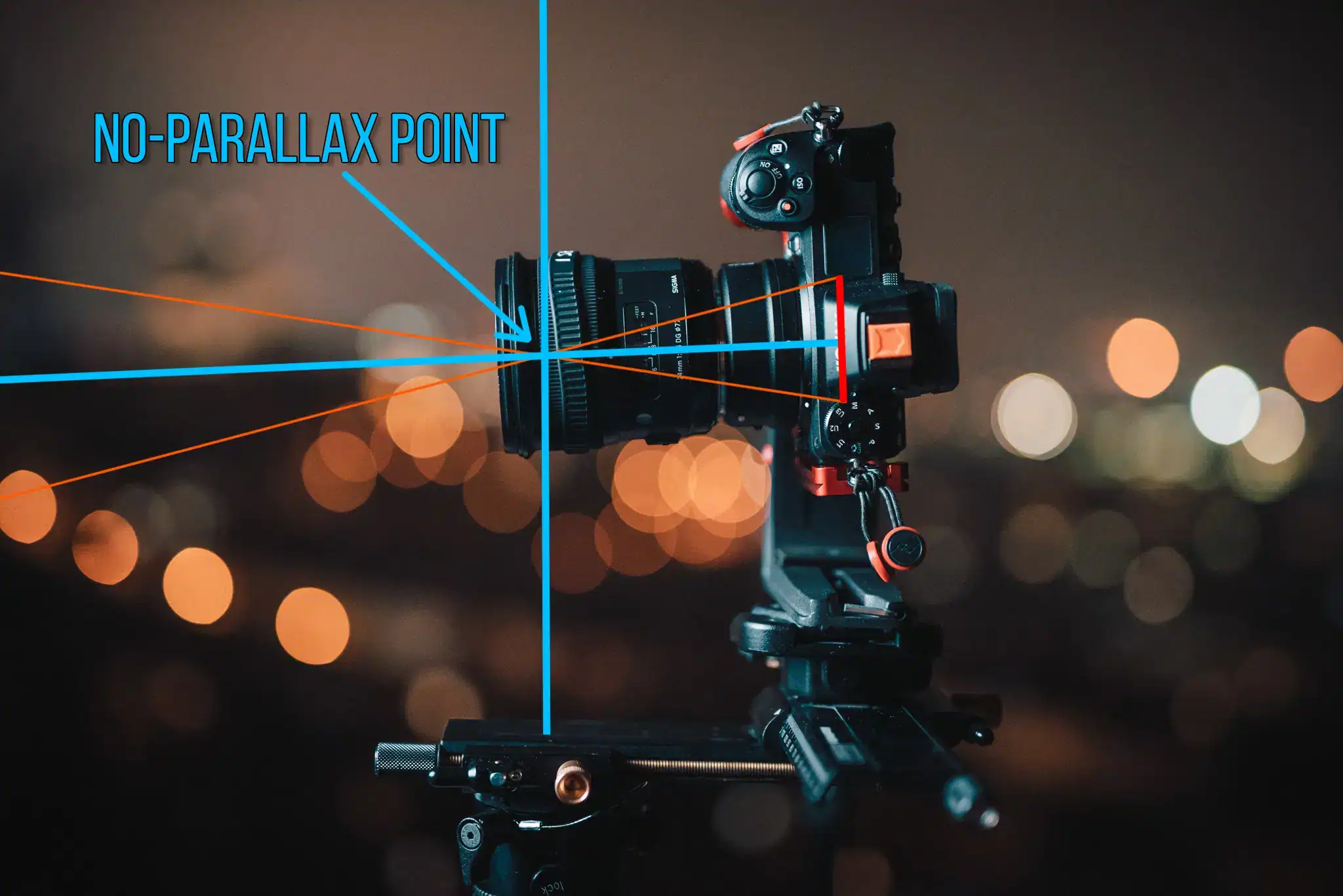
- Panoramic head with fore-aft sliding rails: Align the lens’s entrance pupil (no-parallax point) with the vertical rotation axis to eliminate parallax between foreground and background. This is non-negotiable for clean stitches, especially with nearby objects.
- Stable tripod with a leveling base: A leveling base lets you keep the head level regardless of leg positions, speeding up setup and ensuring consistent rows.
- Remote trigger or app control: Use a wired remote or SnapBridge app to avoid touching the camera during exposure. Enable Exposure Delay if needed.
Optional Add-ons
- Pole or car mount: On poles, use guy-lines when possible and a safety tether. On vehicles, use rated suction mounts on clean glass/metal, double-tether, and obey local laws. Expect more shots to cover parallax and motion.
- Lighting aids: Small LED panels or bounced flash to lift dark interiors (avoid mixed color temps if you can).
- Weather protection: Rain covers and a microfiber cloth. The 14mm’s bulbous element attracts droplets—wipe frequently.
Panoramic Head Basics (Video)
New to nodal calibration? This short video dives into practical setup and best practices for perfect pano heads.
Step-by-Step Shooting Guide
Standard Static Scenes
- Level tripod and align nodal point: Mount the Z8 + adapter + 14mm GM on the panoramic head. Slide the camera along the rail until nearby/overlapping objects do not shift relative to each other when you pan left/right. Mark the rail scale for this setup so you can repeat it quickly.
- Set manual exposure and lock white balance: Meter for the mid-tones or the brightest important highlight and keep settings fixed. Lock WB (Daylight for sun, Tungsten for warm interiors, or custom Kelvin) so colors remain consistent across frames.
- Frame sequence: For a spherical, capture two rows:
- Row 1: Pitch +35°, 6 frames around (every 60°) with ~30% overlap.
- Row 2: Pitch −35°, 6 frames around.
- Add 1 zenith (straight up) and 1 nadir (straight down). Tip the rig gently to get a clean nadir if the tripod blocks it.
With excellent technique, 6×2+Z+N (≈14 shots) is enough; for safety or very close foreground, do 8×2+Z+N (≈18 shots).
- Take a clean nadir: After the main sequence, move the tripod slightly and shoot a handheld nadir plate with the same exposure and WB to patch out the tripod later.
HDR / High Dynamic Range Interiors
- Bracket ±2 EV: Use the Z8’s exposure bracketing (e.g., 3 or 5 frames at 2 EV steps) to capture bright windows and dark corners. Keep aperture and ISO fixed; vary shutter speed only.
- Lock WB: Maintain a single white balance across all brackets and frames to avoid color shifts. Shoot RAW for maximum dynamic range and nuanced recovery.
Low-Light / Night Scenes
- Use longer shutter speeds: On a tripod, favor ISO 64–400 for quality, with 1–10 s exposures as needed. The Z8 remains very usable up to ISO 1600–3200 for moving crowds or wind movement in trees if you must raise ISO.
- Remote trigger + IBIS off: Turn off IBIS on tripod to avoid micro-shifts; use Exposure Delay (e.g., 0.2–0.5 s) to settle vibrations before each exposure.
- Banding control: With electronic shutter, enable high-frequency flicker reduction when shooting under LED or fluorescent lights.
Crowded Events
- Two-pass method: Do a fast first pass to get the whole sphere. On the second pass, wait for gaps in the crowd for the frames that need clean coverage.
- Mask in post: In PTGui or Photoshop, blend the two passes to remove duplicate people and ghosting. Overlap generously.
Special Setups (Pole / Car / Drone)
- Pole: Use a lightweight carbon pole, keep the rig near vertical, and rotate slower to reduce sway. Fast shutter speeds help mitigate motion blur if the pole flexes.
- Car: Use rated suction cups, safety tethers, and a spotter. Keep speeds low. Expect to shoot more frames and possibly at higher ISO to freeze vibrations.
- Drone: This lens/camera is too heavy for typical drones; instead, plan ground-based poles or mast rigs.
Recommended Settings & Pro Tips
Exposure & Focus
| Scenario | Aperture | Shutter | ISO | Notes |
|---|---|---|---|---|
| Daylight outdoor | f/8–f/11 | 1/100–1/250 | 64–200 | Lock WB (Daylight); avoid f/16 unless you need extra depth (diffraction). |
| Low light/night | f/4–f/5.6 | 1/30–10 s | 64–800 (up to 1600–3200 if needed) | Tripod + remote; enable Exposure Delay; IBIS off. |
| Interior HDR | f/8 | Bracket ±2 EV | 64–400 | 3–5 frames per angle; protect highlights from windows. |
| Action / moving subjects | f/5.6–f/8 | 1/200+ | 400–1600 | Freeze motion; shoot double passes for masking. |
Critical Tips
- Focus: Switch to manual focus and set near the hyperfocal distance. At 14mm and f/8 on full frame, hyperfocal is roughly ~0.8–0.9 m; everything from ~0.45 m to infinity will be acceptably sharp.
- Nodal calibration: With the adapter mounted, your entrance pupil position changes slightly. Start with the camera plate centered, then slide forward/back until near/far features align during a pan. Mark the rail for repeatability.
- White balance: Lock WB per scene (Daylight, Cloudy, Tungsten, or custom Kelvin). Mixed lighting often looks worse when WB floats between frames.
- RAW over JPEG: 14-bit RAW from the Z8 gives headroom for HDR merges and delicate color correction. JPEG fine is okay for quick social media but not for pro tours.
- Stabilization: Turn off IBIS on tripod. Handheld panos are possible, but for 360×180 with a rectilinear ultra-wide, a pano head significantly improves results.
- Metadata & profiles: Some adapters pass EXIF; if lens profile isn’t detected, set lens type to Rectilinear 14mm in your stitching software and apply profiles in Lightroom/ACR as needed.
Stitching & Post-Processing
Software Workflow
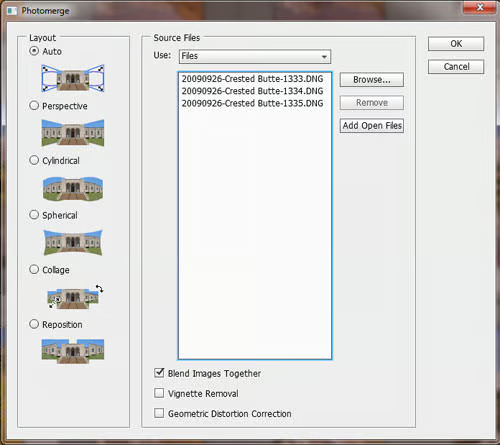
Import RAWs into Lightroom/ACR, apply lens corrections (distortion, CA) if you prefer, and synchronize exposure/WB across the set. Export as 16-bit TIFFs or send RAWs directly to PTGui/Hugin. In PTGui, set lens type to Rectilinear, focal length 14mm, and generate control points. Rectilinear ultra-wides need more frames than fisheyes but reward you with straighter lines and fewer fisheye artifacts at horizons. As a rule of thumb, use 25–30% overlap for fisheyes and about 20–30% for rectilinear wides; this guide’s 30% target is conservative and robust. For tool deep-dives and pro comparisons, see this PTGui review. PTGui reviewed for professional panorama work.
Cleanup & Enhancement
- Nadir patch: Use PTGui’s Viewpoint correction or export to Photoshop to clone/patch the tripod. Many AI-based tools can speed this up.
- Color & noise: Apply global color balance, then reduce noise on shadow pushes (especially above ISO 1600). Sharpen last.
- Level the horizon: Fix roll/pitch/yaw in your stitcher so the pano loads level in viewers.
- Export for VR: Render a 2:1 equirectangular (e.g., 12,000–16,000 px wide for high-end tours) as JPEG/PNG/TIFF, depending on your platform’s requirements.
For foundational pano technique and DSLR/ML workflows that carry over to the Z8, Oculus’ guide is concise and practical. Using a mirrorless camera to shoot and stitch a 360 photo. If you’re learning panoramic heads from scratch, this illustrated tutorial is also helpful. Panoramic head setup tutorial.
Useful Tools & Resources
Software
- PTGui (fast control point generation and HDR pano support)
- Hugin (open-source alternative)
- Lightroom / Photoshop (RAW processing, nadir cleanup)
- AI tripod removal/retouch tools (Speeds up nadir patching)
Hardware
- Panoramic heads (Nodal Ninja, Leofoto, or equivalent with fore-aft rails)
- Carbon fiber tripod with a leveling base
- Wireless/wired remote shutter
- Pole extensions and vehicle-rated mounts with safety tethers
Disclaimer: brand names are for reference; check official sites for compatibility and specs.
Common Mistakes & How to Avoid Them
- Parallax error: Always align the entrance pupil over the rotation axis before a full capture.
- Exposure flicker: Use full manual exposure and locked white balance across all frames.
- Tripod shadows and footprints: Shoot or patch a nadir plate after moving the tripod.
- Ghosting from movement: Do two passes and mask in post; increase overlap.
- LED banding: Use high-frequency flicker reduction on the Z8; prefer shutter speeds synced to local mains frequency.
- Lens flare: Shield the bulbous front element from direct sun; change angle slightly between rows if needed.
Field-Proven Scenarios
Indoor Real Estate (Mixed Lighting)
Set the Z8 to base ISO 64–100, f/8, and bracket ±2 EV (3–5 frames) to preserve window highlights. Lock WB to 4000–4500K if tungsten dominates, or 5000–5600K for daylight-balanced interiors. Keep the head level and shoot 6×2 + Z + N. Use Lightroom to balance color casts before stitching. Expect clean, detailed edges from the 14mm GM, especially around door frames and cabinetry.
Outdoor Sunset (High DR, Windy Roof)
Raise ISO to 200–400 if the rooftop has a breeze to keep exposure times short (1/60–1/200 s). Shield the lens from direct low-angle sun with your hand or a flag. Bracket if the sun is in frame. For critical work at base ISO, wait for lulls in the wind and use Exposure Delay. The Z8’s DR at ISO 64 is superb—use it when conditions allow.
Event Crowds (Motion Control)
Use f/5.6–f/8, 1/200–1/500 at ISO 400–1600. Do a fast primary pass, then a second pass for clean plates. In PTGui, align to the static architecture; then blend people selectively. The 14mm’s rectilinear projection helps keep walls and stage lines straight for natural-looking results.
Rooftop Pole (Maximum Coverage, Minimal Footprint)
Use a carbon pole with a small panoramic head and safety tether to a belt or anchor point. Increase overlap (e.g., 8×2 + Z + N) to give your stitcher more data, as slight deflection can cause alignment issues. Keep shutter speeds faster (1/125–1/250) at ISO 400–800 to minimize motion blur from sway.
Frequently Asked Questions
- Can I shoot handheld panoramas with the Nikon Z8?
Yes for simple cylindrical panos (e.g., 5–6 shots around), but for full 360×180 with a rectilinear 14mm you’ll get better results on a tripod with a panoramic head. Handheld multi-row spheres risk parallax and misalignment.
- Is the Sony FE 14mm f/1.8 GM wide enough for single-row 360?
For a cylindrical pano, yes—5–6 shots can cover 360°. For a full spherical (360×180), a single row won’t cover zenith/nadir; plan two rows (+35°/−35°) plus zenith and nadir.
- Do I need HDR for interiors with bright windows?
Often yes. Bracketing ±2 EV (3–5 frames) protects highlight detail while retaining clean shadows. Stitch after merging to HDR or use PTGui’s HDR workflow directly.
- How do I avoid parallax issues with this adapter/lens combo?
Use a panoramic head and calibrate the entrance pupil with the Z8 + Techart adapter + 14mm GM assembled. Slide the fore-aft rail until foreground/background objects don’t shift when panning. Mark your rail for repeat use.
- What ISO range is safe on the Z8 in low light?
For critical quality, keep ISO 64–800 on a tripod. ISO 1600–3200 is still very usable with modern noise reduction when you need faster shutter speeds to manage movement or wind.
- Can I set custom modes for pano on the Z8?
Yes. Assign a Custom Shooting Mode (U1/U2/U3 equivalents via banks) with manual exposure, WB lock, IBIS off, Exposure Delay on, and bracketing preset. This speeds up field setup.
- How can I reduce flare with the 14mm GM’s bulbous element?
Avoid pointing directly at strong light sources, use your hand/flag to shade the lens, and slightly adjust angle between rows if you see ghosts. Clean the front element frequently—smudges flare easily.
- What’s the best panoramic head choice for this setup?
Any precise, compact head with indexed clicks and fore-aft rails works. Look for solid clamps, a leveling base, and easy repeatability. Nodal Ninja and Leofoto offer reliable options.
Further Learning & Standards
To dive deeper into DSLR/mirrorless 360 workflows and lens planning, these are solid, community-vetted resources: Guidelines for shooting and stitching 360 photos and Panoramic head tutorial with diagrams. For resolution math and field coverage with various focal lengths, see the Panotools wiki reference. DSLR spherical resolution primer.
Trust, Safety, and Practical Limits
Always verify adapter compatibility and update firmware before critical jobs; test autofocus and aperture control. When working at heights or in public, use safety tethers, observe local regulations, and never block exits or foot traffic. The Z8’s electronic shutter can show LED banding; enable flicker reduction. The 14mm GM has a vulnerable front element—use the hood cap when moving, and keep a microfiber cloth ready. Back up in the field (dual card slots) and create redundant copies at the end of the day. If something goes wrong (missed zenith, soft frames), reshoot an extra row for coverage—you’ll thank yourself in post.
Wrap-up: How to shoot panorama with Nikon Z8 & Sony FE 14mm f/1.8 GM
This combo, enabled by a thin E-to-Z adapter, delivers high-resolution, low-noise 360° panoramas with clean lines and exceptional detail. The trade-off versus fisheye is more frames and stricter technique—but the pay-off is premium architectural rendering and flexible files for pro virtual tours. Level the rig, lock exposure and WB, calibrate the entrance pupil, and capture two robust rows plus zenith and nadir. With careful HDR where needed and a disciplined post workflow in PTGui/Hugin, you’ll produce crisp, seamless 360 photos suitable for web VR, real estate, or fine-art prints.