Why This Camera & Lens Are Great for Panoramas
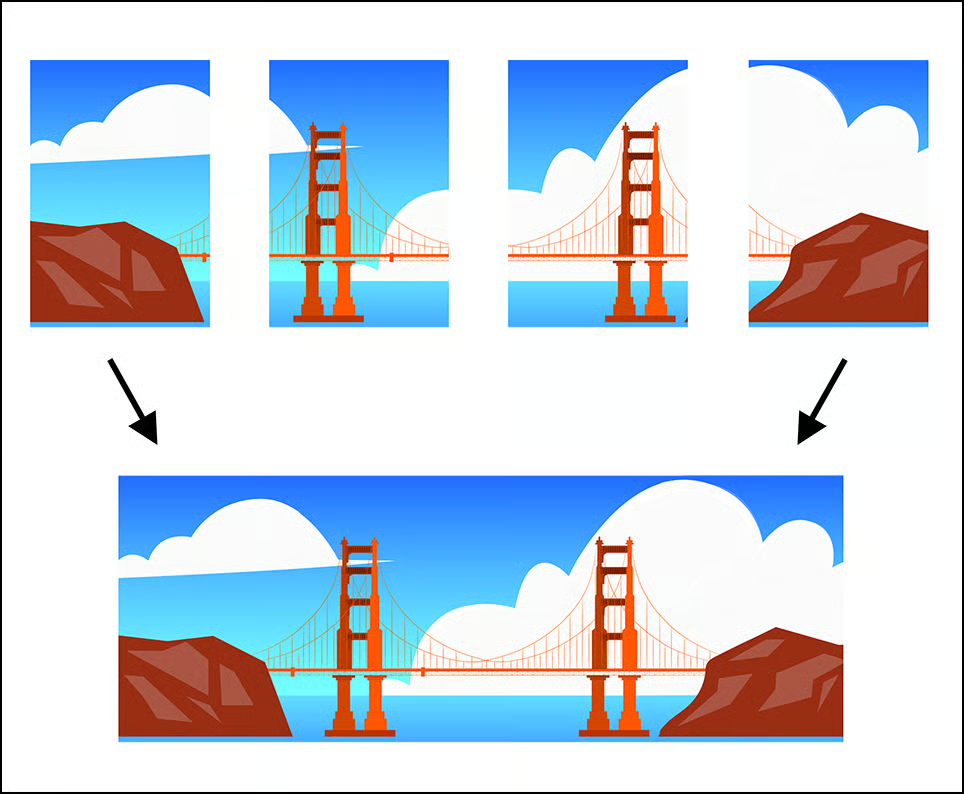
The Nikon Z8 paired with the Samyang 12mm f/2.8 ED AS NCS Fish-Eye is a fast, efficient 360° panorama combo. The Z8’s 45.7MP full-frame stacked BSI sensor (approx. 36×24 mm) captures high detail and wide dynamic range—around 14 stops at base ISO—while the camera’s electronic shutter eliminates shutter shock. Meanwhile, the Samyang 12mm f/2.8 is a diagonal fisheye covering a 180° diagonal field of view on full frame, letting you cover a full sphere with relatively few shots. It’s fully manual (focus and aperture), which is a benefit for panoramas where you want everything locked to ensure uniform exposure and color.
On the Z8, the lens is typically used via the Nikon FTZ/FTZ II adapter (Nikon F mount version of the Samyang 12mm). This combination maintains excellent optical alignment, and you can register the lens in the Z8’s Non-CPU lens data to enable properly tuned IBIS and EXIF metadata. The fisheye projection simplifies stitching because the lens sees a lot of the scene per frame, though you must manage fisheye distortion and carefully align the nodal point for parallax-free results.
Quick Setup Overview
- Camera: Nikon Z8 — full-frame 45.7MP stacked BSI CMOS; excellent DR at base ISO; 5-axis IBIS; electronic shutter only.
- Lens: Samyang 12mm f/2.8 ED AS NCS Fish-Eye — diagonal fisheye, 180° diagonal FOV on full frame; manual focus/aperture; best sharpness typically at f/5.6–f/8; moderate CA correctable in post.
- Estimated shots & overlap (tested): 6 around at 60° yaw increments + 1 zenith + 1 nadir (8 total) with 30–35% overlap. Outdoors with distant subjects, 5 around + Z + N can work, but 6+Z+N is safer. For extra safety or complex interiors, 8 around + Z + N.
- Difficulty: Moderate. The fisheye is forgiving for coverage but requires careful nodal alignment and consistent settings for clean stitches.
Planning & On-Site Preparation
Evaluate Shooting Environment
Walk the scene before you set up. Look for moving elements (people, cars, flags), hard highlights (sun, windows), reflections (glass, polished floors), and tight spaces where nearby objects increase parallax risk. If you must shoot against glass, place the lens as close as possible without touching to minimize reflections and flare; shield with a cloth or hood as needed. Note where the sun or bright lights are—lens flare is more likely with fisheye glass.
Match Gear to Scene Goals
The Z8’s clean low-ISO files and wide dynamic range at ISO 64–200 make it excellent for high-fidelity landscape and real-estate 360s. It tolerates ISO 800–1600 for night scenes with good noise control. The Samyang fisheye means fewer frames and faster capture, which reduces ghosting in scenes with motion and makes pole or rooftop work more efficient. Distortion is expected from a fisheye, but that’s normal for spherical 360 workflows—stitchers understand fisheye projection well.
Pre-shoot Checklist
- Power & storage: Fully charged batteries; dual high-speed cards. The Z8 is power-hungry—carry at least one spare.
- Clean optics: Front element and sensor/cover glass free of dust; fisheye front bulbs show dust easily.
- Tripod & head: Leveling base and a calibrated panoramic head with nodal alignment for this lens.
- Safety: Assess wind on rooftops; use tethers on poles and car mounts; never lean over edges; secure all clamps.
- Backup: Shoot an extra rotation when feasible (and an extra bracket set for HDR) in case of stitching issues.
Essential Gear & Setup
Core Gear
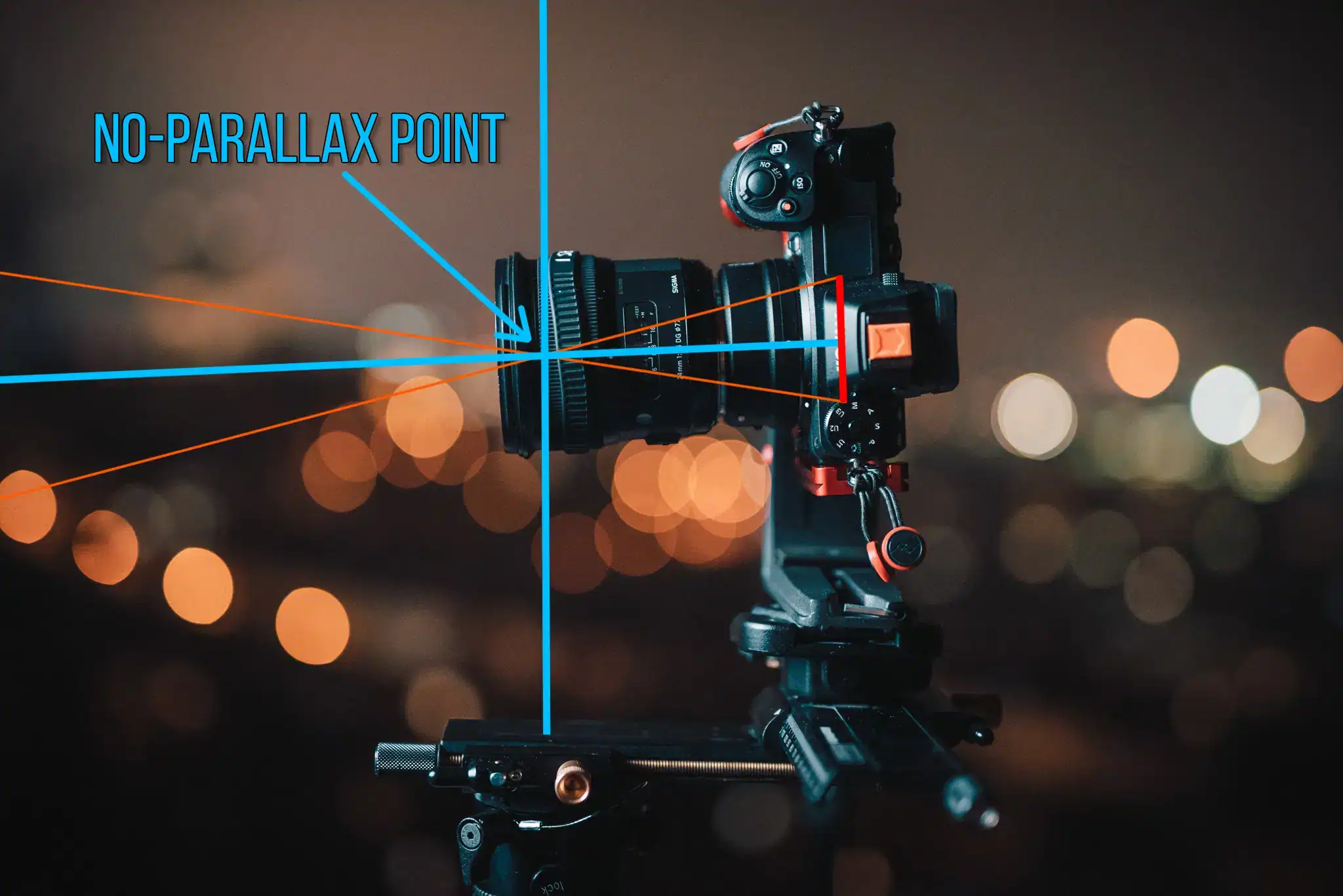
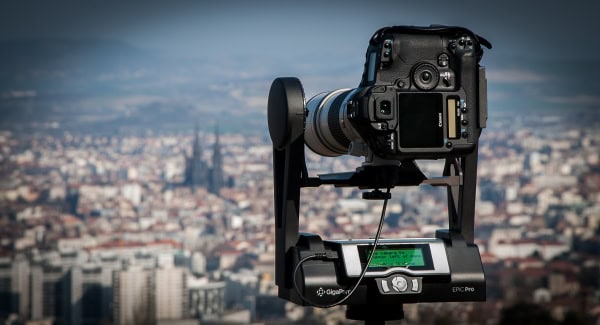
- Panoramic head: A proper pano head lets you rotate around the lens’s no-parallax point (entrance pupil). This eliminates parallax between foreground and background, making stitches clean even in tight interiors.
- Stable tripod with leveling base: Level the base, not just the head. That way, each yaw step holds the horizon—critical for consistent overlap.
- Remote trigger or SnapBridge: Trigger without touching the camera. The Z8’s electronic shutter helps, but minimizing physical contact avoids tripod oscillation.
Optional Add-ons
- Pole or car mount: Use safety tethers, tighten all clamps, and avoid gusty conditions. Reduce rotation speed to minimize vibration.
- Lighting aids: LED panels or flashes for dark interiors—balance color temperature carefully to avoid mixed WB.
- Weather protection: Rain covers, microfiber cloths, and a lens hood or hand shade to reduce flare from the fisheye.
For a deeper dive into setting up panoramic heads to avoid parallax, see this step-by-step reference from Meta’s Creator documentation on high-end 360 capture. Set up a panoramic head to shoot perfect high-end 360 photos
Step-by-Step Shooting Guide
Before You Start
In the Z8 Menu, add Non-CPU Lens Data for 12mm f/2.8 so IBIS is tuned. On a tripod, switch IBIS OFF to avoid micro-drift. Use the Z8’s virtual horizon display to level. Set exposure mode to Manual and white balance to a fixed preset or Kelvin value.
Standard Static Scenes
- Level tripod and align nodal point: Slide the camera on the pano rail so the lens’s entrance pupil sits on the rotation axis. As a starting point, many diagonal fisheyes align roughly 60–70 mm in front of the sensor plane, but calibrate precisely using the foreground-background alignment test.
- Manual exposure and locked WB: Meter the midtones, then lock exposure. For daylight, try ISO 64–100, f/8, 1/125–1/250. Set WB to Daylight or a Kelvin value (e.g., 5600K). Shoot RAW for flexibility.
- Capture sequence: With the Samyang 12mm fisheye, shoot 6 frames around at 60° yaw increments, then 1 zenith and 1 nadir. Aim for 30–35% overlap.
- Nadir shot: Tilt down to capture the ground for tripod removal. If the tripod foot is too big, consider a hand-held nadir shot from the rotation center after moving the tripod.
HDR / High Dynamic Range Interiors
- Bracket exposures: Use 3–5 frames per angle, typically ±2 EV or ±1 EV increments depending on contrast. The Z8 supports extensive AEB series—5 frames at ±2 EV is a great start for bright windows.
- Lock WB per bracket set: Keep WB constant across brackets to avoid color mismatches during merging.
- Keep the sequence consistent: For each yaw angle, complete all brackets before rotating to the next angle.
Low-Light / Night Scenes
- Use a tripod and remote: With the Z8’s electronic shutter, vibration is minimal, but stability is still crucial.
- Exposure strategy: f/4–f/5.6, ISO 200–800, and shutter times as needed (1/10–1 s). If you must raise ISO, 1600–3200 is acceptable; apply noise reduction in post.
- Watch LED banding: Under certain LED lighting, electronic shutter can introduce banding. Use High Frequency Flicker Reduction when needed.
Crowded Events
- Two-pass method: First pass for coverage, second pass to catch gaps in foot traffic. Markers or consistent timing can help you mask people later.
- Shorten shutter: Use 1/200 s or faster when freezing motion is key, and accept a slightly higher ISO to keep frames sharp.
Special Setups (Pole / Car / Rooftop)
- Secure everything: Safety tether the camera and head. On cars, use redundant mounts; avoid high speeds and rough roads during capture.
- Reduce shot count: The fisheye’s wide coverage lets you use 6 around + Z + N. Keep rotations smooth and deliberate to minimize pole oscillations.
Recommended Settings & Pro Tips
Exposure & Focus
| Scenario | Aperture | Shutter | ISO | Notes |
|---|---|---|---|---|
| Daylight outdoor | f/8–f/11 | 1/100–1/250 | 64–200 | Lock WB (Daylight/5600K); shoot RAW for best DR |
| Low light/night | f/4–f/5.6 | 1/10–1/60 | 200–800 (up to 1600–3200 if needed) | Tripod, remote; use HF Flicker Reduction for LEDs |
| Interior HDR | f/8 | Bracket ±2 EV | 64–400 | Expose for midtones; merge brackets before stitching |
| Action / moving subjects | f/5.6–f/8 | 1/200+ | 400–1600 | Freeze motion; consider two-pass capture |
Critical Tips
- Hyperfocal focus: At 12mm and f/8 on full frame, hyperfocal is roughly 0.6 m. Set manual focus slightly beyond 0.6 m and leave it there.
- Nodal calibration: Use a light stand near and a building edge far away. Rotate the camera; if the near object shifts against the background, slide the camera along the rail until the shift disappears. Mark this setting on your rail.
- White balance lock: Choose a Kelvin value or a matching preset across the entire sequence. Avoid Auto WB for panoramas.
- RAW priority: The Z8’s 14-bit RAW files preserve DR, helping with HDR merges and tough lighting.
- IBIS management: On tripod, turn off IBIS. Handheld or pole work can benefit from IBIS, but take care with consistent overlap.
If you’re curious how many shots your resolution will yield in equirectangular output, the PanoTools wiki has a helpful overview of DSLR spherical resolution. DSLR spherical resolution reference
Stitching & Post-Processing
Software Workflow
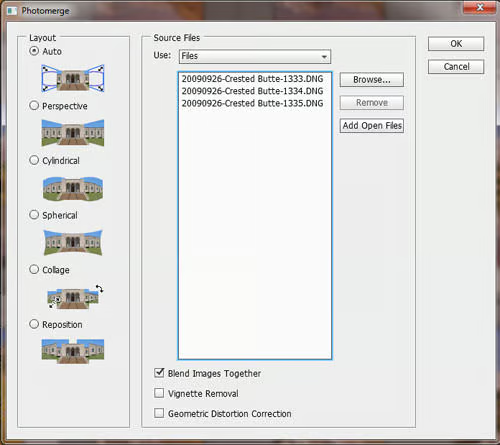
For this fisheye combo, PTGui is a top choice. Set lens type to Fisheye (let PTGui auto-detect if you prefer), add your images, and create control points. The fisheye simplifies stitching because you need fewer shots, though you’ll still patch the nadir and check verticals. Recommended overlap is ~30–35% for fisheyes. Hugin is a solid open-source alternative, and Lightroom/Photoshop can stitch simpler panoramas but are less specialized for full 360 equirectangulars. Why PTGui excels at 360 stitching
Cleanup & Enhancement
- Nadir patch: Export a layered panorama and patch the tripod using a separate nadir shot, AI tools, or manual clone/heal.
- Color & noise: Apply consistent color correction. Use luminance noise reduction for high-ISO frames; keep details natural.
- Leveling: Use pitch/roll/yaw tools to level the horizon and correct verticals. Ensure the horizon is dead-level for VR viewing.
- Output: Export as a 2:1 equirectangular JPEG (quality 90–100) or 16-bit TIFF for further editing. For web VR, 8K (7680×3840) is common; go higher if your workflow and hardware allow.
Recommended Video Tutorial
Visual learners often pick up faster with a walkthrough. Here’s a concise panoramic shooting tutorial that pairs well with this guide:
For a structured production pipeline that includes DSLR/mirrorless 360 capture and stitching for VR delivery, see the Creator guide from Meta. DSLR/Mirrorless 360 capture and stitch workflow
Useful Tools & Resources
Software
- PTGui panorama stitching
- Hugin open source
- Lightroom / Photoshop
- AI tripod/nadir removal tools
Hardware
- Panoramic heads (Nodal Ninja, Leofoto, Sunwayfoto)
- Carbon fiber tripods with leveling base
- Wireless remotes or apps
- Pole extensions / car mounts with tethers
Disclaimer: software/hardware names are provided for search reference; check official sites for specifications and compatibility.
If you’re new to panoramic heads, this practical overview is worth a read. Panoramic head basics and setup
Common Mistakes & How to Avoid Them
- Parallax errors: Always rotate around the lens’s entrance pupil and confirm with a near/far alignment test.
- Exposure flicker: Use Manual exposure and fixed WB. Avoid Auto ISO unless you lock it to one value.
- Missed coverage: Count your frames; for this setup, 6 around + Z + N is the safe baseline.
- Ghosting from movement: Take a second pass and mask moving subjects during stitching.
- Night noise and blur: Keep ISO modest, use a stable tripod, and trigger remotely. Choose longer shutter speeds over high ISO when possible.
- Fisheye flare: Shade the lens with your hand or time shots when bright lights are out of frame.
Real-World Case Studies
Indoor Real Estate (Mixed Lighting)
In a living room with bright windows, set ISO 64–100, f/8, and bracket ±2 EV across 5 frames. Shoot 6 around + Z + N. Merge HDRs per angle first, then stitch the fused images. Lock WB to 5000–5600K to avoid color shifts between frames.
Outdoor Sunset (High Contrast Sky)
Use a single exposure if the contrast is manageable (ISO 64, f/8, 1/125). If the sun is in frame, bracket ±2 EV. Expect flare; shield the lens and consider shooting a second frame with the sun occluded by your hand to blend in post.
Crowded Event (People Walking)
Use 1/200–1/320 s at f/5.6–f/8 and ISO 400–800. Do two rotations. In PTGui, select the cleanest bodies from either pass with masking. The fisheye’s wider coverage means fewer frames to manage motion across.
Rooftop / Pole Shooting
Wind is your main enemy. Keep the camera compact, minimize accessories, and rotate slowly. 6 around + Z + N is usually sufficient; patch the nadir later. Always tether your rig and keep a hand on the pole when near edges.
Frequently Asked Questions
- Can I shoot handheld panoramas with the Nikon Z8?
Yes for quick stitches, but for reliable 360 VR quality you need a tripod and pano head. Handheld increases parallax and overlap inconsistency, leading to stitching errors—especially indoors with nearby objects.
- Is the Samyang 12mm f/2.8 fisheye wide enough for single-row 360?
For a full sphere, plan 6 shots around plus zenith and nadir. A single horizon row alone won’t fully cover the zenith/nadir at 12mm diagonal fisheye, though a slight upward tilt can reduce the zenith hole outdoors.
- Do I need HDR for interiors with bright windows?
Usually yes. The Z8’s DR is strong at base ISO, but bright windows often exceed a single exposure. Bracket ±2 EV (3–5 frames) and fuse before stitching for clean, natural-looking results.
- How do I avoid parallax issues with this lens?
Use a calibrated panoramic head and align the entrance pupil. Start around 60–70 mm forward from the sensor plane and fine-tune with a near/far alignment test. Mark your rail once you find the sweet spot.
- What ISO range is safe on the Z8 in low light?
ISO 64–200 is ideal. ISO 800–1600 is still very clean; 3200 is usable with noise reduction; 6400+ is possible but expect more NR and detail smoothing. Prefer longer exposures on a tripod rather than pushing ISO.
- Can I create custom settings for pano work?
Yes. Save a preset with Manual exposure, fixed WB, RAW, IBIS off (tripod), electronic front settings not needed on Z8, and your preferred bracketing. This speeds up field setup substantially.
Safety, Workflow, and Trust Tips
- Always verify clamps and tethers before lifting poles or shooting near edges. Wind can topple even heavy tripods.
- Back up in the field: Copy to a second card or portable SSD after critical shoots. Consider dual card writing for redundancy.
- Keep a microfiber cloth handy: Fisheye front elements are vulnerable to smudges and raindrops.
- Be transparent with clients: The fisheye approach uses fewer frames but requires careful nodal setup and post-production for nadir patching; set expectations about turnaround.