
Why This Camera & Lens Are Great for Panoramas
The Nikon Z8 paired with the Canon EF 8–15mm f/4L Fisheye USM is a powerhouse combo for fast, high-coverage 360° capture. The Z8’s 45.7MP full‑frame stacked BSI CMOS sensor (35.9 × 23.9 mm) delivers excellent detail with wide dynamic range at base ISO 64, while its in‑body image stabilization (IBIS) and electronic shutter help produce vibration‑free frames on a tripod. The Canon fisheye zoom offers two useful panoramic behaviors on full frame: at 8mm it produces a circular fisheye image (~180° in all directions across the circle), minimizing shot count; at 15mm it becomes a 180° diagonal fisheye, preserving more edge detail with slightly more frames.
As this is a cross‑mount pairing, you’ll use a smart EF‑to‑Z adapter that supports electronic aperture control and EXIF pass‑through (brands like Fringer, Viltrox, and Commlite offer options; autofocus may be limited, but manual focus is preferred for panoramas). The fisheye’s predictable distortion is exactly what panorama software expects, and it reduces the total number of images needed compared to rectilinear lenses—especially handy in crowds, windy rooftops, or tight interiors.
Quick Setup Overview
- Camera: Nikon Z8 — full-frame 45.7MP stacked BSI CMOS (approx. 8256 × 5504). Pixel pitch ~4.35 µm; base ISO 64 with 14+ stops of measured dynamic range at base in field tests.
- Lens: Canon EF 8–15mm f/4L Fisheye USM — fisheye zoom (circular at 8mm; diagonal at 15mm), constant f/4. Best sharpness at f/5.6–f/8; mild lateral CA at the frame edges that is easily corrected in post.
- Estimated shots & overlap on full frame:
- 8mm circular fisheye: 4 around (90° yaw) + optional zenith + nadir; 25–35% overlap along the horizon. Advanced: 3 around (120°) possible with careful nodal alignment, but 4 is safer.
- 12mm fisheye: 5–6 around + zenith + nadir; 25–30% overlap.
- 15mm diagonal fisheye: 6 around + zenith + nadir (6+2), or 8 around in complex scenes for extra overlap.
- Difficulty: Easy–Moderate (2/5 with pano head; 3/5 handheld).
Planning & On-Site Preparation
Evaluate Shooting Environment
Before setting up, scan the scene for moving objects, bright windows, shiny surfaces, and obstacles near the lens. With fisheye lenses, anything too close to the front element can loom large—keep objects at least 50–100 cm away when possible. For glass interiors or car windows, shoot perpendicular to the glass and keep the front element a few centimeters away to reduce reflections. Remember that circular fisheyes see everything, including your feet and tripod legs—plan a nadir shot or later patch.
Match Gear to Scene Goals
The Nikon Z8’s base ISO 64 is a gift for real estate and sunsets—expect clean shadows and strong highlight recovery when you bracket. Its electronic shutter is silent and vibration‑free for long exposures. The EF 8–15mm’s fisheye coverage means fewer frames: critical in crowds or at events where subjects move between shots. For ultra‑clean indoor work, lean on the Z8’s dynamic range at ISO 64–200 and bracket ±2 EV; for hand‑held or windy outdoor shoots, ISO 200–800 is a reliable range on the Z8 with minimal quality loss.
Pre-shoot Checklist
- Charge batteries, format high‑speed cards, and clean lens front/rear elements (fisheye flare shows easily).
- Level your tripod; verify pano head settings and nodal calibration for 8mm and 15mm marks.
- Safety: use a stable tripod footprint, weight the center column if windy, and tether gear on rooftops or poles.
- Backup workflow: capture a second safety round (especially the nadir) and a fast reduced-pass set in case people moved.
Essential Gear & Setup
Core Gear
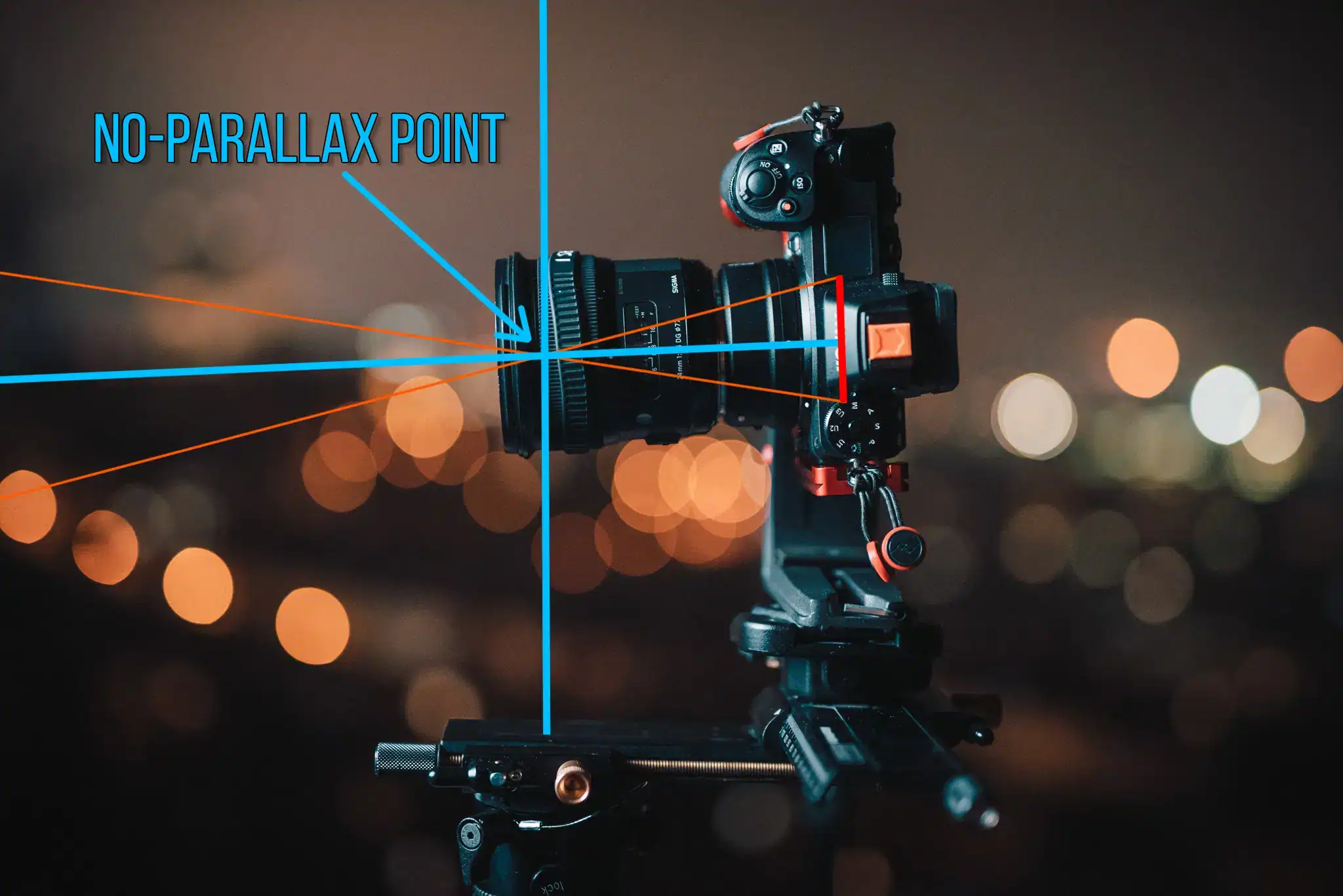
- Panoramic head: A calibrated panoramic head aligns the lens’s entrance pupil (nodal point) over the rotation axis to eliminate parallax between near and far objects. This is essential for perfect stitches with nearby subjects.
- Stable tripod with leveling base: A half‑ball or dedicated leveling base speeds setup and keeps yaw rotation level—key for consistent overlap and horizon control.
- Remote trigger or smartphone app: Even though the Z8’s electronic shutter is vibration‑free, use a remote or self‑timer to avoid touching the camera. Enable exposure delay if needed.
Optional Add-ons
- Pole or car mount: For elevated viewpoints or vehicle captures, add a safety tether and keep rotation slow to minimize flex. Watch wind loading and avoid crowded places where gear could fall.
- Small LED panels or flash for interiors: Gentle fill light can tame deep shadows in large rooms when bracketing alone isn’t enough.
- Weather protection: A rain cover, microfiber cloths, and a lens hood (remove the hood at 8mm to avoid hood intruding into the circular image) help maintain contrast and keep water off the front element.
New to panoramic heads? A step‑by‑step primer on pano head setup and entrance pupil alignment is invaluable. See this panoramic head tutorial for fundamentals at the end of this section. Panoramic head basics and alignment
Step-by-Step Shooting Guide
Standard Static Scenes
- Level tripod and align nodal point:
- Mount the Nikon Z8 + EF 8–15mm on your pano head via an EF‑to‑Z smart adapter.
- Use two vertical objects (one near, one far). Rotate the camera. If their relative position shifts, adjust the fore-aft rail until parallax disappears. Mark your rail positions for 8mm and 15mm on tape for repeatability.
- Manual exposure and white balance:
- Switch to M mode, set ISO, aperture, and shutter to expose the mid‑tones. Disable Auto ISO.
- Lock white balance (Daylight for sun, 3200–4000K for tungsten interiors, or set a custom Kelvin). This prevents visible seams from color shifts between frames.
- Capture sequence with overlap:
- At 8mm: shoot 4 frames around at 0° pitch, 90° yaw spacing, ensuring 25–35% overlap around the horizon. Optional: add 1 zenith and 1 nadir if you want dense coverage.
- At 15mm: shoot 6 frames around at 60° yaw, then 1 zenith and 1 nadir. Tilt up slightly on the around shots if you’re skipping a zenith frame, but ensure you still have overlap at the floor.
- Nadir capture for tripod removal:
- Either shoot a dedicated nadir frame by tilting down, or shoot a handheld nadir by carefully moving the tripod aside and placing the lens roughly over the previous rotation center.
HDR / High Dynamic Range Interiors
- Bracket ±2 EV: Use 3 or 5-frame brackets to balance bright windows and dim corners. Keep the aperture fixed (typically f/8) and vary shutter speed only.
- Lock WB and focus: Keep white balance and focus fixed across all brackets and angles to avoid stitch mismatches and color banding.
- Timing: For flickering LED or fluorescent lights, choose shutter speeds that are multiples of the local mains frequency (e.g., 1/50 or 1/60) to reduce banding with the Z8’s electronic shutter.
Low-Light / Night Scenes
- Stability first: Use a sturdy tripod; turn off IBIS on a tripod to avoid micro‑jitter. The Z8’s electronic shutter is silent and vibration‑free.
- Exposure: f/4–f/5.6, ISO 100–800, and longer shutter times (1–10 sec) are common. The Z8 remains very clean up to ISO 800–1600; use 1600 only if wind or movement forces shorter exposures.
- Remote or self‑timer: Trigger without touching the camera; enable Exposure Delay if needed to settle any residual vibrations from the head.
Crowded Events
- Two passes strategy: First capture quickly for coverage. Second, wait for gaps in the crowd or better poses, then re‑shoot frames that had motion problems.
- Masking later: In PTGui or similar, you can blend people from multiple passes and remove ghosting by masking.
Special Setups (Pole / Car / Drone)
- Pole: Attach a safety tether; keep exposures short (<1/60) to limit motion blur. Use 8mm to reduce shot count at elevation. Watch wind gusts and never operate over crowds.
- Car‑mounted: Use vibration‑damping mounts; don’t exceed safe road speeds for your rig; capture at stops for sharp frames. Consider 8mm and 4‑around for speed.
- Drone: The Z8 is heavy for most drones; instead, use a drone-designed camera. If you must, only with a certified heavy‑lift platform and proper permits.
Real-World Mini Case Studies
Indoor Real Estate
At ISO 64, f/8, bracket ±2 EV, 6 around at 15mm + zenith/nadir. This yields clean verticals and rich window detail with less fisheye stretch on furniture edges. Shoot a handheld nadir for a clean floor patch.
Outdoor Sunset
Use 8mm for speed: 4 around at ISO 64–100, f/8, and bracket if the sun is in frame. Shield the lens from flare with your hand—and make sure that hand isn’t in the shot. Consider an extra frame exposed for the sky for blending.
Event Crowds
Set 8mm, f/5.6–f/8, ISO 400–800, 1/125–1/250. Do two passes and mask people later. A fisheye minimizes the number of moments when someone walks through the stitch zone.
Recommended Settings & Pro Tips
Exposure & Focus
| Scenario | Aperture | Shutter | ISO | Notes |
|---|---|---|---|---|
| Daylight outdoor | f/8–f/11 | 1/100–1/250 | 100–200 | Lock WB (Daylight); 25–35% overlap |
| Low light/night | f/4–f/5.6 | 1/30–8s | 100–800 | Tripod, remote; disable IBIS on tripod |
| Interior HDR | f/8 | Bracket ±2 EV | 64–400 | Balance windows & lamps; keep shutter multiples of mains frequency indoors |
| Action / moving subjects | f/5.6–f/8 | 1/200+ | 400–800 | Faster shutter to freeze motion; consider two-pass method |
Critical Tips
- Manual focus at hyperfocal: At 8mm and f/8, focus around 0.5–1 m; depth‑of‑field covers to infinity. Switch AF off after focusing.
- Nodal calibration: Use near/far objects and rotate to remove parallax. Mark your rail positions for 8mm and 15mm so you can set them instantly in the field.
- White balance lock: Mixed lighting? Set a Kelvin value or custom WB. Consistent color is vital for seamless stitches.
- RAW over JPEG: RAW maximizes the Z8’s dynamic range and lets PTGui or your RAW processor remove CA and optimize tone mapping.
- IBIS and stabilization: Turn off IBIS on a tripod. With poles or handheld, IBIS can help—ensure the adapter reports focal length or set manual focal length data to match 8mm/15mm.
- Lens hood: Remove the hood at 8mm to avoid the hood intruding into the circular frame.
- Adapter notes: A smart EF‑to‑Z adapter with electronic aperture is required. AF isn’t critical for panos; manual focus is preferred.
Stitching & Post-Processing
Software Workflow
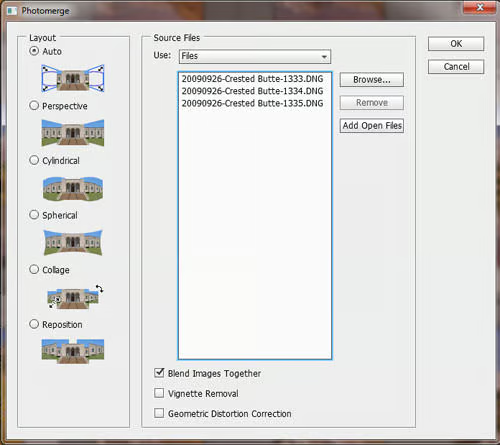
Import RAW files into Lightroom, Capture One, or similar, apply global WB and lens CA corrections, and export 16‑bit TIFFs to your stitcher. PTGui is the industry standard for spherical panos and handles fisheye data effortlessly; Hugin is a powerful open-source alternative. With fisheyes, aim for ~25–30% overlap along the horizon; rectilinear lenses can work with ~20–25% but require more shots. PTGui’s “Optimize” and “Viewpoint correction” tools are excellent for refining stitches and patching the nadir. Why many pros rely on PTGui for complex panoramas
Cleanup & Enhancement
- Nadir patch: Use PTGui’s Viewpoint correction, Photoshop’s Clone/Heal, or AI patching tools to remove the tripod and create a clean floor.
- Color and noise: Balance color casts across the set, and apply noise reduction where needed (especially if you pushed ISO 800–1600).
- Geometry: Level the horizon and set a neutral “front” view by adjusting yaw/pitch/roll. Use the panorama editor to pick a pleasing initial view.
- Export: Create a 2:1 equirectangular JPEG/TIFF for VR. With a 45.7MP sensor and 4‑around at 8mm, expect roughly 10–12K wide equirects depending on overlap and cropping; 6+2 at 15mm can climb higher. For theoretical coverage, see spherical resolution references. Understanding spherical resolution for DSLR panoramas
Want a concise walkthrough of capture and stitching? This video is a helpful overview for DSLR/mirrorless 360 photos:
If your goal is VR delivery (WebVR, Meta Quest), review platform-specific guidelines for equirectangular formatting, resolution, and metadata. Meta’s DSLR/mirrorless 360 photo guidance
Useful Tools & Resources
Software
- PTGui panorama stitching
- Hugin open source
- Lightroom / Photoshop for RAW processing and cleanup
- AI tripod removal tools for faster nadir patching
Hardware
- Panoramic heads (Nodal Ninja, Leofoto, Sunwayfoto)
- Carbon fiber tripods with leveling bases
- Wireless remote shutters or Nikon app control
- Pole extensions / car mounts with safety tethers
Disclaimer: brand names are for research starting points. Verify current compatibility and official documentation before purchase. For more on head setup and best practices, see: Pano head setup and parallax control
Common Mistakes & How to Avoid Them
- Parallax error → Align the entrance pupil using a pano head; avoid shooting handheld when nearby objects are in frame.
- Exposure flicker → Manual exposure and locked white balance; disable Auto ISO.
- Tripod in frame → Capture a nadir frame for patching, or use viewpoint correction later.
- Ghosting from moving subjects → Shoot two passes and mask in post.
- Noise at night → Keep ISO at 64–800 when possible and lengthen shutter on a tripod.
- Hood intrusion at 8mm → Remove the lens hood for circular fisheye shots.
- Adapter surprises → Test your EF‑to‑Z adapter; confirm aperture control, EXIF, and IBIS behavior. Set focal length manually if EXIF doesn’t pass through.
Frequently Asked Questions
-
Can I shoot handheld panoramas with the Nikon Z8?
Yes, especially outdoors with distant subjects. Use 8mm for fewer frames, ISO 200–800, 1/125–1/250, and overlap generously (35–40%). However, for interiors or near objects, a pano head is strongly recommended to avoid parallax.
-
Is the Canon EF 8–15mm wide enough for a single-row 360?
Absolutely. At 8mm on full frame it’s a circular fisheye—4 around often covers the sphere, with optional zenith/nadir. At 15mm (diagonal fisheye), plan 6 around + zenith + nadir for robust stitching.
-
Do I need HDR for interiors with bright windows?
Usually yes. The Z8’s dynamic range is excellent, but bright windows can exceed it. Bracket ±2 EV (3–5 shots) at f/8 and merge in PTGui or a RAW tool before stitching for natural results.
-
How do I avoid parallax issues with this setup?
Use a panoramic head and align the lens’s entrance pupil. Calibrate using near/far objects, and mark your rail positions for 8mm and 15mm. Keep the camera level and rotate only around the vertical axis.
-
What ISO range is safe on the Z8 in low light?
For tripod work, ISO 64–400 is ideal; ISO 800 remains very clean. If wind or motion requires faster shutter speeds, ISO 1600 is still usable with modest noise reduction.
-
Can I set up custom modes for panoramas on the Z8?
Yes. Save a “Pano” custom configuration with M mode, locked WB, manual focus, IBIS off (tripod), exposure delay, and your typical aperture. This speeds up on‑site workflow.
-
How do I reduce flare with a fisheye?
Avoid strong backlight when possible, use your hand or a flag just out of frame to shade the front element, and keep the glass spotless. Consider extra frames for blending overflared areas.
-
What panoramic head should I pick for this combo?
Choose a compact, precise head with fore‑aft and vertical adjustment (e.g., Nodal Ninja or Leofoto alternatives). It must allow repeatable marks for 8mm and 15mm entrance pupil positions.
Safety, Limitations & Data Integrity
Always tether your camera on rooftops or poles; don’t shoot over crowds with elevated rigs. The Z8’s electronic shutter can band under some artificial lighting—choose shutter speeds matched to mains frequency. Verify EF‑to‑Z adapter reliability before client work and carry a backup memory card strategy: duplicate to two cards if your workflow allows, and keep a second complete capture set whenever time permits. Panoramic heads can loosen over time—periodically check fasteners, and consider thread locker on non‑adjustable joints.
Further Reading
For a broader primer on DSLR/mirrorless 360 workflows beyond this specific combo, this community Q&A consolidates practical techniques and common pitfalls. Techniques to shoot 360 panoramas