Why This Camera & Lens Are Great for Panoramas
The Nikon Z7 II paired with the Sigma 15mm f/1.4 DG DN Diagonal Fisheye Art is an exceptional combo for high‑end 360° panorama work. The Z7 II’s 45.7MP full‑frame BSI CMOS sensor (35.9×23.9 mm) delivers outstanding resolving power with a pixel pitch of ~4.35 μm and class‑leading dynamic range at base ISO 64. That means cleaner shadows and better window retention in real estate, interiors, and sunset scenes. Its 5‑axis IBIS helps handheld frames, while EFCS and a sturdy mount make it excellent on a tripod. The Sigma 15mm f/1.4 DG DN Diagonal Fisheye Art covers a 180° diagonal field of view on full frame—ideal for reducing the number of shots needed for a full sphere while maintaining impressive edge sharpness when stopped down to f/5.6–f/8. Being a diagonal fisheye, distortion is intentional and predictable, which stitching software handles well when the lens is correctly profiled.
Important mount note: the Sigma 15mm f/1.4 DG DN Diagonal Fisheye Art is currently offered for Sony E and Leica/Panasonic/Sigma L mounts. To use it on a Nikon Z7 II, you need a reliable E‑to‑Z adapter (e.g., Megadap ETZ21 Pro/TZE adapters). Autofocus and aperture control typically pass through, but for 360 work you’ll often prefer manual focus and manual exposure anyway. Always test your adapter for mechanical fit, electronic reliability, and infinity focus before a paid shoot.
Quick Setup Overview
- Camera: Nikon Z7 II — full-frame (FX) 45.7MP BSI sensor; base ISO 64; ~14.5 EV dynamic range at base; 14‑bit RAW; 5‑axis IBIS.
- Lens: Sigma 15mm f/1.4 DG DN Diagonal Fisheye Art — diagonal fisheye with 180° diagonal FOV; very sharp stopped down; excellent coma control; low lateral CA for a fisheye; heavy, robust construction.
- Estimated shots & overlap (tested guidelines on full frame):
- Fast single row: 8 around at 0° tilt, ~30% overlap + 1 zenith + 1 nadir (safe for clean stitching).
- Efficiency mode: 6 around at +10° tilt + zenith + nadir (works outdoors; mind pole coverage).
- Maximum coverage: 2 rows, 6 shots at +30° and 6 shots at −30° + zenith + nadir (overkill but bulletproof for complex interiors).
- Difficulty: Moderate — fewer frames than rectilinear, but requires careful nodal alignment and disciplined exposure/WB control.
Planning & On-Site Preparation
Evaluate Shooting Environment
Walk the scene first. Look for moving people, cars, flags, foliage, and reflective surfaces like glass and polished floors. Moving elements cause ghosting; reflections reveal the photographer and tripod, demanding careful nadir work. If shooting through glass, get the front element as close as possible (1–3 cm) to minimize reflections; use a rubber lens shade if available and shoot perpendicular to the glass. Note light direction—fisheyes are prone to flare with strong backlight. Plan for bracketed HDR in interiors where windows are several stops brighter than interior walls.
Match Gear to Scene Goals
Here’s why the Nikon Z7 II & Sigma 15mm f/1.4 DG DN Diagonal Fisheye Art are a practical match. The Z7 II’s low base ISO 64 taps maximum dynamic range, crucial for HDR panoramas. Its sensor stays clean up to ISO 800–1600 for night cityscapes with a tripod. The 15mm diagonal fisheye reduces shot count, accelerating fieldwork while preserving detail for 8–20K equirectangular outputs. The tradeoff: fisheye distortion is part of the look. Stitchers handle it, but straight edges near frame borders can appear curved pre‑stitch; that’s expected.
Pre-shoot Checklist
- Charge EN‑EL15c batteries; carry a spare. Format fast UHS‑II or CFexpress memory cards.
- Clean the lens and sensor. Dust becomes glaring on large skies and interior walls.
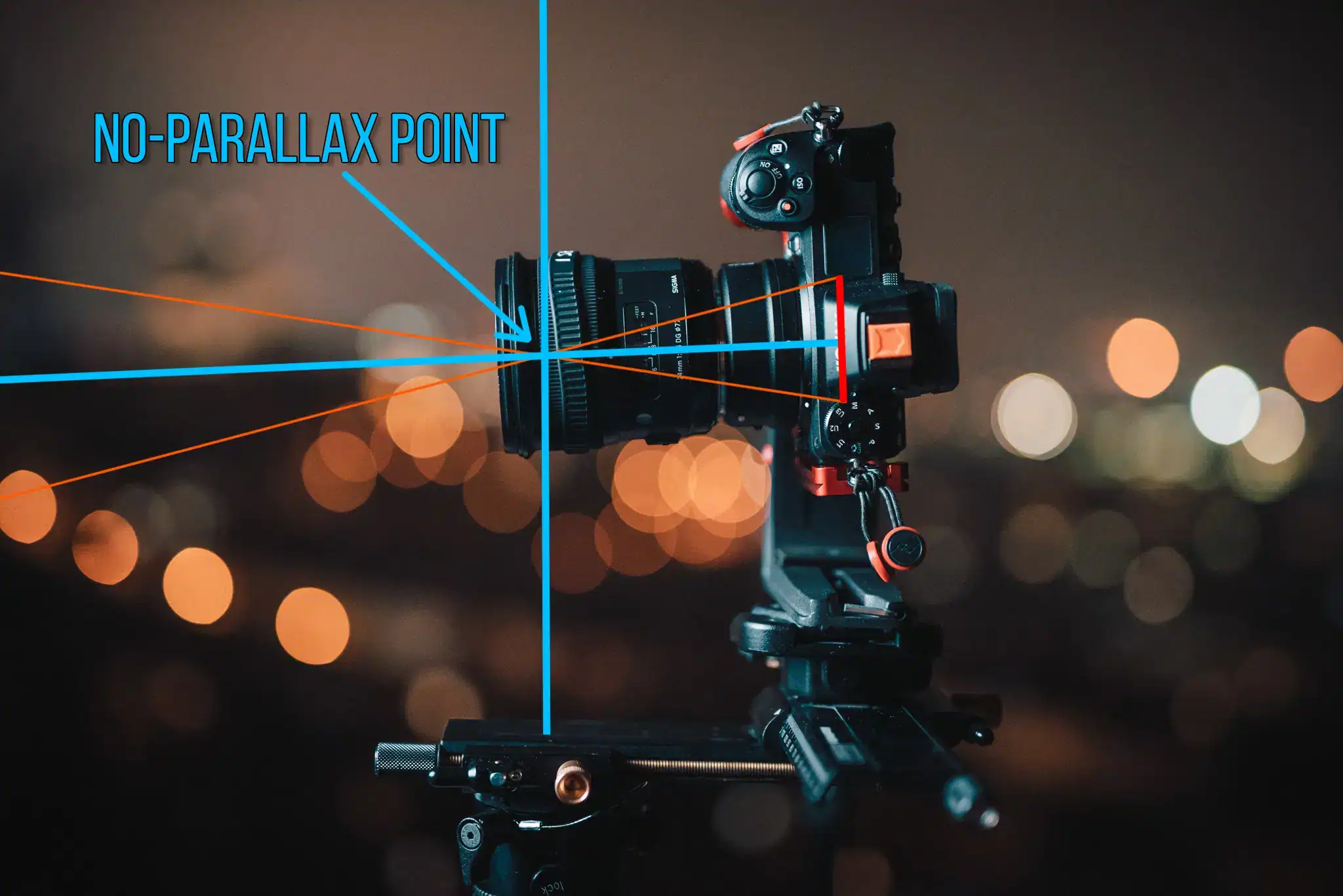
- Level your tripod and pre‑calibrate your panoramic head for the lens’s no‑parallax point.
- Safety: on rooftops use sandbags and tethers; in wind, reduce pole height and keep people clear of the rig; for car‑mounts, follow local laws and mount appropriately.
- Backup plan: shoot a second safety round and, for HDR, consider 5‑frame brackets in high‑contrast scenes.
Essential Gear & Setup
Core Gear
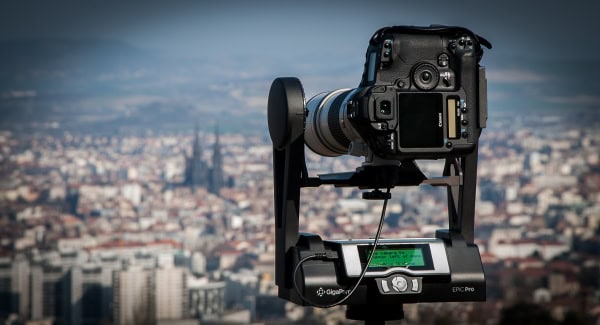
- Panoramic head: Enables rotation around the lens’s entrance pupil (nodal point) to eliminate parallax. Use a rail system with fore/aft adjustment and a vertical arm for precise nodal alignment.
- Stable tripod with a leveling base: A leveling base lets you level the head once and rotate freely, saving time and preventing horizon drift.
- Remote trigger or SnapBridge app: Fire the shutter without touching the camera; also useful for pole and car setups.
Optional Add-ons
- Extension pole or car mount: For elevated views or vehicle‑based capture. Use robust clamps, check torque, add a safety tether, and beware of wind load—this lens is big.
- Lighting aids: Small LED panels to balance dark corners in interiors. Avoid mixed color temps; set WB manually.
- Weather protection: Rain cover and microfiber cloths. Salt spray can etch coatings—wipe promptly.
New to panoramic heads and nodal alignment? This primer is a solid deep dive into best practices and setup logic. Read a panoramic head tutorial.
Step-by-Step Shooting Guide
Standard Static Scenes
- Level tripod and align the nodal point: On your panoramic head, slide the camera forward/back until near and far vertical objects stay aligned as you pan. Mark this position on the rail so you can repeat it quickly next time.
- Manual exposure and WB: Set M mode and lock exposure. Pick a neutral white balance (Daylight 5200K outdoors or a measured Kelvin) to avoid color shifts across frames.
- Focus: Switch to MF, zoom in with magnified live view, and focus near the hyperfocal distance. With a 15mm on full frame, at f/8 the hyperfocal is roughly 0.95 m; set around 1 m for crisp near‑to‑infinity coverage.
- Capture pattern: With this lens, 8 shots around at 0° tilt with ~30% overlap is very reliable. Rotate in even increments (every 45°). Add a zenith shot pointing up and a nadir shot pointing down.
- Nadir strategy: After the main round, either shoot a clean nadir by tilting the arm off‑center (viewpoint correction in PTGui) or shoot a handheld nadir and replace the tripod footprint later.
HDR / High Dynamic Range Interiors
- Bracket exposures: 3 or 5 frames at ±2 EV often balances bright windows and interior shadows. Keep aperture fixed and vary shutter speed.
- Lock WB and focus: Consistency across brackets prevents color shifts and alignment errors.
- Sequence: Complete all brackets at each yaw position before rotating to the next. Use auto‑bracketing and a 2‑second timer or remote trigger.
Low-Light / Night Scenes
- Use a tripod; turn IBIS off on solid support. Prefer EFCS to eliminate shutter shock. Long exposures are fine—let the sensor work at ISO 64–400 for best quality; ISO 800–1600 remains usable on the Z7 II if wind or movement demands faster shutter.
- Shield the lens from stray light with your hand just outside the frame; check for flare. Take a test frame and inspect highlights.
- Consider two passes: one for sky exposure, one for foreground, then blend if DR is extreme.
Crowded Events
- Two rotations technique: First pass quickly to establish coverage; second pass wait for gaps or better poses in each direction. You can mask in the best frames later.
- Use faster shutter speeds (1/200s+) at f/5.6–f/8 and ISO 400–800 to freeze people without motion smears.
Special Setups (Pole / Car / Drone)
- Pole: Keep the rig compact; the Sigma 15mm f/1.4 is heavy (~1.3 kg class). Use a carbon pole rated for the load, secure the camera with a safety tether, and avoid gusty conditions. Rotate slowly to reduce sway.
- Car: Use purpose‑built suction rigs and vibration‑isolating arms. Keep shutter speed high (1/500s+). Do not endanger traffic or violate regulations.
- Drone: This combo is not drone‑viable due to size/weight—use a native drone workflow instead.
Field Case Studies
Indoor Real Estate
Set ISO 100–200, f/8, bracket ±2 EV, 8 shots around + zenith + nadir. Keep the camera height consistent room‑to‑room. Watch for mirrors and glass—shoot an extra frame with you hidden and mask later.
Outdoor Sunset
Manual exposure at base ISO 64 for the sky; bracket two darker frames for foreground if needed. Flare is the enemy—compose so the sun star is partially occluded by architecture or trees.
Rooftop with Wind
Shorten the center column, add a sandbag, and use a lower pole section if elevating. Increase shutter to 1/125–1/250s at ISO 200–400 to keep every frame identical and sharp.
Recommended Settings & Pro Tips
Exposure & Focus
| Scenario | Aperture | Shutter | ISO | Notes |
|---|---|---|---|---|
| Daylight outdoor | f/8–f/11 | 1/100–1/250 | 64–200 | Lock WB to Daylight; enable EFCS; IBIS off on tripod |
| Low light/night | f/4–f/5.6 | 1/30–1/60 (tripod) or 1/125–1/250 (wind) | 200–800 (1600 max if needed) | Remote trigger; watch flare; shoot a sky pass if necessary |
| Interior HDR | f/8 | Bracket ±2 EV | 64–400 | 3–5 frames per angle; consistent WB |
| Action / moving subjects | f/5.6–f/8 | 1/200+ | 400–800 | Double pass and mask people in post |
Critical Tips
- Manual focus at hyperfocal (~1 m at f/8): guarantees near‑to‑infinity sharpness.
- Nodal calibration: Mark your fore/aft rail setting once you’ve found the no‑parallax point. Recheck if you change adapters or QR plates.
- White balance lock: Mixed lighting causes color seams; pick Kelvin and keep it fixed across the set.
- RAW over JPEG: 14‑bit NEF maximizes DR and lift in post, especially for HDR merges.
- Stabilization: Turn IBIS off on a tripod to avoid micro‑jitters. Handheld tests can use IBIS on.
- Shutter mode: Use electronic front curtain shutter (EFCS) to reduce vibration; full electronic can band under some LED lights—test first.
Stitching & Post-Processing
Software Workflow
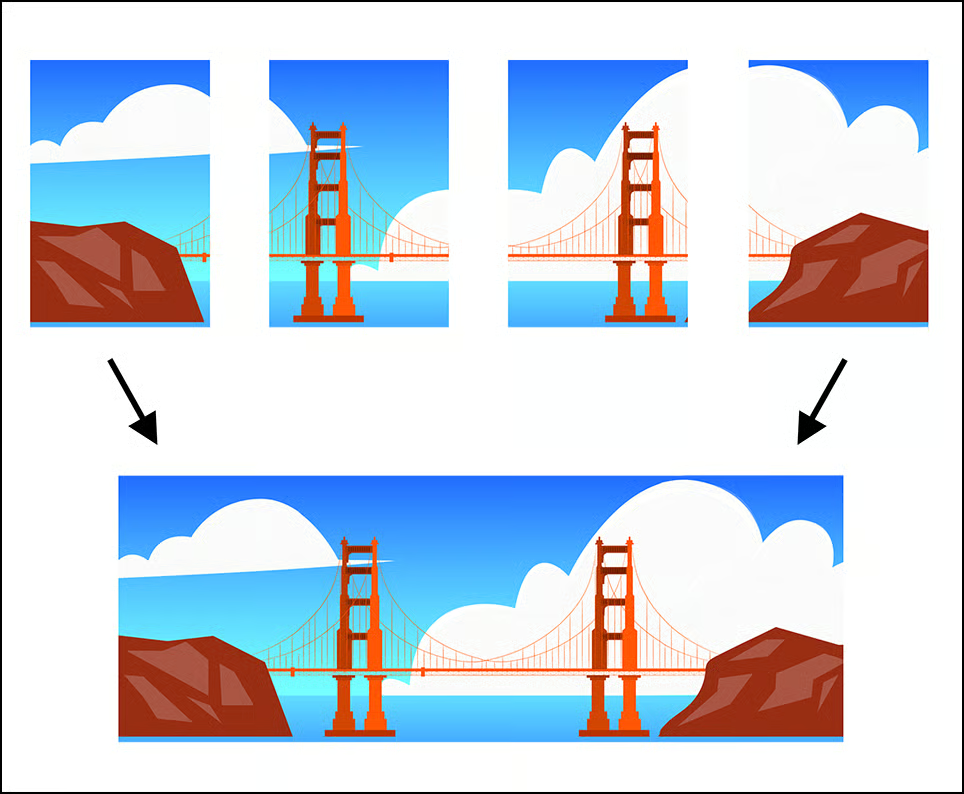
Import RAWs to Lightroom for basic lens corrections (turn off auto distortion if your stitcher handles fisheye geometry), apply consistent WB/exposure tweaks across the entire set, then export 16‑bit TIFFs to PTGui or Hugin. In PTGui, set Lens Type to Fisheye, FOV to approximately 180° diagonal (the optimizer will refine), and use control points automatically. Fisheye sets need about 25–30% overlap; rectilinear lenses would need 20–25% or more frames overall. PTGui’s Masking and Viewpoint Correction make nadir cleanup much easier. For many shooters, PTGui remains the fastest, most robust stitcher for mixed HDR+fisheye jobs. See an in‑depth PTGui review.
Cleanup & Enhancement
- Nadir patch: Use PTGui’s Viewpoint Correction or export to Photoshop to clone/patch the tripod. AI content‑aware tools help when the floor is textured.
- Color and noise: Balance highlights/shadows first, then apply modest noise reduction (the Z7 II stays very clean up to ISO 800). Watch chroma noise in deep shadows.
- Level and straighten: Use horizon tools to correct roll/yaw/pitch; keep vertical lines vertical for architecture.
- Export: For VR platforms, equirectangular JPEG 8K–12K is typical; for archive or high‑end deliverables, 16‑bit TIFF at 16K–20K width. Z7 II + 15mm FE often results in ~18–22K width depending on overlap and rows.
To understand how many pixels you can expect for full spheres with different lenses and cameras, consult the spherical resolution tables. Read PanoTools spherical resolution guidelines.
If you’re new to VR publishing and delivery formats, this step‑by‑step creator documentation is a helpful overview, including equirectangular preparation and metadata. Using a mirrorless camera to shoot and stitch a 360 photo.
Video: Panoramic Head Setup & Stitching Basics
Prefer to watch a quick primer before you shoot? Here’s a concise video that complements the steps above.
Useful Tools & Resources
Software
- PTGui for fast, robust fisheye stitching and masking
- Hugin (open source) for detailed control
- Lightroom / Photoshop for RAW prep and retouching
- AI tools for tripod/nadir removal and people masking
Hardware
- Panoramic heads (Nodal Ninja, Leofoto, Really Right Stuff)
- Carbon fiber tripods with leveling bases
- Wireless remotes or SnapBridge app control
- Pole extensions and vehicle mounts with safety tethers
Disclaimer: product names are for reference; check official sites for specs and compatibility.
For a broader panorama gear overview and lens recommendations for virtual tours, this guide is a helpful supplement. Virtual tour camera and lens guide.
Common Mistakes & How to Avoid Them
- Parallax error: Always rotate around the entrance pupil; re‑check nodal alignment if your adapter or QR plate changes the geometry.
- Exposure flicker: Lock exposure and WB across the set; don’t use auto ISO or auto WB for panoramas.
- Tripod shadows and footprints: Shoot a clean nadir frame and patch later; mind your shadow at golden hour.
- Ghosting from movement: Use double passes and mask in post; increase shutter speed for crowd shots.
- Noise at night: Prefer longer exposures at low ISO rather than pushing ISO high; the Z7 II rewards patience.
- Adapter pitfalls: If using an E‑to‑Z adapter, test for aperture control reliability and infinity focus; switch to manual focus for consistency.
Frequently Asked Questions
- Can I shoot handheld panoramas with the Nikon Z7 II?
Yes for partial panos or quick 360s in bright light, but a tripod and panoramic head are strongly recommended. Handheld 360s with a fisheye can work if you rotate around your body’s center and keep overlap high, but expect stitching errors near foreground objects. For professional work, use a leveled tripod and nodal head.
- Is the Sigma 15mm f/1.4 DG DN Diagonal Fisheye Art wide enough for a single‑row 360?
Usually yes with extra pole shots. A robust pattern is 8 around at 0° tilt plus zenith and nadir. Outdoors you can try 6 around at +10° tilt plus poles, but ensure 25–30% overlap and check for gaps near the zenith.
- Do I need HDR for interiors with bright windows?
Often yes. Bracket ±2 EV (3 or 5 frames) to retain window detail and clean interior shadows. The Z7 II’s base ISO 64 DR is strong, but sunny windows can exceed it. Merge HDR before or during stitching (PTGui can handle HDR stacks).
- How do I avoid parallax issues with this lens and an adapter?
Mount the Z7 II on a panoramic head, slide the camera along the rail to find the entrance pupil, and mark that setting. If you change adapters or plates, re‑test. Use near/far verticals to confirm alignment as you pan.
- What ISO range is safe on the Z7 II in low light?
For tripod work, aim for ISO 64–400 and extend shutter times. If wind or motion forces faster shutter, ISO 800–1600 is still clean, especially if you expose to the right and process from 14‑bit NEF files.
Inspiration & Field Examples
Safety, Reliability, and Data Protection
The Sigma 15mm f/1.4 fisheye is sizable; ensure your panoramic head’s vertical arm and rotator are rated for the combined weight of camera + lens + adapter. Tighten all clamps, use a safety tether on rooftops, and never leave the rig unattended in crowds. Turn off IBIS on a tripod to prevent sensor drift. For data integrity, write to both card slots when possible, keep a second card on you, and back up immediately after the shoot to two locations. When time allows, shoot a duplicate rotation as a safety take—this is invaluable if a single frame was bumped or blurred.
Coverage & Resolution Estimates
With a 45.7MP Z7 II file (8256×5504), the 15mm diagonal fisheye yields roughly 150° horizontal FOV. That’s about 55 px/degree horizontally, translating to an equirectangular around 18K–20K width for an 8‑around pattern once overlap, blending, and optimization are considered. Two‑row capture can push beyond 20K with cleaner poles, which is useful for high‑end VR tours and large wall displays. These are practical numbers; exact results depend on overlap and your stitcher’s optimization.
Final Thoughts: How to Shoot Panorama with Nikon Z7 II & Sigma 15mm f/1.4 DG DN Diagonal Fisheye Art
This combo is a speed machine for pro‑quality 360s: fewer frames than rectilinear lenses, excellent DR from the Z7 II, and exceptional optical performance from Sigma’s fisheye when stopped down. Get the fundamentals right—nodal alignment, locked exposure/WB, disciplined overlap—and your stitches will be clean and consistent. For deeper fundamentals and a refresher on panoramic head setup, this structured guide is worth bookmarking. Set up a panoramic head for high‑end 360 photos.