
Why This Camera & Lens Are Great for Panoramas
If you want to learn how to shoot panorama with Nikon Z6 II & Sigma 8mm f/3.5 EX DG Circular Fisheye, this combo is a proven, efficient path to high-quality 360° capture. The Nikon Z6 II’s 24.5MP full-frame BSI CMOS sensor (35.9 × 23.9 mm) offers excellent low-light performance, roughly 14+ stops of dynamic range at base ISO, and a generous pixel pitch (~5.9 µm) that keeps noise under control during dusk and interior work. Its in-body image stabilization (IBIS), robust bracketing, silent shutter, and reliable manual focus aids (magnification and peaking) make it a strong body for both tripod and pole workflows.
The Sigma 8mm f/3.5 EX DG Circular Fisheye is a circular fisheye that projects a 180° field of view in all directions onto a circular image on full frame. For panoramas, that means fewer shots to cover the full sphere, faster capture in dynamic scenes, and easier stitching. Distortion is intentional (fisheye mapping), which stitching software understands well. On Z-mount, use the FTZ II adapter with the Nikon F-mount version of this Sigma lens; autofocus compatibility can vary by lens revision, but for 360 work you’ll be using manual focus anyway, so it’s not a limitation.
Bottom line: the Z6 II’s image quality and the Sigma 8mm’s extreme coverage deliver speed and reliability for single-row 360 photos with minimal frames, especially valuable in real estate, venues, tourism, and events where time and motion are factors.
Quick Setup Overview
- Camera: Nikon Z6 II — Full-frame 24.5MP BSI CMOS; strong DR at ISO 100; practical low-light ISO 100–1600 for panoramas.
- Lens: Sigma 8mm f/3.5 EX DG Circular Fisheye — circular fisheye mapping; sharp stopped to f/5.6–f/8; minimal lateral CA after correction; very bulbous front element (handle with care).
- Estimated shots & overlap (field-tested):
- Fast set: 4 around at 90° yaw, 0° pitch + 1 nadir (total 5). ~30% overlap.
- Minimal set: 3 around at 120° yaw, 0° pitch + optional nadir. Requires accurate nodal alignment and careful overlap.
- HDR interiors: same frame counts, bracket ±2 EV (3–5 frames) per position.
- Difficulty: Easy–Moderate (easy capture, careful nodal alignment needed for perfect stitches).
Planning & On-Site Preparation
Evaluate Shooting Environment
Walk the scene first. Note moving people, flags, trees, or vehicles; wind strength; reflective surfaces such as glass or polished floors; and direct sun sources that may flare this bulbous fisheye. If shooting through glass, keep the lens as close as safely possible to reduce reflections and minimize ghosting. Observe the closest objects you’ll include—anything within ~0.7 m demands spot-on nodal alignment with a circular fisheye to avoid parallax.
Match Gear to Scene Goals
The Nikon Z6 II offers clean files at ISO 100–800 and still-usable results up to ISO 1600–3200 for night scenes. Its 14-bit RAW and wide DR preserve highlight detail at sunsets and windowed interiors. The Sigma 8mm’s ultra-wide coverage reduces the number of shots, crucial when people move, the wind shakes a pole, or traffic flows. The trade-off: fisheye mapping exaggerates curvature of straight edges; proper leveling and careful software interpretation are essential to keep walls and horizons looking natural in the final projection.
Pre-shoot Checklist
- Power & storage: Full batteries for body, clean SD/CFexpress cards, and a spare. Consider writing to both slots for redundancy.
- Optics: Clean the lens and sensor (the Sigma’s front element attracts dust/flare). Carry a microfiber cloth and blower.
- Support: Leveling base on tripod, panoramic head calibrated for this camera/lens, and a remote (SnapBridge app or cable).
- Safety: On rooftops or poles, tether the rig; check wind; avoid standing under the gear; secure the tripod legs.
- Backup workflow: If time allows, shoot a second pass. If crowds move, a second pass simplifies masking later.
Essential Gear & Setup
Core Gear
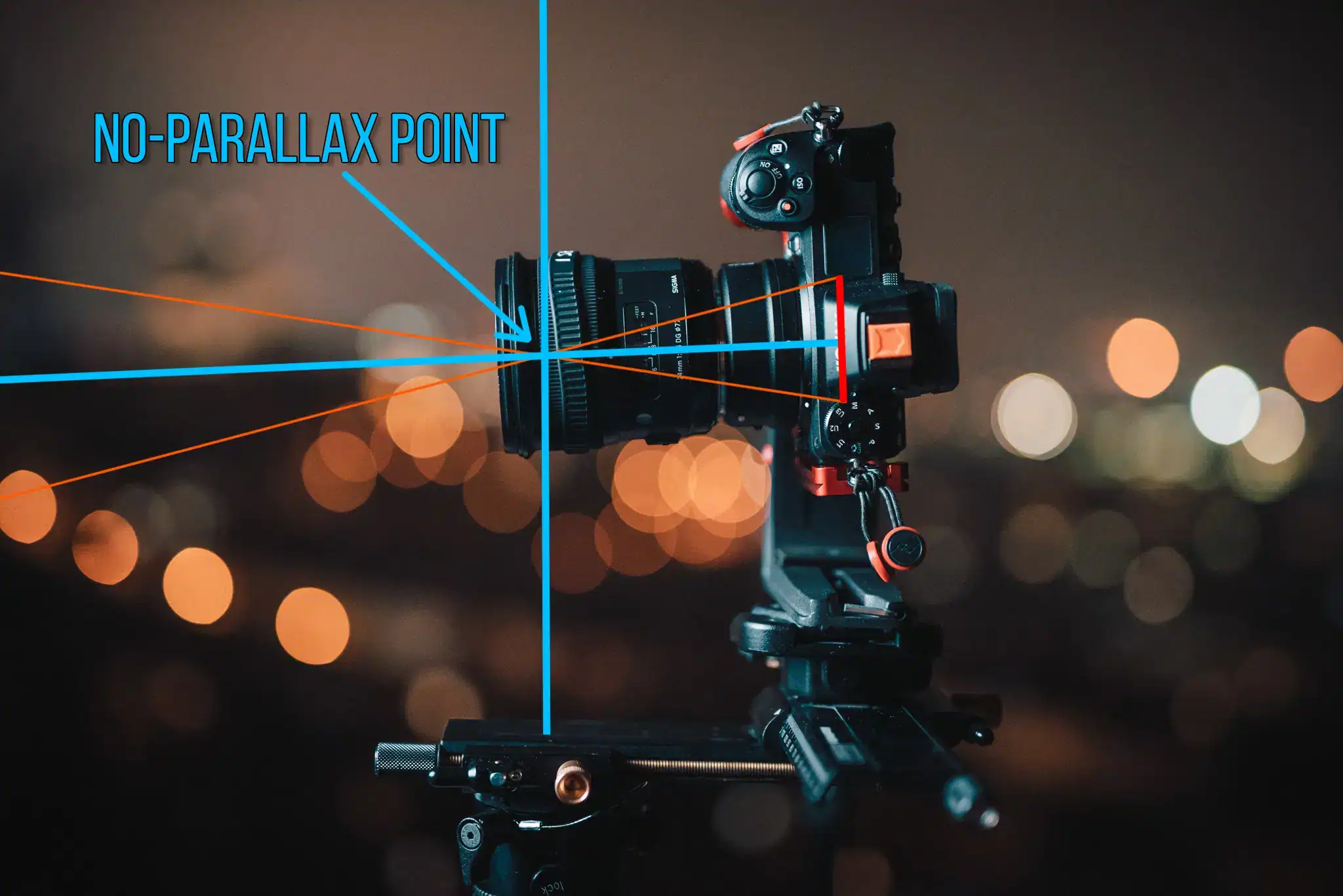
- Panoramic head: Allows rotation around the lens’s entrance pupil (nodal point) to eliminate parallax when nearby objects overlap between frames.
- Stable tripod with leveling base: A level base ensures yaw-only rotation; this keeps the horizon true and simplifies stitching.
- Remote trigger or phone app: Fire shots without touching the camera to prevent micro-blur. The Z6 II works well with Nikon SnapBridge.
Optional Add-ons
- Pole or car mount: Great for elevated views or moving platforms. Always add a safety tether, minimize wind exposure, and watch vibration.
- Lighting tools: A small LED for dark corners on interior jobs; avoid mixed color temperatures where possible.
- Weather protection: Rain cover for the Z6 II; lens hood ring protectors; microfiber cloths for drizzle or sea spray.
Step-by-Step Shooting Guide
Standard Static Scenes
- Level and align nodal point: Level the tripod using the base and head levels. Calibrate the panoramic head so the lens’s entrance pupil sits exactly over the rotation axis. For the Z6 II + Sigma 8mm, a typical starting rail offset (from the camera’s tripod socket toward the lens) is around 65–75 mm; refine with a close foreground object and a distant background line—rotate left/right and adjust until there’s no relative shift.
- Manual exposure and white balance: Set M mode with a fixed ISO, shutter, and aperture. Lock WB (e.g., Daylight or a custom Kelvin) to avoid color mismatches between frames. Disable auto ISO and exposure smoothing.
- Capture sequence with overlap:
- Recommended: 4 around at 0° pitch, yaw at 0°/90°/180°/270°, then 1 nadir with the camera tilted down. This yields generous overlap for clean stitches.
- Minimal: 3 around at 0° pitch, yaw at 0°/120°/240°, plus an optional nadir. Use only if you’ve nailed nodal alignment and the scene is forgiving.
- Nadir (ground) shot: Tilt down to capture clean ground where the tripod sits. If your panoramic head supports a small lateral shift (or use a handheld “viewpoint” shot), it makes patching easier.
HDR / High Dynamic Range Interiors
- Bracket exposures per position: Use 3–5 exposures at ±2 EV to retain window highlights and lift interior shadows. Keep the aperture constant.
- Lock WB and focus: Maintain consistent color and focus across all brackets and positions to prevent stitching artifacts.
Low-Light / Night Scenes
- Use longer shutter speeds with a sturdy setup: Start around f/4–f/5.6, ISO 400–800, and adjust shutter to expose to the right without clipping highlights.
- Trigger remotely and use EFCS: Enable Electronic Front-Curtain Shutter on the Z6 II, and turn IBIS off when on a tripod to prevent sensor micro-movements.
Crowded Events
- Shoot two passes: First, get the full coverage; second, wait for gaps or ask people to pause briefly. Keep rotations smooth and fast.
- Blend in post: Use masks to choose the cleanest frame for each area, minimizing ghosting.
Special Setups (Pole / Car / Drone)
- Pole: Tether everything, avoid strong winds, and spin more slowly between frames. The 8mm’s low frame count helps before vibrations cause blur.
- Car mount: Choose smooth pavement, lower tire pressure slightly if safe, and keep shutter speeds higher (1/200–1/400) to freeze micro shake between frames.
Recommended Settings & Pro Tips
Exposure & Focus
| Scenario | Aperture | Shutter | ISO | Notes |
|---|---|---|---|---|
| Daylight outdoor | f/8–f/11 | 1/100–1/250 | 100–200 | Lock WB (Daylight); disable in‑camera lens corrections for consistent mapping |
| Low light / night | f/4–f/5.6 | 1/30–1/60 (or longer on tripod) | 400–800 (1600 if needed) | Remote trigger; IBIS off on tripod; enable EFCS |
| Interior HDR | f/8 | Bracket ±2 EV (3–5 frames) | 100–400 | Expose for windows in one bracket, shadows in another |
| Action / moving subjects | f/5.6–f/8 | 1/200+ | 400–800 | Freeze motion; consider two-pass shooting for clean composites |
Critical Tips
- Manual focus near hyperfocal: At 8mm on full frame, f/8 gives an extremely short hyperfocal distance (~0.3–0.5 m). Set MF around 0.4–0.5 m and verify with magnification; use focus peaking on the Z6 II if needed.
- Nodal calibration: Start with ~70 mm rail offset, then refine using a nearby object and distant line as references. Record your final rail marks on gaffer tape for quick setups later.
- White balance lock: Choose a consistent WB or custom Kelvin to avoid mismatched color between frames and brackets.
- Shoot RAW: Keep 14-bit RAW for maximum dynamic range and robust color correction. Disable in-camera distortion/vignette corrections for fully predictable fisheye mapping in the stitcher.
- IBIS off on tripod: Prevent micro-oscillation. Combine with remote trigger and EFCS to minimize vibrations.
Stitching & Post-Processing
Software Workflow
Import RAW files into Lightroom or your preferred RAW processor. Correct chromatic aberration if needed but avoid heavy lens “de-fish” corrections—your stitcher wants fisheye mapping. In PTGui or Hugin, set lens type to circular fisheye with 180° FoV and let the optimizer place control points. For this 8mm circular fisheye, 25–30% overlap is sufficient and typically stitches cleanly with 3–4 around. Export to an equirectangular 2:1 panorama (e.g., 8192×4096 or 12K+ for high-end work). For a deeper review of PTGui’s strengths and workflow, see this overview from Fstoppers at the end of this paragraph. PTGui reviewed: powerful tool for complex panoramas.
Cleanup & Enhancement
- Tripod/nadir patch: Use a “viewpoint” optimized nadir frame in PTGui or clone the tripod out in Photoshop. Many virtual tour tools now include AI-based nadir patching.
- Color & noise: Match white balance across brackets, perform global color correction, and apply moderate noise reduction for night shots.
- Level & orientation: Level the horizon and set a pleasing initial view (yaw/pitch/roll) before export.
- Delivery: Export high-quality JPEG (e.g., 90–95% quality) or 16-bit TIFF if further editing is needed. For VR platforms, confirm the 2:1 equirectangular format.
Want a concise overview for DSLR/mirrorless 360 workflows and platform-ready output? Read the official guidance from Meta’s creator docs linked here. Using a DSLR or mirrorless to shoot and stitch a 360 photo.
Video: Panoramic Head Fundamentals
If you’re new to panoramic heads and nodal alignment, this video will help you visualize the setup before you head out.
For a primer on panoramic head principles and common pitfalls, see this accessible tutorial. Panoramic head tutorial and tips.

Useful Tools & Resources
Software
- PTGui panorama stitching
- Hugin (open source)
- Lightroom / Photoshop / Affinity Photo
- AI nadir patching tools in virtual tour platforms
Hardware
- Panoramic heads: Nodal Ninja, Leofoto, and similar
- Carbon fiber tripods with a leveling base
- Wireless remote shutters or SnapBridge app
- Pole extensions or vehicle mounts with safety tethers
Disclaimer: Names above are for search/reference. Check the official sites and manuals for the latest specs and procedures.
Common Mistakes & How to Avoid Them
- Parallax error: Calibrate the entrance pupil carefully and record your rail settings.
- Exposure flicker: Use manual exposure and locked WB; disable auto ISO.
- Tripod shadows and footprints: Capture a nadir and patch it cleanly in post.
- Ghosting from moving subjects: Shoot a second pass and mask in post.
- Night-time noise and blur: Use stable support, EFCS, remote trigger, and the lowest workable ISO.
- Flare with fisheye: Shield the lens from direct sun, avoid strong backlight angles, and clean the front element frequently.
Field Examples & Use Cases
Indoor Real Estate
Bracket ±2 EV at each yaw position to preserve window detail. Keep the tripod centered in the room for symmetry, level the base, and avoid placing the lens too close to furniture edges that exaggerate curvature. The Z6 II’s clean ISO 100–400 keeps interiors crisp; f/8 ensures deep DOF.
Outdoor Sunset
Meter for highlights first; shoot a 3–5 shot bracket per position if the sky is bright. The Sigma 8mm keeps frames to a minimum so you can finish before light changes. Keep ISO 100–200; consider 4 around + nadir for maximum overlap.
Event Crowds
Use 4 around at 1/200–1/400, f/5.6–f/8, ISO 400–800. Shoot a second pass when people shift. The Z6 II’s silent mode reduces distraction and micromovement during capture.
Rooftop or Pole Shooting
Wind is the real enemy. Use a compact pole, tether, and high shutter speeds. Keep your yaw steps smooth and pause between shots to let vibrations settle. The circular fisheye’s minimal frames reduce risk of misalignment from sway.
Car-Mounted Capture
Park and shoot static frames rather than rolling shots to avoid stitching issues. If you must capture quickly, aim for 1/400 with ISO 800–1600, and expect to mask moving objects in post.
Frequently Asked Questions
-
Can I shoot handheld panoramas with the Nikon Z6 II?
Yes, but expect more stitching errors with close foregrounds. The Sigma 8mm’s wide coverage helps, yet for clean interiors and precise lines a tripod with a calibrated panoramic head is strongly recommended.
-
Is the Sigma 8mm f/3.5 wide enough for a single-row 360?
Absolutely. With a circular fisheye on full frame, 3–4 shots around cover the sphere horizontally. Add a nadir to remove the tripod footprint. Four around + nadir is a safe, reliable pattern.
-
Do I need HDR for interiors with bright windows?
In most real estate or high-contrast interiors, yes. Use ±2 EV bracketing (3–5 frames) at each yaw position to preserve both window highlights and interior shadows, then merge before or during stitching.
-
How do I avoid parallax issues with this lens?
Mount the Z6 II and Sigma 8mm on a panoramic head, align the lens’s entrance pupil over the rotation axis, and avoid very close objects if your calibration isn’t perfect. Record your rail marks for quick repeatability.
-
What ISO range is safe on the Z6 II for low light panoramas?
For tripod-based panos, ISO 100–800 is ideal; push to ISO 1600 for night if necessary. Use EFCS, remote trigger, and long exposures instead of very high ISO to preserve detail and color.
Extra Technical Notes & Good Practices
- FTZ II adapter: The Sigma 8mm f/3.5 EX DG in Nikon F mount works well via FTZ II. Autofocus behavior can vary by lens version; manual focus is preferred for 360 work.
- Entrance pupil vs nodal point: In pano parlance, “nodal point” often refers to the entrance pupil—rotate about this point to eliminate parallax.
- Overlap targets: For fisheye panoramas, 25–30% overlap is a good baseline. More overlap makes control point placement easier and reduces stitching artifacts.
- Output resolution: A 24.5MP sensor with 4–5 frames can comfortably deliver 8K equirectangulars for virtual tours. For technical background on spherical resolution with DSLRs, see this reference. DSLR spherical resolution considerations.
Final Notes on Reliability and Safety
The Nikon Z6 II + Sigma 8mm f/3.5 circular fisheye delivers speed and dependable results when properly set up. Always lock exposure, WB, and focus; disable IBIS on tripod; and use EFCS with a remote trigger. Note the Sigma’s exposed front element—use a cap when moving between locations, and keep a microfiber cloth handy. On rooftops and poles, tether your gear and work with a spotter if possible. Lastly, verify your software is up to date—PTGui, Hugin, and RAW processors evolve, and their latest documentation may refine steps or improve results.