
Why This Camera & Lens Are Great for Panoramas
The Nikon Z6 II and the Sigma 14-24mm f/2.8 DG DN Art make a powerful combo for panoramic and 360 photo work. The Z6 II’s 24.5MP full-frame BSI CMOS sensor (approx. 35.9 × 23.9 mm; pixel pitch ~5.9 µm) delivers excellent low-light performance and a wide dynamic range at base ISO, giving you clean tonal recovery in highlights and shadows. Its 5-axis in-body stabilization (IBIS) helps when you need to shoot handheld or on a pole, and the electronic front-curtain shutter (EFCS) minimizes vibration for tack-sharp tripod work. The Sigma 14-24mm f/2.8 DG DN Art is a rectilinear ultra-wide zoom known for high corner-to-corner sharpness, well-controlled coma, and low chromatic aberration, with a fast f/2.8 maximum aperture for interiors and night scenes.
Important mount note: the 14-24mm f/2.8 DG DN Art is made in Sony E and L-mount. To use it on a Nikon Z6 II you’ll need a reliable E-to-Z adapter (for example, Megadap ETZ21 Pro or Techart TZE-01). Aperture control and autofocus generally work, but performance and compatibility depend on firmware. If you prefer a native or no-adapter route, an alternative is the Sigma 14-24mm f/2.8 DG HSM Art (Nikon F) via Nikon’s FTZ adapter, or Nikon’s own Z 14-30mm f/4 S. This guide assumes you’re using the DG DN via a compatible E-to-Z adapter and focuses on the shooting workflow for this focal range.
Quick Setup Overview
- Camera: Nikon Z6 II — Full-frame (24.5MP), excellent DR at ISO 100–200, strong high-ISO performance, 5-axis IBIS, EFCS for reduced vibration.
- Lens: Sigma 14-24mm f/2.8 DG DN Art — Rectilinear ultra-wide zoom; sharp across the frame from f/5.6–f/8, low CA, bulbous front element (no standard screw-in filters), fixed hood; ideal for architecture and landscapes.
- Mount note: Use a quality Sony E-to-Nikon Z adapter (e.g., Megadap ETZ21 Pro). Confirm firmware for AF/aperture control; consider supporting the lens on the pano head to reduce stress on the thin adapter.
- Estimated shots & overlap for 360×180 equirectangular:
- 14mm: 3 rows × 6 around (−45°, 0°, +45°) + zenith + nadir = 20 images (≈30% overlap)
- 18mm: 3 rows × 8 around + Z + N = 26 images
- 24mm: 4 rows × 8 around + Z + N = 34 images
- Difficulty: Moderate. Requires nodal alignment and consistent exposure, but very manageable with practice.
Planning & On-Site Preparation
Evaluate Shooting Environment
Survey the scene for dynamic range (bright windows and dark corners), reflective surfaces (glass, polished floors), and motion (people, foliage, traffic). For windows and glass, shoot slightly off-angle to minimize reflections and flare. If you must shoot against glass, press a rubber lens hood lightly to the glass or stand 10–20 cm away to reduce double reflections. Avoid strong backlight directly hitting the bulbous front element—use your hand or the lens hood to flag the sun.
Match Gear to Scene Goals
The Z6 II’s wide DR at base ISO and clean shadows up to ISO 800 make it a reliable indoor-and-outdoor body for panoramas. The Sigma 14-24mm’s rectilinear rendering keeps architecture straight, making it a go-to for real estate, interiors, and cityscapes. At 14mm, you can cover a full sphere with fewer images than longer focal lengths, reducing total stitch points and labor. At 24mm, you’ll capture finer detail (useful for gigapixel-style results) at the cost of more frames.
Pre-shoot Checklist
- Power and storage: Two fully charged EN-EL15c batteries and multiple fast UHS-II cards.
- Clean optics: Gently clean the front element to avoid flare and ghosting; check sensor for dust.
- Tripod and pano head: Level the base. Verify your nodal (no-parallax) point settings for 14mm and 24mm.
- Safety: On rooftops or high-wind areas, tether the camera, weight the tripod, and watch the lens hood catch the wind. For car mounts/poles, double-check clamps and safety lines.
- Backup: Shoot an extra “safety round,” especially for commercial jobs. If time allows, do one clockwise and one counterclockwise pass.
Essential Gear & Setup
Core Gear
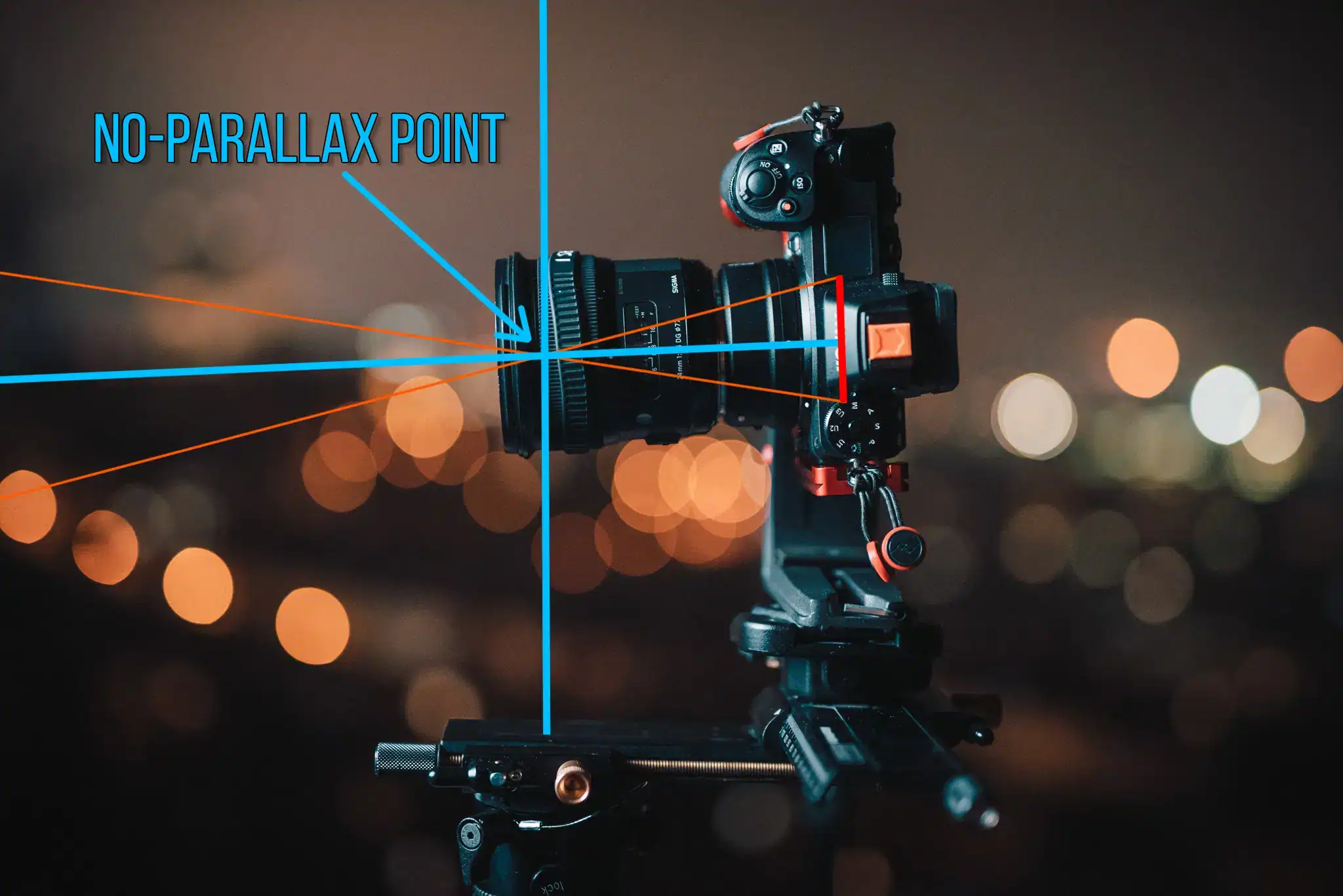
- Panoramic head: A two-axis panoramic head lets you align the lens’s entrance pupil (nodal point) over the rotation axis to eliminate parallax. This matters most when foreground objects are close or when shooting interior architecture.
- Stable tripod with leveling base: A leveling base speeds setup and keeps your horizon consistent across rows.
- Remote trigger/Nikon SnapBridge app: Fire the shutter without touching the camera. Enable EFCS on the Z6 II to reduce micro-vibrations.
Optional Add-ons
- Pole or car mount: Use a rigid pole and safety tethers. Wind can flex the system—use faster shutter speeds, higher ISO if needed, and shoot fewer, more overlapped frames to reduce misalignments.
- Lighting aids: For low-light interiors, a dim continuous light for patching the nadir or balancing dark corners (keep it subtle to avoid visible falloff between frames).
- Weather protection: A rain cover and microfiber cloths; the Sigma’s large front element needs extra care in mist or spray.
Step-by-Step Shooting Guide
Standard Static Scenes
- Level and lock: Use the tripod’s leveling base and the Z6 II’s virtual horizon. A level base keeps your row pitch consistent.
- Align the entrance pupil: Place two vertical objects (near and far) overlapping in the frame. Rotate the camera; adjust the rail until the relative position doesn’t shift. Mark the rail position for 14mm and 24mm so you can recall it quickly. Expect slightly different nodal settings across focal lengths.
- Manual exposure and white balance: Set M mode. Pick a consistent WB (Daylight/Tungsten) to avoid stitching color shifts. Shoot RAW for maximum dynamic range.
- Focus: Use manual focus. At 14–18mm, set near the hyperfocal distance (around 1–1.5 m at f/8) to keep everything sharp. Disable IBIS on a tripod to prevent sensor micro-movements between frames.
- Capture pattern:
- At 14mm: rows at −45°, 0°, +45°, 6 shots per row (60° yaw steps), then zenith and nadir.
- At 24mm: four rows (e.g., −60°, −20°, +20°, +60°), 8 shots per row (45° yaw steps), plus zenith and nadir.
- Nadir shot: After the main set, move the tripod slightly or shoot handheld for a clean floor patch. Keep the camera roughly over the nodal point to minimize parallax errors.
HDR / High Dynamic Range Interiors
- Bracket for windows: The Z6 II supports up to 9-frame exposure bracketing. For interiors, a practical choice is 5 frames at 1 EV steps (−2 to +2 EV). Alternatively, manually shoot −2/0/+2 for a 3-shot HDR set.
- Lock WB and shutter mode: Keep WB fixed. Use EFCS and a remote for consistent results across brackets and frames.
- Keep order: Always shoot brackets in the same order and mark the sequence verbally or with a note so post-processing is easier.
Low-Light / Night Scenes
- Exposure strategy: Use f/4–f/5.6, shutter 1/30–1/60 sec on tripod, and ISO 200–800. The Z6 II is clean up to ISO 1600; for critical commercial work, ISO 100–800 is the sweet spot.
- Reduce vibration: Turn off IBIS on tripod, enable EFCS, use a remote, and raise mirrorless “exposure delay” if you’re seeing any residual shake.
- Watch moving lights: Cars and signs may cause light streaks and stitching mismatch; time your shots so moving objects appear consistently across frames.
Crowded Events
- Two-pass method: First pass fast to lock the background; second pass capture “clean plates” for problem areas when people move away.
- Faster shutter: Go 1/200–1/250 sec at f/5.6–f/8, ISO 400–800 to freeze motion. You’ll blend/mask in post.
- Overlap more: Increase overlap to 35–40% to give the stitcher more options with moving subjects.
Special Setups (Pole / Car / Drone)
- Safety first: Use a safety tether, inspect clamps, and never stand under the rig. For car rigs, avoid highways; drive slowly on smooth surfaces.
- Vibration management: Use higher shutter speeds (1/250–1/500), slightly higher ISO, and shoot fewer frames with more overlap to mitigate micro-shifts.
- Leveling: A pendulum leveler or gimbal can help keep rows even on a pole; fix residual roll in post.
Recommended Settings & Pro Tips
Exposure & Focus
| Scenario | Aperture | Shutter | ISO | Notes |
|---|---|---|---|---|
| Daylight outdoor | f/8–f/11 | 1/100–1/250 | 100–200 | Lock WB (Daylight); EFCS on tripod |
| Low light/night | f/4–f/5.6 | 1/30–1/60 | 200–800 | Remote trigger; IBIS off on tripod |
| Interior HDR | f/8 | Bracket 5×1 EV | 100–400 | Balance windows and lamps; keep WB fixed |
| Action / moving crowd | f/5.6–f/8 | 1/200+ | 400–800 | Two passes; mask in post |
Critical Tips
- Manual focus at hyperfocal: At 14mm f/8, hyperfocal is roughly around 1 m; focus slightly beyond that for sharpness from near to infinity.
- Nodal point calibration: Mark repeatable rail positions for 14mm, 18mm, and 24mm. Slight differences matter with close foregrounds.
- White balance lock: Mixed lighting can vary frame-to-frame. Lock WB to avoid hard-to-fix color seams.
- RAW over JPEG: 14-bit NEF gives you headroom for highlight recovery and clean shadows in HDR merges.
- IBIS and tripod: Turn IBIS off on a tripod. Leave it on for handheld/pole work.
- Filter note: The Sigma’s bulbous front element limits filter use. If you need ND, use a rear-gel or a dedicated holder system designed for this lens.
Stitching & Post-Processing
Software Workflow
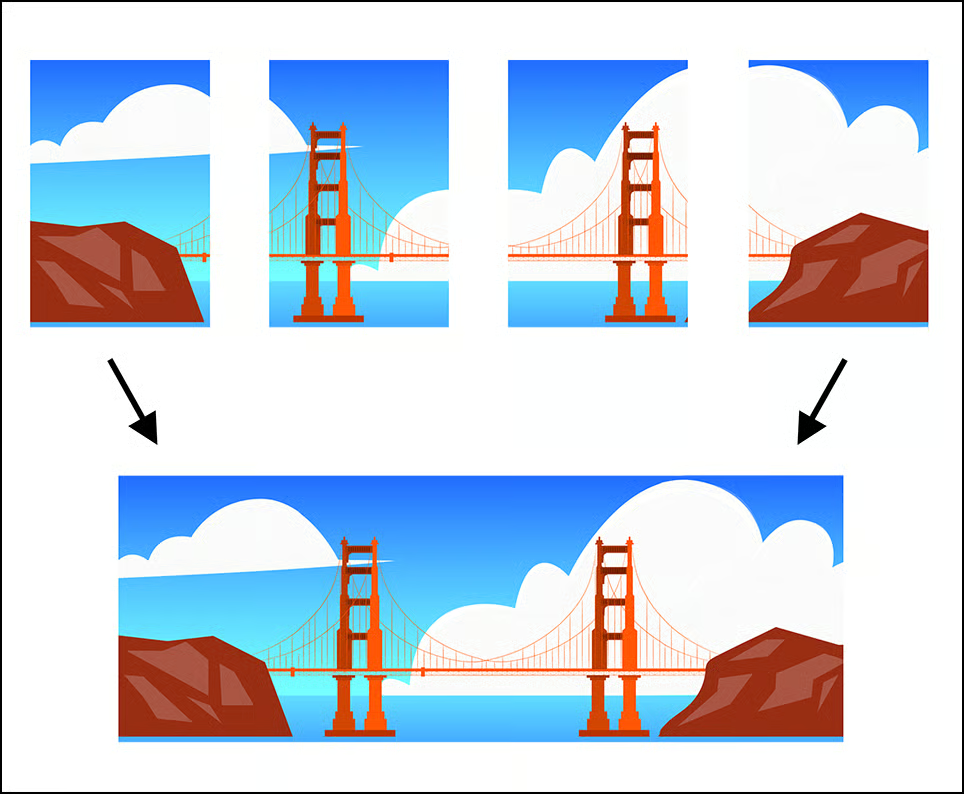
Import RAW files into Lightroom or your preferred RAW processor. Sync WB and exposure settings across each row and bracket group. For HDR panoramas, merge brackets first (Lightroom HDR Merge or SNS-HDR) or let PTGui handle HDR internally. As a rule of thumb, fisheye workflows need fewer images but require defishing; rectilinear ultra-wide like 14–24mm need more frames but provide more consistent geometry at the edges. Aim for 25–35% overlap horizontally and vertically for robust control point generation. For high-end control, PTGui remains an industry standard; Hugin is a capable open-source alternative. See a practical review of PTGui’s strengths for complex stitches at the end of this section. Why PTGui is a top tool for panorama stitching.
Cleanup & Enhancement
- Nadir patch: Export a layered panorama and clone out the tripod, or use a branded patch/AI tool. Save a clean equirectangular master.
- Color and noise: Balance color across rows and apply modest noise reduction on low-light frames. Avoid over-smoothing detail.
- Leveling: Correct roll, yaw, and pitch so the horizon is straight. PTGui’s optimizer and vertical line control points help.
- Export: For virtual tours, export a 2:1 equirectangular JPEG (8–16k on the long edge depending on your use case). Many platforms prefer sRGB and under 100 MB. For VR guidance, see platform-specific docs. Shooting and stitching 360 photos for VR platforms.
If you’re new to nodal alignment, a panoramic head tutorial with diagrams can accelerate your learning. Panoramic head setup tutorial.
Useful Tools & Resources
Software
- PTGui — fast, precise stitches with HDR and masking
- Hugin — capable open-source stitcher
- Lightroom / Photoshop — RAW prep, retouching, nadir patching
- AI tools — tripod removal and cleanup assistance
Hardware
- Panoramic heads (Nodal Ninja, Leofoto, Sunwayfoto)
- Carbon fiber tripods with leveling base
- Wireless remotes and L-plates
- Pole extensions and car mounts with safety tethers
- Sony E-to-Nikon Z adapter (Megadap ETZ21 Pro / Techart TZE-01) for the DG DN lens
Disclaimer: Product names are for reference. Check current specifications and firmware on official sites.
Common Mistakes & How to Avoid Them
- Parallax errors: The #1 panorama killer. Calibrate the nodal point and keep it consistent across rows.
- Exposure flicker: Use Manual mode, fixed WB, and fixed focus. Avoid auto ISO for critical work.
- Tripod shadows/repeats: Shoot a nadir plate and patch it later.
- Ghosting from motion: Shoot two passes and mask; increase overlap to give the stitcher more options.
- IBIS on tripod: Turn IBIS off to prevent frame-to-frame micro-shifts.
- Adapter stress: The DG DN is front-heavy. Support the lens on the pano head; don’t let the thin E–Z adapter carry all the torque.
Frequently Asked Questions
- Can I shoot handheld panoramas with the Nikon Z6 II?
Yes, especially for single-row panos. Use 1/250 sec or faster, IBIS on, and 30–40% overlap. For full 360×180 scenes, a tripod and panoramic head are strongly recommended for clean nadirs and minimal parallax.
- Is the Sigma 14-24mm f/2.8 DG DN Art wide enough for single-row 360s?
Not for a complete 360×180 in a single row. At 14mm rectilinear you typically need 3 rows plus zenith and nadir. Single-row works for cylindrical or partial panos (landscapes) but not for full spheres.
- Do I need HDR for interiors with bright windows?
Usually, yes. The Z6 II has solid DR, but windows often exceed sensor latitude. Bracket 5 frames at 1 EV steps (−2 to +2 EV) and merge for clean highlights and shadow detail.
- How do I avoid parallax issues with this lens?
Use a pano head and align the entrance pupil over the rotation axis. Calibrate at 14mm and again at 24mm; mark rail positions. Keep foreground objects from brushing the frame edges, and maintain consistent camera height.
- What ISO range is safe on the Z6 II for low light panos?
For commercial-quality work, ISO 100–800 is ideal on a tripod. ISO 1600 is still very usable; beyond that, noise increases and can make HDR merges more delicate.
- Adapter concerns: can I reliably use the DG DN on my Z6 II?
With a quality E-to-Z adapter (Megadap ETZ21 Pro, Techart TZE-01) and current firmware, many users report solid results. Support the lens on the pano head to reduce stress on the adapter, and expect to handle lens corrections in software rather than in-camera profiles.
Want to go deeper into frame counts versus focal length? The Panotools wiki is an excellent reference for spherical coverage math. DSLR spherical resolution reference.
Field-Tested Scenarios
Indoor Real Estate
Shoot at 14–16mm, f/8, ISO 100–200 on a tripod. Bracket 5×1 EV for windows. Keep overlap at ~30–35%. Watch reflective surfaces like chrome fixtures or mirrors—frame so the camera isn’t directly visible, or plan to mask the reflection in post. Keep lights either all on or all off to reduce color cast mixing.
Outdoor Sunset Cityscape
Start 15 minutes before sunset to capture a base pano in softer light. Then repeat during blue hour for clean building lights. Consider two separate stitches—one for sky color and one for building detail—and blend in post for a “time blend” effect.
Event with Moderate Crowd
Run a fast base pass at 1/200 sec, ISO 400–800. Then wait for gaps to shoot clean plates for key problem areas (entrances, signs). In PTGui, use masks to select the best people from each frame.
Rooftop or Pole Shooting
Use a safety tether, short pole, and faster shutter (1/250–1/500). Stick to a simpler pattern (fewer frames, more overlap) to minimize stitch issues from flex. Avoid gusts or add a guy-line to stabilize the pole.
Trust & Safety Notes
Bulbous ultra-wide lenses are prone to flare and front-element damage. Always carry a cap and a microfiber cloth. In wind, the lens hood can act like a sail—keep a hand on the rig and add weight to your tripod. Back up your files in the field (dual cards help) or clone to a portable SSD after each location. For adapter setups, periodically check tightness between body, adapter, and lens—tiny play can introduce stitch alignment errors.
For more background on pano technique and gear choices, this comprehensive DSLR/virtual tour guide is a solid perspective piece: DSLR and mirrorless virtual tour guide.