
Why This Camera & Lens Are Great for Panoramas
The Nikon Z6 II paired with the Nikon Z 14–24mm f/2.8 S is a robust, pro-leaning combo for panoramic and 360° photography. The Z6 II uses a 24.5 MP full-frame (35.9 × 23.9 mm) BSI CMOS sensor with excellent pixel pitch (~5.9 μm) and strong base-ISO dynamic range (~14 stops at ISO 100). That means clean files, flexible shadows, and less stitching noise in low light. Its in-body image stabilization (IBIS) helps for handheld or pole work (turn it off on a tripod), and the body’s weather sealing and dual card slots support reliable field workflows.
The Z 14–24mm f/2.8 S is an ultra-wide rectilinear zoom known for high corner sharpness, very low distortion for its class, controlled coma, and excellent flare resistance with its supplied hood. It’s not a fisheye, so you’ll shoot more frames than an 8mm FE, but you’ll gain straight lines—critical for architecture and real estate. At 14mm, vertical field of view is generous, and in portrait orientation you can cover the entire sphere with 2–3 rows plus zenith/nadir shots. In short, this kit balances speed, quality, and versatility for creators learning how to shoot panorama with Nikon Z6 II & Nikon Z 14-24mm f/2.8 S.
Quick Setup Overview
- Camera: Nikon Z6 II — Full-frame 24.5 MP BSI CMOS; ~14 EV DR at ISO 100; clean up to ISO 1600–3200 with careful exposure; IBIS for non-tripod use.
- Lens: Nikon Z 14–24mm f/2.8 S — rectilinear ultra-wide zoom. Sharp from wide open; peak sharpness around f/5.6–f/8; mild geometric distortion; strong flare control with hood; vignette lowers by f/5.6–f/8.
- Estimated shots & overlap (tested, portrait orientation):
- At 14mm: 3 rows × 8 around (yaw steps ~45°) at -40°, 0°, +40° + zenith + nadir = 26–28 shots with generous overlap and easy stitches.
- Fast capture: 2 rows × 8 around at -35°, +35° + zenith + nadir = 18–20 shots; keep 25–30% overlap and mind edges for clean control points.
- At 20–24mm: expect 10–12 around per row (portrait), 3 rows + Z/N for high-resolution gigapixel-style output.
- Difficulty: Intermediate (rectilinear 14mm needs nodal alignment and multi-row technique, but stitches very cleanly when done right).
Planning & On-Site Preparation
Evaluate Shooting Environment
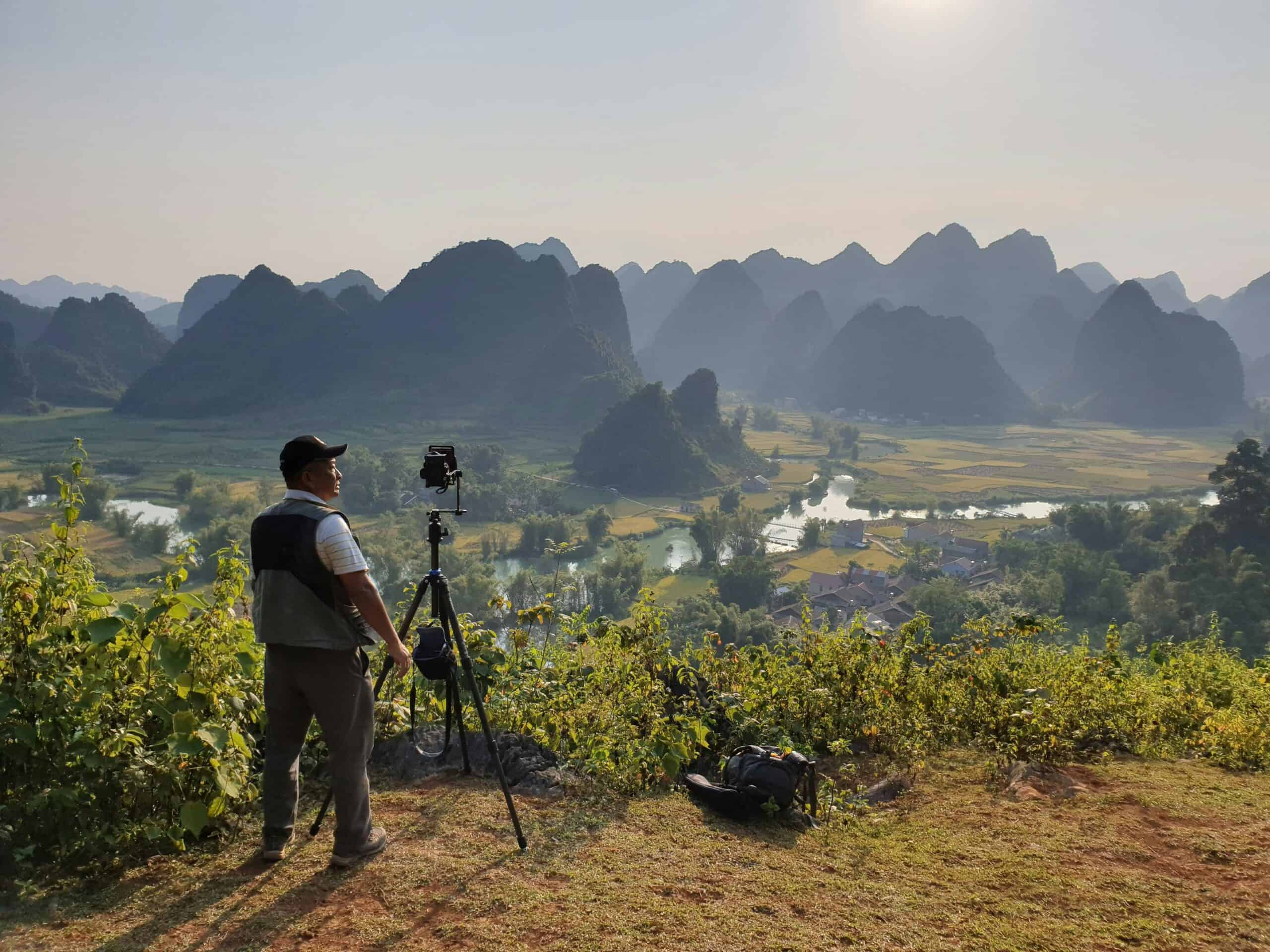
Before you shoot, scan for moving subjects, reflective glass, and close foreground elements (railings, chairs, plants). Moving people or vehicles can cause ghosting. If you must shoot against glass, keep the lens hood close (1–2 cm) to reduce internal reflections; angle slightly to avoid seeing your own tripod and to minimize flare. Note wind exposure on rooftops or balconies; a gust can shake a tall pole or light tripod, so lower your center column and add weight.
Match Gear to Scene Goals
The Z6 II’s dynamic range and relatively clean ISO up to 1600 make it strong in interiors with window contrast and exterior dusk scenes. Indoors, stick to ISO 100–400 with bracketing; at night, ISO 800–1600 is a safe sweet spot if you have to shorten shutter speeds for moving subjects. The rectilinear 14–24mm demands more frames than a fisheye but preserves straight lines—perfect for real estate, interiors, and cityscapes where a fisheye would require defishing and can bend verticals.
Pre-shoot Checklist
- Charge batteries and format both cards; the Z6 II’s dual slots help with backups.
- Clean lens front/rear elements; use a blower on the sensor; dust shows up in big skies.
- Level tripod on a firm surface; pre-calibrate your panoramic head for this lens.
- Safety: watch wind loads, rooftop edges, and pole clearances; tether the rig if elevated.
- Backup workflow: after your main pass, shoot a second safety pass (even quick single-row) in case of stitching issues.
Essential Gear & Setup
Core Gear
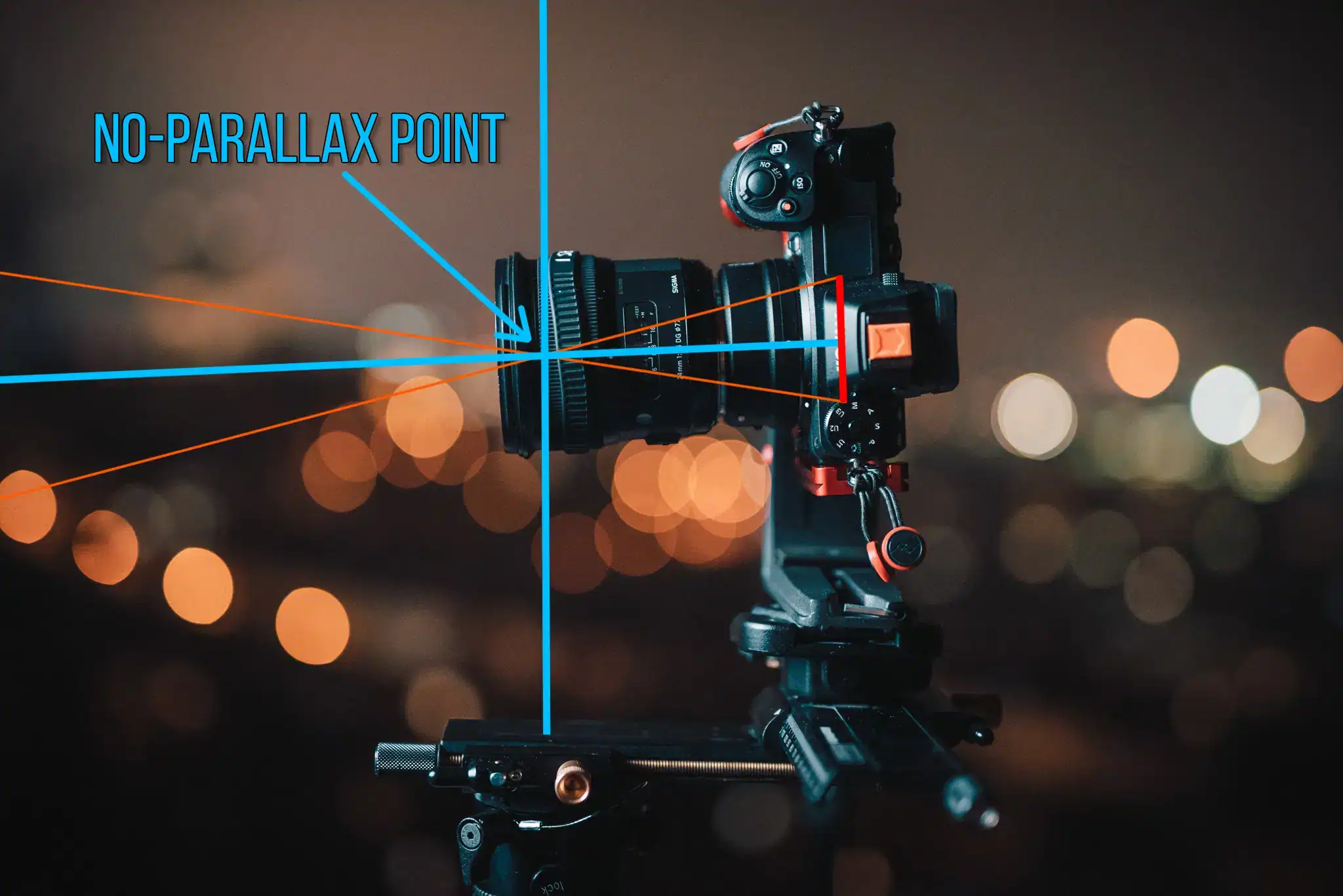
- Panoramic head: A rotator with fore–aft and lateral rails lets you place the lens over its no-parallax point (entrance pupil). This alignment prevents nearby objects from shifting relative to the background as you rotate, which is key for perfect stitches.
- Stable tripod with leveling base: A leveling base speeds leveling so your yaw stays truly horizontal, keeping the horizon easy to align in stitching.
- Remote trigger or SnapBridge app: Fire without touching the camera to avoid micro-shake, especially critical at slower speeds.
Optional Add-ons
- Pole or car mount: Use a safety tether, keep the rig centered, and avoid high winds. For moving platforms, increase shutter speed and consider shooting fewer frames with more overlap.
- Lighting aids: For interiors, small LEDs for dark corners; bounce cards to lift shadows while keeping consistency across frames.
- Weather protection: Rain cover and lens hood. The Z6 II and 14–24 S are weather-sealed, but seals aren’t submersible; wipe off salt spray promptly.
Step-by-Step Shooting Guide
Standard Static Scenes
- Level tripod and align the nodal point: Mount the Z6 II in portrait orientation on your pano head. Adjust the fore–aft rail so a nearby object (1–2 m) and a far object stay aligned when you pan left/right. With the Z 14–24 at 14mm, a starting fore–aft offset around 70–85 mm from the sensor plane mark (Φ on the camera body) often gets you close; then fine-tune in the field.
- Manual exposure and locked white balance: Set M mode, choose WB (Daylight or a measured Kelvin like 5600K). Consistency prevents visible seams. Shoot RAW for maximum flexibility.
- Capture sequence:
- Recommended high-quality pass: 3 rows × 8 around (yaw 45° apart) at -40°, 0°, +40° + zenith + nadir.
- Quick pass: 2 rows × 8 around at -35° and +35° + zenith + nadir.
Rotate consistently in one direction. Use an L-bracket or nodal rail marks to repeat precisely.
- Take the nadir frame: Tilt straight down to capture the ground for tripod patching. If the head blocks part of the frame, move the tripod slightly and shoot a clean plate—note you’ll need to mask carefully in post.
HDR / High Dynamic Range Interiors
- Bracket ±2 EV (3–5 frames) at each yaw/pitch position to balance windows and interior shadows. The Z6 II’s 14-bit RAW files blend cleanly.
- Lock WB, ISO, and focus. Use AEB or manual bracketing with continuous shooting to keep timing consistent. Merge exposure stacks before stitching or use exposure fusion in PTGui.
Low-Light / Night Scenes
- Use f/4–f/5.6 and longer shutter speeds on a tripod. Safe ISO ranges on the Z6 II: 100–800 for maximum quality; 1600–3200 if you need to freeze motion (expect fine-grain noise that denoises well).
- Turn IBIS off on a tripod to prevent sensor micro-drift; use a remote release and the electronic front-curtain shutter to minimize vibration.
Crowded Events
- Shoot two passes: one full grid for structure, and a second pass to capture empty gaps in key directions. Note the yaw angles so you can match frames during masking.
- Keep shutter speeds at 1/200 s or faster to freeze people if motion blur becomes distracting. Later, blend clean frames into your master pano.
Special Setups (Pole / Car / Drone)
- Secure everything: tether camera, tighten all clamps, and use a short pole section when windy. Avoid vehicles above low neighborhood speeds unless you’re experienced with vibration control.
- Increase overlap to ~35% and reduce your total frame count to compensate for movement. In cars, use faster shutter (1/500–1/1000 s) and shoot fewer positions at 14mm to ensure alignment.
Field Case Studies
Indoor Real Estate
Shoot at 14–18mm, f/8, ISO 100, bracket ±2 EV. 3 rows × 8 around + Z/N. Keep the camera level and verticals straight; lock WB to 4000–5000K to tame mixed lighting. Add a small fill light to dark corners but keep consistency.
Outdoor Sunset Cityscape
Expose for highlights at ISO 100–200, f/8, 1/125–1/250 s; consider a two-pass blend (one for sky, one for shadows) if you want to avoid HDR artifacts. The Z6 II files recover shadows well; don’t blow the sunlit clouds.
Event Crowds
Use 14mm to minimize frames and shorten total capture time. 2 rows × 8 around + Z/N at 1/250 s, f/5.6, ISO 800–1600. Mask moving people later.
Rooftop Pole
Shorten the pole, add a safety tether, and increase overlap. Use 1/500 s on windy evenings. IBIS can help if you’re not on a tripod.
Recommended Settings & Pro Tips
Exposure & Focus
| Scenario | Aperture | Shutter | ISO | Notes |
|---|---|---|---|---|
| Daylight outdoor | f/8–f/11 | 1/100–1/250 | 100–200 | Lock WB to Daylight or 5600K |
| Low light/night | f/4–f/5.6 | 1/10–1/60 (tripod) | 400–1600 | Remote trigger; IBIS off on tripod |
| Interior HDR | f/8 | Bracket ±2 EV | 100–400 | Windows balanced without blowing highlights |
| Action / moving subjects | f/5.6–f/8 | 1/200+ | 400–1600 | Double pass to fill gaps |
Critical Tips
- Manual focus at hyperfocal: At 14mm and f/8, hyperfocal is ~0.8 m; focus slightly beyond 1 m and everything from ~0.5 m to infinity is sharp.
- Nodal calibration: Place two vertical objects (near and far) in the frame, then pan left/right. Adjust rail until there’s no relative shift. Mark your rail for 14mm and 24mm so you can recall quickly next time.
- White balance lock: Use Kelvin or a preset; avoid Auto WB shifts between frames that cause stitching seams.
- RAW over JPEG: RAW keeps highlight and shadow headroom; Z6 II 14-bit files grade beautifully for sky recovery.
- IBIS on/off: On for handheld/pole work; off on tripod to prevent micro-movements during long exposures.
For a deeper primer on panoramic head setup and avoiding parallax, see this panoramic head tutorial. Panoramic head fundamentals
Stitching & Post-Processing
Software Workflow
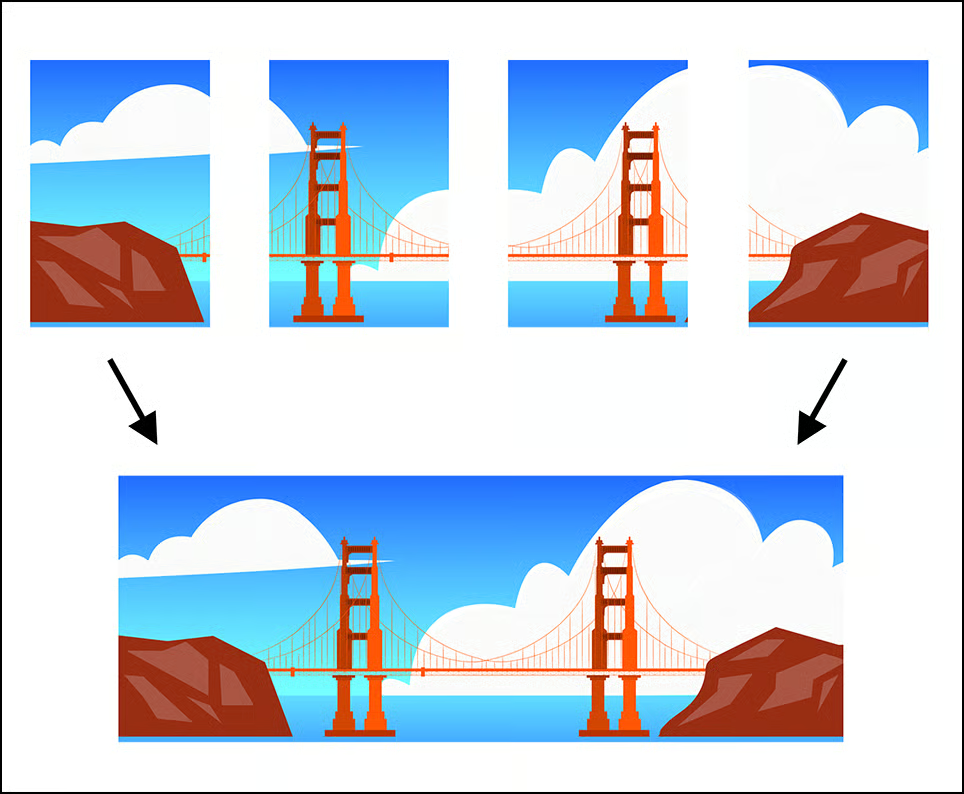
Import RAWs to Lightroom or Capture One. Apply identical base settings (profile corrections off for now, fixed WB, minimal noise reduction). For HDR, either pre-merge exposure brackets to 32-bit HDR DNGs or feed bracket sets into PTGui’s exposure fusion/HDR mode. Rectilinear lenses like the 14–24 S generally need 20–25% overlap; our 8-around pattern at 14mm portrait yields very robust control points and clean stitches.
PTGui is an industry standard for spherical panoramas thanks to precise control points, masking, and fast GPU acceleration; Hugin is a capable open-source alternative. Lightroom/Photoshop can stitch basic panoramas but are less predictable for full 360×180 spheres and complex multi-row grids. Why many pros choose PTGui for complex panos
Cleanup & Enhancement
- Nadir patch: Use PTGui Viewpoint Correction, Photoshop generative fill, or clone from an offset “clean plate” nadir shot.
- Color: Fine-tune WB and HSL globally for consistency; address mixed lighting via local adjustments.
- Noise: Apply moderate luminance NR for ISO 1600–3200 night panos; mask details to keep edges crisp.
- Leveling: Use the horizon tool to correct roll/yaw/pitch; ensure verticals remain true for architectural sets.
- Export: For VR platforms, export equirectangular 2:1 at 8K–12K on this 24 MP camera/lens combo; for virtual tours, JPEG quality 10–12 or HEIC with careful compression. For later grading, keep layered TIFF/PSB masters.
If you’re new to DSLR/mirrorless 360 workflows, Meta’s guide outlines the full capture-to-stitch process. Using a mirrorless camera to shoot and stitch a 360 photo
Useful Tools & Resources
Software
- PTGui panorama stitching
- Hugin (open source) for multi-row spheres
- Lightroom / Photoshop for RAW development and nadir cleanup
- AI tripod removal tools (generative fill)
Hardware
- Panoramic heads: Nodal Ninja, Leofoto, Sunwayfoto, or Really Right Stuff multi-row heads
- Carbon fiber tripods with leveling base for quick setup
- Wireless remote shutters or SnapBridge control
- Pole extensions / car mounts with safety tethers
Disclaimer: software/hardware names provided for search reference; check official sites for details.
Prefer to watch first? This overview helps you visualize the full capture and stitching workflow.
For an end-to-end 360 capture checklist with a panoramic head, see this professional step-by-step. Set up a panoramic head for high-end 360 photos
Common Mistakes & How to Avoid Them
- Parallax error: Always align the lens over the no-parallax (entrance pupil) point before serious work. Mark your rail once dialed in.
- Exposure flicker: Don’t use Auto ISO or Auto WB; lock both and use full Manual exposure.
- Tripod shadows in outdoor sun: Plan the nadir shot and patch; rotate so your body doesn’t cast across multiple frames.
- Ghosting from movement: Increase shutter speed, time shots between moving subjects, and mask in post using secondary passes.
- Night noise: Keep ISO as low as practical and lengthen shutter on tripod; the Z6 II handles ISO 1600–3200, but expose to the right to minimize noise.
- IBIS left on with tripod: Disable IBIS to avoid micro-blur during long exposures.
Frequently Asked Questions
- Can I shoot handheld panoramas with the Nikon Z6 II?
Yes, especially with IBIS, but expect more stitching challenges. Use faster shutter speeds (1/250 s+), increase overlap to 35–40%, and keep the camera rotating around your body as consistently as possible. For mission-critical 360° work, a tripod and pano head remain best.
- Is the Nikon Z 14–24mm f/2.8 S wide enough for a single-row 360?
For full 360×180 spheres, a single row at 14mm usually won’t cover zenith and nadir cleanly. Plan on 2–3 rows plus separate zenith/nadir shots. If you need fewer frames, consider a fisheye lens; otherwise, enjoy the straight lines and high detail of the 14–24.
- Do I need HDR for interiors with bright windows?
Often yes. Bracket ±2 EV (3–5 shots) per yaw/pitch position to capture window detail and interior shadows. Merge to HDR DNGs or use exposure fusion in PTGui for a natural look.
- How do I avoid parallax issues with this lens?
Mount the camera on a panoramic head with fore–aft and lateral rails. At 14mm, start with the entrance pupil roughly 70–85 mm forward of the sensor plane mark, then refine by checking for relative movement between near and far objects while panning. Mark your rail once calibrated.
- What ISO range is safe on the Z6 II in low light?
For tripod work, stay at ISO 100–400 and lengthen shutter. For handheld/pole or event motion, ISO 800–1600 is a safe sweet spot; 3200 is usable with good exposure and careful denoise. The Z6 II’s BSI sensor keeps shadow noise tight if you expose to the right.
- Can I set custom modes for faster pano setup?
Yes. Assign a Custom Setting bank with Manual exposure, RAW, fixed WB (e.g., 5600K), IBIS off (for tripod), and manual focus. Save a separate bank for handheld with IBIS on and slightly higher minimum shutter speed.
- How to reduce flare with an ultra-wide rectilinear like the 14–24 S?
Use the hood, avoid placing the sun near the frame edge across multiple frames, and shade the lens with your hand/flag when needed. Slightly adjust yaw to keep severe light sources consistent in adjacent frames.
- What’s the best tripod head for this setup?
A multi-row panoramic head with adjustable rails and a click-stop rotator (e.g., Nodal Ninja or Leofoto) is ideal. Look for sturdy clamps, clear angle markings, and a leveling base to speed up precise alignment.