
Why This Camera & Lens Are Great for Panoramas
The Nikon Z6 II and Canon RF 15–35mm f/2.8L IS USM combination gives you full-frame image quality with a flexible ultra‑wide rectilinear zoom. The Z6 II offers a 24.5 MP BSI CMOS sensor (approx. 35.9 × 23.9 mm) with excellent dynamic range at base ISO, reliable dual card slots (CFexpress/XQD + SD), and 5‑axis IBIS to stabilize hand‑held frames. The RF 15–35mm is Canon’s pro‑grade ultra‑wide zoom with fast f/2.8 aperture, weather sealing, and excellent sharpness from f/4–f/8—the apertures most pano shooters use for maximum edge‑to‑edge quality.
Important compatibility note: the Canon RF 15–35mm is not natively mountable on the Nikon Z6 II (there is no widely available RF‑to‑Z adapter due to flange distance and electronic protocol constraints). If you cannot physically pair this lens and body, use the guidance below as a field‑tested workflow for an equivalent rectilinear ultra‑wide on the Z6 II (e.g., NIKKOR Z 14–30mm f/4 S or Z 17–28mm f/2.8). All framing, exposure, and overlap advice translates 1:1. If you do own a Canon RF body, the same shooting steps also apply to the RF 15–35mm mounted natively.
Rectilinear ultra‑wides keep straight lines straight—ideal for architecture and interiors—but require more shots than a fisheye for full 360×180° coverage. The upside is clean geometry and less de‑fishing in post, which often yields crisper edges in high‑resolution virtual tours.
Quick Setup Overview
- Camera: Nikon Z6 II — Full Frame 24.5 MP BSI CMOS, pixel pitch ~5.9 µm, strong base‑ISO dynamic range (~14 EV), 5‑axis IBIS.
- Lens: Canon RF 15–35mm f/2.8L IS USM — Rectilinear ultra‑wide zoom, sharpest at f/4–f/8, moderate barrel distortion at 15mm, very good corner performance by f/5.6–f/8. Note: not natively compatible with Nikon Z mount.
- Estimated shots & overlap (full‑frame, rectilinear):
- At 15mm: 6 around at 0° + 4 at +60° + 4 at −60° + zenith + nadir ≈ 16–18 total (25–30% overlap).
- At 24mm: 8 around at 0° + 6 at +55° + 6 at −55° + zenith + nadir ≈ 22–24 total.
- At 35mm: 10 around per row, three rows + Z/N ≈ 32+ shots (best reserved for ultra‑high‑res work).
- Difficulty: Moderate — rectilinear wides take more shots than fisheyes but deliver cleaner lines and more consistent rendering.
Pro tip: If you need speed, use the widest focal length (15–16mm) and favor three‑row capture. If you need absolute resolution, zoom toward 24–35mm and add rows for more total pixels.
Planning & On-Site Preparation
Evaluate Shooting Environment
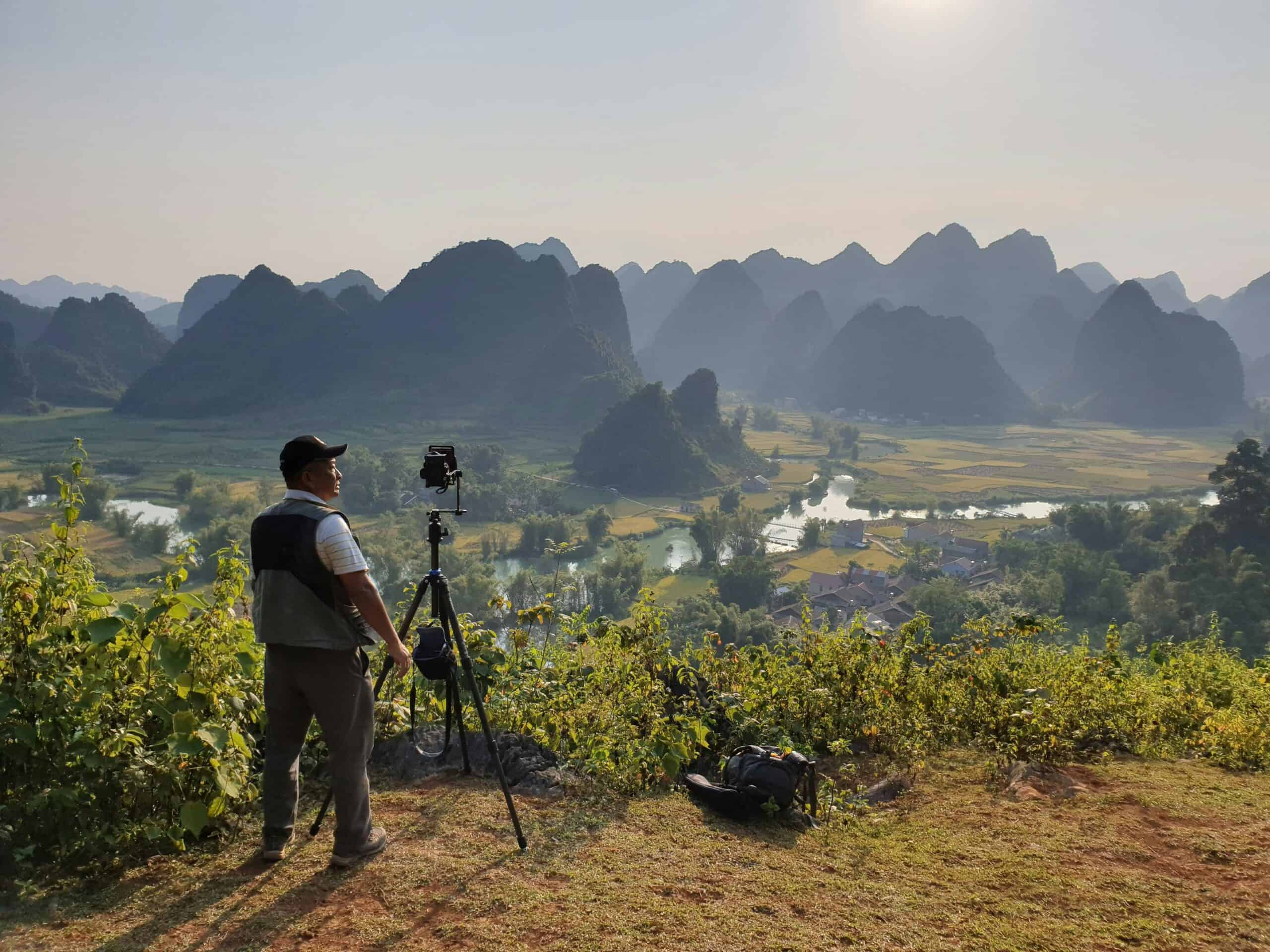
Look for moving elements (people, cars, trees in wind), reflective surfaces (glass, polished floors), and high contrast windows or sun. In interiors, step back from glass by at least 30–50 cm to reduce reflections and ghosting; use a rubber lens hood against the glass if you must shoot close. Outdoors at sunset, plan your start angle opposite the sun to minimize flare streaks in your first frames.
Match Gear to Scene Goals
The Nikon Z6 II’s low‑noise 24 MP sensor is ideal for 360 photo capture where clean tones matter across many frames. Expect clean results at ISO 100–800, usable at ISO 1600, and only push to ISO 3200+ when the tripod can’t stay longer. The RF 15–35mm f/2.8L (or Nikon Z 14–30/4 S as a native stand‑in) gives you flexibility: at 15mm you’ll complete a full 360 with about 16–18 frames; at 24–35mm you can create ultra‑high‑resolution gigapixel panoramas with more frames. Rectilinear glass keeps architecture straight, which is perfect for real estate and interiors.
Pre-shoot Checklist
- Charge EN‑EL15c batteries; carry a spare. Clear/format both cards; enable backup to second slot.
- Clean the front element and the sensor; dust heals poorly across many frames.
- Level the tripod; verify panoramic head rail calibrations and record marks for your lens/focal.
- Safety: tether on rooftops and poles; watch wind gusts. For car mounts, double‑secure with safety cables.
- Backup workflow: shoot an extra 0° row or a full second pass in tricky light or crowded scenes.
Essential Gear & Setup
Core Gear
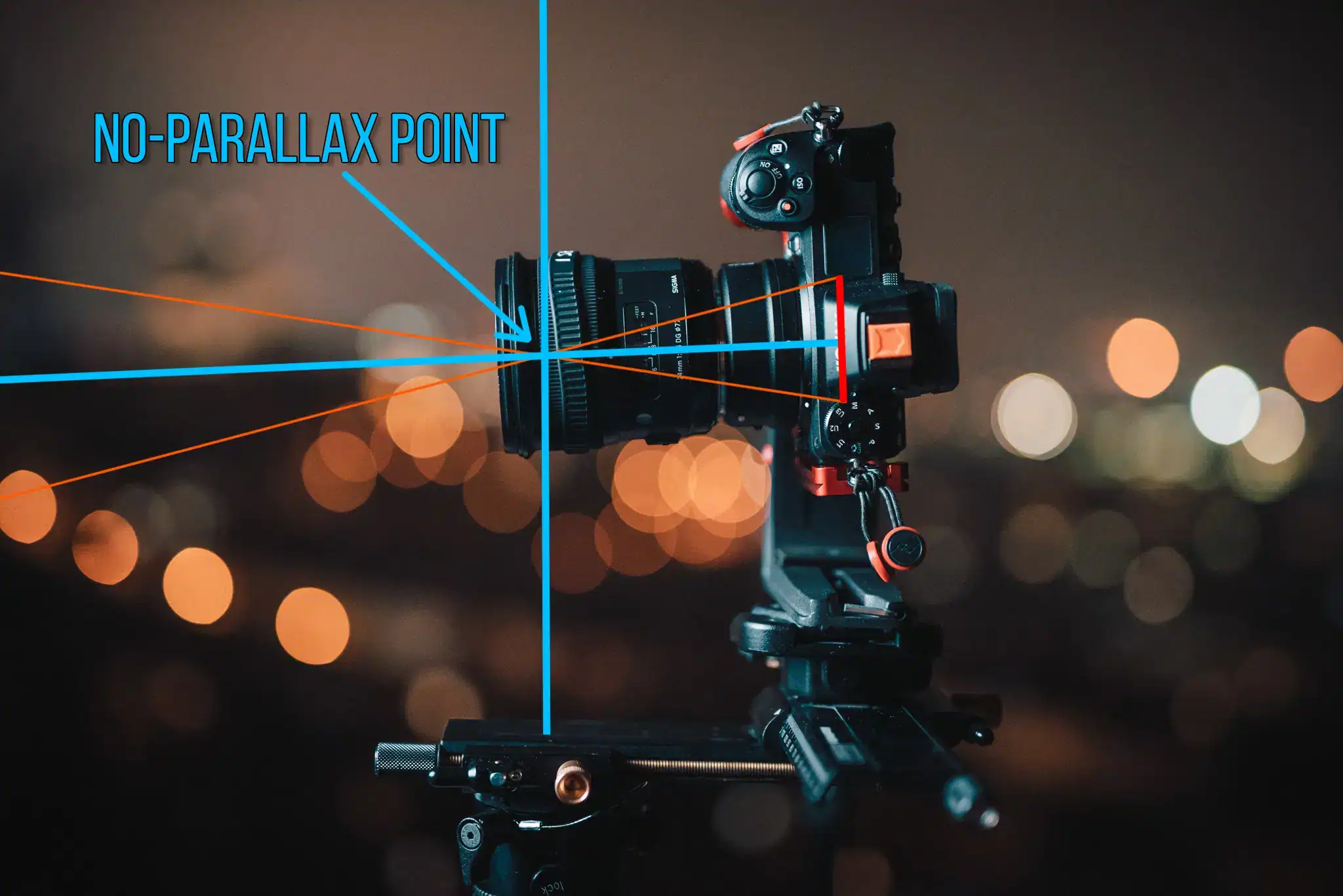
- Panoramic head with fore/aft and lateral rails. Align the entrance pupil (no‑parallax point) to minimize parallax when rotating—critical for interiors with nearby objects.
- Stable tripod with a leveling base or half‑ball for fast setup; keep legs short in wind.
- Remote trigger or SnapBridge app for vibration‑free exposures. On the Z6 II, enable Exposure Delay or use the self‑timer for extra stability.
Optional Add-ons
- Carbon fiber pole or car mount for elevated views. Safety first: tether the camera, watch for power lines, and keep exposure times short in wind to reduce motion blur.
- Small LED panels or continuous lights to lift shadows in interior HDR; avoid color temperature mismatches.
- Rain covers and microfiber cloths. In sea spray or mist, wipe often and shoot an extra pass.
For a deeper dive into panoramic head setup and why nodal alignment matters, see this step‑by‑step panoramic head guide from Oculus Creator. Set up a panoramic head for high‑end 360 photos
Step-by-Step Shooting Guide
Standard Static Scenes
- Level tripod & align nodal point. On your rails, slide the camera so that foreground and background objects stay registered when you pan left/right. Start with an approximate entrance pupil offset of 70–90 mm forward from the sensor mark for most 15–16mm rectilinear lenses, then fine‑tune.
- Switch to Manual exposure and lock White Balance. Set WB to Daylight (around 5200–5600K) outdoors; use a measured Kelvin value indoors to avoid color shifts across frames. Disable Auto ISO.
- Focus: use manual focus at or near the hyperfocal distance. At 15mm and f/8 on full frame, hyperfocal is roughly ~0.95 m; at f/11, ~0.7 m. Confirm with magnified live view.
- Shoot with tested overlap. For 15mm: capture 6 shots around at 0°, 4 at +60°, 4 at −60°, plus zenith and nadir. Rotate consistently (e.g., 60–75° increments at 0° row) and keep the same rotation direction.
- Take a clean nadir shot for tripod removal. Either lean the tripod slightly or shoot a handheld nadir while maintaining the lens over the rotation point.
HDR / High Dynamic Range Interiors
- Bracket ±2 EV (three shots is often enough; five if windows are extremely bright). On the Z6 II, use exposure bracketing and a remote to keep timing consistent.
- Lock WB and focus. Shoot a full exposure set at each position before rotating to the next to simplify batch stitching.
- Beware flicker: avoid auto exposure; keep ISO fixed; let shutter vary within your bracket.
Low-Light / Night Scenes
- Use a tripod with IBIS OFF and lens IS OFF to avoid micro‑jitter feedback. Start around f/4–f/5.6, ISO 100–400, and lengthen shutter to 1–4 seconds as needed.
- The Z6 II handles ISO 800–1600 well; try to keep it ≤1600 for panoramas to avoid noisy seams.
- Use a remote or 2–5 s Exposure Delay. Windy nights? Add weight to the tripod or lower the center column.
Crowded Events
- Shoot two passes: an initial fast sweep for base coverage, then a second sweep waiting for gaps to fill clean seams.
- Keep shutter speeds at 1/200 s+ if you want to freeze people. If some motion is inevitable, plan to mask frames during stitching.
- Aim for higher overlap (30–35%) to give your stitcher more options for control points.
Special Setups (Pole / Car / Elevated)
- Secure a tether and secondary safety line. For poles, keep exposures short (1/250 s+) to reduce rotation blur; consider a higher ISO (400–800) to hold speed.
- Car‑mounted panos: shoot at a standstill; stabilize with sandbags and vibration‑damping pads; beware panel flex on thin roofs.
Recommended Settings & Pro Tips
Exposure & Focus
| Scenario | Aperture | Shutter | ISO | Notes |
|---|---|---|---|---|
| Daylight outdoor | f/8–f/11 | 1/100–1/250 | 100–200 | Lock WB (daylight); keep IBIS OFF on tripod |
| Low light/night | f/4–f/5.6 | 1/30–2 s | 200–800 | Tripod + remote; prefer slower shutter over high ISO |
| Interior HDR | f/8 | Bracket ±2 EV | 100–400 | Expose mid frame to protect highlights |
| Action / moving subjects | f/5.6–f/8 | 1/200+ | 400–800 | Two-pass method; higher overlap |
Critical Tips
- Manual focus near hyperfocal for consistent sharpness across frames; recheck after zooming or changing aperture.
- Nodal point calibration: mark your fore/aft rail positions for 15mm, 20mm, 24mm to speed repeatability. Expect the entrance pupil to shift slightly with zoom.
- White balance lock: mixed lighting? Pick a Kelvin that balances the scene (e.g., 3600–4200K under tungsten/LED), then correct globally in post.
- Shoot RAW: the Z6 II’s files have ample latitude for highlight recovery and shadow lifting, which is crucial when stitching 16–30 frames.
- Stabilization: turn IBIS/Lens IS OFF on a tripod to prevent sensor compensation drift between frames; leave it ON only when hand‑held sweeps are unavoidable.
- Use EFCS (Electronic Front Curtain Shutter) or Exposure Delay to reduce micro‑vibrations on long lenses or delicate mounts.
Stitching & Post-Processing
Software Workflow
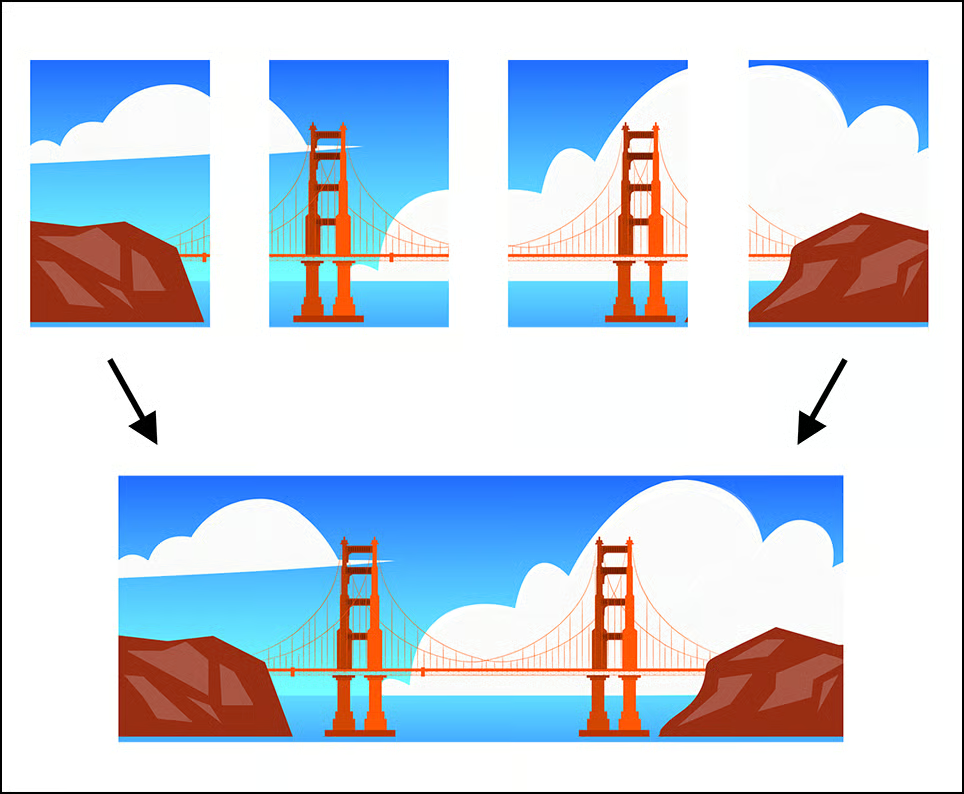
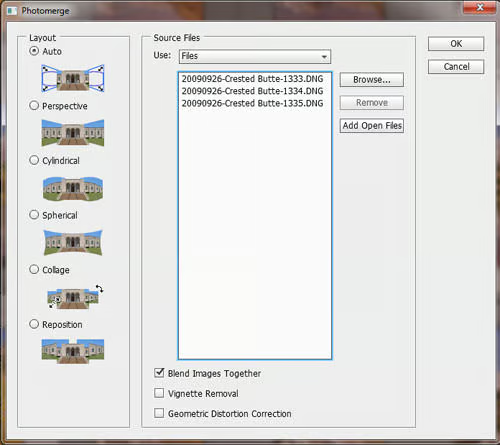
Ingest and organize your RAWs, then stitch with dedicated panorama software. PTGui is the industry standard for speed and control, Hugin is an excellent open source option, and Lightroom/Photoshop can handle simpler single‑row sets. Fisheye lenses allow fewer shots with greater overlap tolerance but need de‑fishing; rectilinear lenses require more frames yet preserve linear geometry. As a rule of thumb: 25–30% overlap for fisheye, 20–30% for rectilinear—more when scenes have low texture or moving elements. For a review of why PTGui remains a favorite among pros, see this overview. PTGui review: why it’s great for complex panoramas
Cleanup & Enhancement
- Nadir cleanup: export a layered TIFF from PTGui/Hugin, then patch the tripod using Photoshop’s clone/heal or generative fill. Many virtual tour platforms also offer AI tripod removal.
- Color and noise: apply global WB and tone corrections first, then targeted noise reduction on shadowy seams to maintain consistency.
- Level horizon: use the stitching software’s optimizer to set pitch/roll/yaw and define straight verticals for architecture.
- Export: for VR, produce a 2:1 equirectangular at 8192×4096 (8K) or 11000–16000 px width for premium tours. Keep a 16‑bit master TIFF and deliver a high‑quality JPEG copy.
Resolution planning matters. For theoretical limits and coverage per focal length on DSLRs/mirrorless, consult the PanoTools spherical resolution reference. PanoTools: DSLR spherical resolution guide
Watch: A practical pano shooting demo
Video tutorials help visualize nodal alignment and overlap strategies before you head on location.
Useful Tools & Resources
Software
- PTGui panorama stitching
- Hugin (open source)
- Lightroom Classic / Photoshop for RAW and retouch
- AI tripod/nadir removal tools
Hardware
- Panoramic heads (Nodal Ninja, Leofoto, Fanotec)
- Carbon fiber tripods with leveling base
- Wireless remotes or smartphone apps
- Pole extensions / car suction mounts with safety tethers
Disclaimer: brand names are for research reference. Verify fit, payload, and compatibility with your specific gear and mounts.
For a broader grounding in pano techniques and gear choices, this panoramic head tutorial is worth bookmarking. Panoramic head: setup and best practices
Real-World Case Studies
Indoor Real Estate (Mixed Lighting)
Body: Z6 II. Lens: equivalent rectilinear ultra‑wide at 15–16mm. Settings: f/8, ISO 100, 3–5 shot brackets at ±2 EV. Lock WB to 4000–4500K to neutralize warm fixtures, then fine‑tune in post. Use 6/4/4 rows (+Z/N) for 16–18 frames per HDR bracket. Keep a microfiber ready: fingerprints or smears become streaks across windows when merged.
Outdoor Sunset (High DR, Wind)
Use f/8, ISO 100–200, 1/60–1/200 s. Add weight to the tripod, shorten leg sections, and shoot the sun‑facing frames last to reduce flare on earlier shots. A lens hood helps, but for ultra‑wides, hand‑flagging just out of frame is often better. Shoot an extra pass of the bright quadrant for safety.
Event Crowd (Motion)
Use 1/200–1/500 s shutter, f/5.6–f/8, ISO 400–800. Do a quick base pass to guarantee coverage, then a second pass to catch clean areas for head swaps. In post, mask in people from the clean pass to minimize ghosts.
Rooftop/Pole (Safety‑First Elevated View)
On a pole, keep shutter 1/250 s+ at ISO 400–800 and f/5.6–f/8. Don’t extend poles in gusts over ~25 km/h. Always tether the camera, and keep the rotation slow and deliberate. Expect slightly higher stitching error rates; add overlap.
About the Nikon Z6 II & Canon RF 15–35mm Pairing
As of now there is no mainstream adapter that maintains full electronic communication from Canon RF lenses to Nikon Z bodies. If you cannot mount the RF 15–35mm on the Z6 II, use a native Nikon Z ultra‑wide (e.g., Z 14–30mm f/4 S or Z 17–28mm f/2.8) or adapt a Canon EF ultra‑wide (like EF 16–35mm) via an EF‑to‑Z adapter that supports aperture control. Everything in this guide remains accurate for rectilinear UWA focal lengths on full frame—only the rail calibration marks will differ.
Behind the Scenes & Workflow Visuals
These visuals help you connect the steps with what you’ll see in the field and in software.
Common Mistakes & How to Avoid Them
- Parallax error → fix by aligning the entrance pupil on a proper panoramic head before shooting.
- Exposure flicker → shoot in full Manual, lock WB, turn off Auto ISO, keep consistent aperture.
- Tripod shadows or footprints → shoot a dedicated nadir and patch it later.
- Ghosting from moving subjects → higher overlap, two‑pass method, and manual masking in the stitcher.
- Night noise → prioritize longer shutter over high ISO; keep the Z6 II at ISO ≤1600 when possible.
- Stabilization micro‑blur on tripod → turn IBIS/Lens IS OFF; use Exposure Delay or a remote trigger.
Frequently Asked Questions
- Can I shoot handheld panoramas with the Nikon Z6 II?
Yes for simple single‑row panos in good light. Use 1/250 s+, f/8, and IBIS ON. For full 360×180° or precise interiors, use a tripod and panoramic head to eliminate parallax and improve stitch reliability.
- Is the Canon RF 15–35mm f/2.8L wide enough for a single‑row 360?
No. At 15mm rectilinear on full frame, you’ll need multiple rows to cover zenith and nadir cleanly. Expect roughly 16–18 shots total using a three‑row pattern plus Z/N.
- Do I need HDR for interiors with bright windows?
Usually yes. Bracket ±2 EV (3–5 shots) to retain window detail and clean shadows. Keep WB and focus locked, and capture the full bracket set at each position before rotating.
- How do I avoid parallax issues with this setup?
Use a panoramic head and align the entrance pupil. Start with the lens about 70–90 mm forward from the sensor mark at 15–16mm, then refine by watching a near/far alignment as you pan. Record your rail marks for future shoots.
- What ISO range is safe on the Z6 II in low light?
ISO 100–800 is the sweet spot; ISO 1600 remains very usable. If you must go higher, expose to the right carefully and apply noise reduction evenly across frames in post.
Safety, Reliability & Backup Workflow
Always tether your camera on rooftops, balconies, and poles. In wind, lower your center column and shorten leg sections. Keep one hand on the rig during rotations when space is tight. Back up your cards immediately after the shoot and maintain a master 16‑bit stitched TIFF alongside a high‑quality JPEG delivery. Check each panorama at 100% for seam issues before publishing.
If you’re new to virtual tours and DSLR/mirrorless 360 capture, this overview adds helpful context and gear advice. Using a mirrorless camera to shoot and stitch a 360 photo