Why This Camera & Lens Are Great for Panoramas
The Nikon D850 and the Sigma 15mm f/1.4 DG DN Diagonal Fisheye Art make a powerhouse combo for immersive panoramas—one for its class-leading sensor and color depth, the other for its ultra-wide, incredibly bright fisheye rendering. The D850’s 45.7MP full-frame (FX) sensor (35.9 × 23.9 mm) delivers exceptional detail and dynamic range, especially at its base ISO 64, which is renowned for maximal highlight headroom and low shadow noise. In practical panorama work, that translates to cleaner stitches and more flexibility for HDR blends.
On the lens side, a 15mm diagonal fisheye on full-frame gives you roughly 180° diagonal field of view, around 147° horizontal and ~94° vertical coverage. That means fewer shots per 360°, faster capture, and fewer seams to manage—perfect for interiors, real estate, and fast-changing outdoor light. The Sigma 15mm f/1.4 DG DN Diagonal Fisheye Art is also extremely sharp even stopped down to f/5.6–f/8, and its fast maximum aperture helps with low-light focusing and cleaner live view composition.
Important mount note for trustworthiness: The Sigma 15mm f/1.4 DG DN Diagonal Fisheye Art is made for mirrorless mounts (Sony E / Leica L). It is not natively compatible with the Nikon D850’s F-mount, and practical adaptation (with infinity focus) is not feasible. If you are shooting on a D850, use an F-mount diagonal fisheye with the same field of view (e.g., Sigma 15mm f/2.8 EX DG Fisheye or Nikon 16mm f/2.8 Fisheye). All shooting, overlap, and stitching techniques in this guide apply 1:1 to those lenses. If you do have a compatible mirrorless body for the Sigma 15/1.4, you can follow the same workflow below.
Quick Setup Overview
- Camera: Nikon D850 — full-frame FX (35.9 × 23.9 mm), 45.7MP; pixel pitch ≈ 4.35 µm; exceptional dynamic range at ISO 64; robust Live View with focus peaking.
- Lens: Sigma 15mm f/1.4 DG DN Diagonal Fisheye Art — diagonal fisheye with ~180° diagonal FOV; excellent sharpness when stopped down; low lateral CA; designed for mirrorless mounts (E/L). For D850, use an equivalent F-mount fisheye (Sigma 15/2.8 or Nikon 16/2.8) with the same technique.
- Estimated shots & overlap (full-frame, 15–16mm diagonal fisheye): 6 around at 60° yaw with ~30% overlap + 1 zenith + 1 nadir. For speed, 4 around + zenith + nadir can work outdoors, but stitching risk increases near the horizon.
- Difficulty: Intermediate — easy capture flow once the nodal point is calibrated.
Planning & On-Site Preparation
Evaluate Shooting Environment
Before setting up, assess light direction, high-contrast areas (windows/sun), reflective surfaces (glass/metal), and moving elements (people, cars, foliage). In interiors with glass, shoot as perpendicular as possible and keep the front element a bit farther from the glass (10–20 cm) to reduce reflections and ghosting. Outdoors at sunset, decide if you want the sun included—fisheyes capture a very wide angle, so flare management matters. Shield the lens with a hand/flag if needed.
Match Gear to Scene Goals
The D850’s DR is best at ISO 64–200; you can push to ISO 800–1600 for night scenes but expect more noise in shadows. A diagonal fisheye drastically reduces shot count, helping avoid exposure shifts between frames and keeping crowds manageable. The Sigma 15mm f/1.4 (or F-mount equivalents at 15–16mm) brings huge FOV with sharp results at f/5.6–f/8—ideal apertures for panos. Use fast apertures (f/1.4–f/2) only for focusing or very dim spaces; stop down for the final capture to maximize edge-to-edge sharpness.
Pre-shoot Checklist
- Charge batteries, empty/backup cards, clean lens and sensor.
- Level tripod; verify panoramic head is calibrated for the lens’ nodal point.
- Safety: check wind on rooftops, use a weight hook and tether; in car mounts, test vibrations and secure all clamps.
- Backup workflow: do one full safety round after the main take (especially if crowds or clouds are moving).
Essential Gear & Setup
Core Gear
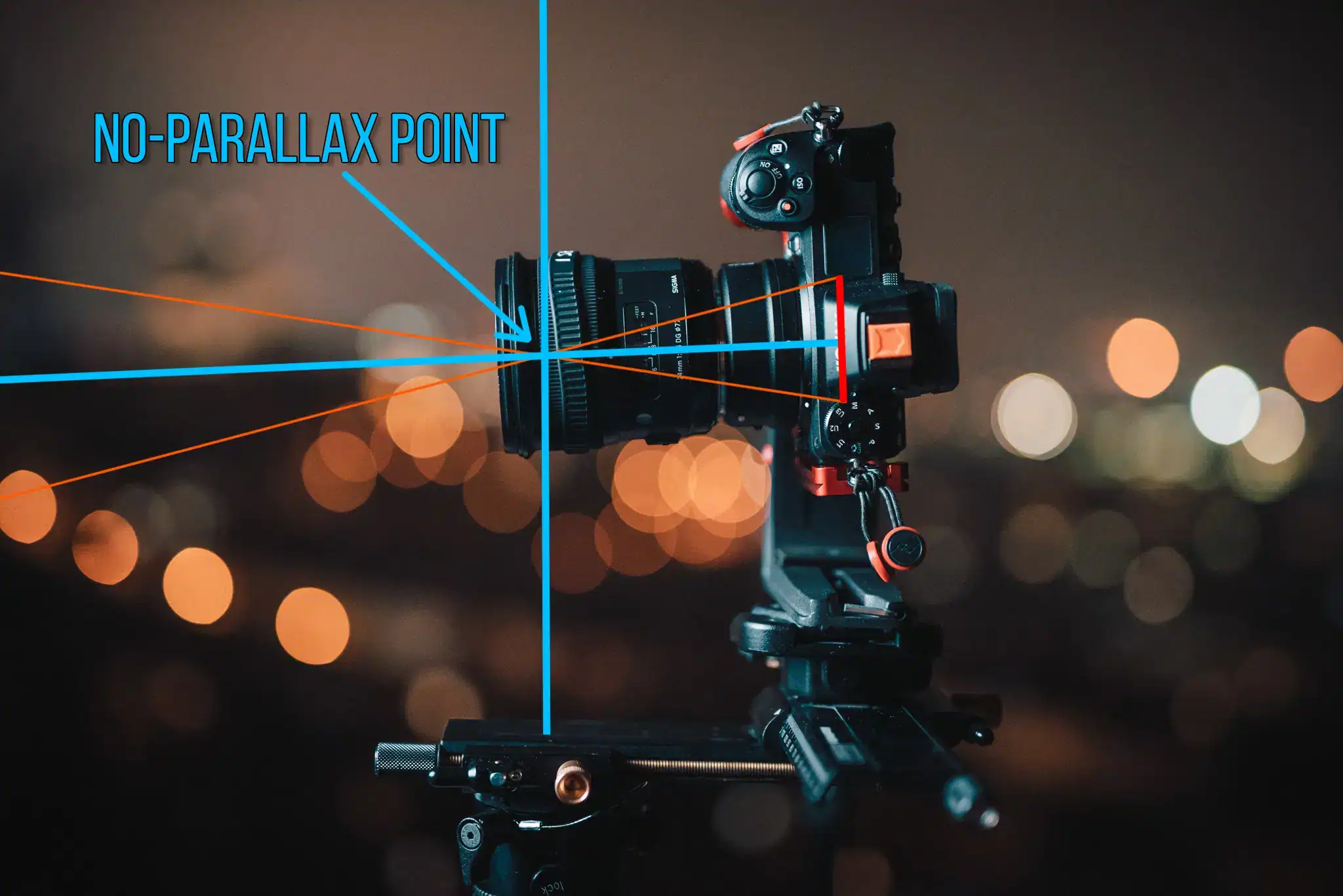
- Panoramic head: Critical for aligning the lens’ entrance pupil (nodal point) with the rotation axis to eliminate parallax. This ensures edges of near and far objects align across frames for clean stitches.
- Stable tripod with a leveling base: Leveling avoids pitch/roll drift across the rotation, keeping horizons straight and reducing post corrections.
- Remote trigger or app: On the D850, use a remote release along with Exposure Delay or Mirror Up to eliminate vibration.
Optional Add-ons
- Pole or car mount: Great for elevated or moving perspectives. Use tethers and safety lines; beware of wind shear and road vibration. Avoid long exposures on a moving platform.
- Lighting aids: Small LED panels or bounced flash can even out interior lighting, but keep placement consistent across frames.
- Weather protection: Rain covers and lens cloths; fisheye fronts are exposed—water droplets are very obvious.
For an in-depth primer on panoramic heads and best practices, see this practical panoramic head tutorial. Panoramic head setup guide
Step-by-Step Shooting Guide
Standard Static Scenes
- Level tripod and calibrate nodal point. Slide the lens on the pano head so that foreground and background elements don’t shift relative to each other while panning. Use two light stands or vertical edges a few feet apart to verify.
- Set manual exposure and lock white balance. For exteriors, start at ISO 64–100, f/8, and shutter 1/100–1/250. For interiors, f/8 at ISO 100–400 is typical; extend shutter as needed.
- Focus manually and lock. Use Live View with focus peaking on the D850. A practical hyperfocal at 15mm and f/8 on full frame is roughly 0.9–1.0 m; set focus slightly beyond 1 m to keep everything from ~0.5 m to infinity acceptably sharp.
- Capture frames with overlap. For 15–16mm diagonal fisheye: 6 shots around at 60° yaw with ~30% overlap is robust. Add 1 zenith (tilt up ~60–90°) and 1 nadir (tilt down) for clean tripod removal.
- Take a nadir patch shot. After the main round, move the tripod slightly or shoot a hand-held downward frame to patch the tripod area later.
HDR / High Dynamic Range Interiors
- Bracket exposures to balance bright windows and interior shadows—±2 EV across 3–5 frames is a good start. The D850’s auto bracketing can automate this across the rotation.
- Keep WB locked and avoid auto ISO; consistency across frames is crucial for stitching HDR panoramas.
- If highlights still clip at base ISO, consider capturing two full rotations (one for windows, one for interior) and blend through masks in post.
Low-Light / Night Scenes
- Mount solidly and use a remote. On the D850, enable Exposure Delay (1–3 s) or Mirror Up + remote to minimize vibration. Live View also helps dampen mirror shock.
- ISO strategy: Aim for ISO 64–200 for maximum quality on tripod. If wind or subject movement forces faster shutter speeds, ISO 400–1600 is workable on the D850, with noise reduction in post.
- Watch for bright point light sources; stop down (f/5.6–f/8) for sharp corners and more pleasing starbursts, but avoid tiny apertures that introduce diffraction softening.
Crowded Events
- Shoot two passes. First, a quick rotation to capture the base panorama. Second, wait for gaps in moving people for critical directions and capture extra plates.
- In post, mask moving subjects using layers. PTGui’s masking and viewpoint correction can help blend tricky overlaps.
Special Setups (Pole / Car / Drone)
- Pole work: Keep rotation slow and smooth; tether gear. Favor faster shutter speeds (1/250+) and higher ISO rather than risking motion blur.
- Car-mounted: Avoid long exposures; shoot at lower ISO during blue hour with the engine off and the car stabilized. Tighten all clamps twice.
Recommended Settings & Pro Tips
Exposure & Focus
| Scenario | Aperture | Shutter | ISO | Notes |
|---|---|---|---|---|
| Daylight outdoor | f/8–f/11 | 1/100–1/250 | 64–200 | Lock WB (Daylight); best DR at ISO 64 on D850 |
| Low light/night | f/4–f/5.6 | 1/30–1/60 | 400–800 (1600 if needed) | Use remote + Exposure Delay or Mirror Up |
| Interior HDR | f/8 | Bracket ±2 EV (3–5 frames) | 100–400 | Balance windows and lamps; keep WB fixed |
| Action / crowds | f/5.6–f/8 | 1/200+ | 400–800 | Freeze motion; do a clean second pass |
Critical Tips
- Manual focus at hyperfocal: At 15mm, f/8, set ~1 m for front-to-back sharpness. Confirm with Live View peaking.
- Nodal point calibration: Start by aligning so that near/far verticals don’t shift while panning. Mark the rail setting with tape for repeatability.
- White balance lock: Prevent color shifts across frames, especially under mixed lighting.
- RAW over JPEG: More latitude for color and HDR merges; 14‑bit lossless compressed RAW on the D850 is a great balance.
- Stabilization and shutter control: D850 has no IBIS; use a solid tripod, remote release, Exposure Delay, and (when safe) Silent Live View to reduce vibration.
Stitching & Post-Processing
Software Workflow
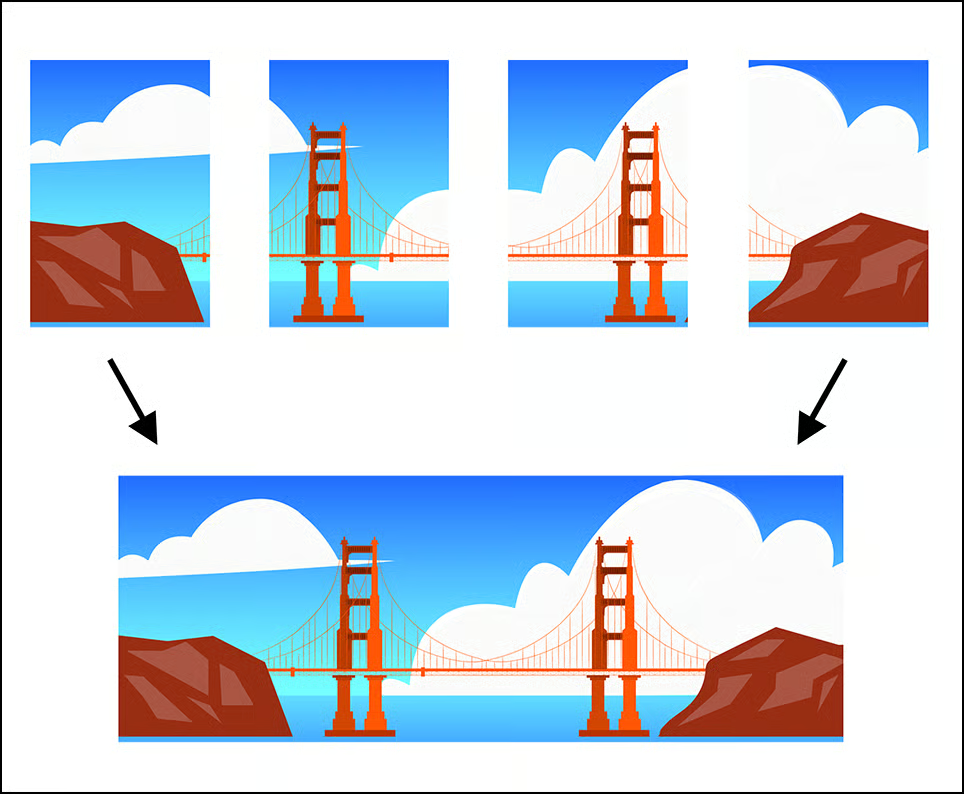
Import RAW files, apply consistent lens corrections (if needed), and sync exposure settings before stitching. In PTGui or Hugin, declare the lens as a full-frame diagonal fisheye at 15–16mm, and use roughly 25–30% overlap between adjacent frames. Fisheye inputs are generally easier to stitch because you need fewer frames, but be sure to set the correct lens type for accurate geometry. After optimizing control points, render an equirectangular 2:1 panorama (e.g., 12000×6000 px or larger, depending on your use case). For advanced masking and HDR integration, PTGui’s blend/mask tools are industry favorites. Why PTGui is a top choice for complex panoramas
Cleanup & Enhancement
- Nadir patch: Clone out the tripod or use a dedicated nadir patch from your extra plate shot. Some AI tools can speed this up.
- Color and noise: Use a consistent tone curve; apply noise reduction on shadowy interiors or night shots.
- Leveling: Correct horizon, roll, pitch, and yaw; anchor verticals in interiors for a natural feel.
- Export: Save an equirectangular JPEG/TIFF for virtual tour players or VR platforms; keep master layers for future edits.
If you plan to publish for VR headsets or web-based experiences, follow platform guidelines for sizes and metadata. VR publishing basics for DSLR 360 photos
Useful Tools & Resources
Software
- PTGui for professional stitching, masking, HDR, and viewpoint correction
- Hugin (open source) for robust control-point editing
- Lightroom / Photoshop for RAW development and finishing
- AI tools for tripod/nadir removal and object cleanup
Hardware
- Panoramic heads: Nodal Ninja, Leofoto, and similar modular systems
- Carbon fiber tripods with leveling bases
- Wireless remotes and L-brackets
- Pole extensions and vehicle mounts (plus tethers/safety lines)
Disclaimer: Names are provided for search convenience. Check official sites for current specs and compatibility.
Want a quick visual overview of nodal alignment and capture flow? The video below is a solid primer for new panoramic shooters.
For a concise 360 DSLR walkthrough including pano-head setup, see this step-by-step overview. Pano head setup for high‑end 360 photos
Common Mistakes & How to Avoid Them
- Parallax error → Calibrate and lock the nodal point; don’t move the tripod between frames.
- Exposure flicker → Use full manual exposure and locked white balance; avoid auto ISO.
- Tripod shadows and footprints → Shoot a dedicated nadir patch or plan to clone in post.
- Ghosting from movement → Take a second pass and mask moving subjects in post.
- Night noise → Favor longer exposures over high ISO when the tripod is stable; stack noise reduction if needed.
- Flare with fisheye → Shield the front element and avoid direct bright sources when possible; shoot a clean plate to blend later.
Field-Proven Use Cases
Indoor Real Estate
Set f/8, ISO 100–200, and bracket ±2 EV for windows. Six shots around plus zenith/nadir ensure minimal stitching issues in tight rooms. Keep the camera slightly above doorknob height to reduce converging lines on furniture.
Outdoor Sunset
Start at ISO 64, f/8, and pick a shutter speed to preserve highlights near the sun. If the sky changes fast, shoot a second rotation just for the sky and blend in post.
Event Crowds
Use 1/200–1/400 at ISO 400–800 to freeze motion. Do a second pass for clean background plates. Place the tripod where people flow around it rather than through your frame.
Rooftop or Pole
Wind kills sharpness. Add weight to the tripod hook, consider a lower extension height or a thicker pole, and raise ISO to allow faster shutter speeds. Always tether on rooftops.
Frequently Asked Questions
-
Can I shoot handheld panoramas with the Nikon D850?
Yes, for quick single-row panos outdoors and distant subjects, handheld can work. But for full 360° with near objects, you’ll likely get parallax errors. A pano head and tripod are strongly recommended for professional results.
-
Is the Sigma 15mm f/1.4 DG DN wide enough for a single-row 360?
Yes, as a diagonal fisheye it’s designed for very wide coverage. On full frame, plan for 6 shots around plus zenith/nadir for robust stitches. In some cases you can do 4 around, but seams may be riskier along the horizon.
-
Do I need HDR for interiors with bright windows?
Typically, yes. Bracketing ±2 EV across 3–5 frames per viewpoint balances windows and room shadows, especially on glossy surfaces. The D850’s DR helps, but bracketing is safer for clean results.
-
How do I avoid parallax issues?
Calibrate the entrance pupil on your panoramic head so that near/far objects do not shift when panning. Use two vertical objects (one near, one far) for testing and mark the rail position for your 15–16mm fisheye.
-
What ISO range is safe on the D850 in low light?
For tripod-based panoramas, aim for ISO 64–200 whenever possible. If wind or motion dictates faster shutter speeds, ISO 400–800 remains very clean; ISO 1600 is usable with careful noise reduction.
Compatibility & Practical Alternatives
Because the Sigma 15mm f/1.4 DG DN Diagonal Fisheye Art is a mirrorless-only lens (E/L mount), it does not natively mount to the Nikon D850’s F-mount. For a true D850 workflow, choose an F-mount diagonal fisheye with similar FOV (Sigma 15mm f/2.8 EX DG Fisheye or Nikon 16mm f/2.8 Fisheye). The capture counts, overlaps, and stitching guidance in this article remain exactly the same. If you own a compatible mirrorless body, you can use the Sigma 15/1.4 directly and follow the steps above unchanged.
If you’d like broader background and buying considerations for DSLR/360 virtual tours, this guide is a concise overview. DSLR 360 virtual tour camera and lens guide