
Why This Camera & Lens Are Great for Panoramas
If you want to know how to shoot panorama with Nikon D850 & Samyang 8mm f/3.5 UMC Fish-Eye CS II, you’ve picked a capable combo that can deliver pro-grade 360 photos with efficient capture speed. The Nikon D850’s 45.7MP full-frame BSI CMOS sensor (approx. 4.35 µm pixel pitch) is known for excellent dynamic range at base ISO 64 (around 14+ stops) and clean files at ISO 100–800. It’s rugged, weather-sealed, and has strong battery life for long pano sessions. The Samyang 8mm f/3.5 CS II is a manual-focus diagonal fisheye designed for APS-C. On the D850, it works best in DX crop mode (approx. 19.4MP files), giving you a very wide 180° diagonal field of view that reduces the number of shots needed for a full 360×180 capture.
Fisheyes are ideal for panoramic work because they allow fewer frames with high overlap, which speeds up capture and stitches reliably. The Samyang 8mm is sharp stopped down to f/8–f/11, has a removable hood (helpful to avoid blocking the FOV or when shaving for special full-frame circular use), and predictable distortion that stitching apps like PTGui and Hugin understand well. The trade-off is characteristic fisheye curvature, but since we’re outputting an equirectangular 360 photo, the fisheye look is managed by the stitcher rather than the final VR experience.
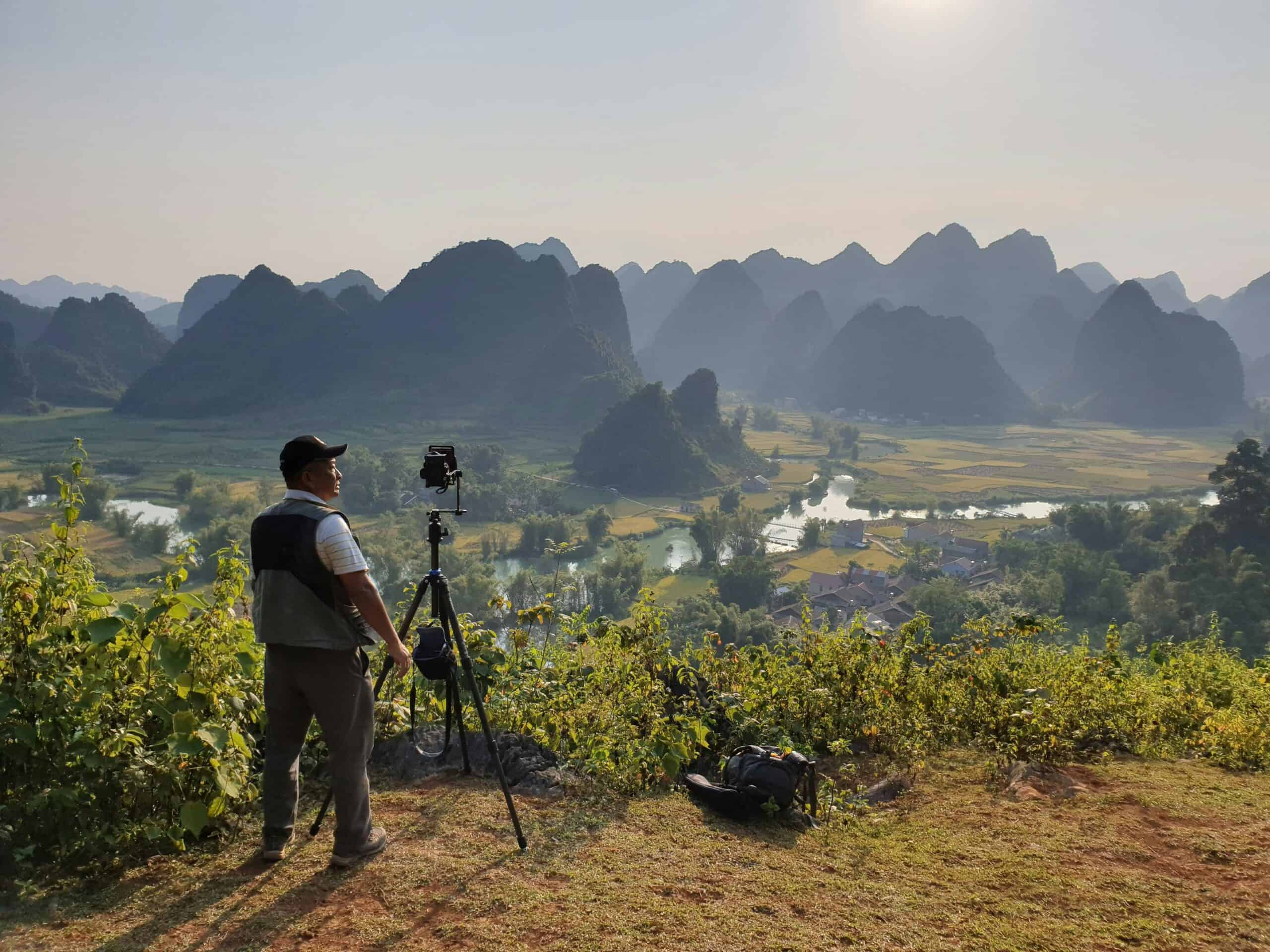
Quick Setup Overview
- Camera: Nikon D850 — Full-frame 45.7MP BSI CMOS, base ISO 64, superb DR, weather-sealed, approx. 1840-shot battery life (CIPA).
- Lens: Samyang 8mm f/3.5 UMC Fish-Eye CS II — diagonal fisheye for APS-C; manual focus; sharpest around f/8–f/11; minimal CA when stopped down; removable hood.
- Crop mode note: Use the D850 in DX crop for clean diagonal fisheye coverage (approx. 19.4MP files per frame). Using full-frame mode will cause heavy vignetting unless aiming for a circular specialty capture.
- Estimated shots & overlap (DX mode):
- Safe standard: 6 shots around at 0° + 1 zenith + 1 nadir (25–35% overlap).
- Fast outdoor pole: 4 shots around at 0° + zenith + nadir (only if sky is clear and scene is simple).
- Complex interiors: 8 shots around + zenith + nadir for extra overlap and precision.
- Difficulty: Moderate (easy once nodal point is calibrated).
Planning & On-Site Preparation
Evaluate Shooting Environment
Walk the scene before you set up. Identify moving subjects, reflective surfaces (glass, glossy floors), tight corners, and bright light sources. If you must shoot through glass, keep the lens as close as possible (1–5 cm) to reduce reflections and ghosting, and use a rubber lens hood if you have one. Watch for wind on rooftops or bridges—vibration can ruin sharpness, especially during long exposures.
Match Gear to Scene Goals
The D850 excels in high-contrast scenes thanks to its base ISO 64 and wide dynamic range; it’s perfect for sunset cityscapes or backlit interiors, especially when combined with bracketing for HDR panoramas. Indoors, the camera stays clean to ISO 400–800, and even ISO 1600 is usable in a pinch. The Samyang 8mm fisheye minimizes the number of frames needed, which is a big advantage for spaces with people or changing light. The trade-off is that diagonal fisheye on DX requires a few more shots than a circular fisheye on full frame—but you gain higher per-frame resolution and cleaner edges in DX mode.
Pre-shoot Checklist
- Power and memory: Fully charge EN-EL15 series batteries and carry a spare. Use fast, reliable cards; RAW+bracketed sequences add up quickly.
- Clean optics: Dust on fisheyes shows up easily. Clean the front element, and if you swap lenses often, inspect the sensor.
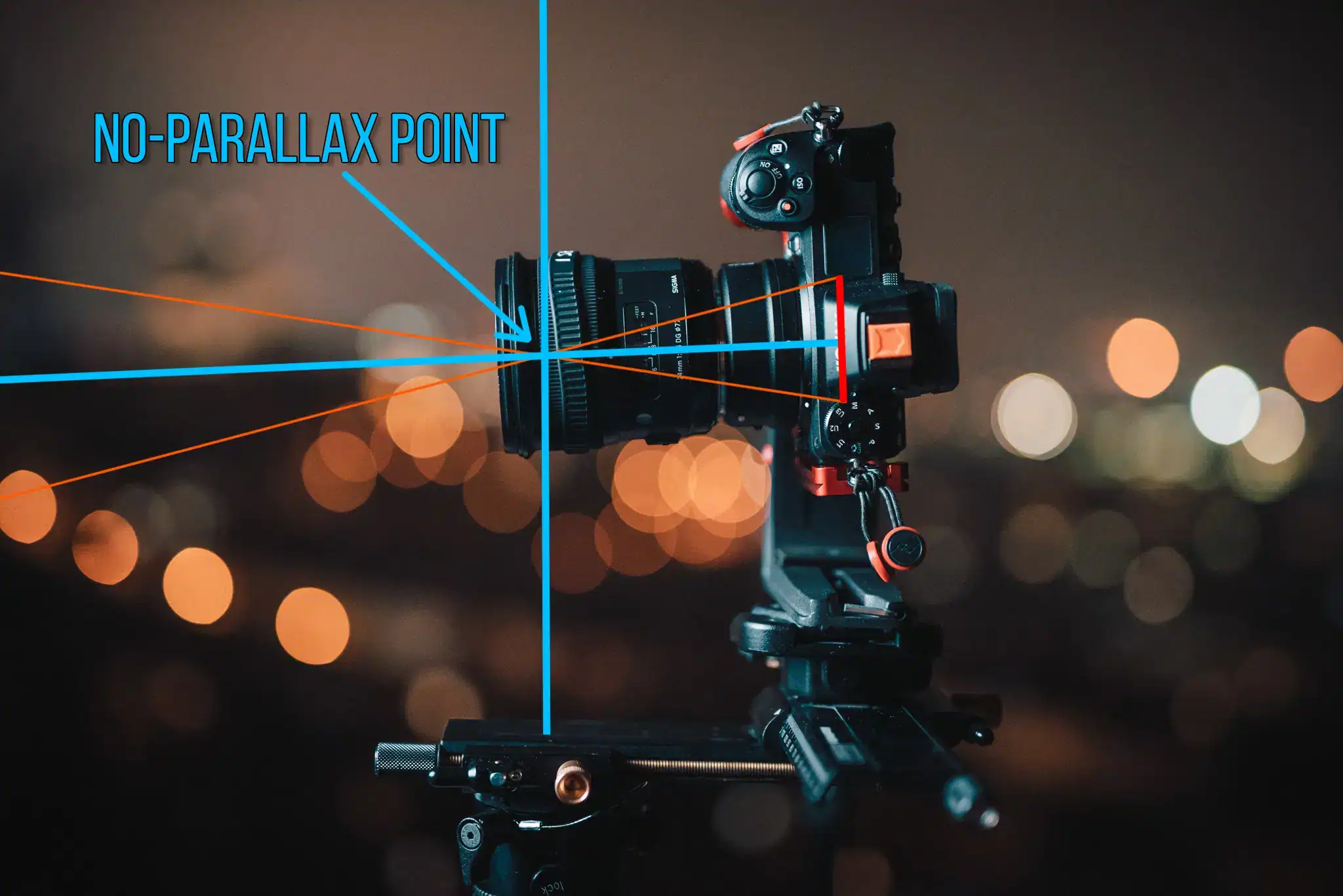
- Level and calibrate: Attach a leveling base and a panoramic head. Confirm nodal point (no-parallax point) settings for the D850 + Samyang 8mm.
- Safety checks: On rooftops or poles, tether the camera, watch for strong gusts, and keep your footprint small in public spaces. Car mounts must be rated and secured properly.
- Backup workflow: When time allows, shoot a second full rotation as a safety pass—especially for client work.
Essential Gear & Setup
Core Gear
- Panoramic head: A multi-row head (e.g., Nodal Ninja/Leofoto) lets you place the lens’s entrance pupil over the rotation axis, eliminating parallax between near and far objects. This is non-negotiable for clean stitches.
- Stable tripod with leveling base: A leveling base speeds up setup and keeps your “around” shots consistent. Carbon fiber reduces vibration for pole work.
- Remote trigger or app: Use a wired remote or the SnapBridge app to minimize vibrations. On the D850, consider Exposure Delay mode or Mirror-Up to further reduce shake.
Optional Add-ons
- Pole or car mount: Great for rooftops, crowds, or elevated views. Always tether the rig. Watch wind loads; rotate more slowly and use faster shutter speeds.
- Lighting aids: Small LED panels to lift shadows in dark corners (turn off between frames unless you can keep intensity constant).
- Weather protection: Rain covers and lens cloths; fisheyes catch droplets easily and every dot shows in a 360.
Step-by-Step Shooting Guide
Standard Static Scenes
- Level and nodal alignment: Level the tripod. Mount your panoramic head and slide the camera so the entrance pupil of the Samyang 8mm sits directly above the rotation axis. Use the classic “near object vs. far background” test and rotate left/right—adjust until their relative position does not shift.
- Exposure and WB lock: Set Manual mode. Pick a mid-tone in the scene, meter it, and lock that exposure across all frames. Set a fixed white balance (e.g., Daylight 5200–5600K outdoors; an appropriate Kelvin value indoors) to avoid color shifts during stitching.
- Focus: Switch the Samyang to manual focus. Use Live View with focus peaking on the D850. For 8mm at f/8, focusing around 0.4–0.5 m gets near-hyperfocal coverage, keeping everything sharp from close foreground to infinity.
- Capture sequence: In DX crop mode, shoot 6 frames around at 0° yaw increments of 60°, then 1 zenith (+60° to +90° tilt), and 1 nadir (−60° to −90° tilt). Maintain at least 25–35% overlap between frames.
- Nadir cleanup: After the main rotation, move the tripod slightly and shoot a handheld nadir patch with the same exposure/WB. This helps you remove the tripod in post.
HDR / High Dynamic Range Interiors
- Bracketed exposure: Use 5-frame AEB at 1 EV steps (−2, −1, 0, +1, +2 EV) to preserve bright windows and shadowed interiors. The D850 supports up to 9 frames; stick to 5 for speed unless the scene is very high contrast.
- Lock WB and aperture: Keep the same white balance and aperture across all brackets to ensure consistent color and depth of field.
- Silent/EFCS and delay: In Live View, use Electronic Front-Curtain Shutter and Exposure Delay to avoid shutter/mirror vibration during long brackets.
Low-Light / Night Scenes
- Tripod discipline: Stick to ISO 64–200 when possible and use longer shutter speeds. If motion is present or wind is strong, ISO 400–800 on the D850 remains clean; ISO 1600 can work with noise reduction in post.
- Remote shooting: Use a remote trigger or SnapBridge. Enable Mirror-Up or Exposure Delay to minimize micro-blur.
- Check histogram: Don’t crush shadows; expose to the right without clipping highlights when you can, and rely on RAW recovery later.
Crowded Events
- Two-pass method: Do a quick first pass to lock your camera position, then wait for gaps and reshoot frames with moving people. You’ll mask them later.
- Faster shutters: Aim for 1/125–1/250s to freeze motion. If needed, raise ISO modestly (400–800) on the D850 to maintain sharpness.
Special Setups (Pole / Car / Drone)
- Secure everything: Tighten clamps, tether the camera, and pre-test your mounts. On a pole, rotate smoothly and limit exposure times to reduce sway.
- Vibration control: Use higher shutter speeds (1/200s+) and consider a slightly higher ISO to compensate. Capture extra overlap in case a frame is soft.
Recommended Settings & Pro Tips
Exposure & Focus
| Scenario | Aperture | Shutter | ISO | Notes |
|---|---|---|---|---|
| Daylight outdoor | f/8–f/11 | 1/100–1/250 | 64–200 | Use base ISO 64 for max DR; lock WB to Daylight |
| Low light/night | f/4–f/5.6 | 1/30–1/60 (or longer on tripod) | 200–800 | Use Mirror-Up/Exposure Delay; remote trigger |
| Interior HDR | f/8 | Bracket 5 frames at 1 EV steps | 64–400 | Balance windows and lamps; keep WB fixed |
| Action / moving subjects | f/5.6–f/8 | 1/200+ | 400–800 | Freeze motion; do two passes for clean stitches |
Critical Tips
- Manual focus near hyperfocal: On 8mm at f/8, set focus ~0.4–0.5 m for front-to-back sharpness.
- Nodal point calibration: Start with the lens positioned so the front element sits just ahead of the rotation axis; use near vs. far object alignment to fine-tune and mark the rail with tape so you can repeat it quickly.
- White balance lock: Use a fixed Kelvin value; mixed lighting can be corrected later, but varying WB across frames causes stitching seams.
- RAW capture: Shoot 14-bit RAW for best dynamic range and color latitude, particularly for HDR merges.
- Stabilization: The D850 has no IBIS and the Samyang has no VR; on a tripod, any stabilization should be off to prevent micro-motion corrections.
- Delay and EFCS: Enable Exposure Delay (e.g., 1–3 s) and Electronic Front-Curtain Shutter in Live View to eliminate vibrations in critical frames.
- Avoid long-exposure NR during brackets: It can introduce gaps between frames and disrupt moving light consistency; apply noise reduction in post.
Stitching & Post-Processing
Software Workflow
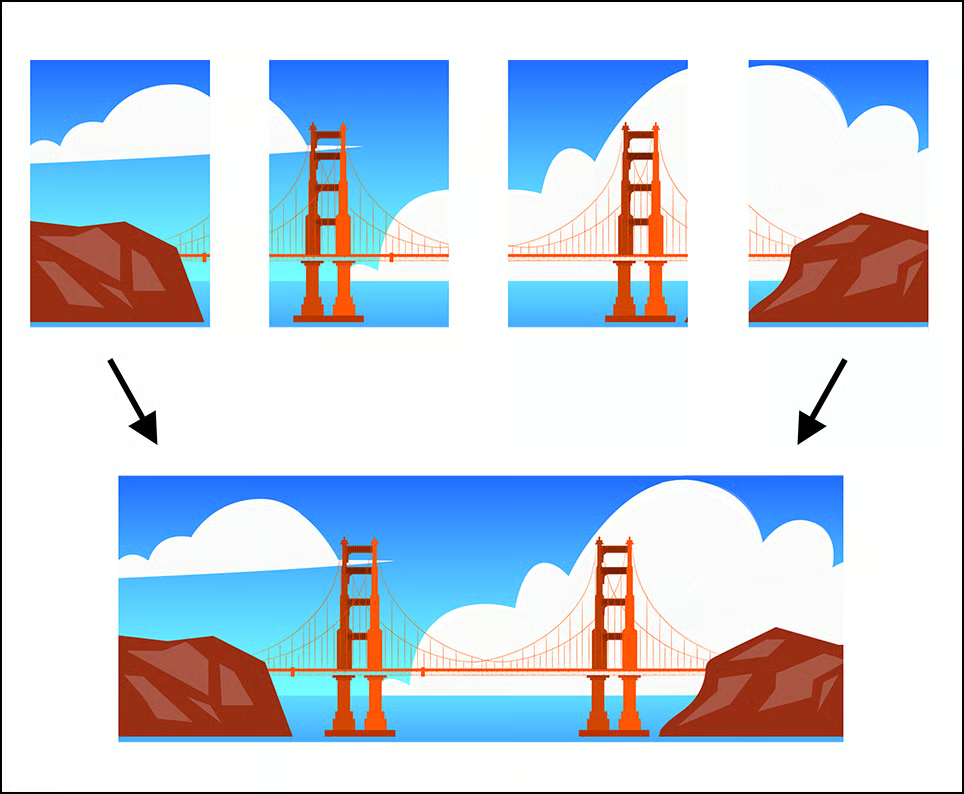
Import RAWs and, if you bracketed, pre-merge exposure sets or let your stitcher handle HDR. PTGui and Hugin both model fisheye lenses well. With a diagonal fisheye in DX, aim for 25–35% overlap. In PTGui, set lens type to “full-frame fisheye” (diagonal fisheye) and let it estimate the FOV; optimize control points, then preview the equirectangular output. PTGui’s exposure fusion and HDR merging are robust for mixed lighting. Hugin is a solid open-source alternative if you’re patient with control points. For background, see the PTGui workflow review and panoramic head tutorials referenced below.
Typical export: 16-bit TIFF master or high-quality JPEG equirectangular at 8k–12k pixels wide for web. With 6-around in DX crop, expect final panos in the 10k–14k range depending on overlap and final crop. Level pitch/roll and use horizon tools. For VR platforms, export JPEGs with appropriate metadata and keep file sizes optimized for faster load times.
Cleanup & Enhancement
- Nadir patch: Use a clean handheld nadir shot or AI tripod removal. Clone/heal any residual seams.
- Color and contrast: Correct white balance drift, tame mixed lighting, and apply gentle contrast. Dehaze sparingly for interiors.
- Noise reduction: Apply luminance NR to shadows when using ISO 800–1600, and consider selective sharpening for edges.
- Final checks: Straighten the horizon, remove dust spots, and inspect the zenith/nadir for stitching mismatches.
- Export: Save a 16-bit master and a web-optimized JPEG. For VR platforms, follow their file size and metadata guidelines.
For a solid primer on pano head setup and high-end 360 capture, see this panoramic head tutorial and the official DSLR-to-360 workflow guidance from Meta’s Creator resources (linked below).
Real-World Use Cases
Indoor Real Estate
Use DX crop, f/8, ISO 64–200, and 5-frame brackets at 1 EV steps. Shoot 6-around + zenith + nadir. Turn off ceiling fans and ask people to step out. Shoot a second safety rotation in case you need to mask moving shadows or doors.
Outdoor Sunset Cityscape
Base ISO 64, f/8–f/11. Capture a bracketed set quickly around blue hour when light changes fast. Consider starting your rotation at the brightest area and moving steadily to maintain consistency. Do an extra zenith if clouds are moving rapidly.
Event Crowd
Use 1/200s+, ISO 400–800, and do two passes. Use masks during post to keep a single person consistent across seams. If a performer moves, plan the seam away from them by adjusting yaw start position.
Rooftop/Pole
Keep the pole vertical via a bubble level. Use faster shutters and overshoot overlap (8-around) to cover any motion blur. Always tether your camera and avoid gusty conditions that could cause sway.
Car-Mounted Capture
Only on private roads or controlled sets for safety. Use rigid suction mounts and safety cables. Short exposures and high overlap (8-around) help counter vibrations. Always prioritize safety over getting the shot.
Recommended Video Tutorials
Want to see the capture and stitching flow? This practical walkthrough covers the essentials from leveling to blending:
Useful Tools & Resources
Software
- PTGui panorama stitching — a fast, pro-grade stitcher with excellent fisheye handling. See a practical PTGui workflow review at Fstoppers.
- Hugin — open-source stitching software with granular control. Good for learning lens models and control points.
- Lightroom / Photoshop — RAW development, lens corrections, and finishing touches.
- AI tripod removal tools — speed up nadir patching when patches are repetitive.
Hardware
- Panoramic heads (Nodal Ninja, Leofoto) — enable precise nodal alignment and repeatable results. Learn the concepts in this panoramic head tutorial.
- Carbon fiber tripods — reduce vibration and weight.
- Leveling bases — speed up setup and consistency.
- Wireless remotes — minimize vibration and allow hands-free bracketing.
- Pole extensions / car mounts — specialized perspectives; use with caution and tethers.
If you plan to publish panoramas for VR headsets, consult the official DSLR-to-360 guidance from Meta’s Creator resources for export and metadata recommendations: Using a DSLR or mirrorless camera to shoot and stitch a 360 photo.
Disclaimer: software/hardware names provided for search reference; check official sites for features and updates.
Common Mistakes & How to Avoid Them
- Parallax error: Align the no-parallax point precisely; even a few millimeters off can cause wavy seams.
- Exposure flicker: Manual mode with fixed WB and aperture. Avoid Auto ISO for bracketed sets.
- Tripod shadows and footprints: Plan a clean nadir, step away during the shot, and capture a handheld nadir patch.
- Ghosting from movement: Use two-pass shooting and mask in post. Extra overlap helps.
- Night noise and blur: Favor base/low ISO and longer exposures with mirror-up and remote. If wind is strong, raise ISO moderately and shorten exposure.
- Dirty fisheye element: Smudges are obvious in 360s. Clean frequently, especially when working near spray or fog.
Frequently Asked Questions
- Can I shoot handheld panoramas with the Nikon D850?
Yes for quick partial panos, but for a full 360×180 you’ll get better results on a tripod with a panoramic head. Handheld fisheye sets can work outdoors if you rotate around the lens, but expect more stitching errors and parallax indoors.
- Is the Samyang 8mm f/3.5 wide enough for a single-row 360 on the D850?
In DX crop mode, yes—use 6 shots around plus zenith and nadir. For very simple sky scenes, 4 around can work, but 6-around is the safer standard for interiors and detailed architecture.
- Do I need HDR for interiors with bright windows?
Often yes. Use 5-frame brackets at 1 EV steps (−2 to +2 EV). This preserves view-through windows while keeping interior detail, and PTGui/Hugin can merge the exposure stacks cleanly.
- How do I avoid parallax issues with this lens?
Mount on a panoramic head and align the entrance pupil over the rotation axis. With fisheyes, the entrance pupil is close to the front element; fine-tune using the near/far test and mark your rail positions for repeatability.
- What ISO range is safe on the D850 in low light?
For pano work, aim for ISO 64–200 whenever possible to maximize dynamic range. ISO 400–800 remains very clean. ISO 1600 is usable with careful noise reduction if you need faster shutter speeds.
- Can I create custom modes for pano on the D850?
While the D850 doesn’t use C1/C2 like some brands, you can save settings to banks. Store a “PAN” bank with Manual exposure, fixed WB, Live View + EFCS, Exposure Delay, and your bracketing preferences to speed up setup.
- How can I reduce flare when using a fisheye?
Avoid pointing directly at the sun when possible; shade the lens with your hand just out of frame, and clean the front element meticulously. Stopping down to f/8–f/11 reduces veiling flare and improves edge acuity.
- What’s the best tripod head for this setup?
A lightweight multi-row panoramic head with precise fore/aft adjustment and angle detents (e.g., Nodal Ninja, Leofoto) balances speed and accuracy. Make sure it can position the lens entrance pupil over the pivot for parallax-free rotations.
Further Reading
- Deep-dive on panoramic heads and setup best practices: Panoramic head tutorial
- Why PTGui is a top choice for stitching fisheye panoramas: PTGui review
- Output considerations for VR platforms and 360 publishing: Using a DSLR or mirrorless camera to shoot and stitch a 360 photo