
Why This Camera & Lens Are Great for Panoramas
The Nikon D850 paired with the Peleng 8mm f/3.5 is a powerful, budget‑friendly setup for creating high‑quality 360° panoramas. The D850’s 45.7 MP full‑frame BSI CMOS sensor (approx. 8256×5504, pixel pitch ~4.35 μm) delivers excellent detail and low noise, while its exceptional base ISO 64 dynamic range (around 14.5–14.8 EV by independent tests) helps preserve highlight detail in bright skies and windowed interiors. The camera’s silent live view mode, exposure delay, mirror‑up, and tilting LCD reduce vibrations and make tripod work more comfortable.
The Peleng 8mm f/3.5 is a manual, circular fisheye on full frame, covering ~180° across its circular image. For 360 panoramas, that extremely wide field of view is an advantage: you need far fewer shots around to cover the full sphere, speeding up capture and minimizing moving‑subject problems. The tradeoff is typical fisheye distortion (normal and correctable in pano stitchers), modest chromatic aberration, and susceptibility to flare. On the D850, use the Non‑CPU Lens Data menu to enter focal length (8 mm) and aperture (f/3.5) so you get proper metering and EXIF. With careful technique, this combo produces clean, high‑resolution equirectangular outputs suitable for virtual tours, VR, and large web embeds.
Quick Setup Overview
- Camera: Nikon D850 — Full Frame 35mm, 45.7 MP BSI CMOS; base ISO 64; excellent DR; no in‑body stabilization.
- Lens: Peleng 8mm f/3.5 — manual, circular fisheye; best sharpness ~f/5.6–f/8; moderate CA; flare‑prone if the sun is in frame.
- Estimated shots & overlap:
- Minimal: 3 shots around at 120° + zenith + nadir (5 total) if your overlap is generous and you avoid near‑field objects.
- Safer: 4 shots around at 90° + zenith + nadir (6 total) for stronger control points and fewer stitching errors.
- Overlap: aim for 30–40% between frames.
- Difficulty: Easy–Moderate (manual lens + nodal alignment required, but few shots per pano).
Planning & On-Site Preparation
Evaluate Shooting Environment
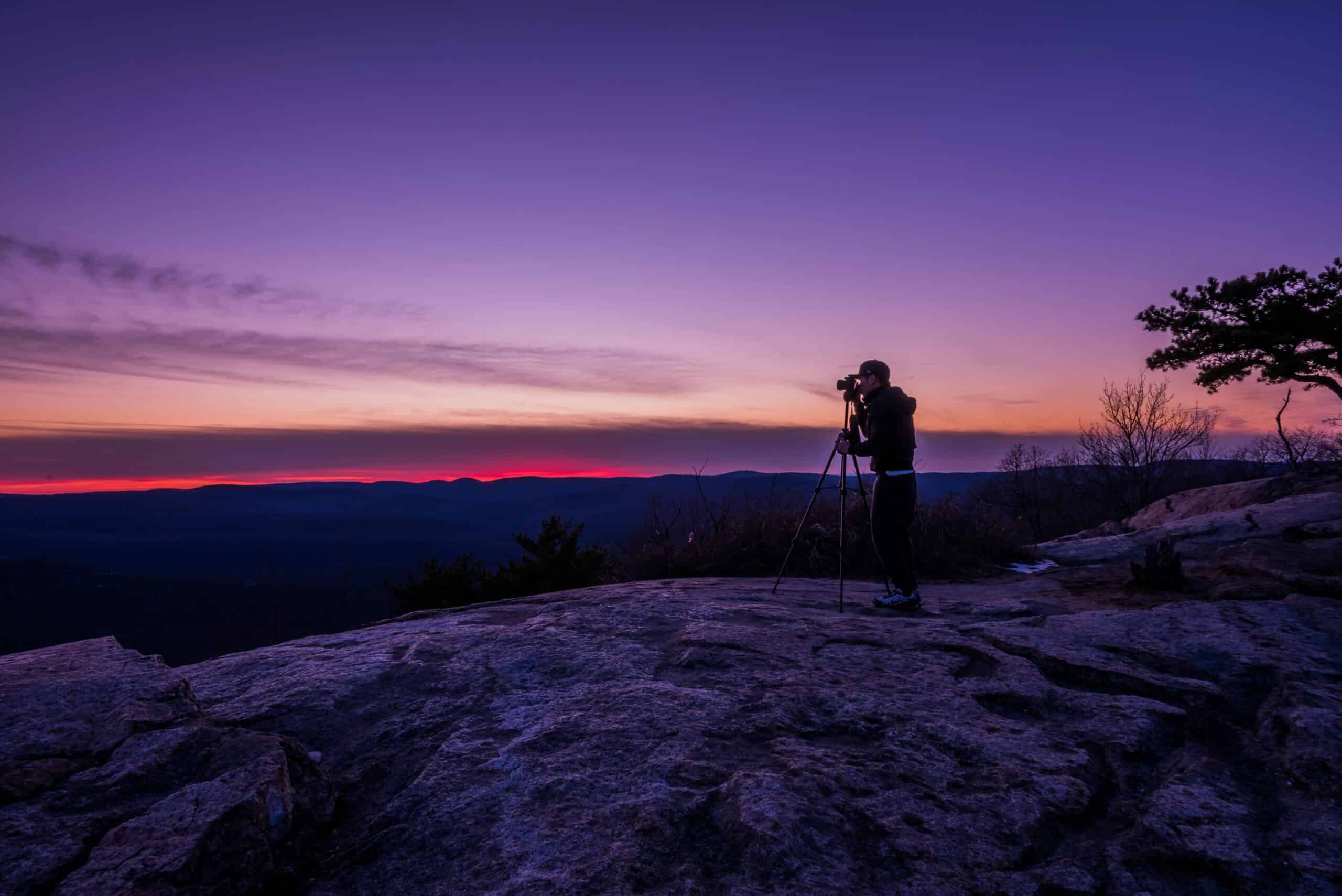
Survey the scene before you extend the tripod. Look for moving elements (people, cars, foliage), reflective surfaces (glass, polished floors), and strong point lights (sun, lamps). If shooting through glass, keep the front element close to the glass (1–2 cm) and shade it with a jacket or rubber hood to minimize reflections and ghosting. Indoors, note mixed color temperatures; in outdoor sunsets, watch for rapidly changing light that could cause exposure mismatches between frames.
Match Gear to Scene Goals
The D850’s base ISO 64 dynamic range gives you strong headroom for bright windows and sunlit clouds, and its clean ISO 100–400 images make low‑noise interior panos possible. The Peleng 8mm fisheye keeps your shot count low, reducing the time moving subjects have to cause ghosting. If you expect extreme highlights (golden hour) or window‑lit interiors, bracket for HDR at ±2 EV. For indoor ambient‑only real estate, ISO 100–400 on a tripod with longer shutter speeds is safe; for urban nights, ISO 400–800 is still quite clean on the D850.
Pre-shoot Checklist
- Power & media: Fully charged EN‑EL15 battery(s) and fast, empty XQD/CFexpress/SD cards.
- Clean optics: Wipe the fisheye front element; dust shows up near light sources. Check the D850 sensor for specks.
- Leveling: Use a leveling base or the D850’s virtual horizon; calibrate your panoramic head for the lens’s no‑parallax point.
- Safety: On rooftops or windy areas, tether your gear; widen tripod stance; avoid lifting the pole near power lines.
- Backup: If conditions are changing or crowds move, shoot a second pass. It gives you maskable alternatives in post.
Essential Gear & Setup
Core Gear
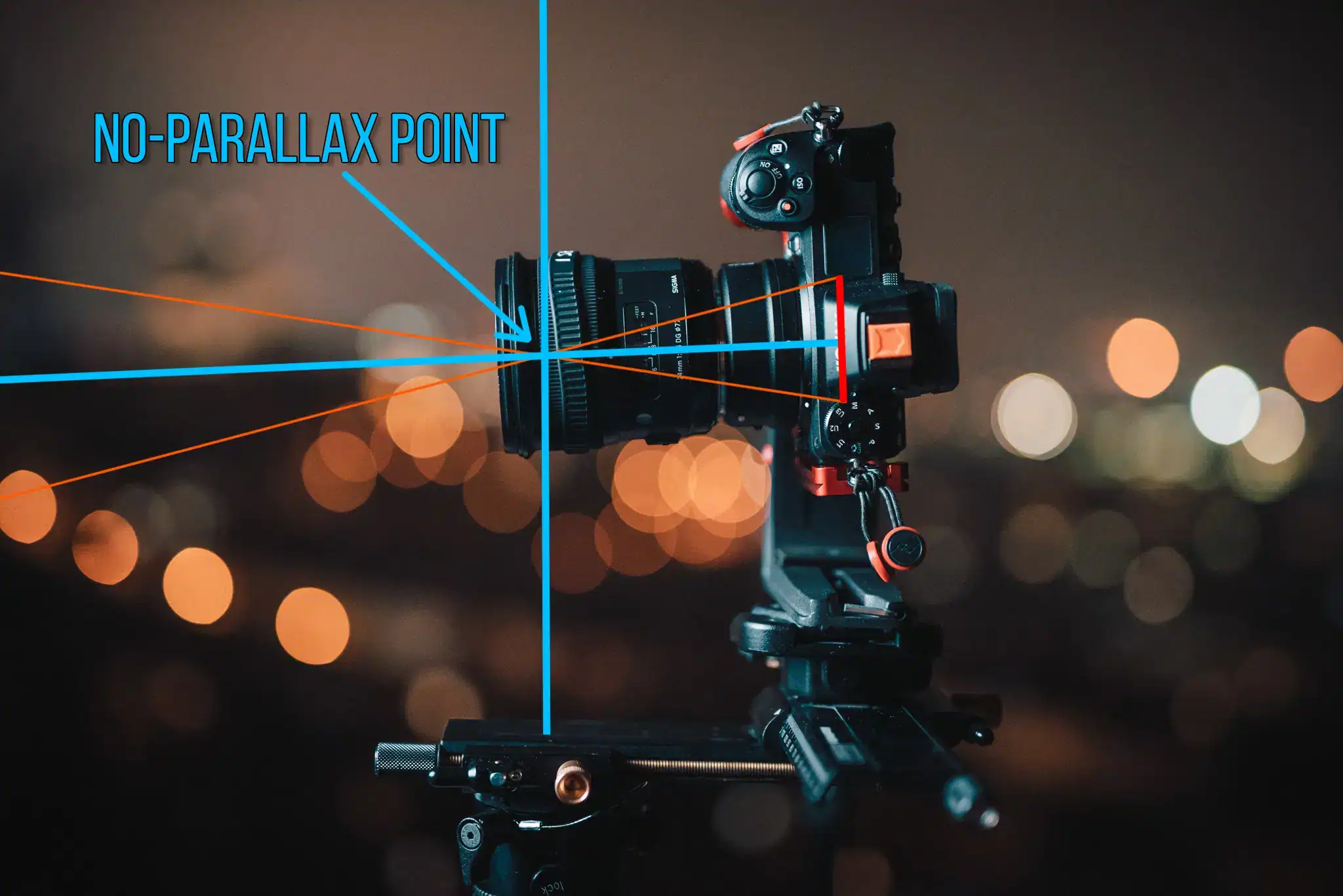
- Panoramic head: Use a head with fore‑aft and lateral adjustment to position the lens’s entrance pupil over the rotation axis. This eliminates parallax when foreground objects overlap the background across frames.
- Stable tripod + leveling base: Leveling keeps your yaw increments consistent and makes stitching easier. A leveling base saves time compared to adjusting tripod legs.
- Remote release or SnapBridge app: Trigger without touching the camera. Also enable exposure delay (1–3 s) or mirror‑up to kill vibrations.
Optional Add-ons
- Pole or car mount: Great for elevated or vehicle‑based captures, but secure everything with tethers and consider wind loads; rotate slower to reduce vibration.
- Continuous lights or small flash: Helpful in dark interiors; keep lighting consistent across all frames to avoid visible seams.
- Weather protection: Rain covers, microfiber cloths, and gaffer tape for quick fixes in the field.
Quick D850 + Peleng Setup Notes
In the D850 Setup menu, add Non‑CPU lens data: 8 mm, f/3.5, and select it so metering and EXIF are recorded. Use A mode for test exposure, then switch to full Manual to lock settings. The Peleng is fully manual: set aperture on the ring and focus using distance scale. For tripod work, enable “Exposure delay mode” or shoot in Mirror‑up with a remote. Focus peaking in live view helps confirm focus if you use magnification.
Step-by-Step Shooting Guide
Standard Static Scenes
- Level and align nodal point: Level your tripod using the leveling base or camera horizon. Slide the lens on the pano head so the entrance pupil sits over the yaw axis. A practical test: line up a near object with a distant edge in the frame and yaw the camera; adjust fore‑aft until there’s no relative shift. With the Peleng 8mm, many rails land around 5.0–5.5 cm forward offset from the pivot as a starting point—fine‑tune on location.
- Lock exposure and white balance: Meter a mid‑tone region, then switch to Manual and keep ISO/shutter/aperture fixed for the entire set. Lock WB (e.g., Daylight 5200–5600K outdoors or a custom Kelvin indoors) to avoid color casts between frames.
- Capture the ring: For this combo, shoot either 3 or 4 shots around at equal yaw increments (120° or 90°), keeping overlap ~30–40%. Keep tilt level at 0° for the ring.
- Zenith and nadir: Tilt up for a zenith shot and down for a nadir. For a clean nadir (tripod removal), take one extra handheld nadir plate by moving the camera laterally over where the tripod stood.
HDR / High Dynamic Range Interiors
- Bracket ±2 EV or ±3 EV: Use 3–5 exposures per angle (e.g., −2/0/+2) to balance bright windows against interior shadows. The D850 handles bracketing in continuous mode; confirm the bracketing order and count before you start.
- WB consistency: Keep a fixed Kelvin WB or a custom preset so multi‑exposure stacks match color across the panorama.
- De‑ghosting strategy: Take a second HDR set if people move; you can blend clean regions later.
Low-Light / Night Scenes
- Longer shutter, controlled ISO: Start at ISO 64–200 for best quality; if wind or subject movement is present, push to ISO 400–800. The D850 remains clean here; 1600 is usable with good noise reduction.
- Stability: Use exposure delay or mirror‑up, a remote trigger, and hang a bag on the tripod for stability. Turn off any lens stabilization (not applicable to the Peleng) on a tripod.
- Light pollution: Use a custom WB if color casts become extreme, or fix in RAW later.
Crowded Events
- Two passes: First pass for full coverage, second pass to capture clean background spaces when people move out of frame.
- Short shutter: Prefer 1/125–1/250 at ISO 400–800 to reduce motion blur. You can still stitch well thanks to the fisheye’s overlap.
- Masking later: Plan to mask moving subjects in post using the clean second‑pass frames.
Special Setups (Pole / Car / Elevated)
- Secure everything: Use tethers and safety lines. For car rigs, avoid highways; shoot at very low speed in safe, controlled areas.
- Wind management: Keep exposures short (raise ISO to 400–800 if needed) and rotate slowly. Check each frame for blur before moving on.
- Redundancy: Shoot an extra ring; vibrations ruin frames unpredictably.
Recommended Settings & Pro Tips
Exposure & Focus
| Scenario | Aperture | Shutter | ISO | Notes |
|---|---|---|---|---|
| Daylight outdoor | f/8–f/11 | 1/100–1/250 | 64–200 | Lock WB to Daylight (5200–5600K); superb DR at ISO 64. |
| Low light/night | f/4–f/5.6 | 1/30–1/60 (tripod) | 200–800 | Use exposure delay or MUP; check for wind blur. |
| Interior HDR | f/8 | Bracket ±2 EV | 64–400 | Balance windows and lamps; keep WB fixed across brackets. |
| Action / moving subjects | f/5.6–f/8 | 1/200+ | 400–800 | Faster shutter to freeze motion; consider two passes. |
Critical Tips
- Manual focus and hyperfocal: At 8 mm and f/8, hyperfocal distance is roughly 0.3 m. Set focus just under 0.5 m and everything from ~0.25 m to infinity stays sharp.
- Nodal point calibration: Start with the lens clamped so the front element sits about 5–5.5 cm forward of the yaw axis, then refine using the near‑far alignment test. Mark your rail once you find the sweet spot, and log it in your phone.
- White balance lock: Mixed lighting causes color seams. Use Kelvin or a custom preset per location rather than Auto WB.
- RAW for flexibility: The D850’s 14‑bit RAW files give you headroom for highlight recovery and cleaner HDR merges than JPEG.
- Use Non‑CPU Lens Data: On the D850, set 8 mm f/3.5 so metering is stable and EXIF data is recorded correctly.
Mini Case Studies (Field‑Tested)
Indoor Real Estate
Tripod with pano head, f/8, ISO 64–200, bracket ±2 EV. Shoot 4 around + zenith + nadir for clean control points. Use a handheld nadir tile to patch the tripod later. Keep WB at 4000–4500K if tungsten dominates or 5000–5200K for mixed warm/cool.
Outdoor Sunset
Lock at ISO 64–100 and expose for highlights; bracket ±2 EV if the sun is in frame. Avoid pointing directly into the sun on every frame; shoot the sun‑side frame last to minimize flare. Consider a second pass to replace flare‑damaged areas in post.
Rooftop with Light Wind
Lower the tripod, widen the stance, and hang a bag. ISO 200–400 for faster shutter (1/125–1/250) at f/8. Use 4 around for robust overlap. Always tether gear and stay clear of edges.
Stitching & Post-Processing
Software Workflow
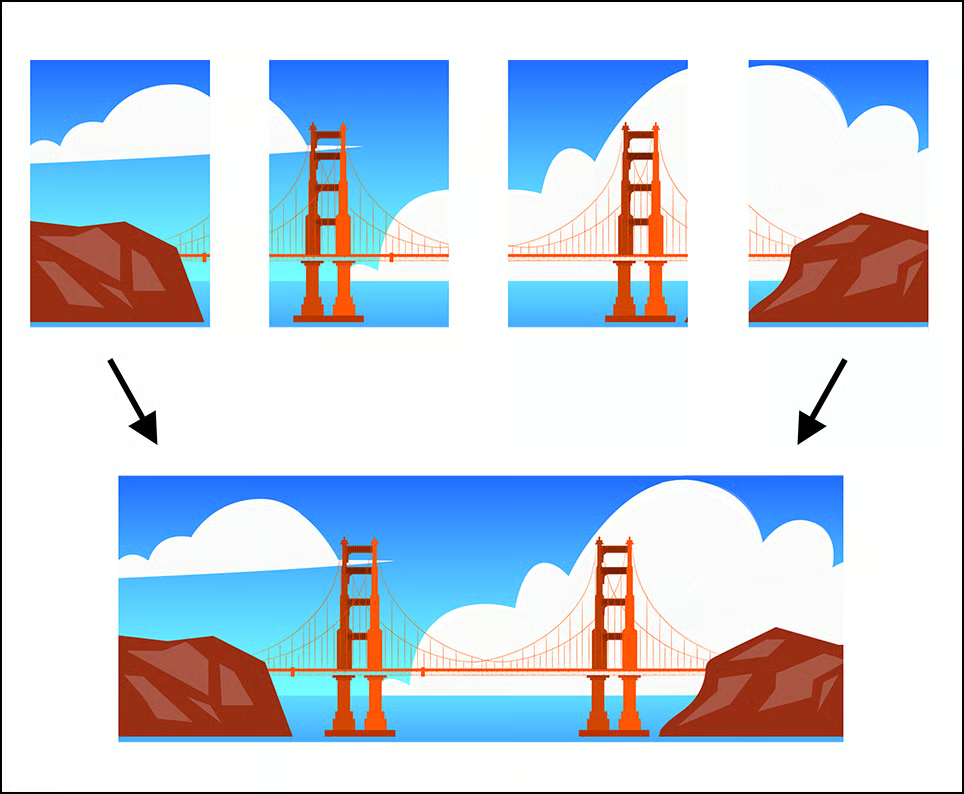
Import your RAW files into Lightroom or Capture One, apply identical base adjustments to the entire set (lens CA removal, WB, gentle noise reduction), then export as 16‑bit TIFFs for stitching. In PTGui or Hugin, select “Fisheye” lens type and confirm focal length (8 mm). With the Peleng, let the software detect control points and optimize. Fisheyes are generally easier to stitch because you require fewer images, though you must account for their projection. Aim for ~30–40% overlap. For rectilinear lenses the overlap can be ~20–25% but more frames are required. After stitching, set the panorama to equirectangular projection and level the horizon; export at 8K–16K width for high‑quality viewing. See professional recommendations on pano heads and control points for deeper context at the end of this paragraph. Comprehensive panoramic head tutorial (techniques and best practices).
Cleanup & Enhancement
- Tripod/nadir patch: Use a separate nadir tile or AI‑based heal/clone. Many virtual‑tour pipelines accept a round logo patch.
- Color and NR: Balance color across frames; apply luminance NR conservatively to preserve texture at night.
- Leveling: Correct yaw, pitch, and roll so horizons are straight and ceilings don’t “tilt.”
- Export: Save an equirectangular JPEG (2:1 aspect) for web/VR. Keep a master 16‑bit TIFF for archival edits.
PTGui remains the industry benchmark for speed and reliability, especially with fisheyes and HDR workflows. Read a practical review of PTGui’s strengths. For VR publishing specifics using DSLR panos, the official Oculus creator docs are also helpful. Using a DSLR to shoot and stitch a 360 photo (Oculus Creator).
Short Video: Pano Head Setup Fundamentals
Visual learners will appreciate a concise walk‑through of panoramic head setup and stitching fundamentals:
Always verify the latest workflow features in your chosen software, as updates often improve fisheye handling, HDR de‑ghosting, and horizon leveling.
Useful Tools & Resources
Software
- PTGui panorama stitching
- Hugin open‑source stitcher
- Lightroom / Photoshop for RAW and retouching
- AI tripod/nadir removal tools
Hardware
- Panoramic heads: Nodal Ninja, Leofoto, or equivalent multi‑row heads
- Carbon fiber tripods for portability and stiffness
- Leveling bases to speed setup
- Wireless remote shutters
- Pole extensions / car mounts (with safety tethers)
Disclaimer: product and software names are provided for search convenience; consult official documentation for current features and compatibility.
Common Mistakes & How to Avoid Them
- Parallax error: Not aligning the entrance pupil over the rotation axis. Calibrate with near‑far alignment tests and mark your rail.
- Exposure flicker: Shooting in auto mode or Auto WB. Use full Manual exposure and a fixed Kelvin WB.
- Tripod shadow/footprint: Forgetting a nadir shot. Capture and later patch the nadir plate.
- Ghosting: Crowds or moving leaves across frames. Take a second pass and mask the clean regions.
- Night noise: Over‑pushing ISO. Use a tripod, longer shutter, and keep the D850 at ISO 64–800 where possible.
Frequently Asked Questions
- Can I shoot handheld panoramas with the Nikon D850?
Yes, but results vary. With a circular fisheye you can sometimes manage 3–4 handheld shots around and stitch them, but parallax (especially with near objects) and inconsistent rotation are common. A tripod with a panoramic head gives much more reliable results and cleaner stitches.
- Is the Peleng 8mm f/3.5 wide enough for a single‑row 360?
Yes. On full frame it’s a circular fisheye, so one horizontal row of 3–4 frames plus zenith and nadir is typically enough. In tight interiors or with lots of near‑field detail, use 4 around for stronger overlap and control points.
- Do I need HDR for interiors with bright windows?
Usually, yes. The D850’s DR is excellent, but high‑contrast interiors often exceed even that. Bracket ±2 EV (or ±3 EV if needed) at each angle, then merge and stitch. Keep WB fixed across brackets for consistency.
- How do I avoid parallax issues with this combo?
Use a panoramic head and align the lens’s entrance pupil over the rotation axis. Start with a ~5–5.5 cm forward offset as a baseline and refine using a near‑far alignment test. Once dialed in, mark your rails to repeat quickly on future shoots.
- What ISO range is safe on the D850 in low light?
For tripod‑based panos, aim for ISO 64–200 for best quality; 400–800 remains very clean. ISO 1600 is usable with careful exposure and modern noise reduction. Favor longer shutter speeds over high ISO when possible.
Safety, Limitations & Honest Notes
The Peleng 8mm is fully manual and can flare with bright light sources—shade the lens and plan your rotation so the sun is captured last. Because it’s a circular fisheye, your effective pixel usage per frame is less than the full 45.7 MP; expect final equirect outputs in the ~10K–16K width range for 4‑around workflows depending on overlap and stitching. The D850 lacks IBIS, but on a tripod that’s not a limitation. Always tether when shooting from rooftops, poles, or vehicle mounts, and avoid gusty conditions that can topple gear. Finally, keep a redundant pass; when you stitch at home, those extra frames often save a panorama.