Why This Camera & Lens Are Great for Panoramas
If you want to learn how to shoot panorama with Nikon D750 & Tokina ATX-i 11-20mm f/2.8, you’re pairing a proven full-frame DSLR with a sharp, fast ultra‑wide zoom. The Nikon D750’s 24.3MP FX sensor (35.9×24mm, ~6.0µm pixel pitch) delivers excellent dynamic range at base ISO (about 14.5 EV), clean color, and reliable ergonomics—great for consistent, stitchable exposures. The Tokina ATX‑i 11–20mm f/2.8 is a rectilinear ultra‑wide designed for APS‑C (DX). On the D750 it triggers Auto DX crop, producing ~10.3MP images (equivalent focal length ~16.5–30mm on full‑frame). That means fewer shots than a longer lens but more shots than a fisheye.
Rectilinear rendering is an advantage for architectural lines and interiors where you want straight walls without fisheye curvature. Wide open at f/2.8 it’s capable in low light; stopped down to f/5.6–f/8 it becomes very sharp across the frame with manageable lateral CA and barrel distortion (especially toward 11mm). The lens uses an 82mm filter thread, focuses as close as ~0.28 m, and offers a grippy manual focus ring—useful when locking focus for panorama consistency. Mount compatibility is straightforward (Nikon F), and the D750’s Auto DX crop plus exposure delay options help keep your 360 photo workflow smooth and vibration‑free.
Quick Setup Overview
- Camera: Nikon D750 — Full-Frame (FX) 24.3MP CMOS, native ISO 100–12,800 (expandable 50–51,200), excellent DR at ISO 100.
- Lens: Tokina ATX‑i 11–20mm f/2.8 — rectilinear ultra‑wide (DX), constant f/2.8, good sharpness by f/5.6–f/8, moderate barrel distortion at the wide end, lateral CA correctable.
- Coverage & overlap (portrait orientation, DX crop):
- At 11mm (≈16.5mm equiv.): 10 shots around (36° steps) + 1 zenith + 1–2 nadirs (with tripod offset).
- At 15mm (≈22.5mm equiv.): 12 shots around + zenith + nadir.
- At 20mm (≈30mm equiv.): 16 shots around + zenith + nadir (or 2-row approach).
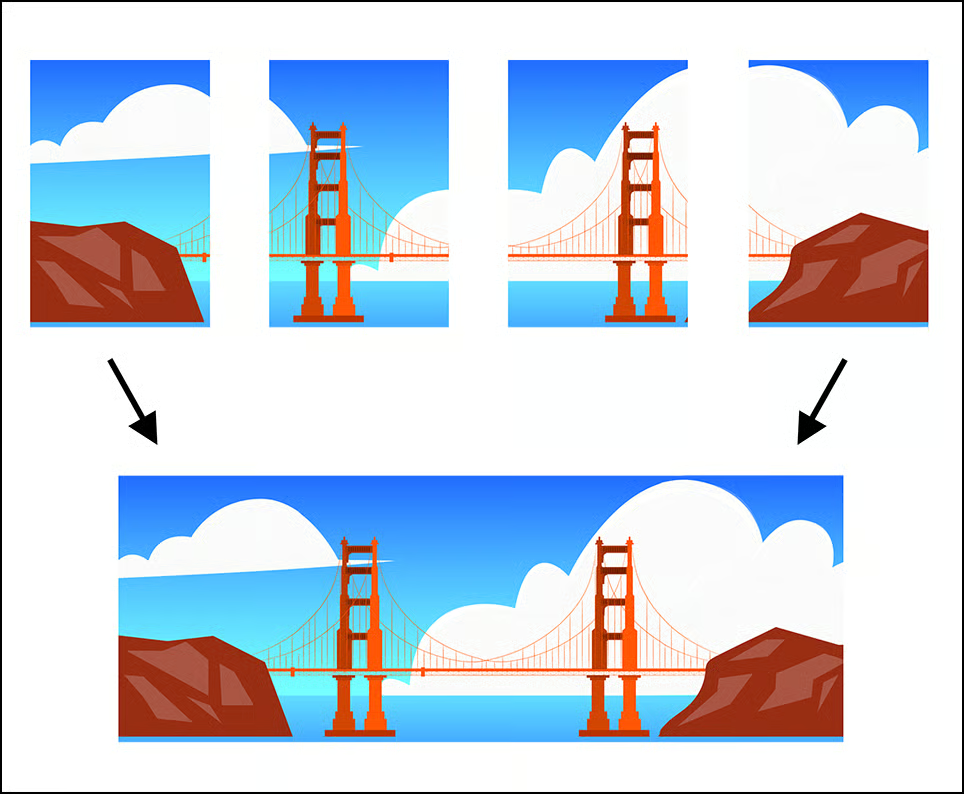
Aim for 25–30% overlap around and between rows for a clean stitch.
- Difficulty: Moderate — rectilinear UWA is forgiving, but you must align the nodal point accurately to avoid parallax, especially indoors.
Planning & On-Site Preparation
Evaluate Shooting Environment
Walk the location first. Note light direction and intensity, reflective surfaces (glass, polished stone), and moving objects (people, trees, vehicles). If shooting through glass, get as close as possible (1–3 cm) and shoot slightly off‑axis to reduce reflections and ghosting. In high‑contrast scenes (interiors with bright windows, sunsets), plan HDR bracketing. For windy rooftops, account for vibration; on water or bridges, time exposures when traffic or waves subside.
Match Gear to Scene Goals
The D750’s strong dynamic range and clean low ISO files are ideal for single‑exposure panoramas and HDR panoramas. Indoors, ISO 100–400 is ideal; ISO 800–1600 is still usable with careful noise reduction. The Tokina’s rectilinear field of view keeps lines straight, which helps in architectural/real estate shots. Compared to a fisheye, you’ll shoot more frames, but you’ll retain more natural perspective and avoid defishing artifacts on edges.
Pre-shoot Checklist
- Power & storage: fully charged batteries; extra SD cards; format in-camera.
- Clean optics: wipe lens front/rear; check sensor for dust—stains repeat across the pano.
- Tripod & head: level the base; confirm panoramic head calibration for nodal point at 11–20mm.
- Safety: assess wind loads (especially on poles/rooftops), use tethers on poles and car rigs; never lean over railings.
- Backup: when time allows, shoot a second full rotation as insurance against blinkers or stitching gaps.
Essential Gear & Setup
Core Gear
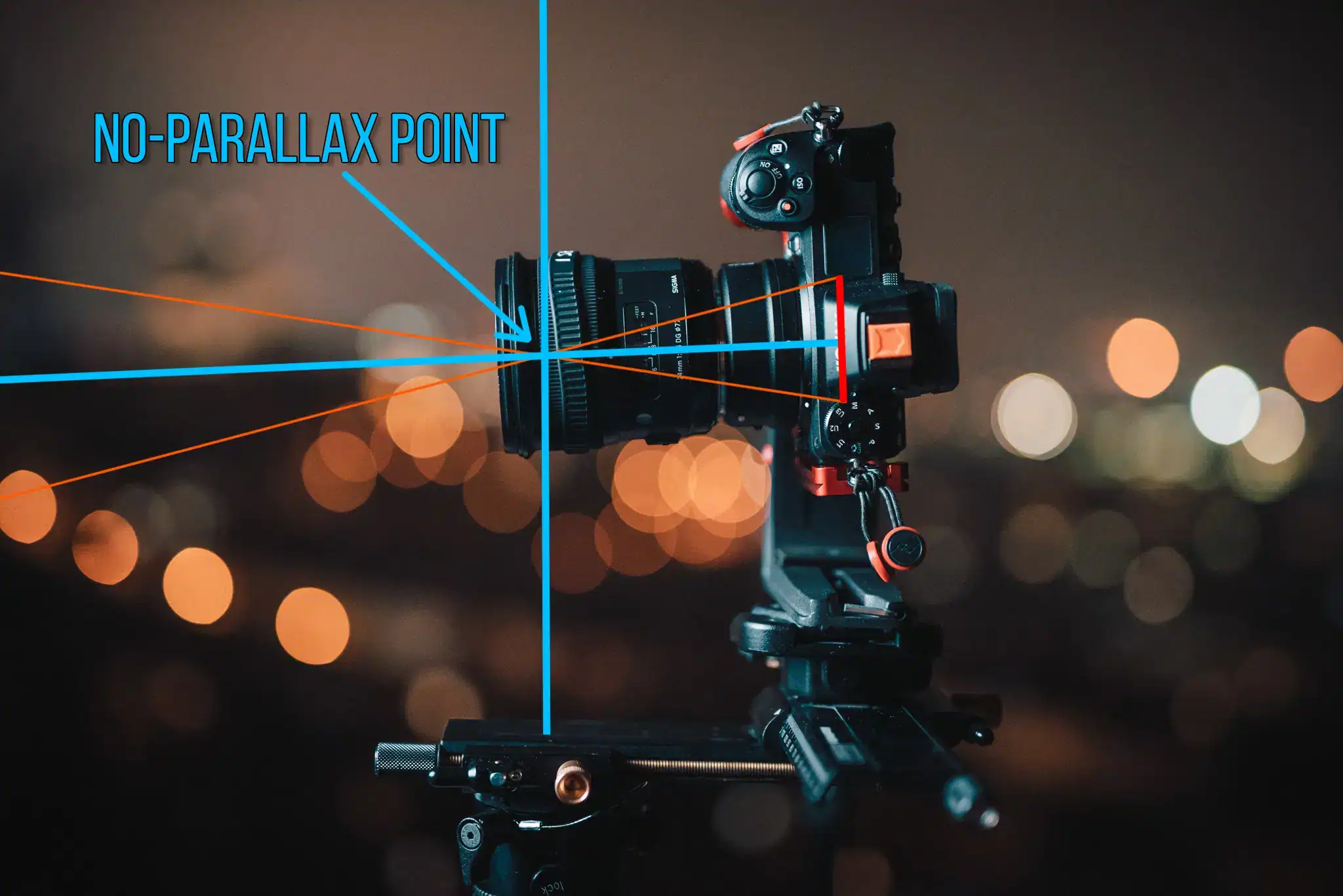
- Panoramic head: lets you align the entrance pupil (nodal point) of the Tokina to eliminate parallax. This is crucial if nearby objects overlap between frames.
- Stable tripod with a leveling base: a leveled yaw axis keeps your horizon true and simplifies stitching.
- Remote trigger or SnapBridge app: minimizes camera shake. On the D750, also enable Exposure Delay Mode (1–3 s) to damp mirror slap.
Optional Add-ons
- Pole or car mount: allows elevated or moving captures. Use guy lines, safety tether, and foam/soft mounts to reduce vibration; keep shutter speeds up.
- Lighting aids: portable LEDs or bounced flash for dim interiors (avoid hot spots and color mismatch; lock white balance).
- Weather protection: rain covers, gaffer tape on joints, silica gel in bag for humid nights.
Step-by-Step Shooting Guide
Standard Static Scenes
- Level and align: Set your tripod on firm ground. Use a leveling base or bubble level. Mount the panoramic head and adjust the rail so the lens rotates around its entrance pupil. As a starting point for the Tokina 11–20mm on the D750, many ultra‑wides fall roughly 65–85 mm forward of the camera’s sensor plane at the wide end—fine‑tune using a near/far alignment test.
- Manual exposure & WB: Switch to M mode. Meter a mid‑tone and set exposure so highlights are protected (check histogram). Lock white balance (Daylight outdoors, a fixed Kelvin or custom WB indoors) to avoid stitching seams from WB shifts.
- Manual focus: Use Live View at 100% to focus slightly beyond hyperfocal (e.g., at 11–14mm f/8, focusing ~1–1.5 m often keeps everything from ~0.6 m to infinity sharp). Turn AF off so focus doesn’t drift.
- Capture sequence: For 11mm DX (≈16.5mm equiv.) in portrait orientation, shoot 10 images around with ~30% overlap. Add 1 zenith (tilt up ~60°) and 1–2 nadir frames (after shifting the tripod or hand‑holding above the tripod hole). Use a consistent cadence: rotate → settle vibrations → trigger.
HDR / High Dynamic Range Interiors
- Bracket for windows: Use exposure bracketing for 3–5 frames around 2 EV apart (or as your scene dictates). Keep WB locked and focus manual.
- Consistency: Shoot the entire pano at one focal length and consistent bracket pattern (e.g., 0/−2/+2 EV). Keep your rotation step identical for every bracketed set so stitching software groups images correctly.
Low-Light / Night Scenes
- Base ISO: Aim for ISO 100–400 when on tripod; the D750 remains clean up to ISO 800–1600 if needed. Use longer exposures rather than boosting ISO whenever possible.
- Stability: Enable Exposure Delay (1–3 s). Use remote release. Consider Mirror-Up + Live View to minimize vibration. Wind control is critical—hang a bag on the tripod hook for damping.
Crowded Events
- Two passes: First pass fast to “hold the scene,” second pass slower while waiting for gaps in moving crowds. Ask people close to the camera to pause briefly if appropriate.
- Post masks: In PTGui/Hugin, use masks to keep the clean subject from one frame and remove ghosts from others.
Special Setups (Pole / Car / Drone)
- Pole: Use a carbon pole and safety tether. Keep shutter speeds at 1/250 s or faster, especially in wind. Rotate the camera more slowly and allow vibrations to settle before each exposure.
- Car-mounted: Use suction mounts on clean glass/paint with safety lines. Avoid highways. Park and shoot; minimize rolling shutter by turning off the engine if safe.
- Drone: The D750 is not a drone payload, but these pano techniques translate to aerial cameras—lock WB/exposure and overlap 25–30%.
Recommended Settings & Pro Tips
Exposure & Focus
| Scenario | Aperture | Shutter | ISO | Notes |
|---|---|---|---|---|
| Daylight outdoor | f/8–f/11 | 1/100–1/250 | 100–200 | Lock WB to Daylight; avoid polarizers that cause uneven sky in wide angles |
| Low light/night | f/4–f/5.6 | 1/30–1/60 | 100–800 | Tripod, remote, and exposure delay; prefer longer exposure over raising ISO |
| Interior HDR | f/8 | Bracket ±2 EV | 100–400 | Balance window highlights and interior shadows |
| Action / moving subjects | f/5.6–f/8 | 1/200+ | 400–800 | Freeze motion; plan a second clean pass for masking |
Critical Tips
- Manual focus near hyperfocal: At 11–14mm and f/8, focusing ~1–1.5 m covers most scenes. Recheck in Live View for critical edges.
- Nodal point calibration: Place a near object (1–2 m) and a far object aligned in the frame. Rotate the camera—adjust the rail until their relative alignment doesn’t shift. Mark rail positions for 11, 14, 20mm.
- White balance lock: Choose a fixed Kelvin or preset to prevent color seams (especially under mixed lighting).
- Shoot RAW: Maximum latitude for highlight recovery, WB changes, and lens correction.
- Stabilization: The D750 has no IBIS; the Tokina has no VR—great for tripod work. On tripod, disable any stabilization on other lenses.
- Use Auto DX crop: With this DX lens, keep Auto DX enabled for clean coverage and predictable FOV. Expect ~10.3MP per frame.
- Mirror & shutter management: Use Exposure Delay Mode (1–3 s). If you must handhold, keep shutter at 1/125–1/250 s and shoot extra overlap.
Stitching & Post-Processing
Software Workflow
Import RAW files into Lightroom or similar, sync basic corrections (WB, profile corrections, moderate sharpening), and export as 16‑bit TIFFs for stitching. In PTGui or Hugin, set lens type to rectilinear and ensure EXIF focal length and crop factor are recognized (DX crop on D750). For the Tokina at 11–20mm, start with ~25–30% overlap. Rectilinear UWA shots need more images than fisheyes but preserve straight lines—great for interiors and architecture. PTGui’s control point generator and optimizer usually handle the Tokina’s low distortion easily if nodal alignment is correct. After stitching, output an equirectangular (2:1) panorama—8k to 12k width is a sweet spot for web and VR galleries depending on your coverage and intended platform. For a deeper primer on pano head setup and best practices, see the panoramic head tutorial. Panoramic head setup and tips.
Cleanup & Enhancement
- Nadir patch: Capture a dedicated nadir shot (move tripod aside) and patch in PTGui or Photoshop. AI-powered content-aware fill can help, but manual cloning around repeated patterns yields better results.
- Color & noise: Balance color casts (especially mixed interior lighting). Apply noise reduction to shadow brackets when doing HDR nocturnes.
- Leveling: Use horizon leveling and straighten verticals. Ensure yaw/pitch/roll is corrected so vertical lines remain true.
- Export: Save as 16‑bit TIFF master, plus a web‑ready JPEG (quality 90+, 8–12k width) for VR viewers. For platform specifics on DSLR 360 uploads, consult the Oculus creator guidance. Using a DSLR to shoot and stitch a 360 photo.
Want a second opinion on software choices? PTGui is a workhorse many pros rely on—see this field review for context. Fstoppers: PTGui review.
Useful Tools & Resources
Software
- PTGui panorama stitching
- Hugin (open source) for comprehensive control
- Lightroom / Photoshop for RAW prep and retouch
- AI-based tripod removal or content-aware fill tools
Hardware
- Panoramic heads: Nodal Ninja, Leofoto, Sunwayfoto
- Carbon fiber tripods with leveling bases
- Wireless remote shutters (Nikon or third-party)
- Pole extensions / car mounts with safety tethers
Disclaimer: product names are for search reference only—verify current specs on official sites. For estimating equirectangular resolution from camera/lens combos, the Panotools wiki is a solid reference: DSLR spherical resolution.
Common Mistakes & How to Avoid Them
- Parallax error: Always align the lens’s entrance pupil. Recalibrate when changing focal length.
- Exposure flicker: Use full manual exposure and locked white balance across the entire rotation.
- Missed coverage: Track your rotation steps; use audible or count-based cadence and overlap. Consider 10 around at 11mm DX as your baseline.
- Tripod shadows or missing nadir: Capture a dedicated nadir frame and patch cleanly.
- Noise at night: Favor longer shutter over higher ISO; the D750 handles ISO 800–1600, but expose to protect highlights and denoise shadows in post.
- Rushing in wind: Let vibrations settle; use Exposure Delay; add weight to your tripod; increase shutter speed if necessary.
Real-World Scenarios with the D750 + Tokina 11–20
Indoor Real Estate
Shoot at 11–14mm DX, f/8, ISO 100–200. Bracket ±2 EV if windows are bright. Keep lights either all on or all off to minimize mixed color. 10–12 around, plus zenith and a patched nadir yields straight walls and clean ceilings. The rectilinear lens avoids fisheye curvature on cabinetry and door frames.
Outdoor Sunset
At 11mm DX, lock WB to Daylight, shoot 10 around, then a second pass 1 stop brighter to ensure shadow detail. Be mindful of the sun’s position; lens flare is manageable but present—shade with your hand just out of frame if needed, and remove any slight vignette in post.
Event with Moving Crowd
Use 1/200 s at f/5.6, ISO 400–800. Do two rotations—one fast to “freeze” key moments, another slower to capture clean background plates. Mask in post for a ghost‑free pano.
Rooftop / Pole
Mount a safety tether; keep the pole vertical; use 1/250–1/500 s and 11mm to maximize overlap. Rotate smoothly, allow wind to settle before each shot, and capture a backup pass in case of blurred frames.
Frequently Asked Questions
- Can I shoot handheld panoramas with the Nikon D750?
Yes for simple cylindrical panos. For 360×180 VR panos, a tripod and panoramic head are strongly recommended to avoid parallax. If you must handhold, use 11mm, shoot fast (1/250 s), increase overlap (40–50%), and shoot multiple passes.
- Is the Tokina ATX‑i 11–20mm f/2.8 wide enough for single‑row 360?
At 11mm in DX crop (≈16.5mm equiv.) a single row of 10 images around plus a zenith and nadir often works for full coverage in portrait orientation. For tighter overlap or higher quality, add a tilted row or increase to 12 around.
- Do I need HDR for interiors with bright windows?
Usually yes. Bracket 3–5 exposures about 2 EV apart to capture window detail and interior shadows. Keep WB and focus locked so the brackets merge consistently during stitching.
- How do I avoid parallax issues with this combo?
Use a panoramic head and align the lens’s entrance pupil. Calibrate at your chosen focal length (e.g., 11mm) using a near/far alignment test. Mark the rail position so you can repeat it precisely in the field. A deeper walkthrough on pano heads is here: DSLR virtual tour guide and pano head basics.
- What ISO range is safe on the D750 in low light?
On tripod, prefer ISO 100–400 and extend shutter speed. ISO 800–1600 is still very usable, especially when you expose carefully and apply moderate noise reduction in post.
Limitations & Safety Notes
This Tokina is a DX lens; your D750 will shoot in DX crop (~10.3MP files). That’s plenty for web and many VR tours, but if you need gigapixel‑class output, consider multi‑row capture or an FX fisheye/mid‑tele on a multi‑row rig. Always tether gear on rooftops or poles, mind wind gusts, and avoid risky positions for a nadir shot—use a patch if space is tight.
Final Thoughts
Mastering how to shoot panorama with Nikon D750 & Tokina ATX‑i 11–20mm f/2.8 is about consistency: locked exposure, fixed WB, precise nodal alignment, and steady rotation. This combo excels at realistic interiors and clean architectural perspectives while staying compact and affordable. Build a repeatable workflow, shoot a backup pass, and your stitches will become reliable, high quality, and VR‑ready.