Why This Camera & Lens Are Great for Panoramas
If you want to learn how to shoot panorama with Nikon D750 & Sigma 15mm f/1.4 DG DN Diagonal Fisheye Art, you’re aiming for a powerful combination of full-frame image quality and ultra-wide coverage. The Nikon D750 is a 24.3MP full-frame DSLR (35.9 × 24 mm sensor) with a pixel pitch around 6 µm, excellent base-ISO dynamic range (~14+ EV at ISO 100), and clean files through ISO 1600–3200 when exposed well. It’s rugged, dependable, and a favorite among real-estate and landscape shooters for its color depth and highlight retention.
The Sigma 15mm f/1.4 DG DN Diagonal Fisheye Art is an ultra-fast diagonal fisheye that delivers a 180° diagonal field of view on full frame. Compared with rectilinear lenses, a fisheye can cover the scene in fewer frames, reducing stitch complexity and time on location. Stopped down to f/5.6–f/8, fisheyes are typically sharp across the frame; with a top-quality Art-series optic, coma and CA are well controlled, which is great for night cityscapes or light trails.
Important mount note: the Sigma 15mm f/1.4 DG DN Diagonal Fisheye Art is produced for mirrorless mounts (e.g., Sony E and L-Mount). It does not natively mount to the Nikon D750’s F-mount, and due to flange distance, there’s no simple passive adapter. If you specifically want to use this Sigma lens, consider a Nikon Z mirrorless body with a Sony E-to-Nikon Z adapter. If you must stay with the D750, use an F-mount diagonal fisheye (e.g., Nikon AF Fisheye 16mm f/2.8D, Samyang 12mm/14mm fisheye, or the older Sigma 15mm f/2.8 EX DG). The shooting methodology below applies to any 15–16mm diagonal fisheye on full frame; mount compatibility just affects which lens you attach.
Quick Setup Overview
- Camera: Nikon D750 — Full-frame (24.3MP), excellent dynamic range at base ISO, strong ISO performance up to 1600–3200 with careful exposure.
- Lens: Sigma 15mm f/1.4 DG DN Diagonal Fisheye Art — diagonal fisheye with 180° diagonal FOV; fast f/1.4 aperture; well-controlled CA and coma. Note: not natively compatible with Nikon F-mount; see mount note above.
- Estimated shots & overlap (full 360×180): 6 around at 60° yaw spacing with 25–30% overlap + 1 zenith + 1 nadir. For extra safety in complex scenes, do 8 around.
- Difficulty: Moderate. A fisheye reduces shot count but requires precise nodal (no-parallax) alignment for best results.
Planning & On-Site Preparation
Evaluate Shooting Environment
Scout light direction, the position of the sun or bright lamps, and reflective surfaces like glass, polished floors, and cars. Reflections complicate stitching if parallax isn’t controlled. When shooting through glass, press the lens hood lightly against it (or use a black cloth) and keep the front element as perpendicular as possible to minimize glare and ghosting. If shooting at sunset, anticipate rapid exposure changes; lock your settings per pano set to avoid flicker between frames.
Match Gear to Scene Goals
The D750’s wide dynamic range helps retain highlight detail in windows and skies, and its clean low-ISO files are ideal for real estate and landscape work. Safe ISO ranges: 100–800 for most daylight and interior tripod work; 1600 is very usable; 3200 is workable with good denoising. The 15mm diagonal fisheye reduces the number of frames you need, which is invaluable in crowded events or windy rooftops. The trade-off is fisheye distortion—easily handled by modern stitching software—but straight lines near the edges will curve before correction.
Pre-shoot Checklist
- Power: Fully charged batteries and a spare. D750 battery life is solid, but bracketing and long exposures drain faster.
- Storage: Fast, reliable SD cards. Shoot RAW; consider 14-bit lossless for maximum flexibility.
- Clean optics: Fisheye front elements are prominent—keep a microfiber cloth handy.
- Tripod & pano head: Leveling base and calibrated panoramic head for precise nodal alignment.
- Safety: On rooftops or poles, add a safety tether, check wind conditions, and avoid overhanging crowds with heavy gear.
- Backup workflow: Shoot a second full pass if time allows. If people move or a frame is soft, your backup saves the set.
Essential Gear & Setup
Core Gear
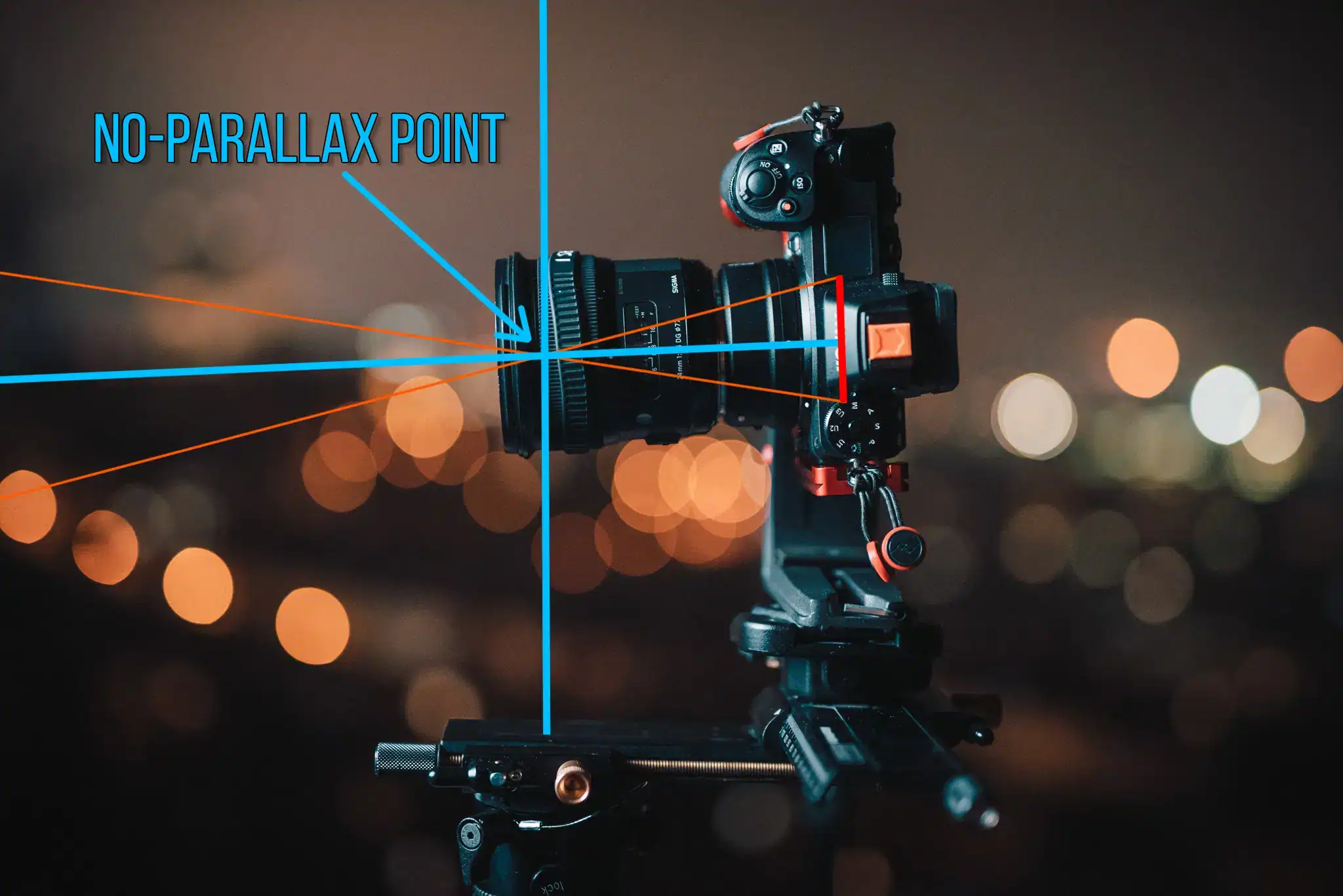
- Panoramic head: Lets you align the lens’s entrance pupil (nodal point) over the rotation axis to eliminate parallax. This is the single most important step for seamless stitches in tight spaces.
- Stable tripod with leveling base: Level the platform first; then the yaw rotation stays true and your frames stay aligned.
- Remote trigger or app: On the D750, also use Exposure Delay Mode or mirror-up to minimize vibrations during long exposures.
Optional Add-ons
- Pole or car mount: For elevated or moving perspectives. Always safety-tether, watch wind, and keep speeds low to reduce vibration. Rotate slower and shoot more overlap.
- Lighting aids: Small LED panels or bounced flash to lift deep shadows in interiors without changing color temperature dramatically.
- Weather protection: Rain covers and desiccants; fisheyes have big front elements—protect them from spray and dust.
For a deeper primer on panoramic heads and why nodal alignment matters, see this panoramic head tutorial. Panoramic head basics
Step-by-Step Shooting Guide
Standard Static Scenes
- Level and lock: Level your tripod using the leveling base. Mount the pano head and lock tilt axes at 0° for the around-the-horizon sweep.
- Calibrate nodal alignment: With a foreground object (1–2 m) and a distant background line, pan the head. Adjust the rail until the foreground object stays in place relative to the background while panning. For a 15–16mm diagonal fisheye, the entrance pupil is typically near the front element; use this to get a fast first approximation, then fine-tune.
- Manual everything: Set Manual exposure, Manual white balance (Daylight/Tungsten/Custom), and Manual focus (focus once, then switch AF off). This keeps color and exposure consistent across frames.
- Capture sequence: Take 6 frames around at 60° yaw increments with 25–30% overlap. Add 1 zenith (tilt up ~60–90°) and 1 nadir (tilt down ~60–90°). If your tripod legs intrude a lot, take a separate handheld nadir for patching.
- Metadata and redundancy: If the scene is important, do an extra safety round—especially if people moved or a gust of wind hit your setup mid-sequence.
HDR / High Dynamic Range Interiors
- Bracket exposure: Use 3–5 frames per angle, typically ±2 EV total range for interiors with bright windows. On the D750, auto-bracketing plus a remote trigger keeps hands off the camera. If you need a larger dynamic range, increase the number of brackets or manually adjust shutter speeds.
- Keep color stable: Lock WB to a fixed Kelvin or a preset that best fits the scene; mixed lighting can be corrected later, but consistency is key for clean stitches.
- Workflow: Either merge HDR per angle first (using a consistent deghosting strength), then stitch; or let PTGui handle exposure fusion during stitching. Test both and adopt the one that gives fewer halos around window frames.
Low-Light / Night Scenes
- Use the tripod to your advantage: Long exposures are fine. Aim for ISO 100–800 with shutter speeds as slow as needed. If motion blur from people or leaves is undesirable, push ISO to 1600–3200 and reduce shutter time, then denoise in post.
- Vibration control: On the D750, enable Exposure Delay Mode or use MUP (mirror up) with a remote. Even tiny vibrations are visible on stars or point lights at 1:1.
- Aperture: f/4–f/5.6 balances sharpness and light gathering. If depth of field is marginal, go to f/8 and increase exposure time.
Crowded Events
- Two passes: Do a fast first pass for safety, then a second pass waiting for gaps in traffic in each direction. Mask/clone in post to remove duplicate heads or ghosting.
- Extra overlap: Increase overlap to 35% if people are moving quickly; more overlap gives the stitcher flexibility to find clean seams.
Special Setups (Pole / Car / Drone)
- Pole: Use a strong carbon pole, keep the rig light, and tether. Rotate slowly, and take 8 around rather than 6 to fight flex and sway. Avoid gusty conditions.
- Car-mounted: Prioritize safety. Use vibration-damping mounts and shoot when the vehicle is stationary. Even slight movement between frames complicates stitching.
Practical Case Studies
Indoor Real Estate
At f/8, ISO 100–400, bracket ±2 EV to balance windows. Use 6 around + zenith + nadir. Turn off moving ceiling fans. If mirrors are present, avoid standing in them—shoot frames so your reflection hides behind the camera or between frames you plan to mask.
Outdoor Sunset
Lock exposure early, meter for highlight retention, and consider an HDR bracket for the frames facing the sun. Work quickly—light changes fast—and do a second pass if time allows.
Rooftop/Pole Capture
Use a safety line and reduce sail area. The fisheye’s reduced shot count means you’re exposed to wind for less time. Rotate smoothly, let vibrations settle before each frame, and add extra overlap.
Recommended Settings & Pro Tips
Exposure & Focus
| Scenario | Aperture | Shutter | ISO | Notes |
|---|---|---|---|---|
| Daylight outdoor | f/8–f/11 | 1/100–1/250 | 100–200 | Lock WB to Daylight; avoid auto |
| Low light/night | f/4–f/5.6 | 1/30–several sec | 100–800 (1600–3200 if needed) | Use remote, Exposure Delay Mode, sturdy tripod |
| Interior HDR | f/8 | Bracket ±2 EV | 100–400 | Balance windows and lamps; consistent WB |
| Action / moving subjects | f/5.6–f/8 | 1/200+ | 400–800 | Freeze motion, consider two-pass capture |
Critical Tips
- Manual focus at hyperfocal: With a 15–16mm fisheye at f/8, focusing ~1–1.5 m yields sharpness from foreground to infinity. Use Live View zoom to confirm, then disable AF.
- Nodal calibration: Start with the lens pushed forward so the rotation axis is near the front element, then fine-tune using a foreground stick and distant line. Mark your rails once dialed in so setup is fast next time.
- White balance lock: Mixed lighting is common indoors. Lock a Kelvin value or custom WB so frames stitch without color shifts.
- RAW over JPEG: RAW gives more latitude for highlight recovery and consistent color matching across frames and brackets.
- Stabilization: The D750 has no IBIS. Use a remote or Exposure Delay Mode to avoid micro-shake. Turn VR off if your lens or adapter setup offers it and you’re on a tripod.
Stitching & Post-Processing
Software Workflow
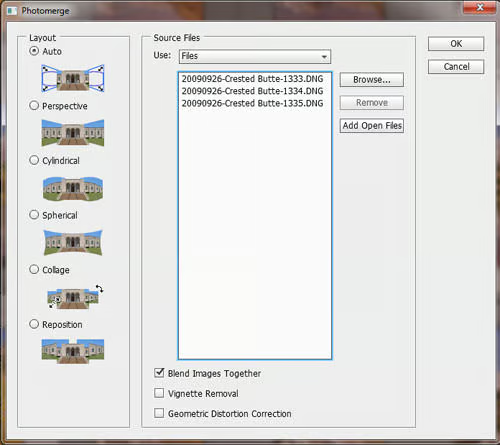
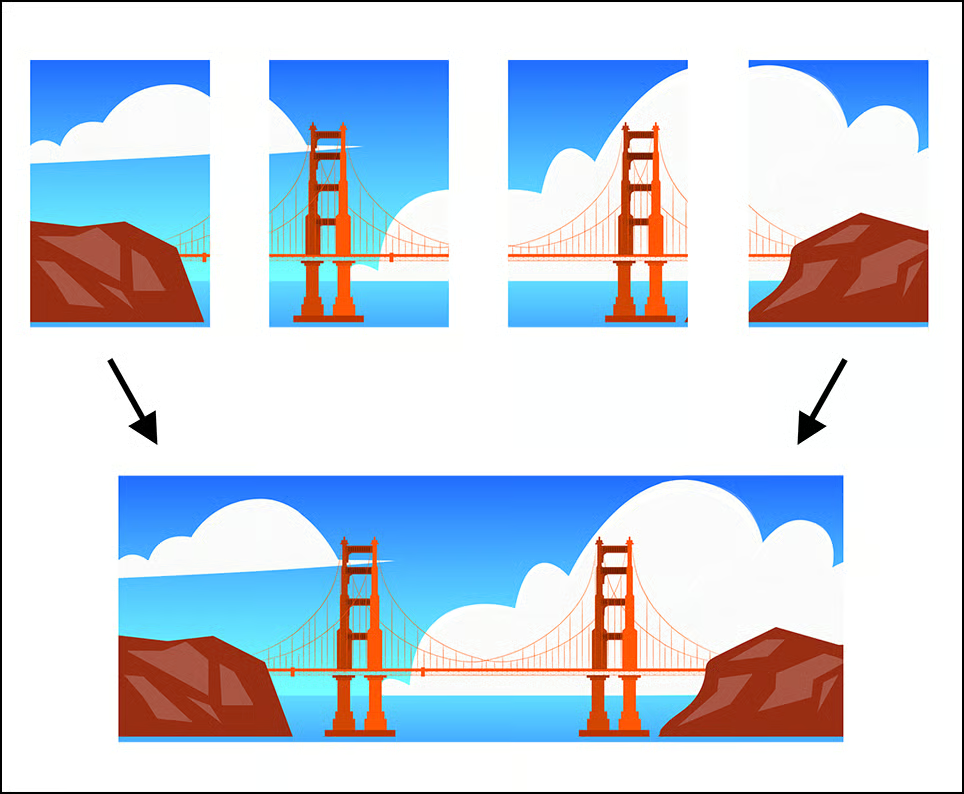
PTGui is a gold standard for professional fisheye panoramas; Hugin is a robust open-source alternative. With a 15mm diagonal fisheye, specify “fisheye” lens type and accurate focal length; use about 25–30% overlap. Modern stitchers can optimize yaw/pitch/roll and lens parameters automatically, but high-quality control points depend on consistent exposure and sharpness. Rectilinear lenses typically require more frames (and more time) but keep straight lines straighter pre-correction. Fisheyes stitch faster with fewer frames but start with curvy edges before projection. For a pro-level review, see this PTGui overview. PTGui in professional workflows
If you’re building for VR delivery, also review camera-to-stitch best practices from VR platforms—the fundamentals translate directly to DLSR/mirrorless panoramas. Oculus: DSLR 360 capture and stitching
Cleanup & Enhancement
- Nadir patching: Take a dedicated nadir shot after moving the tripod and patch it using a clone layer or an AI tripod removal tool.
- Exposure and color: Apply consistent global corrections first. If you merged HDR beforehand, keep tonemapping consistent across angles.
- Noise control: Apply luminance and color NR carefully, especially for high-ISO night scenes. Fisheye edges hide noise better, but avoid over-smoothing textures.
- Horizon leveling: Use the “verticals” and “horizontal” tools in PTGui/Hugin to ensure level horizons and correct roll/pitch.
- Export: For VR platforms, export a 2:1 equirectangular JPEG (8-bit sRGB) or 16-bit TIFF if you’ll grade further. Ensure metadata (projection, FoV) is preserved if required by your viewer.
For theory on spherical resolution and shot count math, see the Panotools wiki reference. DSLR spherical resolution
Useful Tools & Resources
Software
- PTGui panorama stitching
- Hugin (open source)
- Lightroom / Photoshop for RAW processing and retouch
- AI tripod removal tools for fast nadir patching
Hardware
- Panoramic heads (Nodal Ninja, Leofoto, Fanotec)
- Carbon fiber tripods with leveling bases
- Wireless remote shutters
- Pole extensions and vehicle mounts (use tethers)
Disclaimer: brand names are provided for research. Verify compatibility and specifications before purchasing.
For a bigger-picture guide on camera-and-lens choices for virtual tours and panoramas, this resource is a great orientation. DSLR virtual tour lens and camera guide
Common Mistakes & How to Avoid Them
- Parallax error: Always align the entrance pupil over the rotation axis. Re-check after moving locations.
- Exposure flicker: Use full Manual mode and lock WB. Avoid auto ISO and auto WB across the set.
- Tripod shadows or legs: Shoot a proper nadir frame and patch. Mind the sun’s position outdoors.
- Ghosting with moving subjects: Increase overlap and shoot two passes; mask in post.
- Noise at night: Favor longer shutter times over cranking ISO. The D750 delivers clean files when exposed to the right.
- Rushing HDR: Keep bracket spacing consistent and use the same deghosting strength throughout a set.
Frequently Asked Questions
- Can I shoot handheld panoramas with the Nikon D750?
Yes for simple cylindrical pans, but for full 360×180 with close foregrounds, use a tripod and panoramic head. Handheld 360s risk parallax errors, especially with a fisheye close to subjects. If you must, keep the camera rotating around the lens, use higher shutter speeds (1/250+), and accept a lower keeper rate.
- Is the Sigma 15mm f/1.4 DG DN Diagonal Fisheye Art wide enough for a single-row 360?
Yes. On full frame, 6 frames around with ~25–30% overlap plus zenith and nadir is a proven baseline. For complex interiors, 8 around adds safety. Note the mount issue—this lens won’t natively fit the D750’s F-mount.
- Do I need HDR for interiors with bright windows?
Usually. Bracket ±2 EV (3–5 frames) to balance window highlights and interior shadows. Merge HDR per angle before stitching or use exposure fusion in PTGui; test both to see which yields cleaner window edges.
- How do I avoid parallax issues with a fisheye?
Use a calibrated panoramic head. Align the entrance pupil by panning with a near object and distant background; adjust until there’s no relative shift. Mark your rails once set so you can reproduce the alignment quickly.
- What ISO range is safe on the D750 in low light?
For tripod work, prefer ISO 100–800. ISO 1600 remains very usable; ISO 3200 can work with careful exposure and modern denoising. Long exposures at lower ISO often beat pushing ISO higher.
- Can I store pano settings as a custom mode?
Yes. Save a “Pano” setup (Manual exposure, fixed WB, manual focus, RAW, exposure delay, bracketing pattern) to a user setting so you can recall it quickly on location.
- How can I reduce flare with a fisheye?
Avoid pointing directly into intense light sources when possible. Shade the lens with your hand just out of frame, or time your rotation so the sun sits near a frame boundary for easier masking. Clean the front element meticulously—smudges cause streaks.
- What panoramic head should I choose for this setup?
Look for a compact two-rail system that supports the D750’s weight and allows fore-aft and vertical adjustments for precise entrance pupil alignment. Nodal Ninja, Leofoto, and Fanotec offer reliable options with scales you can mark for repeatability.
Watch: Panoramic Head Setup and Stitching Fundamentals
Seeing the process helps. The following video demonstrates practical setup insights that translate directly to the D750 + fisheye workflow.
Also see a step-by-step primer on panoramic head setup for high-end 360 photos. Panoramic head setup principles
Field Notes, Safety, and Honest Limitations
Mount compatibility is the primary caveat in how to shoot panorama with Nikon D750 & Sigma 15mm f/1.4 DG DN Diagonal Fisheye Art. You cannot mount this DG DN lens directly to the D750. If you’re locked to the D750 body, pick an F-mount diagonal fisheye with similar coverage; the workflow stays identical. If you’re flexible with bodies, consider Nikon Z with an E-to-Z adapter for the Sigma DG DN.
Weight and handling: Fast fisheyes often have large front elements. Use a head with a solid clamp, verify your rails are locked before rotating, and avoid windy conditions on rooftops or poles. Always tether your rig when above people or traffic.
Backups and data integrity: After each important pano, review at 100% for a soft or blurred frame. Replace any suspect angle immediately. Duplicate your card contents at the end of the shoot to two separate drives.