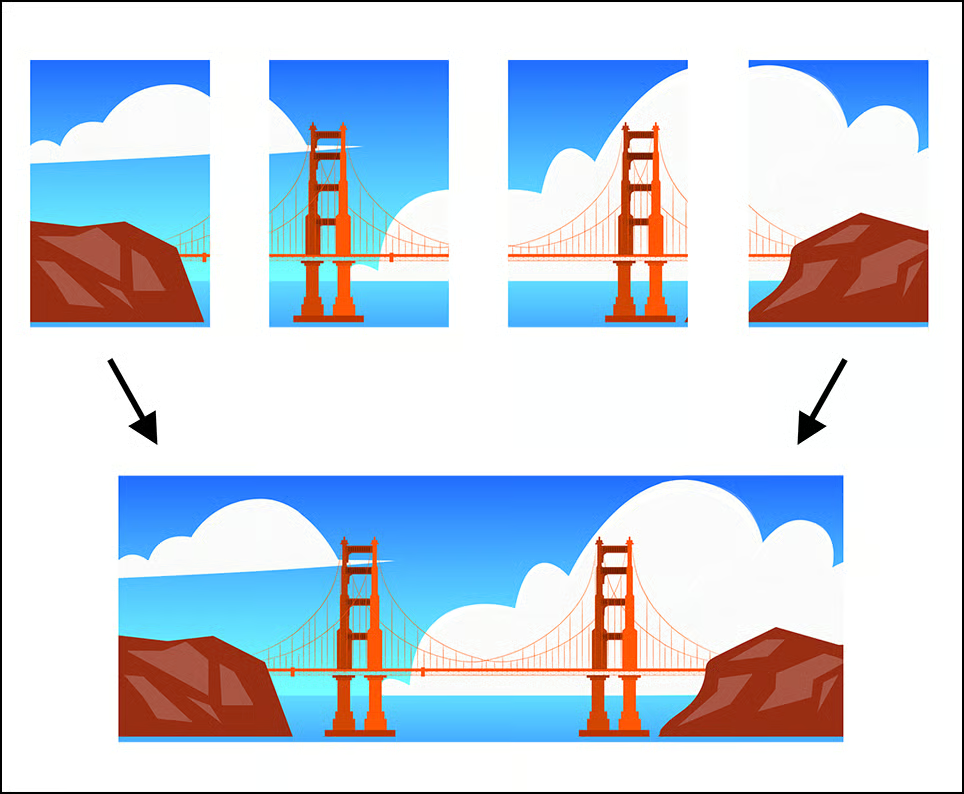
Why This Camera & Lens Are Great for Panoramas
The Nikon D750 paired with the Samyang 8mm f/3.5 UMC Fish-Eye CS II is a budget-friendly yet highly capable setup for creating immersive 360° panoramas. The D750’s 24.3MP full-frame sensor (35.9 × 24.0 mm) delivers excellent dynamic range (~14.5 EV at ISO 100) and low-light performance thanks to generous 5.97 µm pixel pitch. The camera is a rugged DSLR with reliable battery life and straightforward manual controls—perfect for controlled panorama workflows where consistency matters. The Samyang 8mm CS II is a manual-focus diagonal fisheye for APS-C with a removable hood, strong UMC coatings, and surprising sharpness when stopped down. This combo lets you choose between two working modes: crop the D750 to DX (for a frame-filling diagonal fisheye, easier stitching, higher per-shot resolution) or run full-frame with the hood removed (for near-circular fisheye coverage and fewer shots).
Because the lens is a fisheye, you can cover the full sphere with far fewer frames than a rectilinear lens would require. That means faster capture on-site, less chance of subject movement between frames, and a simpler stitch. The trade-off is typical fisheye distortion (which good stitching software accounts for) and some chromatic aberration at the edges, manageable with software correction. Mount compatibility is straightforward: the lens is Nikon F-mount, fully manual. On the D750 you can register it under Non-CPU Lens Data for metering and consistent EXIF. In short, if you want to learn how to shoot panorama with Nikon D750 & Samyang 8mm f/3.5 UMC Fish-Eye CS II, this guide will walk you through practical, field-tested steps.
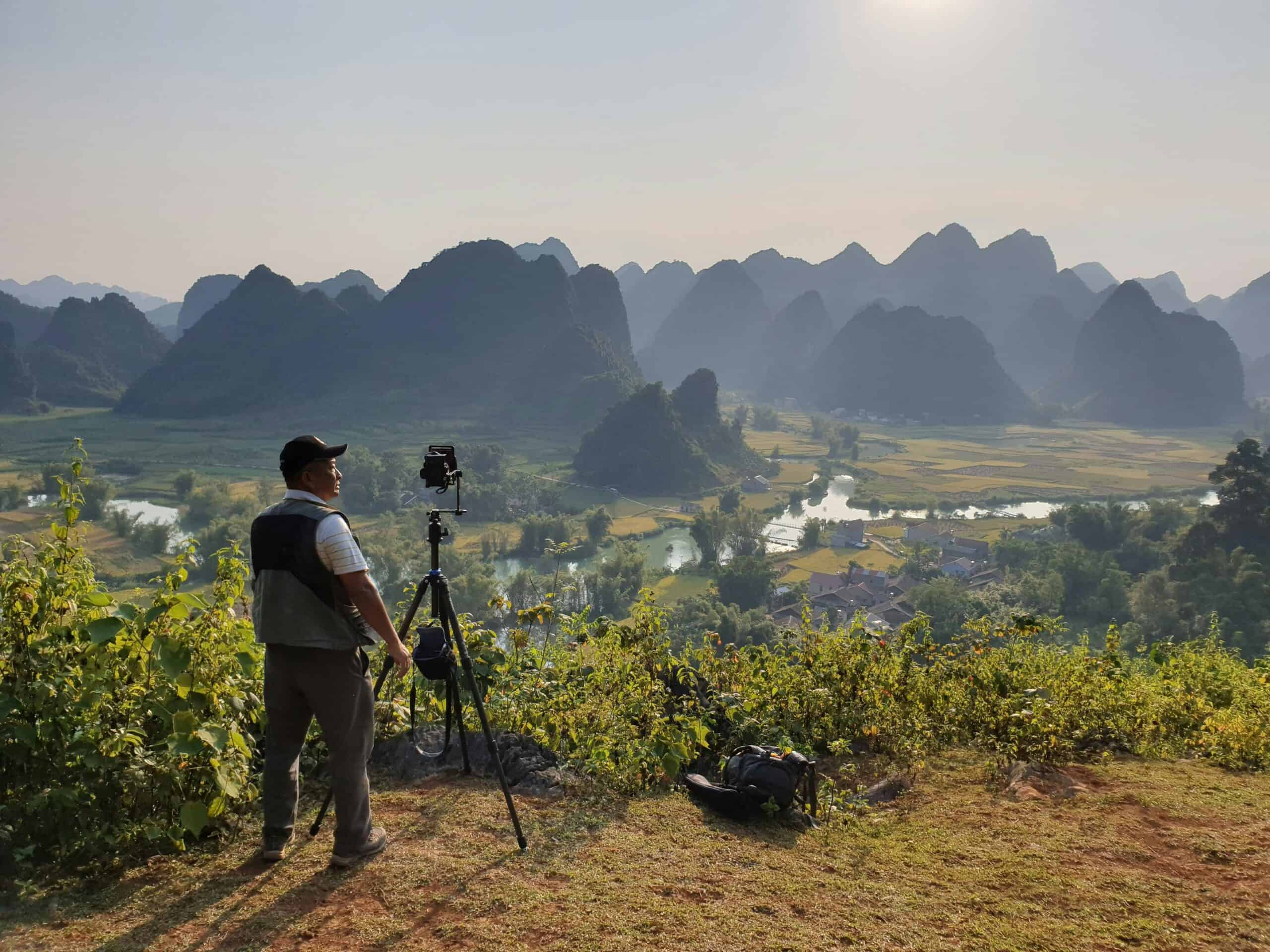
Quick Setup Overview
- Camera: Nikon D750 — 24.3MP full-frame (FX), 35.9 × 24.0 mm, pixel pitch ~5.97 µm, base ISO 100 (native 100–12,800; Hi to 51,200), excellent DR ~14.5 EV at ISO 100.
- Lens: Samyang 8mm f/3.5 UMC Fish-Eye CS II — manual focus, diagonal fisheye on APS-C (DX), removable hood, best sharpness f/5.6–f/8, moderate edge CA but good center sharpness.
- Estimated shots & overlap (field-tested):
- D750 in DX crop (approx 10.3MP per frame): 6 around at 60° with 25–30% overlap + 1 zenith + 1 nadir. For extra margin or moving scenes: 8 around at 45°.
- D750 full-frame with hood removed (near-circular fisheye): 3 around at 120° + zenith + nadir. For safety and cleaner nadir: 4 around + N + Z.
- Difficulty: Easy to Intermediate. The capture is quick; the key skill is nodal alignment and consistent exposure.
Planning & On-Site Preparation
Evaluate Shooting Environment
Start with the light: is it high-contrast (bright windows, sunny exteriors) or flat (overcast, interiors with uniform lighting)? Look for moving elements—people, cars, foliage in wind—and reflective surfaces such as polished floors and glass. If shooting through glass, press a rubber lens hood gently against it and shoot at a slight angle to avoid reflections; distance from the glass helps reduce flare and ghosting. Check the horizon line—leveling is crucial for a believable panorama.
Match Gear to Scene Goals
The D750’s DR helps when balancing shadowy interiors against bright windows. Indoors, ISO 400–800 remains very clean on this body; ISO 1600 is usable with light noise reduction. The Samyang 8mm fisheye means fewer frames, minimising stitching errors in crowded or windy scenes. For maximum resolution, use DX crop (more frames, higher stitch size); for speed or tight spaces (rooftops, events), consider full-frame near-circular mode with the hood removed to reduce shot count. Note: removing or shaving the lens hood is at your own risk—be gentle and verify vignetting and circle coverage before client work.
Pre-shoot Checklist
- Battery charged, spare battery ready; large, fast memory card(s).
- Clean lens front and rear; check sensor for spots (stop down, test shot against sky).
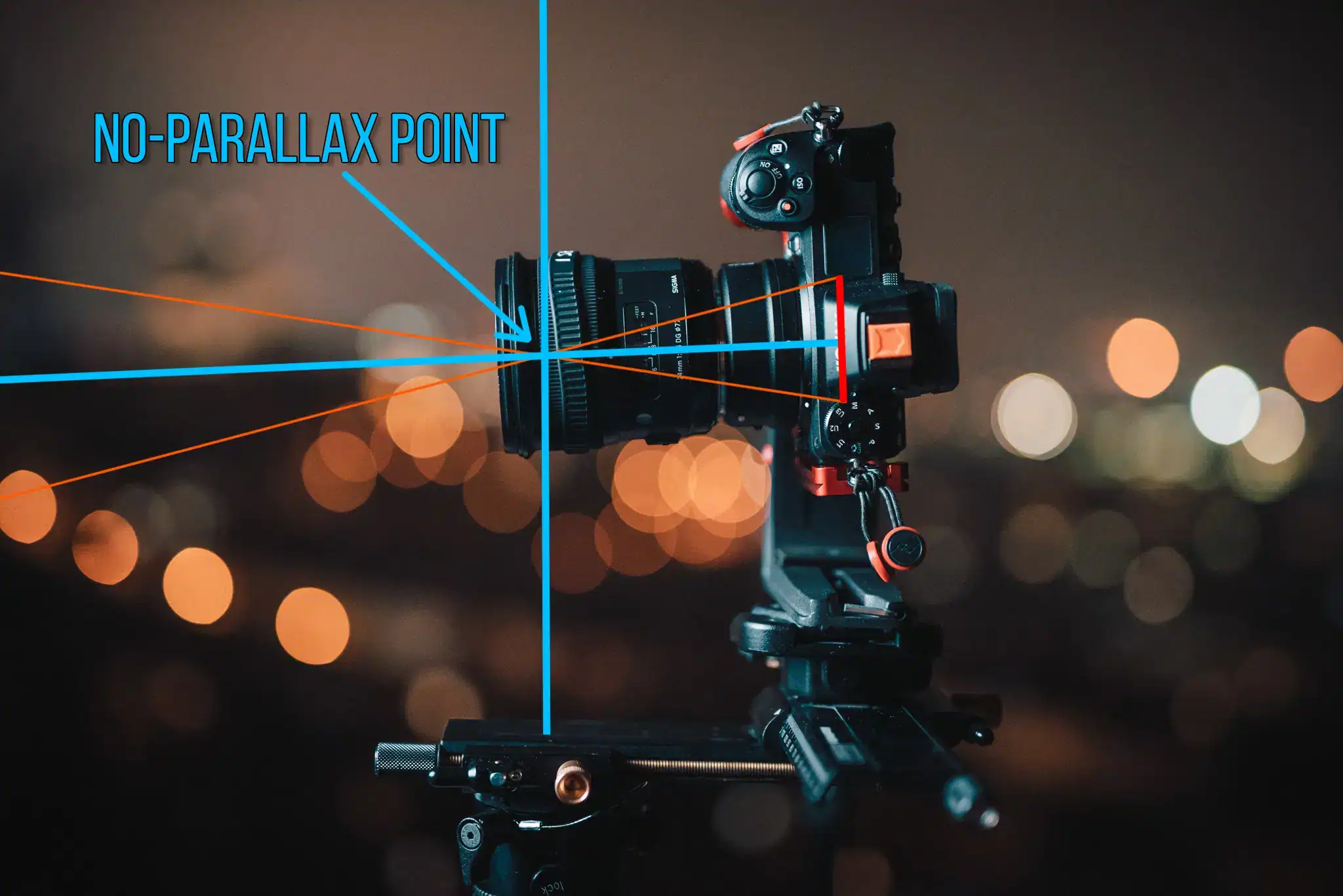
- Tripod level and stable; panoramic head calibrated to the lens’s no-parallax (entrance pupil) point.
- Safety: if on rooftops, in wind, or using poles, secure with tethers; avoid overhead power lines.
- Backup workflow: shoot an extra safety round, especially for HDR interiors or moving crowds.
Essential Gear & Setup
Core Gear
- Panoramic head: enables rotating the camera around the lens’s entrance pupil (nodal point) to eliminate parallax, the number-one cause of stitching errors. Sliding rails let you dial in this position precisely.
- Stable tripod with leveling base: makes yaw rotations truly horizontal, preventing “wavy” horizons and reducing post-leveling.
- Remote trigger or camera self-timer: prevents vibrations. Mirror-up mode (MUP) helps on the D750 for longer exposures.
Optional Add-ons
- Pole or car mount: useful for elevated views or vehicle interiors. Always use a safety tether; watch wind load and vibration.
- Continuous lights or small flashes: for dim interiors to balance color and save ISO.
- Weather protection: a simple rain cover and a microfiber towel can save a shoot.
Step-by-Step Shooting Guide
Standard Static Scenes
- Register Non-CPU Lens on the D750: Menu > Setup > Non-CPU lens data. Set focal length 8mm and max aperture f/3.5. This enables proper metering and meaningful EXIF.
- Level tripod & align nodal point: Mount the camera on your panoramic head, slide the lens over the rotation axis. Aim two vertical reference edges (near and far) and rotate—adjust until parallax disappears. Mark this rail setting with tape for repeatability.
- Manual exposure & locked white balance: Switch to M mode. Meter the brightest area you must hold detail in (e.g., sky or windows). Set exposure so highlights are protected, then keep it fixed for the full spin. Set WB to a fixed preset (Daylight/Tungsten) or Kelvin to avoid stitching color shifts.
- Focus and aperture: With the Samyang, set focus manually around 0.6–1 m and stop down to f/8. This keeps everything from roughly 0.3 m to infinity sharp.
- Capture sequence:
- DX crop mode: 6 around at 60° steps, slight up-tilt (+5–10°) to grab more sky, then 1 zenith, 1 nadir.
- Full-frame near-circular: 3 around at 120°, plus zenith and nadir. For safety, do a second pass or add a fourth around frame.
- Nadir (ground) shot: After your around-frames, tilt down for a clean nadir. You can also offset the tripod slightly or shoot a hand-held nadir patch and blend it later.
HDR / High Dynamic Range Interiors
- Bracket ±2 EV (3 or 5 frames): The D750’s DR is strong, but bright windows still clip; bracket to keep window detail and clean shadows.
- Lock WB and focus; keep the tripod completely still. Shoot all brackets at each position before rotating to reduce moving-subject misalignment.
- Use MUP (mirror up) and a remote if shutter speeds drop below 1/60 s to eliminate vibration.
Low-Light / Night Scenes
- Use tripod and long exposures. Start around f/4–f/5.6, 1/10–1/30 s, ISO 400–800. The D750 handles ISO 1600 acceptably when needed; expose to protect highlights and lift shadows in post.
- Turn off any in-lens stabilization (not applicable to the Samyang 8mm) when on tripod, and use self-timer or remote release.
- Consider doing two passes: one for the base exposure, one to catch highlight detail in bright signs or windows for blend.
Crowded Events
- Shoot two passes: a quick pass for coverage and a second waiting for breaks in foot traffic near the camera.
- Keep overlap generous (30–40%) to give your stitcher options for de-ghosting.
- Mask moving subjects in post to avoid ghosting seams.
Special Setups (Pole / Car / Elevated)
- Secure everything with tethers and lock all clamps. Check wind; with a fisheye you can keep shutter speeds faster (1/100–1/250) to reduce motion blur on a flexing pole.
- Rotate more slowly and pause between frames to dampen vibrations. Consider shooting an extra row for redundancy.
Recommended Settings & Pro Tips
Exposure & Focus
| Scenario | Aperture | Shutter | ISO | Notes |
|---|---|---|---|---|
| Daylight outdoor | f/8–f/11 | 1/100–1/250 | 100–200 | Lock WB (Daylight); D750 base ISO gives max DR |
| Low light/night | f/4–f/5.6 | 1/10–1/60 | 400–800 (1600 if needed) | Tripod & remote; use MUP to avoid vibration |
| Interior HDR | f/8 | Bracket ±2 EV | 100–400 | Expose for windows in base frame; blend brackets |
| Action / moving subjects | f/5.6–f/8 | 1/200+ | 400–800 | Freeze motion; shoot double pass for clean masks |
Critical Tips
- Manual focus and hyperfocal: On an 8mm, set f/8 and focus ~0.6–1 m for near-to-infinity sharpness.
- Nodal point calibration: With the Samyang 8mm on a typical Nodal Ninja-style head, expect the entrance pupil near the front element plane. Use a sliding rail to remove parallax; mark your sweet spot for quick setups.
- White balance lock: Avoid Auto WB. Mixed lighting? Use Kelvin (e.g., 3200–3800 K indoors; 5200–5600 K daylight) and fix tint later across all frames.
- RAW over JPEG: The D750’s 14-bit RAW gives better highlight recovery and smoother HDR merges.
- Stabilization: The D750 has no IBIS. If using other VR lenses on tripod, turn VR off.
- Hood considerations: For full-frame circular coverage, remove the Samyang’s hood carefully; test for vignetting and flare sensitivity before critical work.
Stitching & Post-Processing
Software Workflow
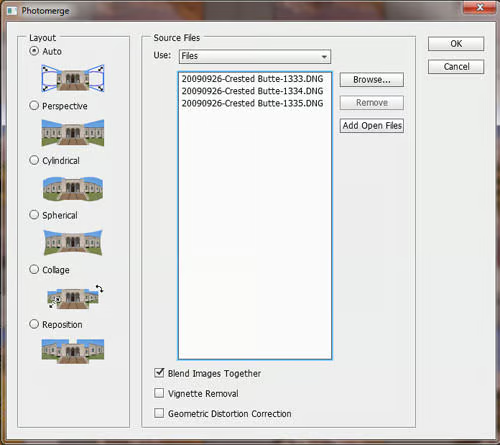
Load your RAWs in Lightroom or similar to synchronize exposure, WB, lens profile (use a generic fisheye profile if needed), and basic noise reduction. Export 16-bit TIFFs to your stitcher. PTGui is the industry staple for fisheye-based 360s, with automatic control point generation, masking, and excellent equirectangular output. Hugin is a solid open-source alternative. With a fisheye, you can get away with fewer frames and still achieve accurate stitches; aim for ~25–30% overlap between frames for robust control points. Rectilinear lenses require more frames and tighter overlap management (20–25%). For the D750 + 8mm DX method (6 around + Z + N), you’ll typically land in the 10–14K equirectangular width range; with full-frame circular (3 around + Z + N), 8–10K is common depending on your stitch settings and cropping.
Once stitched, set horizon and straighten using the roll/yaw/pitch tools. Export an equirectangular 2:1 image (e.g., 12000 × 6000 px) for VR viewers or virtual tour platforms. PTGui’s template system is great for repeating shoots with the same nodal settings. For more about why PTGui is often preferred, see this review at the end of this paragraph. Fstoppers review: PTGui for incredible panoramas
Cleanup & Enhancement
- Tripod/nadir patch: Render a nadir-only pano or clone stamp in Photoshop. Some AI tools can automatically remove tripods from equirectangulars.
- Color balance: Use HSL and split-toning to neutralize mixed lighting. Keep WB consistent across the full pano.
- Noise reduction: The D750 tolerates NR well up to ISO 1600. Apply luminance NR carefully to preserve fine detail.
- Sharpening: Output sharpen after resizing; avoid over-sharpening before 360 upload.
- Export: Save a high-quality JPEG (quality 10–12) or 16-bit TIFF master. For VR platforms, keep the 2:1 aspect and embed XMP panorama metadata if required.
For a clear overview of DSLR 360 capture and stitching workflows, this platform guide is concise and up to date: Using a DSLR or mirrorless to shoot and stitch a 360 photo
Useful Tools & Resources
Software
- PTGui panorama stitching
- Hugin (open-source stitching)
- Lightroom / Photoshop for RAW prep and retouching
- AI tripod removal/cleanup tools
Hardware
- Panoramic heads (Nodal Ninja, Leofoto, Fanotec) for precise nodal alignment
- Carbon fiber tripods and leveling bases
- Wireless remote shutters
- Pole extensions and safe car mounts
For an illustrated primer on finding and using a panoramic head, this guide is helpful: Panoramic head tutorial
Disclaimer: software/hardware names provided for search reference; verify features and compatibility on official sites.
Real-World Scenarios With This Combo
Indoor Real Estate (DX crop, HDR)
Use DX mode for more per-frame detail. Shoot 6 around + Z + N with ±2 EV brackets. Lock WB to 4000–4500 K for mixed daylight/tungsten. Keep ISO 100–400; let shutter vary. Stitch brackets in PTGui (or pre-merge HDRs), then correct verticals and patch the nadir.
Outdoor Sunset (Full-frame circular for speed)
Remove the hood. Shoot 3 around + Z + N at ISO 100–200, f/8, 1/100–1/250. Meter for highlights to avoid clipping the sun edge; do a second pass one stop brighter if foregrounds are too dark. The faster capture minimizes cloud and wave motion between frames.
Crowded Event (DX crop, extra overlap)
Stick to 6–8 around with 30–40% overlap. Two full passes help you mask moving people. Keep shutter above 1/200 at ISO 400–800 to freeze motion. The D750’s files can tolerate mild NR later without losing texture.
Rooftop / Pole Elevated (Full-frame circular)
Use a robust pole, tether, and gloves. Wind is the enemy; shoot quickly at 1/200–1/400, ISO 400–800. Add an extra around-frame to hedge against vibration-blurred shots. Check the horizon alignment meticulously in post.
Car Interior (DX crop)
Space is tight; DX mode keeps the frame-filling fisheye with fewer extreme black areas. Use a compact nodal head, f/8, ISO 400–800. Bracket if windows are bright; cover the nadir by removing the rig for a handheld patch frame.
Safety, Limitations & Quality Expectations
The Samyang 8mm CS II on a full-frame D750 will vignette heavily unless the hood is removed (or shaved). Hood removal is reversible on CS II but proceed carefully. Expect more susceptibility to flare without the hood; plan angles to keep the sun out of the frame border. The lens is fully manual; learn to set Non-CPU Lens Data for stable metering. The D750 has no IBIS; stability comes from your tripod, technique, and timing. With clean technique, you can achieve 10–14K-wide equirectangular outputs in DX mode and ~8–10K in full-frame circular mode—plenty for VR tours and web delivery. For a deeper look at projection math and expected resolutions, see this reference: DSLR spherical resolution (PanoTools)
Common Mistakes & How to Avoid Them
- Parallax error: Not aligning the entrance pupil. Calibrate once; mark your rail and reuse.
- Exposure flicker: Shooting in Auto. Use Manual exposure and fixed WB across all frames.
- Soft images: Focusing to infinity. On 8mm, set f/8 and focus ~0.6–1 m for everything sharp.
- Tripod in the shot: Always capture a nadir patch and plan for a clean clone.
- Ghosting: Moving people/trees between frames. Increase overlap, shoot fast, and mask in post.
- Flare with hood removed: Avoid strong backlight crossing the frame edge; use your body or a flag to block stray light.
Frequently Asked Questions
- Can I shoot handheld panoramas with the Nikon D750?
Yes, but expect more stitching errors. Use high shutter speeds (1/250+), generous overlap (40–50%), and rotate your body around the lens as much as possible. For critical work, a panoramic head is strongly recommended.
- Is the Samyang 8mm f/3.5 UMC Fish-Eye CS II wide enough for single-row 360?
In DX crop: yes—6 around + Z + N is reliable. In full-frame circular mode (hood removed): 3 around + Z + N can cover a sphere, though you may add a fourth around frame for safety and cleaner nadir coverage.
- Do I need HDR for interiors with bright windows?
Often yes. The D750 has strong DR, but interiors with bright windows typically need ±2 EV brackets to preserve view detail without noisy shadows. Stitching software can align HDR brackets per view.
- How do I avoid parallax issues with this setup?
Use a panoramic head and align the entrance pupil: set up a near and far vertical object, rotate the camera, and slide the lens on the rail until there’s no relative shift. Mark the position for the Samyang 8mm so you can repeat it next time.
- What ISO range is safe on the D750 in low light?
ISO 100–800 is very clean; ISO 1600 is still usable with modest noise reduction. If you need ISO 3200, expose carefully and plan for more NR in post. Prefer longer shutter times on a tripod when possible.
Extra Visuals & Learning
For a broader discussion of camera and lens choices for 360 virtual tours, this guide offers practical advice: DSLR virtual tour camera & lens guide