Why This Camera & Lens Are Great for Panoramas
If you’re wondering how to shoot panorama with Nikon D750 & Peleng 8mm f/3.5, you’ve picked a powerful, budget-friendly combo. The Nikon D750 is a 24.3MP full-frame DSLR (FX, 6016×4016px) with a large ~5.9µm pixel pitch and excellent base-ISO dynamic range (~14.5 EV at ISO 100). That means clean files, strong highlight recovery, and low noise—crucial when blending multiple frames or bracketing for HDR panoramas. The Peleng 8mm f/3.5 is a manual circular fisheye that projects a ~180° field of view onto a circular image on full frame. This gives you full-sphere coverage with very few shots (as few as 3 around), which speeds up capture, reduces stitch seams, and helps in dynamic environments.
Because the Peleng is fully manual (aperture and focus), exposure consistency is easy—you set and forget. The D750’s Non-CPU Lens Data menu also lets you register the lens (8mm, f/3.5) so the camera meters more consistently and embeds EXIF data. Distortion from a fisheye isn’t a problem for panoramas; stitching software (PTGui/Hugin) models fisheye projection precisely. Nikon F-mount compatibility is straightforward, and the D750’s exposure delay modes, live view, and solid battery life make it a reliable pano workhorse indoors and outside.
Quick Setup Overview
- Camera: Nikon D750 — Full-frame (FX) 24.3MP sensor, ~5.9µm pixel pitch, excellent DR at base ISO.
- Lens: Peleng 8mm f/3.5 — Circular fisheye; manual focus/aperture; sharpest around f/5.6–f/8; modest CA that’s easily corrected in post.
- Estimated shots & overlap:
- 3 around at 120° yaw (pitch 0°) + optional nadir for best speed; ~30–35% overlap.
- 4 around at 90° yaw + nadir for safer control points and cleaner edges.
- Optional zenith if your head blocks the top; many scenes are covered by the circular frame without a dedicated zenith.
- Difficulty: Easy–Medium (manual lens, nodal calibration once, very quick field workflow).
Planning & On-Site Preparation
Evaluate Shooting Environment
Before you shoot, assess light direction, contrast, and moving elements. For interiors, note windows and reflective surfaces (glass, mirrors, polished floors). If you must shoot near glass, place the lens as close as practical (a few centimeters) to reduce reflections and ghosting. Outdoors, avoid placing the sun in the center of the frame with a circular fisheye; instead, rotate to keep the sun near an edge to minimize flare arcs.
Match Gear to Scene Goals
The D750’s wide dynamic range is ideal for sunrise/sunset landscapes and interior scenes where you need to retain window detail. Practical ISO guidance: ISO 100–800 is “safe-clean,” ISO 1600 remains very usable, ISO 3200 acceptable with noise reduction. The Peleng 8mm’s fisheye view means fewer shots and lower total capture time—great for crowds or windy rooftops. The trade-off is a circular image that demands careful nadir cleanup and slightly lower final resolution than multi-row rectilinear panos—but it’s more than enough for virtual tours and web 360 photos.
Pre-shoot Checklist
- Power & storage: fully charged EN-EL15 battery, spare battery, and ample cards.
- Lens/sensor clean: circular fisheye sees everything—smudges will stitch into every frame.
- Tripod leveling: use a leveling base; calibrate your panoramic head’s nodal point before the job.
- Safety: tether on rooftops, mind wind loads on poles, verify car mounts and route legality.
- Backup: shoot a second pass when time allows; if something moves (flags, people), you’ll have options.
Essential Gear & Setup
Core Gear
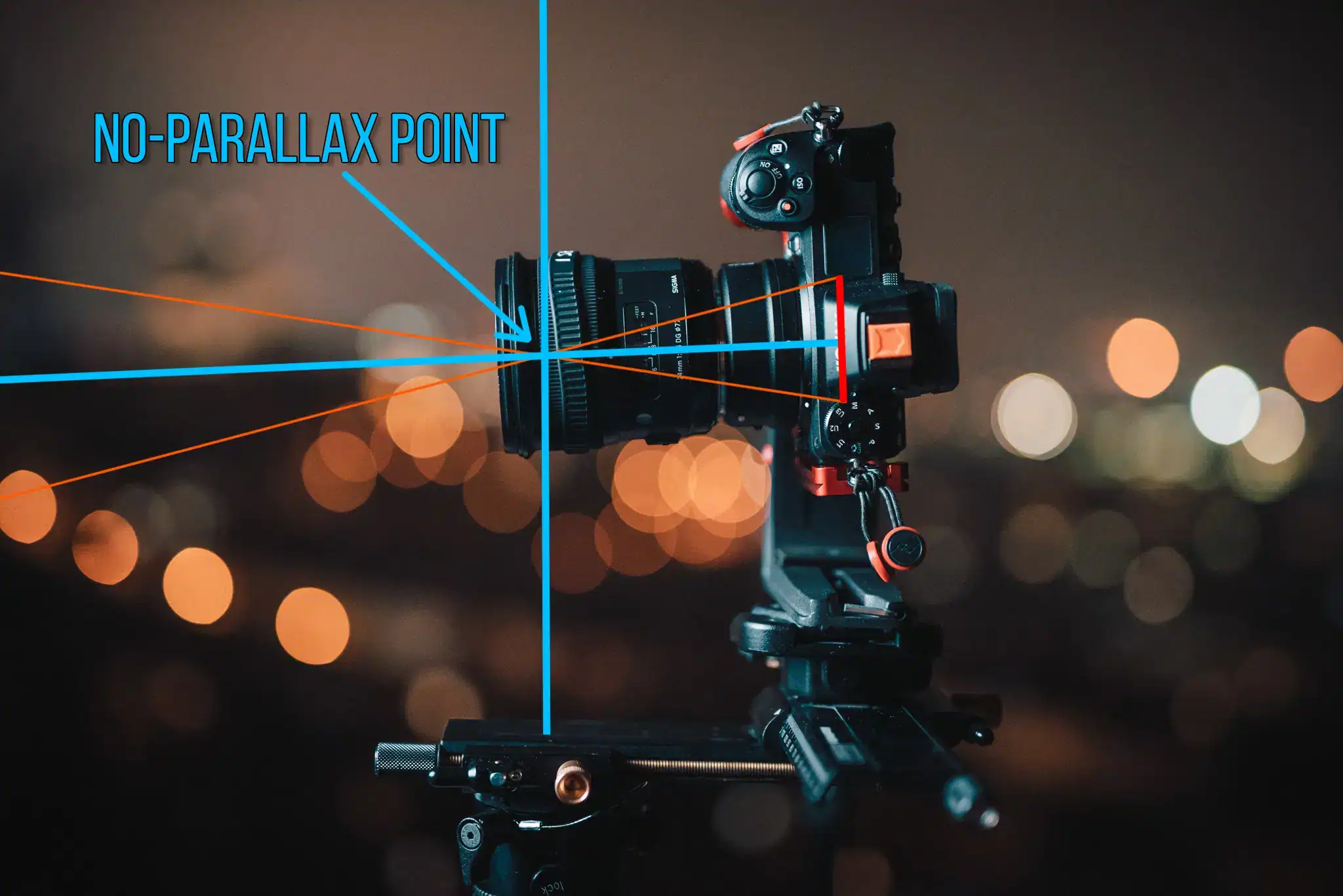
- Panoramic head: lets you rotate the camera around the lens’s entrance pupil (nodal point) to eliminate parallax. With a circular fisheye, a simple rotator (R-series or single-row) is often enough.
- Stable tripod with leveling base: a flat, level rotation is key to fast stitching and consistent overlap.
- Remote trigger or self-timer/exposure delay: the D750’s Exposure Delay Mode (1–3s) reduces mirror slap and vibration.
Optional Add-ons
- Pole or car mount: keep speed low, mind vibration, use a safety tether. Wind amplifies sway—short exposures reduce blur.
- LED lighting or flash for deep interiors: balance with existing light; avoid hotspots that complicate blending.
- Weather protection: rain covers, lens cloths, and silica gel for humid shoots.
Nikon D750 + Peleng 8mm Specific Setup Notes
- Register the lens: Menu > Setup > Non-CPU Lens Data (8mm, f/3.5). This improves metering and EXIF.
- Focus: set manual focus around 0.4–0.6 m at f/8 for near-hyperfocal coverage; confirm in live view at 100%.
- Aperture: f/5.6–f/8 is the sharpness/DOF sweet spot for this lens.
- Vibration control: the Peleng has no VR; enable Exposure Delay Mode or use mirror-up with a remote for long shutters.
Step-by-Step Shooting Guide
Standard Static Scenes
- Level and nodal alignment: level the tripod, center the entrance pupil over the rotator. With the Peleng 8mm, a good starting entrance pupil is ~35–45 mm behind the front rim; fine-tune using the near/far alignment test.
- Manual exposure and white balance: switch to M mode; set WB to Daylight (≈5200K) or a fixed Kelvin suited to the scene. Locking WB avoids inconsistent color across frames.
- Capture sequence:
- Option A (fast): 3 shots around at yaw 0°/120°/240°; pitch 0°.
- Option B (safer overlap): 4 shots around at 90° increments; pitch 0°.
- Add 1 nadir shot by tilting down or moving the tripod slightly for easier patching.
- Nadir capture: from the same nodal alignment, tilt down and shoot the floor, or move the camera off the tripod position for a clean plate to clone later.
HDR / High Dynamic Range Interiors
- Bracket ±2 EV to balance bright windows and interior shadows. On the D750, use exposure bracketing (3 or 5 frames) and turn Auto ISO off.
- Lock WB (e.g., 4000–4500K for mixed tungsten/daylight) so brackets match color. Keep aperture fixed; vary shutter speed.
- Use a remote or exposure delay to avoid shake. Maintain the same start yaw for every bracket to simplify batch stitching.
Low-Light / Night Scenes
- Exposure: start at f/4–f/5.6, 1/30–1/60, ISO 400–1600 depending on wind and scene brightness. For static cityscapes on a solid tripod, go longer shutter at ISO 100–400.
- Enable Exposure Delay Mode (1–3s) or mirror-up with a remote. Review sharpness at 100% before moving to the next yaw.
Crowded Events
- Two-pass strategy: first capture a full set quickly; then wait for gaps to re-shoot frames with problematic motion.
- Keep overlap generous (4 around) for more control points. Mask people creatively in post to reduce ghosting.
Special Setups (Pole / Car / Rooftop)
- Secure all gear with a tether; check bolts and quick-releases. Avoid extending poles fully in high winds.
- Use short exposures (1/200s+) on poles/car to combat vibration; increase ISO if needed. Drive slowly and avoid bumps if car-mounted, and respect local laws.
Recommended Settings & Pro Tips
Exposure & Focus
| Scenario | Aperture | Shutter | ISO | Notes |
|---|---|---|---|---|
| Daylight outdoor | f/8–f/11 | 1/100–1/250 | ISO 100–200 | Lock WB (Daylight ~5200K); use 3 shots around for speed |
| Low light/night | f/4–f/5.6 | 1/30–1/60 (tripod) | ISO 400–1600 | Exposure Delay Mode or remote; check for wind-induced blur |
| Interior HDR | f/8 | Bracket ±2 EV | ISO 100–400 | Fixed WB (e.g., 4000–4500K); vary shutter only |
| Action / moving subjects | f/5.6–f/8 | 1/200+ | ISO 400–1600 | Higher shutter to freeze movement; 4 around for overlap |
Critical Tips
- Manual focus near hyperfocal: at 8mm and f/8, focus ≈0.4–0.5 m keeps almost everything sharp to infinity. Confirm in live view.
- Nodal alignment: mark your rail position once found. A taped reference saves minutes on every job.
- White balance lock: avoid “Auto WB” shifts across frames or brackets; consistency matters more than perfect WB.
- RAW capture: maximizes dynamic range and color latitude for HDR merges and shadow recovery.
- Stabilization: the D750 has no IBIS; if you ever mount a VR lens for pano work on a tripod, switch VR off.
Field Case Studies
Indoor real estate with bright windows
Use 4 around + nadir for cleaner edges. Bracket 5 frames at ±2 EV, f/8, ISO 100. Set WB to 4300K to split the difference between daylight windows and tungsten lamps. In post, blend HDR per view, then stitch.
Outdoor sunset viewpoint
Expose for midtones at ISO 100–200, f/8, 1/125s. If the sun is in-frame, shoot a second pass as it dips for a cleaner sun disk, then blend in post. Use 3 around for speed before the light changes.
Busy event
Go 4 around and shoot two full passes. Use shorter exposures (1/200–1/400s) and ISO 800–1600. In post, mask bodies to reduce ghosting and maintain continuity along seams.
Stitching & Post-Processing
Software Workflow
Import RAW files and perform basic adjustments (lens CA removal, exposure consistency) in Lightroom or Capture One, but avoid heavy sharpening before stitching. In PTGui or Hugin, set Lens Type to Fisheye and specify 8mm focal length. For a circular fisheye on full frame, templates in PTGui often autodetect lens parameters well. Industry guidelines: ~25–35% overlap for fisheye sequences is sufficient, while rectilinear lenses typically need 20–25% but many more shots. Expect an equirectangular output around 6000–10,000 px wide from a 3–4 shot circular-fisheye set with the D750.
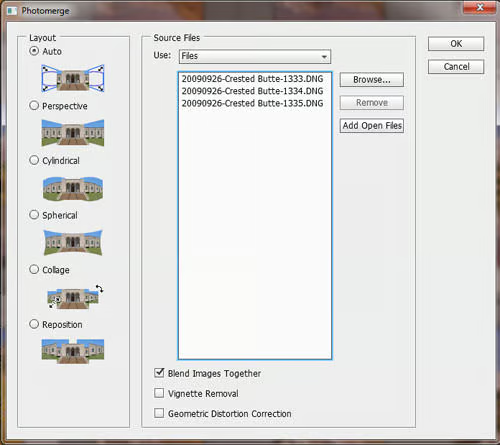
For high dynamic range, first merge brackets per viewpoint (LR/ACR HDR or PTGui’s built-in HDR workflow), then stitch the HDR set. PTGui’s masking tools help fix moving objects and tripod overlaps; Hugin offers similar control-point and masking features but with a steeper learning curve.
Cleanup & Enhancement
- Nadir patch: export a layered panorama (TIFF/PSD), patch the tripod using a clean nadir plate or a logo/AI tool. Clone reflections and repeating textures carefully.
- Color consistency: correct mixed lighting casts; apply selective HSL adjustments to even out room colors.
- Noise management: at ISO 1600–3200, apply luminance NR sparingly to preserve detail.
- Leveling: use horizon/vertical guides in PTGui or Photoshop to correct roll/yaw/pitch so the horizon is true.
- Export: for VR, export equirectangular 2:1 JPEG at 8–12K width (quality 85–90). Keep a 16-bit TIFF master for archiving.
For deeper reading on head setup and best practices, see a panoramic head tutorial and a professional PTGui review. Panoramic head basics. PTGui reviewed for high-end panoramas.
Recommended Learning Video
For complete end-to-end guidance on DSLR 360 photos (capture to VR), Oculus’s creator guide is an authoritative reference. DSLR 360 photo workflow.
Useful Tools & Resources
Software
- PTGui panorama stitching
- Hugin open source
- Lightroom / Photoshop
- AI tripod/nadir removal and logo patch tools
Hardware
- Panoramic heads: Nodal Ninja (R-series for fisheye), Leofoto single-row rotators
- Carbon fiber tripods with leveling bases
- Wireless remote shutters or intervalometers
- Pole extensions and vehicle mounts (with safety tethers)
Disclaimer: Brand names for search convenience. Verify specs and compatibility on official sites.
Common Mistakes & How to Avoid Them
- Parallax errors: always align the entrance pupil (nodal point) before the shoot; test with near/far objects.
- Exposure flicker: use full Manual mode and locked WB; avoid Auto ISO when bracketing.
- Tripod in the frame: capture a clean nadir and patch it; keep legs as close as possible without overlapping the lens.
- Ghosting from moving subjects: shoot two passes and use masks in PTGui/Photoshop.
- Night noise: prioritize lower ISO and solid support; use exposure delay and a remote to keep frames tack sharp.
Frequently Asked Questions
- Can I shoot handheld panoramas with the Nikon D750?
Yes—especially with the Peleng 8mm because you only need 3–4 frames around. Use fast shutters (1/200s+), higher ISO (800–1600), and keep your rotation around your body’s center. Expect more stitching cleanup versus a leveled tripod.
- Is the Peleng 8mm f/3.5 wide enough for single-row 360?
Definitely. As a circular fisheye on full frame, it covers ~180° in all directions. Three shots around at 120° often cover the full sphere; add a nadir for a cleaner floor. Four around at 90° provides safer overlap and better control points.
- Do I need HDR for interiors with bright windows?
Usually yes. The D750 has great DR, but window-to-room contrast often exceeds what a single exposure can hold. Use 3–5 frames at ±2 EV and blend before stitching or use PTGui’s HDR workflow.
- How do I avoid parallax issues with this setup?
Calibrate the entrance pupil on your panoramic head so the lens rotates over it. With the Peleng 8mm, start around 35–45 mm behind the front rim and refine using near/far alignment. Mark the rail once perfect.
- What ISO range is safe on the D750 for low light panoramas?
ISO 100–800 is very clean; ISO 1600 is generally excellent; ISO 3200 remains usable with noise reduction. If you can stabilize and lengthen shutter, prefer ISO 100–400 for maximum dynamic range.
- Can I save pano settings to a custom mode?
Yes. Use U1/U2 user settings: store Manual exposure, fixed WB, RAW, exposure delay, and bracketing preference. It speeds up field setup significantly.
- How can I reduce flare with a circular fisheye?
Avoid placing the sun centrally; keep it near frame edges, shade the lens with your hand or a small flag placed out of frame, and clean the front element meticulously. Consider blending a second frame with the sun slightly blocked.
- What panoramic head works best for this combination?
A lightweight single-row head with precise fore-aft adjustment (e.g., Nodal Ninja R-series or a compact rail + rotator) is ideal. You don’t need a heavy multi-row head for a circular fisheye workflow.
Safety, Limitations & Trust Notes
The Peleng 8mm is manual-only and can flare more readily than modern coatings; plan your angles and carry a microfiber cloth. The circular image means your maximum finished resolution is lower than multi-row rectilinear panos, but the speed advantage is huge. On rooftops or poles, always tether gear and assess wind. For car-mounted shots, keep speeds low and ensure legal compliance. Back up in the field—copy cards to a second device and, when possible, shoot a safety pass. For further technical background on achievable spherical resolution with different lenses and sensors, see the PanoTools community resource. DSLR spherical resolution basics.