
Why This Camera & Lens Are Great for Panoramas
If you’re searching for how to shoot panorama with Nikon D750 & Fujifilm XF 8-16mm f/2.8 R LM WR, here’s the straight truth first: the Fujifilm XF 8–16mm (X-mount, APS-C) cannot be mounted on a Nikon D750 (F-mount, full-frame DSLR). The flange distance and fully electronic aperture of the XF lens make a functional adapter impractical for the D750.
That said, the technique you’ll use to capture professional 360° panoramas is the same regardless of brand, as long as your lens provides a similar field of view and you align the no-parallax (entrance pupil) properly. So this guide gives you two practical paths that map 1:1 to the skills you’re here to learn:
- Use the Nikon D750 with an equivalent rectilinear ultra‑wide (e.g., AF-S 16–35mm f/4 VR, 14–24mm f/2.8, or a prime around 14–20mm). This yields a full-frame FOV similar to the XF 8–16mm on APS-C.
- Use the Fujifilm XF 8–16mm on a Fuji X body (X-T/X-H series). Its 8mm end (~12mm FF equivalent) is superb for multi-row panoramas and interior work.
Why this combo concept works: the Nikon D750’s 24.3MP full-frame sensor offers excellent dynamic range (~14.5 EV at ISO 100) and forgiving high-ISO performance, while the XF 8–16mm is a class-leading rectilinear ultra-wide zoom renowned for sharpness, low coma, and robust weather sealing. Whether you execute on the D750 with an equivalent Nikon ultra-wide, or pair the XF 8–16mm with a Fuji body, the capture and stitching workflow below will help you produce clean, high-resolution 360 photos.
Quick Setup Overview
- Camera: Nikon D750 — full-frame 24.3MP CMOS (35.9×24mm), pixel pitch ~5.97 µm, excellent base ISO 100 dynamic range (~14.5 EV), reliable at ISO 800–1600 for pano work.
- Lens: Fujifilm XF 8–16mm f/2.8 R LM WR (rectilinear, APS-C) — equivalent to ~12–24mm on full-frame; very sharp from f/4–f/8, good control of CA/flare, no optical stabilization, weather-sealed, bulbous front element (no front filters). Note: not mountable on the D750; use a Nikon ultra-wide delivering a similar FOV.
- Estimated shots & overlap (rectilinear ultra-wide):
- 12mm full-frame equivalent (e.g., XF 8mm on APS-C): Fast field set — 8 around at 0°, 6 at +45°, 6 at −45°, + zenith + nadir (≈22–24 frames). High quality — 10 around at 0°, 8 at +45°, 8 at −45°, + zenith + 2–3 nadir (≈29–31 frames).
- 24mm full-frame equivalent: 12–14 around at 0°, 8 at +45°, 8 at −45°, + zenith + nadir (≈29–31 frames).
- Overlap: 30–40% horizontal for rectilinear ultra-wide; 30–40% vertical between rows.
- Difficulty: Moderate to advanced (multi-row capture and precise no‑parallax alignment are required).
Planning & On-Site Preparation
Evaluate Shooting Environment
Scan for moving subjects, wind, reflective glass, and strong backlight. For interiors, note mixed lighting (daylight + tungsten/LED) to plan white balance. If shooting through glass, get the front element as close as safe (1–3 cm) and use a lens hood or black cloth to block reflections; angle slightly to avoid your own reflection. Outdoors at sunset, plan for changing light and consider bracketing if window-to-shadow contrast is high.
Match Gear to Scene Goals
The Nikon D750’s dynamic range lets you preserve highlight detail while lifting shadows; it’s clean at ISO 100–800 and usable at ISO 1600–3200 with careful exposure. The XF 8–16mm’s rectilinear design keeps lines straight—ideal for architecture and interiors—though it requires more frames than a fisheye to achieve a full 360×180 sphere. If speed matters (events, rooftops), use the widest end (12mm FF equivalent) to reduce rows while maintaining quality. For critical real estate interiors, shoot more frames to increase overlap and stitching reliability.
Pre-shoot Checklist
- Power and storage: Fully charge batteries, carry spares; use fast, high-capacity cards.
- Clean optics: Wipe lens and sensor; bulbous elements attract dust and flare.
- Head calibration: Level tripod, verify panoramic head’s no-parallax alignment for your exact focal length.
- Safety: Use sandbags in wind; tether gear on rooftops/poles; ensure car mounts are rated and secure.
- Backup workflow: Shoot a “safety” second pass; consider a bracketed set for insurance against exposure errors.
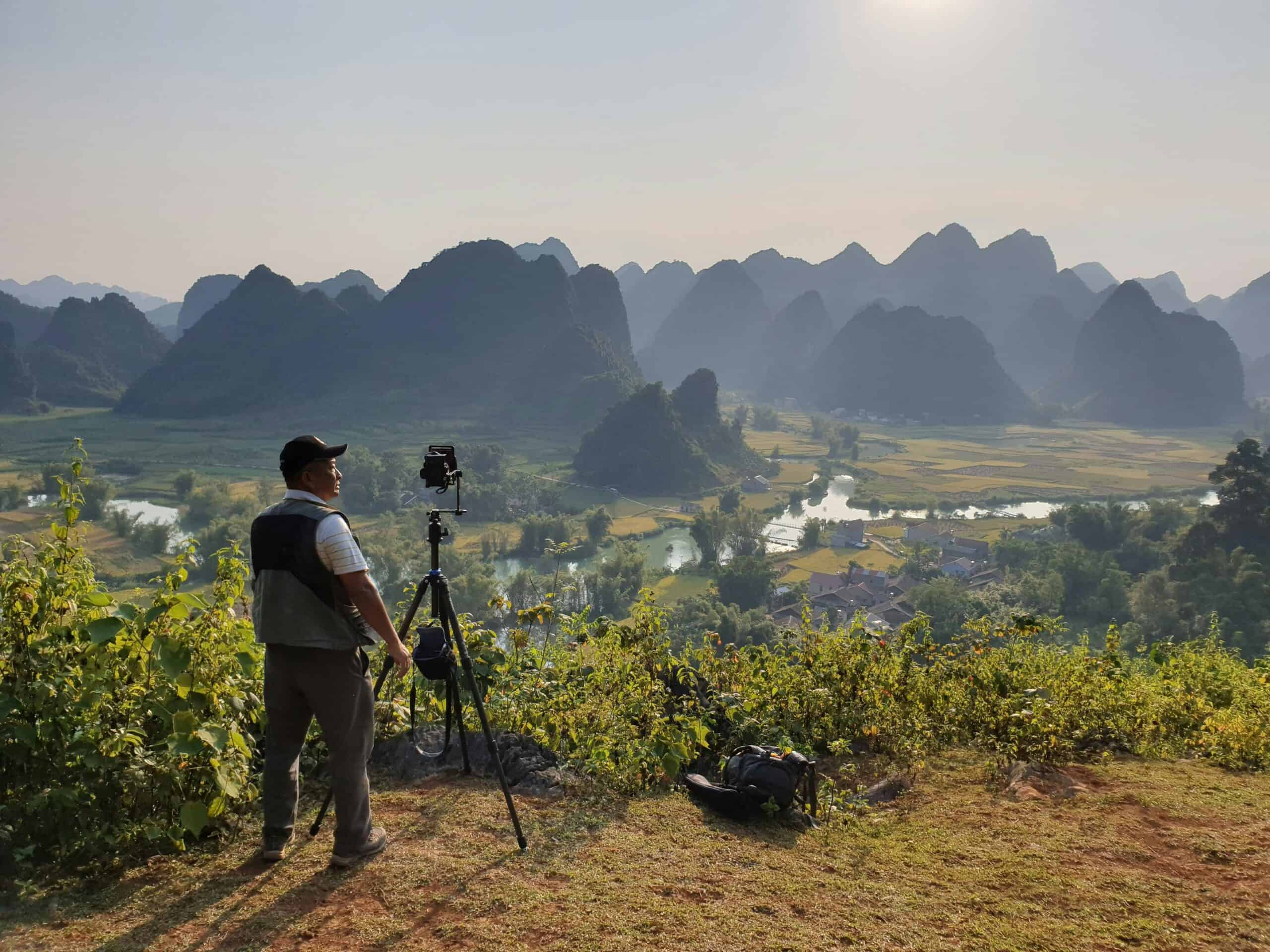
Essential Gear & Setup
Core Gear
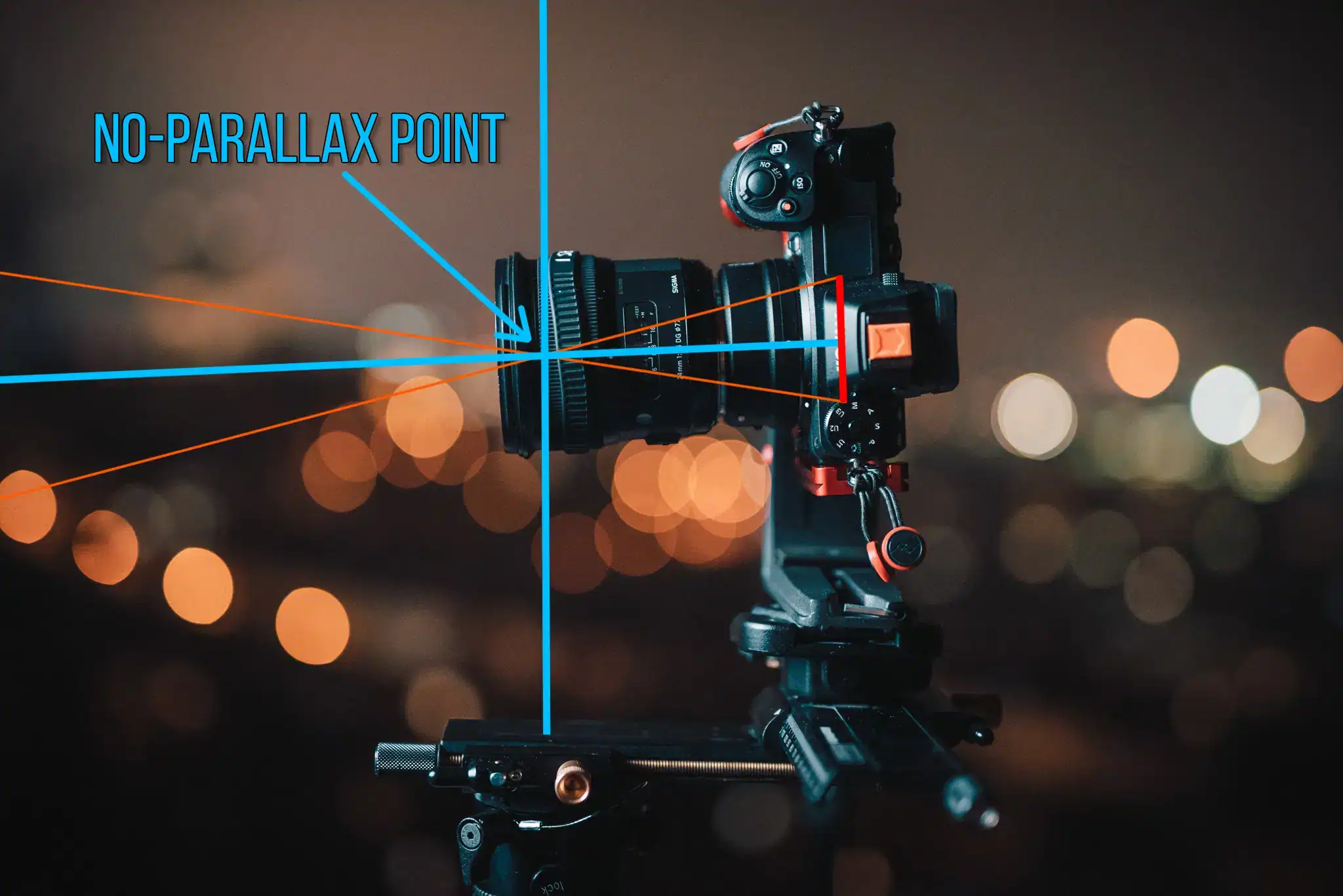
- Panoramic head: Enables rotation around the lens’s entrance pupil (no-parallax point) to avoid parallax between near and far objects for seamless stitches.
- Stable tripod + leveling base: A leveling base speeds alignment so your rows maintain even overlap.
- Remote trigger/app: Avoids vibration; use 2s self-timer if a remote isn’t available.
Optional Add-ons
- Pole or car mount: For elevated views or drive-bys. Always tether gear, check wind loads, and avoid highways with exposed rigs.
- Lighting aids: Small LED panels for dark corners in interior work; keep color temperature consistent.
- Weather protection: Rain covers and microfiber cloths; bulbous lenses need extra care in drizzle.
Need a primer on panoramic heads and alignment? See this practical panoramic head tutorial for grounding before your first field attempt. Panoramic head tutorial
Step-by-Step Shooting Guide
Standard Static Scenes
- Level and align: Level your tripod, then adjust the panoramic head so the camera rotates perfectly on the horizontal axis. Calibrate the entrance pupil (no-parallax point) for your focal length by aligning a near and far object; rotate the camera—if the near object shifts relative to the far object, adjust the fore-aft rail until the shift disappears.
- Manual exposure and fixed WB: Switch to Manual mode and set a consistent exposure (meter for highlights; the D750 can recover shadows well). Lock white balance (Daylight for sun, Tungsten for warm interiors) to avoid color shifts across frames.
- Focus once, then lock: Use live view to focus at or near the hyperfocal distance. For a 12mm FF equivalent at f/8, hyperfocal is around 0.5–0.7 m; on full frame at 12–16mm f/8, focus around 0.7–1 m for front-to-back sharpness. Switch to manual focus to lock.
- Capture with overlap: At 12mm FF equivalent:
- Fast pass: 8 around at 0°, 6 at +45°, 6 at −45°, then 1 zenith and 1 nadir.
- High-quality: 10 around at 0°, 8 at +45°, 8 at −45°, 1 zenith, 2–3 nadir (for cleaner tripod removal).
- Nadir capture: After the main set, slide the tripod or use a nadir adapter to capture a clean ground plate for tripod removal.
HDR / High Dynamic Range Interiors
- Bracket exposures: Use ±2 EV (3 or 5 frames). On the D750, AE bracketing supports 2–9 frames; 5 frames at 1 EV spacing or 3 frames at 2 EV spacing are common for windows + interior balance.
- Lock WB and focus: Keep WB fixed to the room’s dominant temperature and lock focus to avoid bracket-to-bracket shifts.
- Consider ghost control: For moving curtains or foliage outside the window, capture an extra “base” exposure to mask in during post.
Low-Light / Night Scenes
- Stability first: Use a rigid tripod, remote release, and mirror-up mode on the D750 or live view to reduce vibration. VR/IS off on tripod.
- Exposure: f/4–f/5.6, shutter 1/10–1/60 depending on wind and subject motion, ISO 100–800 preferred; ISO 1600 is acceptable on the D750 with noise reduction in post.
- Watch flare: With bulbous ultra-wides, shield stray light with your hand or flag off street lamps.
Crowded Events
- Two passes: First pass quickly for geometry; second pass time your shots for gaps in moving people.
- Faster shutter: Aim for 1/200–1/400 at f/5.6–f/8 and ISO 400–800 to freeze motion. You can still blend frames in post to minimize ghosting.
Special Setups (Pole / Car / Drone)
- Secure everything: Double-clamp, tether, and check wind. On a pole, rotate slower and let vibrations settle before each exposure.
- Small rotations: Increase overlap to 40–50% if vibration is unavoidable; shoot extra safety frames for critical rows.
Recommended Settings & Pro Tips
Exposure & Focus
| Scenario | Aperture | Shutter | ISO | Notes |
|---|---|---|---|---|
| Daylight outdoor | f/8–f/11 | 1/100–1/250 | 100–200 | Lock WB (Daylight); protect highlights |
| Low light/night | f/4–f/5.6 | 1/10–1/60 | 100–800 (up to 1600 on D750) | Tripod + remote; turn VR/IS off |
| Interior HDR | f/8 | Bracket ±2 EV | 100–400 | Balance windows and lamps; fixed WB |
| Action / moving subjects | f/5.6–f/8 | 1/200+ | 400–800 | Freeze motion, shoot two passes |
Critical Tips
- Manual focus at hyperfocal: For 12–16mm FF equivalent, f/8 with focus ~0.7–1 m yields near-to-infinity sharpness.
- Nodal calibration: Mark your rail positions for each focal length; keep notes on your phone. Repeat whenever you switch lenses or zoom.
- White balance lock: Avoid color shifts; choose a WB preset to match the dominant light.
- Shoot RAW: Maximizes dynamic range and color latitude for HDR merges and stitch blending.
- Stabilization: D750 has no IBIS; disable lens VR on tripod. Handheld tests with VR are okay but not recommended for multi-row 360s.
Stitching & Post-Processing
Software Workflow
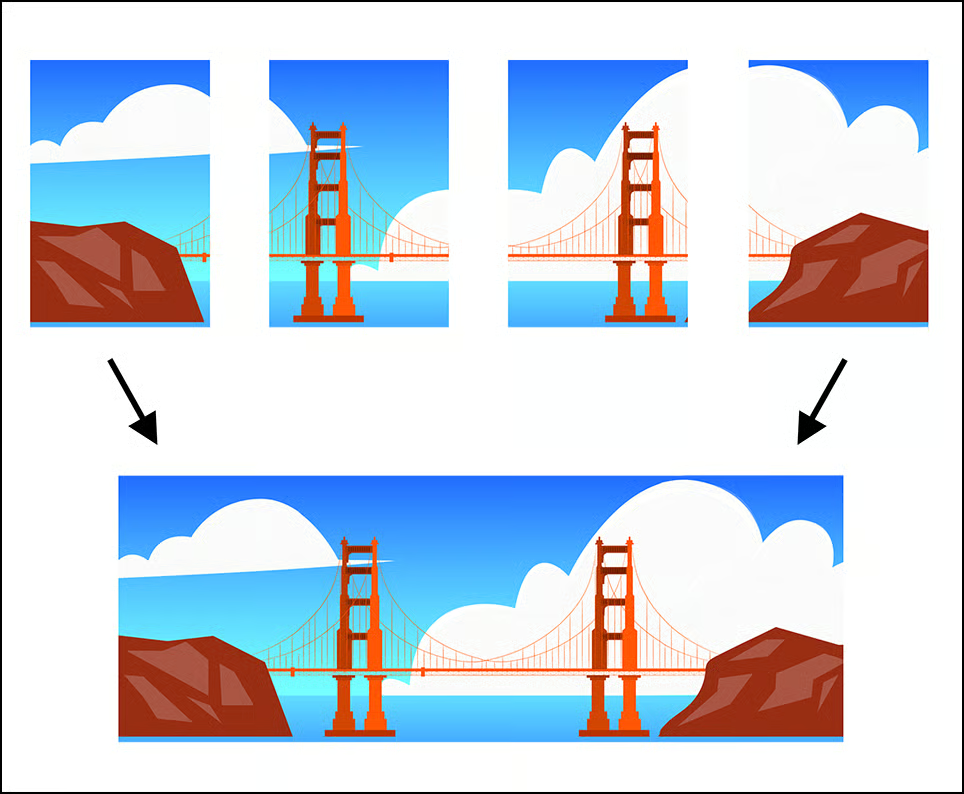
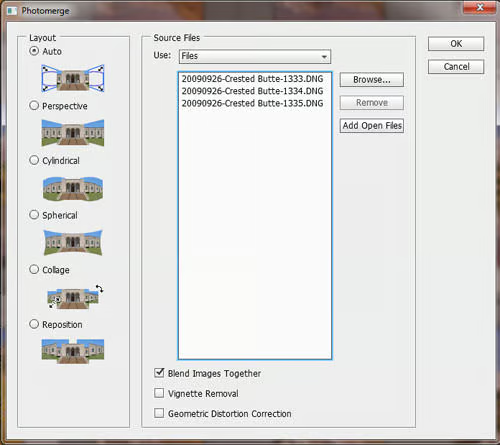
Import RAWs, apply base corrections (lens profile off or consistent if using one), and send frames to a dedicated stitcher. PTGui is an industry standard for complex multi-row rectilinear sets; Hugin is a capable open-source alternative. For rectilinear ultra‑wide panoramas, expect to use 30–40% overlap. Export as an equirectangular 2:1 image (e.g., 10000×5000 px) for VR viewers. For fundamentals from a VR perspective, see this DSLR-to-360 overview. Using a DSLR or mirrorless to shoot and stitch a 360 photo
Cleanup & Enhancement
- Nadir patch: Use a clean nadir frame; patch with a logo or clone/heal tools in Photoshop.
- Color and noise: Match white balance across rows; apply luminance noise reduction to high-ISO night scenes.
- Level horizon: Use the stitcher’s yaw/pitch/roll controls; force verticals upright for interiors.
- Output targets: Deliver 8K (7680×3840) for webVR; go 12–16K for premium tours or print-down workflows.
PTGui’s optimizer, control points editor, and masking tools are especially helpful for rectilinear UWA sets. For an in-depth review and why many pros prefer it, see this PTGui review. PTGui review on Fstoppers
Curious about spherical resolution per focal length and sensor? The Panotools wiki offers useful benchmarks for planning shot counts. DSLR spherical resolution reference
Useful Tools & Resources
Software
- PTGui panorama stitching
- Hugin (open source)
- Lightroom / Photoshop for RAW, masking, and finishing
- AI tripod/nadir removal tools (content-aware fill, generative fill)
Hardware
- Panoramic heads (Nodal Ninja, Leofoto, Sunwayfoto)
- Carbon fiber tripods (3–4 section, high torsional rigidity)
- Leveling bases and rotators with click-stops
- Wireless remotes or apps (intervalometer optional)
- Pole extensions and rated car mounts with tethers
Disclaimer: Names above are provided for reference; verify specs and compatibility on official sites.
Common Mistakes & How to Avoid Them
- Parallax error: Always align the no-parallax point for your focal length and keep it fixed during the set.
- Exposure flicker: Manual exposure and locked WB—no auto modes during a panorama pass.
- Inconsistent overlap: Use a rotator with detents and maintain 30–40% overlap horizontally and vertically.
- Tripod/nadir mess: Take a clean nadir frame; consider a nadir adapter to offset the tripod.
- High-ISO noise: Favor longer exposures over high ISO; the D750 handles ISO 800–1600 well but keep ISO low when possible.
- Wind shake: Add weight, lower the center column, and wait 1–2 seconds after rotation before releasing the shutter.
Frequently Asked Questions
-
Can I shoot handheld panoramas with the Nikon D750?
For single-row landscapes, yes. For full 360×180 with rectilinear ultra-wide lenses, handheld introduces parallax and uneven overlap. Use a tripod and panoramic head for consistent, high‑quality stitches.
-
Is the Fujifilm XF 8–16mm wide enough for a single-row 360?
No. As a rectilinear ultra-wide, it still needs multiple rows to cover zenith and nadir cleanly. Plan at least three rows (−45°, 0°, +45°) plus zenith and nadir.
-
Do I need HDR for interiors with bright windows?
Usually yes. Bracket ±2 EV (3 or 5 shots) to preserve window detail and lift interior shadows. Keep WB fixed and merge HDR per view before stitching or use exposure fusion in PTGui/Hugin.
-
How do I avoid parallax issues?
Rotate around the lens’s entrance pupil. Calibrate your panoramic head with near/far alignment and mark the rail positions for each focal length you use.
-
What ISO range is safe on the D750 in low light?
ISO 100–800 is ideal; ISO 1600 is still very usable with careful exposure and noise reduction. Go to 3200 only when shutter speed limitations force it.
-
Can I set up Custom Shooting Modes for pano on the D750?
Yes. Program U1/U2 for panorama presets (Manual exposure, fixed WB, RAW, single-point AF then MF lock, self-timer or remote). This speeds up repeatable, error-free setups.
-
What tripod head should I get?
A multi-row panoramic head with fore-aft and lateral rails (e.g., Nodal Ninja or Leofoto) allows precise entrance-pupil alignment for rectilinear ultra-wides.
-
Can I use the XF 8–16mm on the Nikon D750 with an adapter?
No practical adapter exists. Use the XF 8–16mm on a Fuji X body, or pair the D750 with a Nikon-mount ultra-wide that yields a similar FOV (e.g., 14–24/2.8 or 16–35/4).
Field Case Studies
Indoor Real Estate (Rectilinear UWA)
Camera on panoramic head, f/8, ISO 100–200, Manual exposure. Three-row capture at 12mm FF equivalent: 10 around at 0°, 8 at +45°, 8 at −45°, plus zenith and 2 nadir frames. Bracket ±2 EV. Result: clean window detail, straight verticals, minimal ghosting. Stitch in PTGui with vertical control points and exposure fusion or HDR merge before stitching.
Outdoor Sunset Overlook
Lock exposure off the bright sky to avoid blown highlights (e.g., f/8, 1/125, ISO 100). If foreground shadow detail is crucial, do a second bracketed pass. Use lens shading with your hand to minimize flare around the sun; for the D750, keep ISO low and rely on dynamic range for shadow recovery.
Event Crowd on a Rooftop
Wind and vibration are the enemies. Sandbag the tripod. Shoot a fast pass first at 1/200, f/5.6, ISO 400–800 to freeze people; then a second pass for the skyline if needed. Mask moving subjects in post to reduce ghosting.
Safety, Care, and Data Integrity
- Lens care: The XF 8–16mm’s bulbous front element is vulnerable—use the cap whenever not shooting; avoid salty spray and drizzle.
- Weather: The D750 is robust but not fully sealed; use a rain cover or umbrella in persistent moisture.
- Tethering: On rooftops/poles, always tether the camera and head; verify clamps and screws are tight between rows.
- Backup: After each location, back up to a second card or device. Keep bracketed sets and passes grouped in folders for a faster stitch.
For more background on DSLR panoramic shooting fundamentals and gear picks, this practical FAQ offers additional perspective. DSLR virtual tour FAQ and lens guide