Why This Camera & Lens Are Great for Panoramas
If you’re learning how to shoot panorama with Nikon D750 & 7Artisans 10mm f/2.8 II Fish-Eye, you’ve picked a combo that is affordable, dependable, and surprisingly capable for 360 photos. The Nikon D750 is a 24.3MP full-frame DSLR (6016×4016) with excellent base-ISO dynamic range (~14+ EV at ISO 100) and clean files up to ISO 1600–3200. Its tilting LCD, robust battery life (EN‑EL15), and reliable Live View make manual focus and exposure control straightforward in the field. The 7Artisans 10mm f/2.8 II is a diagonal fisheye built for full-frame; it’s manual focus, compact, and very wide, which means you can cover a full spherical panorama with fewer shots compared to a rectilinear lens—saving time and reducing stitch risks in dynamic environments.
Fisheye projection purposely curves lines, but 360 stitching software uses that projection to match frames, often yielding stronger control point matches and fewer blending errors than ultra-wide rectilinears. The tradeoff is edge stretching and more visible chromatic aberration or flare near strong light sources if you shoot wide open. Stopping down to f/5.6–f/8 on this lens improves sharpness and edge behavior notably. The Nikon F-mount body and this manual lens pair easily; you set aperture on the lens, focus manually, and lock exposure on the body. For creators aiming at efficient 360 capture (virtual tours, outdoor vistas, and urban scenes), this kit balances cost and performance very well.
Quick Setup Overview
- Camera: Nikon D750 — Full-frame 24.3MP CMOS; excellent base ISO DR; clean ISO 100–1600, usable 3200 in a pinch.
- Lens: 7Artisans 10mm f/2.8 II Fish-Eye — diagonal fisheye for full-frame, manual focus; best sharpness around f/5.6–f/8; can show CA near edges; hoodless front demands careful flare control.
- Estimated shots & overlap:
– Tripod 360×180: 6 around (0° tilt) at ~60° yaw increments + 1 zenith + 1 nadir (25–30% overlap).
– Minimal set for fast work: 5 around + zenith + nadir if you accept tighter overlap.
– On a pole: 6 around (tilt up +5–10°), patch nadir in post. - Difficulty: Easy–Intermediate (fisheye means fewer frames; nodal calibration still required for clean interiors).
Planning & On-Site Preparation
Evaluate Shooting Environment
Look for moving subjects (people, cars, leaves), reflective surfaces (glass, water, glossy floors), and strong light sources (sun, bulbs) that can cause flare or ghosting. If you shoot through glass, get the lens as close as safely possible (1–3 cm) and shoot perpendicular to reduce reflections; carry a flexible rubber lens hood if you can. Check for wind on rooftops or when using a pole—vibration blurs long exposures and introduces stitch misalignment. Avoid very close foreground objects unless your nodal point is dialed in; fisheye exaggerates parallax if alignment isn’t precise.
Match Gear to Scene Goals
The D750’s dynamic range at ISO 100–200 lets you preserve skies and deep shadows; for interiors with bright windows, combine that with HDR bracketing. The 7Artisans 10mm fisheye needs fewer shots, so it’s ideal when you have moving crowds or minimal setup time. Indoors, distortion is not a problem in spherical panos, but precise nodal alignment is crucial to avoid parallax in near objects. For low light, the D750 is comfortable at ISO 400–800 on a tripod with longer shutter speeds; when you must freeze motion outdoors at dusk, ISO 1600–3200 is still very workable in RAW with careful noise reduction.
Pre-shoot Checklist
- Power and storage: Fully charged EN‑EL15, fast cards; consider dual cards for backup via overflow or duplicate capture.
- Optics: Clean lens and sensor; fisheyes amplify dust spots in sky and flat walls.
- Tripod leveling and pano head: Calibrate nodal point beforehand; pack a small bubble level or leveling base.
- Safety: Tether gear on rooftops/poles; watch wind gusts; avoid over-reaching to “get the shot.”
- Backup workflow: Shoot a second safety set (especially interiors); it costs minutes and can save a delivery.
Essential Gear & Setup
Core Gear
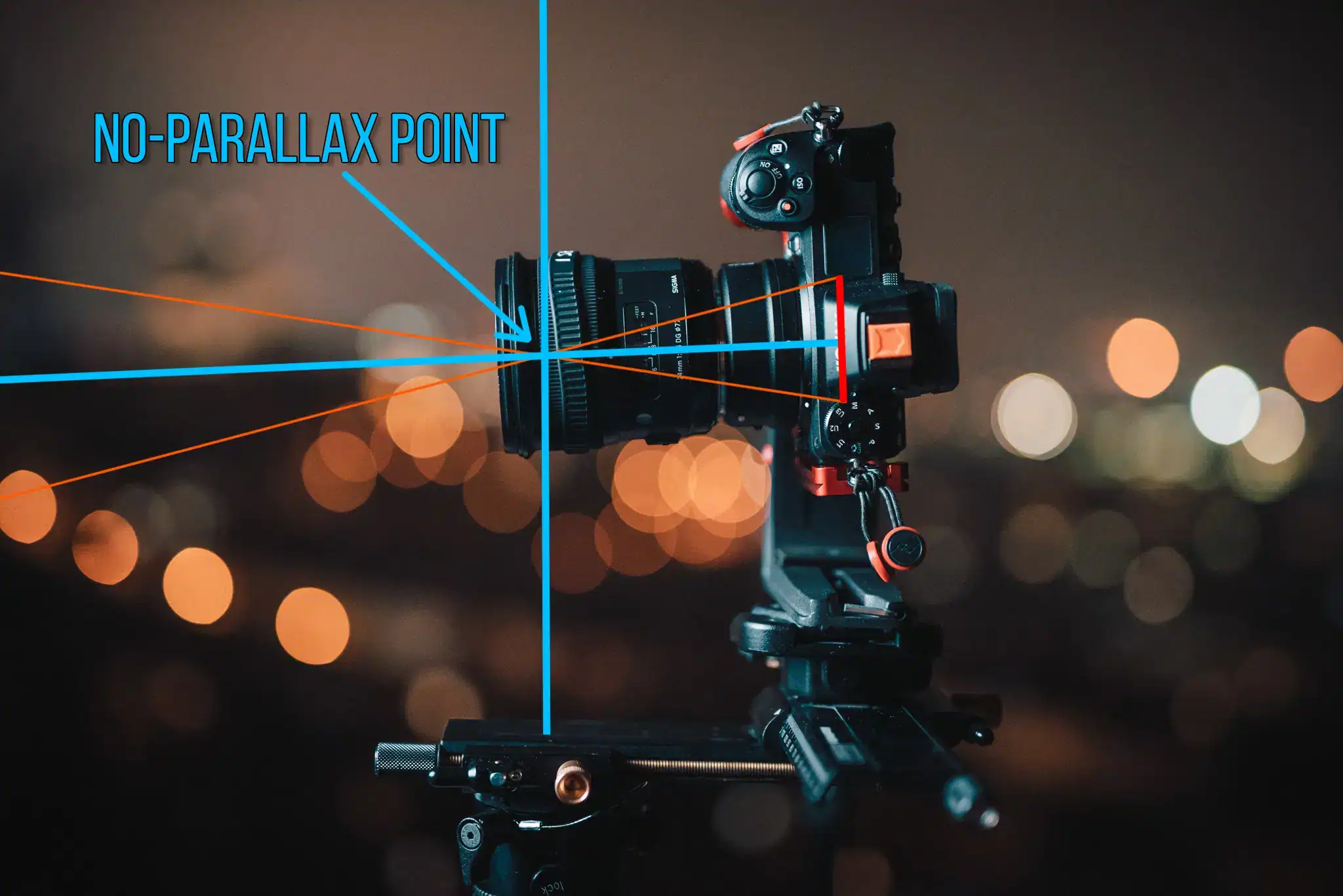
- Panoramic head: A proper panoramic head lets you rotate around the lens’s no-parallax (nodal) point, eliminating parallax errors so stitching software can align frames perfectly. Calibrate once and mark your rails for repeatable setup.
- Stable tripod with leveling base: Leveling the base means your yaw increments stay even, which simplifies stitching and horizon leveling later.
- Remote trigger or app: Use a cable release or self-timer/Exposure Delay Mode to avoid vibration. The D750’s mirror lock-up or Exposure Delay helps further reduce shake.
Optional Add-ons
- Pole or car mount: Great for over-crowd views or vehicle-based capture. Always use a safety tether, watch wind load, and avoid high speeds. Longer poles magnify vibration—use faster shutters.
- Lighting aids: Small LED panels can lift shadows in dark interiors without changing color temperature too much. Keep lighting consistent frame-to-frame.
- Weather protection: Rain covers and microfiber cloths for sudden drizzle; fisheyes are prone to droplets across a huge FOV.
Recommended Deep Dive
For a clear visual demo on panoramic head setup, watch the video below. It reinforces the concepts of leveling, nodal alignment, and shot sequencing you’ll use with the D750 and 10mm fisheye.
Step-by-Step Shooting Guide
Standard Static Scenes
- Level tripod and align nodal point: Use your leveling base, then set the panoramic head so that rotation stays level. Start with a typical fisheye nodal offset (often ~60–70 mm from the sensor plane for diagonal fisheyes) and fine-tune by aligning near/far objects while panning. Mark your rails for the D750 + 7Artisans combo once dialed in.
- Manual exposure and locked white balance: Switch to M mode. Meter the brightest part you need to retain (e.g., sky) and set exposure to protect highlights while keeping shadows recoverable in RAW. Set WB to Daylight/Kelvin value (e.g., 5600K outdoors) or a custom preset to keep color consistent across frames.
- Focus: Use Live View at maximum magnification, focus around 0.8–1 m, then stop down to f/8. This approximates hyperfocal coverage with a 10mm fisheye on full-frame, keeping near to infinity acceptably sharp.
- Capture sequence: For maximum safety, shoot 6 around at 60° yaw intervals with ~30% overlap, then 1 zenith (+90° tilt) and 1 nadir (–90°). Use exposure delay or a remote to prevent vibration.
- Nadir options: If a clean nadir is hard to shoot (tripod in the way), take a handheld nadir shot after rotating the rig aside, or plan to patch the tripod in post.
HDR / High Dynamic Range Interiors
- Bracket ±2 EV: The D750’s BKT button makes 3–5–7 frame brackets easy. For interiors with bright windows, 5 or 7 frames at 2 EV spacing balances lamps, walls, and exterior highlights.
- Keep WB locked: Avoid automatic WB shifts across brackets; set a fixed Kelvin or preset to ensure consistent color blending.
- Drive mode: Use continuous high and a remote; one press captures the full bracket set per angle. Consider Exposure Delay Mode if not using mirror-up.
- Time budgeting: HDR multiplies frames; budget extra time and watch for moving people that can cause ghosting.
Low-Light / Night Scenes
- Stabilize and lengthen: On a tripod, use ISO 100–400 whenever possible and extend shutter speed to 2–8 seconds. The D750 files remain very clean at low ISO with long exposures.
- Noise management: Consider Long Exposure NR if you’re not bracketing; otherwise, do noise reduction in post to avoid doubling your capture time.
- Avoid stabilization confusion: The D750 body has no IBIS and the 7Artisans lens has no VR, so vibration control is purely mechanical—tripod, remote, and exposure delay.
Crowded Events
- Two-pass strategy: First pass captures the environment; second pass waits for gaps or cleaner subjects.
- Freeze motion: If you need to stop blur, aim for 1/200–1/500 at ISO 800–1600. Accept some noise; it’s easier to reduce noise than fix motion-blur ghosts.
- Masking later: Plan to blend or mask moving people in post using layers or PTGui’s masking tools.
Special Setups (Pole / Car / Drone)
- Pole work: Keep yaw increments steady; tilt up 5–10° to ensure zenith coverage. Use a safety tether and watch wind. Shutter speed should be kept higher (1/250+) to reduce pole sway blur.
- Car mount: Mount low for stability, add safety lines, and shoot when the car is stationary. Avoid traffic hazards and legal risks.
- Drone: The D750 is not a drone payload; for aerials, use a drone-integrated camera and stitch separately.
Field-Proven Mini Case Studies
Indoor real estate
Tripod, pano head, f/8, ISO 100, 5–7 frame brackets at ±2 EV per angle. Watch for mirrors and glass; stand back from glass panes and shoot perpendicular to minimize reflections.
Outdoor sunset
Expose for the sky at ISO 100–200, f/8. You can bracket 3 frames to retain shadow detail. Angle away from the sun to reduce fisheye flare; shield with your hand just outside the frame if needed.
Event crowds
Single-exposure workflow (no HDR) with ISO 800–1600, f/5.6–f/8, and 1/200+. Capture two passes and mask later to manage movement.
Rooftop pole
Short pole extension, 6 around only, faster shutter (1/250–1/500), and a safety tether. Patch nadir in post.
Recommended Settings & Pro Tips
Exposure & Focus
| Scenario | Aperture | Shutter | ISO | Notes |
|---|---|---|---|---|
| Daylight outdoor | f/8–f/11 | 1/100–1/250 | 100–200 | Lock WB (Daylight or 5600K) |
| Low light/night | f/4–f/5.6 | 1/30–8s (tripod) | 100–800 | Use Exposure Delay Mode or remote |
| Interior HDR | f/8 | Bracket ±2 EV | 100–400 | Balance windows and interior lights |
| Action / moving subjects | f/5.6–f/8 | 1/200+ | 400–1600 | Two-pass capture, mask later |
Critical Tips
- Manual focus near hyperfocal: With 10mm at f/8, focusing around ~1 m yields near-to-infinity sharpness. Always check at 100% in Live View.
- Nodal calibration: Start around a 60–70 mm rearward offset from the sensor plane mark and fine-tune with near/far objects. Mark the rail positions once perfected for this body/lens.
- White balance lock: Avoid AWB shifts between frames; choose Kelvin or custom preset to prevent color seams.
- RAW capture: Always shoot RAW for dynamic range and color flexibility, especially with HDR and mixed lighting.
- Mirror/shutter control: Use Exposure Delay Mode (1–3 s) or mirror-up with a remote to minimize micro-shake.
Stitching & Post-Processing
Software Workflow
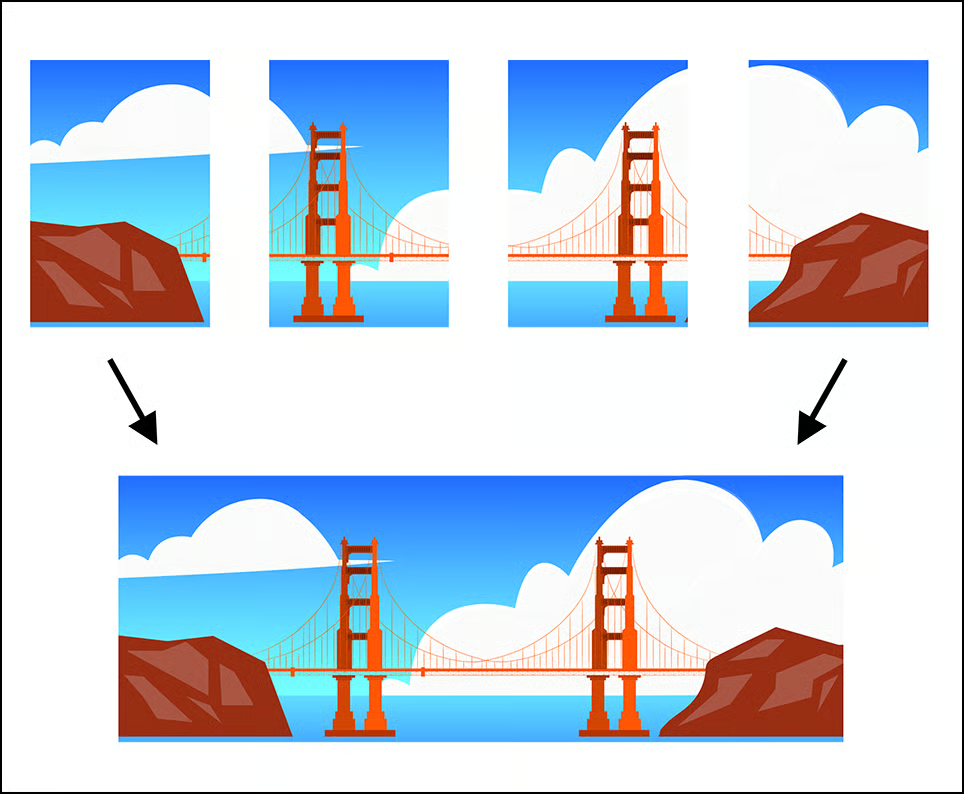
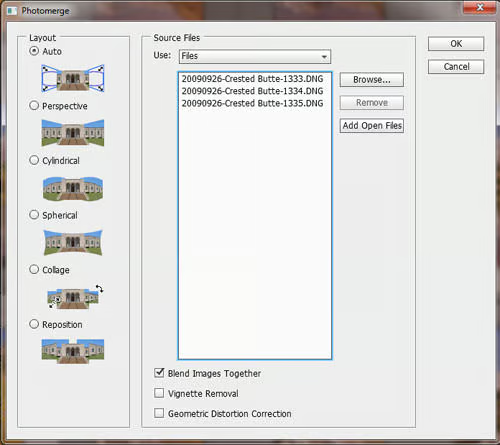
Import RAWs and apply basic global corrections first (lens CA reduction, a touch of noise reduction, consistent WB). Then stitch with PTGui or Hugin. Fisheye frames are usually easier to align and require fewer shots, but be mindful of flare and edge CA. For fisheyes, 25–30% overlap is a good target; for rectilinear shots, 20–25% overlap is common. PTGui’s template-based workflow and masking tools make it popular for fast, reliable 360 projects. For an in‑depth review of PTGui’s strengths, see this hands-on overview from Fstoppers at the end of this paragraph. PTGui reviewed for professional panoramas.
Cleanup & Enhancement
- Nadir patch: Clone out the tripod or use AI fill tools to patch the ground. Capture a clean handheld nadir tile if time allows.
- Color consistency: Balance room temperature (e.g., tungsten) and daylight spill by setting a unified WB before stitching. Fine-tune HSL globally after stitching.
- Noise control: Apply luminance NR moderately; fisheye edges can accentuate noise if underexposed. Consider local NR on shadow corners
- Leveling: Use the software’s horizon tool and optimize roll/yaw/pitch so the virtual horizon is accurate in VR viewers.
- Export: For VR platforms, export a 2:1 equirectangular at 8K–12K on a 24MP body (8K is a common balance between detail and file size). Keep a 16‑bit master TIFF for archiving.
For general shooting and stitching guidance with DSLRs, Oculus’s creator documentation is a reliable resource for standards and best practices. Using a DSLR to shoot and stitch a 360 photo. For nodal head fundamentals across gear, this tutorial is a solid reference: Panoramic head setup basics.
Useful Tools & Resources
Software
- PTGui panorama stitching
- Hugin open source
- Lightroom / Photoshop for RAW prep and retouching
- AI tripod/nadir removal tools
Hardware
- Panoramic heads (Nodal Ninja, Leofoto) with fore-aft and lateral rails
- Carbon fiber tripods to reduce vibration and weight
- Leveling bases (half-ball or compact plate)
- Wireless remote shutters/cable releases
- Pole extensions / car mounts with safety tethers
Disclaimer: software and hardware names are for search reference; confirm latest features and compatibility on official sites.
Common Mistakes & How to Avoid Them
- Parallax error: Always align the lens’s no-parallax point with the rotation axis; don’t pan from a non-calibrated ball head.
- Exposure flicker: Manual mode and locked WB prevent brightness and color shifts frame-to-frame.
- Tripod shadows and footprints: Capture or patch the nadir tile.
- Ghosting from movement: Use faster shutters where possible and mask moving subjects in post.
- Night noise and blur: Keep ISO low on a tripod, extend shutter times, and use a remote and exposure delay to avoid shake.
Frequently Asked Questions
-
Can I shoot handheld panoramas with the Nikon D750?
Yes for quick 180s or multi-row landscapes, but for 360×180 spheres, a tripod and pano head are strongly recommended. Handheld fisheye panos often suffer from parallax and uneven horizons, especially indoors with close objects.
-
Is the 7Artisans 10mm f/2.8 II wide enough for single-row 360?
For full spherical coverage, plan 6 around + zenith + nadir. In some outdoor cases, 5 around + zenith can work, but overlap gets tight. For consistent professional results, stick to 6+2.
-
Do I need HDR for interiors with bright windows?
Usually yes. The D750 has great dynamic range, but windows can be 8–12 stops brighter. Bracket 5–7 frames at ±2 EV, then merge in PTGui or pre-merge to 32‑bit before stitching.
-
How do I avoid parallax issues with this lens?
Use a panoramic head, set the rail so rotation occurs around the lens’s no‑parallax point, and verify by aligning a near object against a distant one while panning. Fine-tune until there’s no relative shift. Mark your rail once calibrated.
-
What ISO range is safe on the D750 in low light?
On a tripod for static scenes, favor ISO 100–400 with longer exposures. For handheld or action, ISO 800–1600 is typically clean; ISO 3200 is usable with careful noise reduction in RAW.
Further Reading and Useful References
Want to compare resolution outcomes based on lens and shot count? The PanoTools Wiki has an excellent primer on spherical resolution planning. Estimating spherical resolution.
For broader planning of DSLR 360 workflows, including lens choices and shot strategies, this practical FAQ is worth a read. DSLR virtual tour FAQ and guide.
Safety, Limitations, and Backup Workflow
On rooftops or poles, a safety tether is non-negotiable. In wind, lower your pole height, increase shutter speed, and reduce your time aloft. Avoid mounting over crowds or traffic. The D750 lacks in-body stabilization; with this manual fisheye there’s no VR—your stability depends entirely on support and technique.
Honest limitations: the 7Artisans 10mm f/2.8 II can show edge CA and flare with strong point lights. Stop down to f/5.6–f/8 and frame to keep the sun or lamps from striking the front element directly. If interiors have complex close objects, parallax demands precise nodal alignment—budget time to calibrate properly before paid shoots.
Backup workflow: capture a second full set, especially for HDR interiors. Keep redundant cards and back up to a portable SSD on-site. Maintain a stitched low-res “contact sheet” when you return so you can quickly verify coverage before delivering finals.