
Why This Camera & Lens Are Great for Panoramas
If you’re researching how to shoot panorama with Hasselblad X1D-50c & Sony FE 16-35mm f/2.8 GM, you’re chasing image quality and control—and that’s a smart goal. The Hasselblad X1D-50c uses a 50MP 43.8×32.9 mm medium-format sensor with large ~5.3 μm pixels, excellent color (up to 16-bit workflow) and roughly 14 stops of dynamic range at base ISO. Colors are clean, roll-off is gentle, and with leaf shutters in XCD lenses you get vibration-free exposures and full flash sync up to 1/2000s—great for interior work.
Meanwhile, the Sony FE 16–35mm f/2.8 GM is one of the sharpest rectilinear ultrawides on full-frame. It’s contrasty, controls coma well, and stays sharp across the frame by f/5.6–f/8—prime territory for stitching. As a rectilinear zoom, it avoids fisheye curvature, though it does require more frames than a fisheye for full 360° coverage.
Important compatibility note: the FE 16–35mm GM (Sony E-mount) does not mount to the X1D-50c (Hasselblad XCD mount), and the X1D relies on in-lens leaf shutters for exposure. There is no practical adapter path. The workable approaches are: (A) shoot your 360° on the X1D with a native XCD wide (e.g., 21/30/45 mm) that matches the FE 16–35’s fields of view, or (B) shoot with the FE 16–35 on a Sony full-frame body and use the same panoramic workflow. This guide covers both paths, with focal length equivalence so you can translate settings and shot counts seamlessly.
Quick Setup Overview
- Camera: Hasselblad X1D-50c — 43.8×32.9 mm CMOS (“44×33 mm” class), 50MP (8272×6200), ~5.3 μm pixels, ~14 stops DR, ISO 100–25600 (best 100–800), no IBIS, leaf-shutter operation via XCD lenses (sync to 1/2000s).
- Lens: Sony FE 16–35mm f/2.8 GM — rectilinear ultrawide zoom, extremely sharp by f/5.6–f/8, low CA and distortion (correctable), no optical stabilization (relies on body IBIS when present). Note: not mountable on X1D; use on Sony full-frame body or use XCD 21/30/45 mm on X1D for equivalent FOV.
- Estimated shots & overlap (tested, rectilinear):
- On full-frame at 16 mm: 2 rows × 8 around (±35–45° pitch) + zenith + nadir ≈ 18–20 shots (30% overlap). Safer option: 3 rows × 8 around + Z/N ≈ 26–28 shots.
- On full-frame at 24 mm: 3 rows × 12 around + Z/N ≈ 38 shots.
- On full-frame at 35 mm: 3 rows × 16 around + Z/N ≈ 50+ shots.
- X1D equivalents: XCD 21 ≈ FF 17 mm; XCD 30 ≈ FF 24 mm; XCD 45 ≈ FF 35 mm. Use the corresponding shot plans above.
- Difficulty: Intermediate (requires nodal alignment and consistent manual exposure).
Planning & On-Site Preparation
Evaluate Shooting Environment
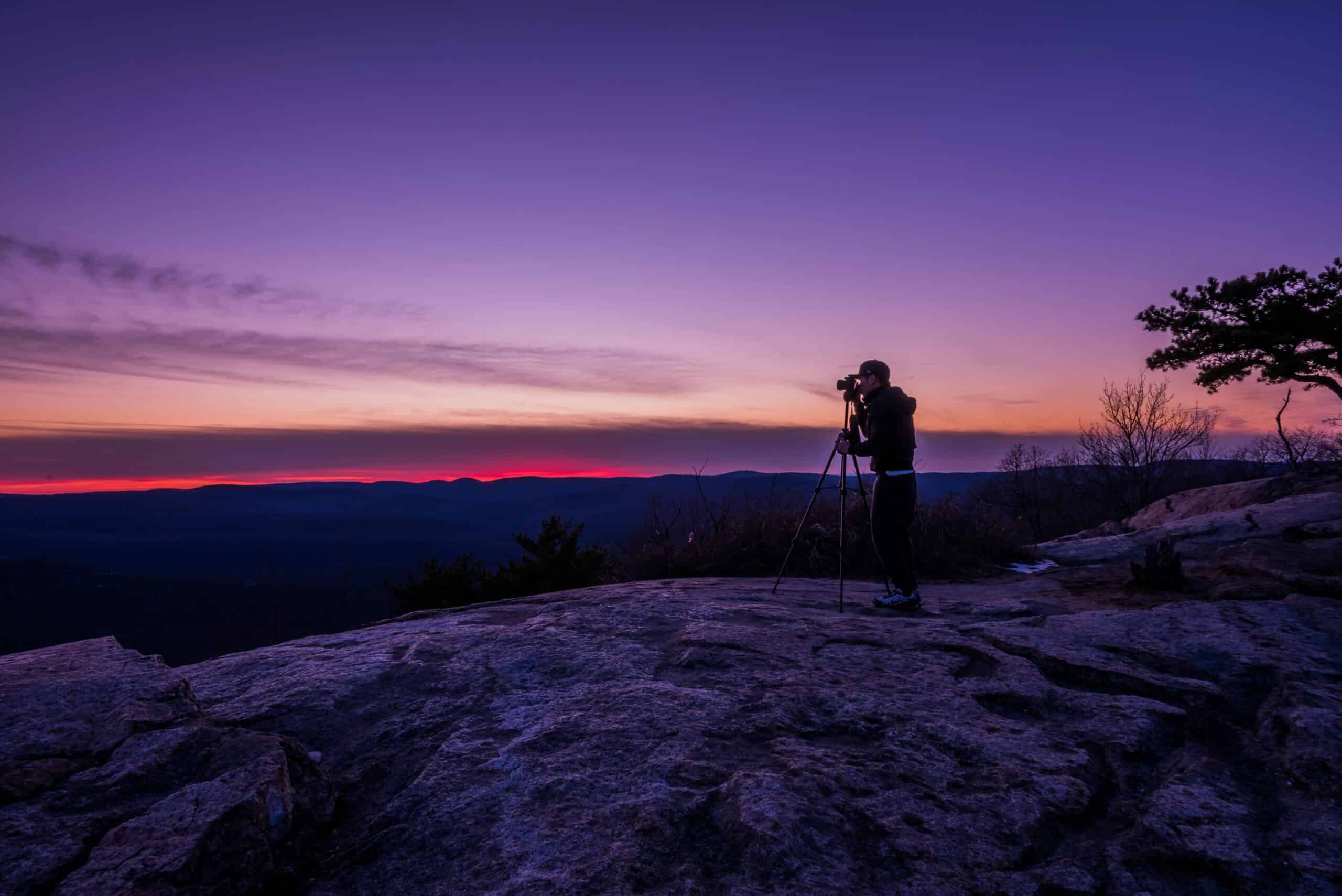
Walk the space first. Note sun direction, reflections (glass, polished floors), and moving subjects (people, cars, foliage). For glass, get the front element as close as possible and shade with a rubber lens hood or a dark cloth. Angle the camera slightly off-axis from direct lights to reduce flare. Indoors, turn off flickering light sources (mixed-frequency LEDs) if possible.
Match Gear to Scene Goals
Why the X1D-50c shines: dynamic range and color. In interiors, you can comfortably bracket at base ISO and recover highlights from windows without banding. Safe ISO on the X1D is 100–400 for critical work; 800 is still clean; above that, noise and color fidelity begin to drop for large VR outputs. If you’re using the Sony FE 16–35mm GM on a Sony body, you’ll enjoy fewer frames at 16–20 mm and fast AF. Rectilinear lenses demand more shots than fisheyes but keep straight lines straight—ideal for architecture and real estate.
Pre-shoot Checklist
- Power and storage: fully charged batteries, ample cards. X1D files are large; plan buffer clears and write speed.
- Clean optics: thoroughly clean lens and sensor. Dust is far more visible in sky and uniform walls across many frames.
- Tripod & panoramic head: level the tripod, check clamp tightness, confirm nodal alignment marks for your focal length.
- Scene safety: assess wind, rooftop edges, crowd flow, and vehicle movement. Use a safety tether for pole/car mounts.
- Backup workflow: when the light is changing quickly, shoot a second safety round or a faster “lower quality” pass to ensure you get something stitchable.
Essential Gear & Setup
Core Gear
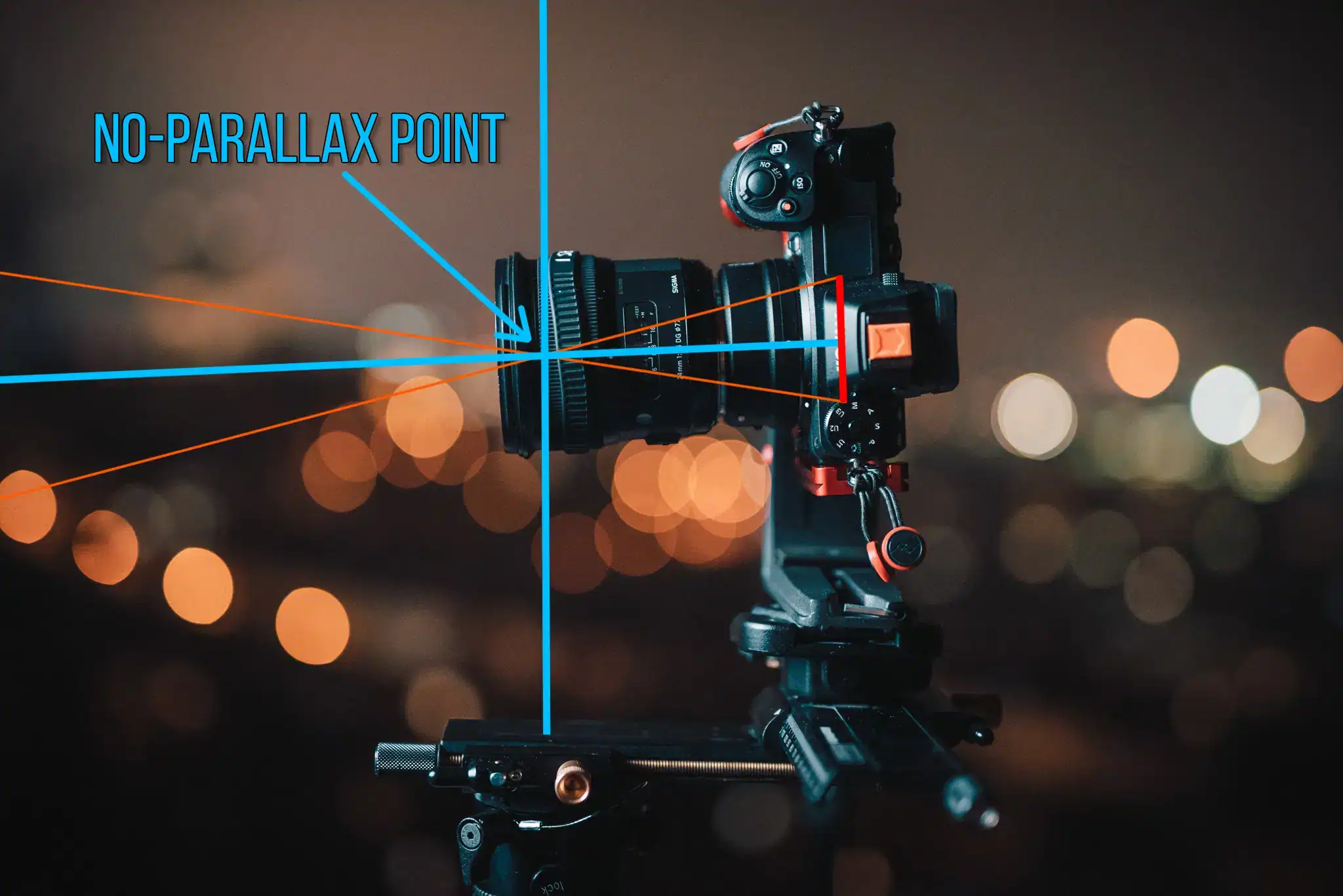
- Panoramic head: a rotator with click-stops and fore–aft slide to align the nodal point (no-parallax point). Nodal alignment eliminates foreground/background shift while rotating, which is critical for clean stitches.
- Stable tripod with leveling base: a leveling base speeds setup and keeps your horizon true. Carbon fiber reduces vibrations.
- Remote trigger/app: use a cable release or app (Hasselblad Phocus Mobile / Sony Imaging Edge) to avoid touching the camera. A 2s timer also works.
Optional Add-ons
- Pole or car mount: great for elevated or moving vistas. Always use a safety tether, keep speeds low, and watch wind load. Avoid long exposures on moving platforms.
- Lighting aids: small LED panels or bounced flash (leaf-shutter advantage!) help balance interior brightness. Flag to prevent reflections.
- Weather protection: rain covers, microfiber cloths, and silica packs. Wet optics kill contrast and stitching consistency.
For a deeper primer on panoramic heads and alignment, see this practical walkthrough on panoramic head setup. Panoramic head tutorial (360 Rumors)
Step-by-Step Shooting Guide
Standard Static Scenes
- Level and align: level the tripod with the base, not the camera. Slide the camera on the pano head until the entrance pupil sits over the pivot. Test by placing a near and far object in frame and rotating—if their relative position doesn’t shift, you’re aligned.
- Manual exposure and white balance: set M mode, choose a mid-tone in the scene to meter, then lock exposure. Set a fixed WB (Daylight/Tungsten/Kelvin). Consistency avoids banding and color seams.
- Focus and aperture: use manual focus at the hyperfocal distance. On the X1D/XCD or Sony FE 16–35mm, f/8 is a sweet spot for sharpness and depth of field (consider f/11 outdoors for maximum corner detail).
- Capture with overlap: for 16–20 mm rectilinear, shoot 2 rows × 8 around (±35–45° pitch), then a zenith and a nadir. Prefer 30% overlap horizontally and 25–30% vertically. If architecture is critical, add a third row at 0° pitch for belt-and-suspenders coverage.
- Take the nadir: after the main set, tilt down and shoot a ground plate for tripod removal. If possible, move the tripod aside and shoot a clean patch frame from the same nodal position.
HDR / High Dynamic Range Interiors
- Bracket ±2 EV (3–5 frames): window highlights vs. interior shadows often exceed 12–14 stops. Bracketing each pano position ensures clean recovery. On X1D, stay around ISO 100–200 for best color depth.
- Lock WB and disable auto features: keep WB fixed; turn off any auto lighting optimizer or DRO-like processing so brackets match.
- Shoot order: for each position, fire through your bracket, then rotate. Consistency per yaw step keeps batch processing simple.
Low-Light / Night Scenes
- Prefer longer shutter over high ISO: with the X1D, ISO 100–400 delivers the cleanest pano tiles; 800 is still workable. Use 1–4 s exposures if needed—leaf shutters are very low vibration, but still use a remote.
- Turn off stabilization when on a tripod: the FE 16–35 GM has no OSS; if you’re on a Sony body with IBIS, disable IBIS to avoid micro-blur from stabilization drift during long exposures.
- Use a wind strategy: weigh your tripod, shoot shielded angles first, and consider shorter exposures with more frames if gusts are strong.
Crowded Events
- Two-pass method: complete a fast rotation for your base stitch, then a second pass where you wait for gaps in the crowd to cleanly capture key areas.
- Mask in post: in PTGui/Hugin, mask people where they overlap frames to prevent ghosts. Keep your nodal alignment perfect—parallax plus moving subjects is a recipe for headaches.
Special Setups (Pole / Car / Drone)
- Secure and tether: on poles, keep the rig’s center of gravity over the shaft and always tether. On vehicles, mount low, minimize speed, and avoid long exposures.
- Reduce rotation speed: rotate slower to allow vibrations to settle before each shot. Use higher shutter speeds (1/250–1/500) to combat oscillation, even if that means higher ISO (up to 800 on X1D, 1600 on many Sony bodies).
- Accept partial coverage: elevated poles often don’t allow perfect zenith/nadir. Plan to patch creatively in post with a clean plate shot from ground level.
Recommended Settings & Pro Tips
Exposure & Focus
| Scenario | Aperture | Shutter | ISO | Notes |
|---|---|---|---|---|
| Daylight outdoor | f/8–f/11 | 1/100–1/250 | 100–200 | Lock WB (Daylight). Prioritize sharp corners for architecture. |
| Low light / night | f/4–f/5.6 | 1/4–1/30 | 100–800 (X1D), 100–1600 (Sony) | Tripod + remote; disable IBIS on tripod. Favor longer shutters over high ISO on X1D. |
| Interior HDR | f/8 | Bracket ±2 EV (3–5 frames) | 100–400 | Balance windows and lamps. Keep WB fixed for each bracket. |
| Action / crowds | f/5.6–f/8 | 1/200+ | 400–800 | Freeze motion, do two-pass strategy for clean stitching. |
Critical Tips
- Manual focus at hyperfocal: focus once and tape the ring if needed. On X1D, use magnified live view; on Sony, use focus peaking + magnify.
- Nodal alignment: place a light stand close to the lens and a distant object behind it. Rotate and adjust fore–aft on the rail until the near object stays centered relative to the far object through the rotation.
- White balance lock: mixed lighting (tungsten + daylight + LEDs) can vary across angles. Fix WB at a Kelvin value to avoid color seams.
- RAW over JPEG: medium-format RAW from the X1D provides latitude for blending HDR and color matching across the set. JPEGs limit stitching recovery.
- Stabilization: no IBIS on X1D; if you’re using a Sony body with the FE 16–35 GM, turn IBIS off on tripod to avoid micro-oscillation blur.
Stitching & Post-Processing
Software Workflow
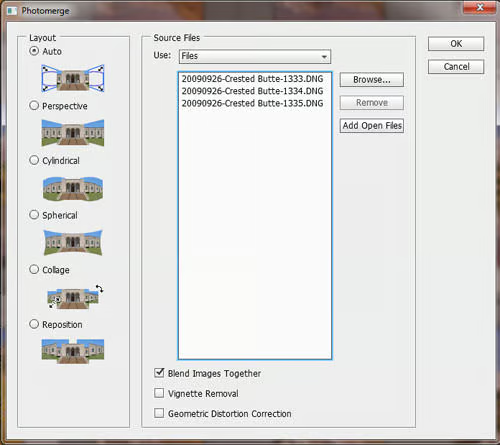
For rectilinear ultrawide sets, PTGui excels with multi-row control points and masking; Hugin is an excellent free alternative. Import your tiles, set lens type to rectilinear, specify focal length and sensor size, then run alignment. Aim for ~30% overlap horizontally and 25–30% vertically. Rectilinear lenses need more images than fisheyes, but reward you with straight architecture and minimal defishing artifacts. For a detailed overview of panorama stitching options and trade-offs, see this review of PTGui. PTGui reviewed by Fstoppers
If you’re new to panoramic head setup and shooting technique, this step-by-step video will help you visualize the process before you stitch:
Cleanup & Enhancement
- Tripod/nadir patch: export a layered panorama (TIFF/PSD) and clone out the tripod, or use an AI nadir patch in your 360 publisher.
- Color and noise: match white balance for consistency. Apply noise reduction only after stitching (luminance first, then chroma).
- Leveling: use horizon leveling tools (roll/yaw/pitch) to ensure a comfortable viewing experience in VR.
- Export: for VR platforms, export equirectangular JPEG/TIFF at 8K–16K on rectilinear-based sets. X1D-50c source files can support very high-resolution gigapixel stitches when using longer focal lengths.
For platform-specific recommendations (file size, projection, metadata), Oculus provides a solid overview. Using a DSLR or mirrorless to shoot and stitch a 360 photo (Oculus)
Useful Tools & Resources
Software
- PTGui panorama stitching
- Hugin (open source) panorama stitcher
- Lightroom / Photoshop for RAW development and patching
- AI tripod removal tools (various plugins)
Hardware
- Panoramic heads: Nodal Ninja, Leofoto
- Carbon fiber tripods with leveling bases
- Wireless remote shutters
- Pole extensions and car mounts (with safety tethers)
Disclaimer: software/hardware names provided for search reference; check official sites for details.
For a practical comparison of focal lengths and their panorama coverage, this guide is a concise reference. Panoramas, focal lengths, and coverage (B&H Explora)
Common Mistakes & How to Avoid Them
- Parallax error → ensure nodal point alignment before you begin. Re-check if you change focal length.
- Exposure flicker → use manual exposure and a fixed WB. Avoid auto ISO and auto WB.
- Tripod shadows / footprints → shoot a nadir plate or patch later with a clean ground shot.
- Ghosting from moving subjects → two-pass method and masking in PTGui/Hugin.
- Noise at night → keep ISO low on the X1D (100–800), use longer shutters, and shield against wind.
- Rushing rotation → wait for vibrations to settle after each tilt/pan movement, especially on poles or decks.
Frequently Asked Questions
- Can I physically shoot handheld panoramas with the X1D-50c?
Yes for simple single-row pans, but for 360×180 VR spheres it’s risky. The X1D’s strengths (dynamic range, color) shine on a tripod with a panoramic head and locked settings. Handheld is fine for quick stitches outdoors with generous overlap, but expect compromises and occasional alignment errors.
- Is the Sony FE 16–35mm f/2.8 GM wide enough for single-row 360?
No. At 16 mm rectilinear, you need at least two rows around plus zenith and nadir for full spherical coverage. A fisheye (e.g., 8–12 mm on full-frame) can cover with far fewer frames, but rectilinear keeps lines straighter for architecture.
- Do I need HDR for interiors with bright windows?
Usually yes. Bracket ±2 EV (3–5 frames) at each pano position to retain window detail and clean shadows. The X1D’s DR helps, but window daylight can exceed 14 stops. Merge brackets either before stitching (per-angle HDR) or use PTGui’s exposure fusion.
- How do I avoid parallax issues?
Align the entrance pupil (no-parallax point) of your lens over the rotation axis. Use a nodal rail and a simple near/far object test. Recalibrate whenever you change focal lengths (16/24/35 mm positions on the FE zoom each have different nodal offsets).
- What ISO range is safe on the X1D-50c in low light?
ISO 100–400 is optimal; 800 remains very usable for large outputs. Avoid pushing beyond 1600 unless necessary; prefer longer exposures on a solid tripod to preserve color depth and micro-contrast.
- Can I set custom modes to speed pano setup?
The X1D line doesn’t use C1/C2/C3 modes like some DSLRs, but you can save user profiles. On Sony bodies, create custom modes for “Pano Daylight” and “Pano HDR” with manual exposure, fixed WB, single AF then manual focus, 2s timer, and RAW capture.
- What’s the best tripod head for this setup?
A two-axis panoramic head with fore–aft and lateral rails (e.g., Nodal Ninja, Leofoto) lets you precisely align the nodal point for any focal length on the FE 16–35 or XCD equivalents. Add a leveling base for quick setup.
- Can I mount the FE 16–35 GM on the X1D-50c?
No. The mounts are mechanically and electronically incompatible, and the X1D relies on leaf shutters in XCD lenses. Use the FE 16–35 on a Sony body, or choose native XCD wides (21/30/45 mm) on the X1D; the technique and shot plans remain the same.
Field-Proven Use Cases
Indoor Real Estate (X1D + XCD 30 ≈ FF 24 mm)
Bracket 5 frames at ±2 EV, f/8, ISO 100–200. Shoot 3 rows × 12 around + Z/N. Leaf-shutter flash at 1/500–1/1000s can subtly lift dark corners. Watch reflections—angle off windows and use a rubber hood against glass.
Outdoor Sunset (Sony + FE 16–35 at 16 mm)
Two rows × 8 around + Z/N, f/8, 1/100, ISO 100–200. Meter for mid-tones, then bracket ±2 EV if the sun is in frame. Start with the sunward sector first as light changes fastest there.
Crowded Event or Market
Pre-plan blocking with pillars or signage to hide tripod legs. Shoot a fast base set (short shutter, ISO 400–800), then a second pass for clean plates of key areas. Mask moving people later in PTGui.
Safety, Limitations & Backup Workflow
Wind is your main enemy—add a weight under the tripod, lower your center column, and keep your rig compact. On rooftops or poles, tether everything. In traffic or crowds, have an assistant watch your back. The limitation of this exact camera/lens pairing is compatibility: the FE 16–35 GM cannot be used on the X1D-50c. If you must use that lens, pair it with a Sony full-frame body; otherwise, choose XCD wides on the X1D. Always shoot a safety round (even at slightly higher ISO) so you can deliver a stitch if the ideal set fails.
If you want a structured technique refresher that complements this guide, this practical Q&A thread remains helpful. Best techniques to take 360 panoramas (Photo.SE)