
Why This Camera & Lens Are Great for Panoramas
The Hasselblad X1D-50c is a 50 MP medium-format mirrorless camera with a 44×33 mm sensor, large 5.3 µm–class pixels, 16-bit color, and roughly 14 stops of dynamic range at base ISO. In practical panoramic work, that translates into cleaner gradients in skies, smoother tonality in interiors, and excellent highlight recovery when you bracket for HDR panoramas. The Sony FE 12–24mm f/4 G is an ultra‑wide rectilinear zoom known for its sharpness across the frame, well‑controlled distortion for its class, and manageable lateral CA. It’s widely used by landscape and architecture shooters who favor rectilinear rendering over fisheye curvature.
Important compatibility note for trustworthiness: the Sony FE 12–24mm f/4 G is a Sony E‑mount lens and does not natively mount to the Hasselblad X1D. There is currently no practical adapter that preserves electronic aperture control and provides full image circle coverage for the X1D’s 44×33 mm sensor. If you came here specifically for “how to shoot panorama with Hasselblad X1D‑50c & Sony FE 12–24mm f/4 G,” treat the FE 12–24mm as your field‑of‑view benchmark. On the X1D, a native XCD 21mm f/4 delivers a similar wide rectilinear perspective (though not as extreme as 12mm FF), and is the recommended option for high‑quality, low‑distortion panoramic capture on this body. If you must adapt 35mm SLR lenses, test coverage and control (aperture, vignetting) carefully before client work.
Bottom line: the X1D-50c provides superb tonal latitude and color depth—ideal for stitching—and a native wide rectilinear like the XCD 21mm f/4, XCD 25V, or XCD 30mm f/3.5 will slot in where the Sony 12–24mm would on a full-frame system. The techniques below focus on medium-format panoramic best practices with a rectilinear ultra-wide field of view, so you can achieve the results you want with the X1D and an appropriate lens choice.
Quick Setup Overview
- Camera: Hasselblad X1D‑50c — 44×33 mm medium‑format sensor, ~50 MP, 16‑bit color, ~14 EV dynamic range at ISO 100, excellent highlight latitude and very clean ISO 100–400 files.
- Lens (conceptual FOV reference): Sony FE 12–24mm f/4 G — rectilinear ultra‑wide zoom, sharp wide open, mild complex (moustache) distortion at the wide end, moderate lateral CA; not natively compatible with X1D. XCD 21mm f/4 is the closest native analog for panoramic workflow.
- Estimated shots & overlap (rectilinear on 44×33):
- With XCD 21mm f/4: 6 shots around per row at ~60–65° yaw steps, plus a second tilted row (+30–40°), zenith, and nadir (≈ 14–16 frames total).
- With XCD 30mm f/3.5: 10–12 shots around at ~30–36° steps, plus upper row, zenith, and nadir (≈ 22–26 frames).
- If you could match 12mm FF FOV on 44×33 (≈15mm): expect ~5 shots around plus zenith and nadir for single‑row sky‑heavy scenes; use two rows for clean zenith coverage.
- Overlap target: 25–30% between frames (rectilinear). More overlap helps with feature‑poor scenes and low‑contrast skies.
- Difficulty: Intermediate — easy with a calibrated panoramic head; multi‑row 360s need careful nodal alignment.
Planning & On-Site Preparation
Evaluate Shooting Environment
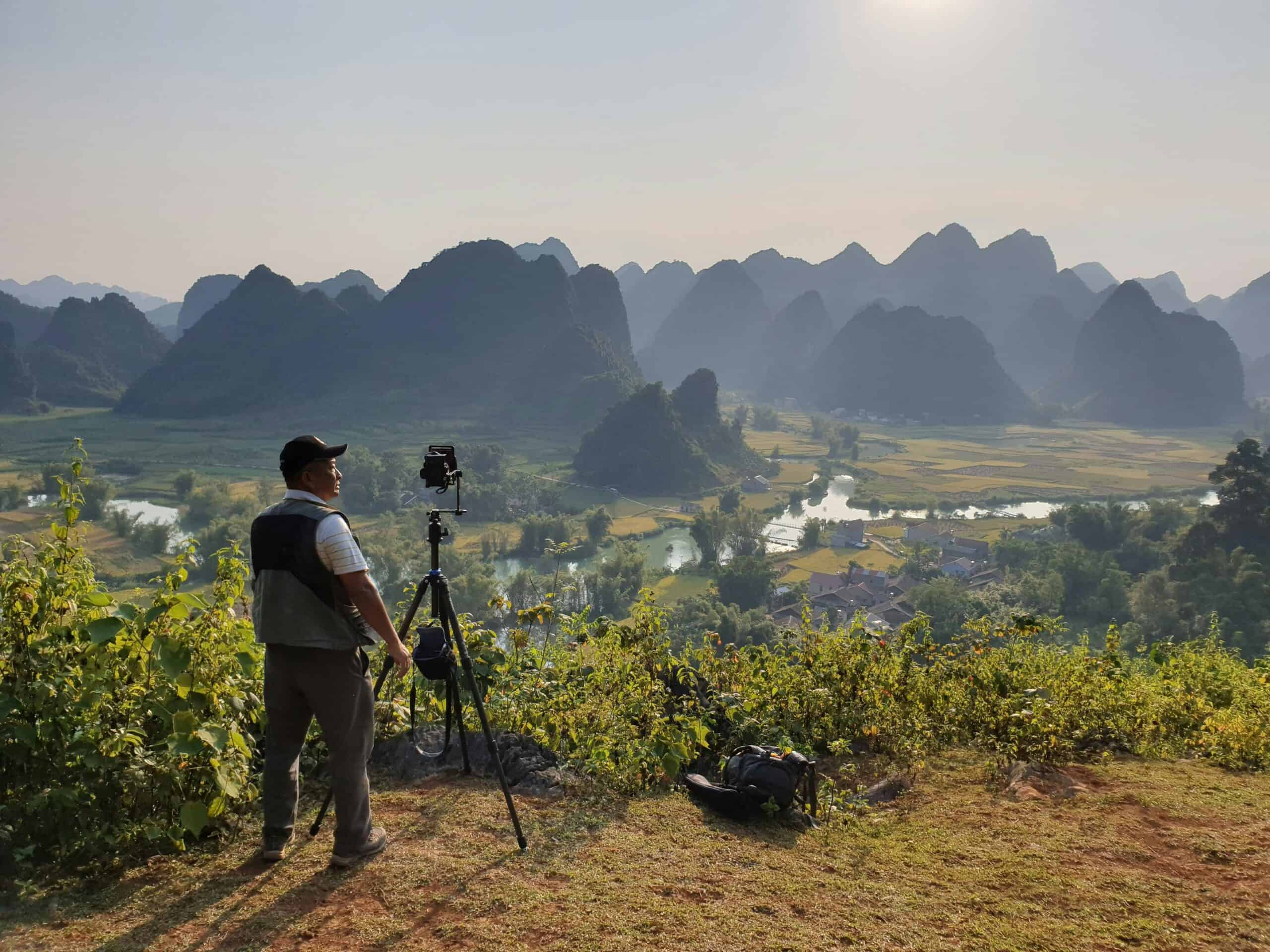
Walk the scene before you set up. Note the sun’s position, reflective surfaces (glass, polished floors, water), and motion (trees, people, vehicles). For interiors with glass walls, keep the lens at least 30–50 cm from the glass to reduce reflections, and use a hood or flag stray light. Outdoors at sunset, plan for fast-changing luminance—pre‑meter and be ready to adjust exposure or bracket. In event or street settings, identify traffic flow and timing patterns so you can shoot during lulls to minimize ghosting.
Match Gear to Scene Goals
The X1D‑50c’s dynamic range is a gift for HDR panoramas—windows and interior lamps can be balanced cleanly at ISO 100–200 with ±2 EV bracketing. Its larger pixels provide lower noise at base ISO, so favor longer shutter speeds on a tripod instead of pushing ISO. A rectilinear ultra‑wide (e.g., XCD 21mm f/4) keeps verticals straight and is ideal for architecture and real estate. While fisheye lenses reduce shot count, their curvature demands more defishing and careful vertical correction later; the rectilinear approach trades a few more frames for cleaner, more natural geometry—perfect for high-end 360 tours.
Pre-shoot Checklist
- Power & storage: two full batteries and ample cards; the X1D’s 50 MP RAWs add up fast during multi‑row 360s.
- Optics hygiene: blow off the sensor and front element; dust clones multiply across stitched sky.
- Tripod leveling: use a leveling base; bubble level on legs is not enough for multi‑row accuracy.
- Pano head calibration: ensure nodal point marks for your lens are set and locked.
- Safety checks: wind rating of tripod, rooftop edge clearance, tether lines for pole/car mounts, and a spotter where needed.
- Backup workflow: shoot a second full pass if time allows; insurance against stitching gaps and people movement.
Essential Gear & Setup
Core Gear
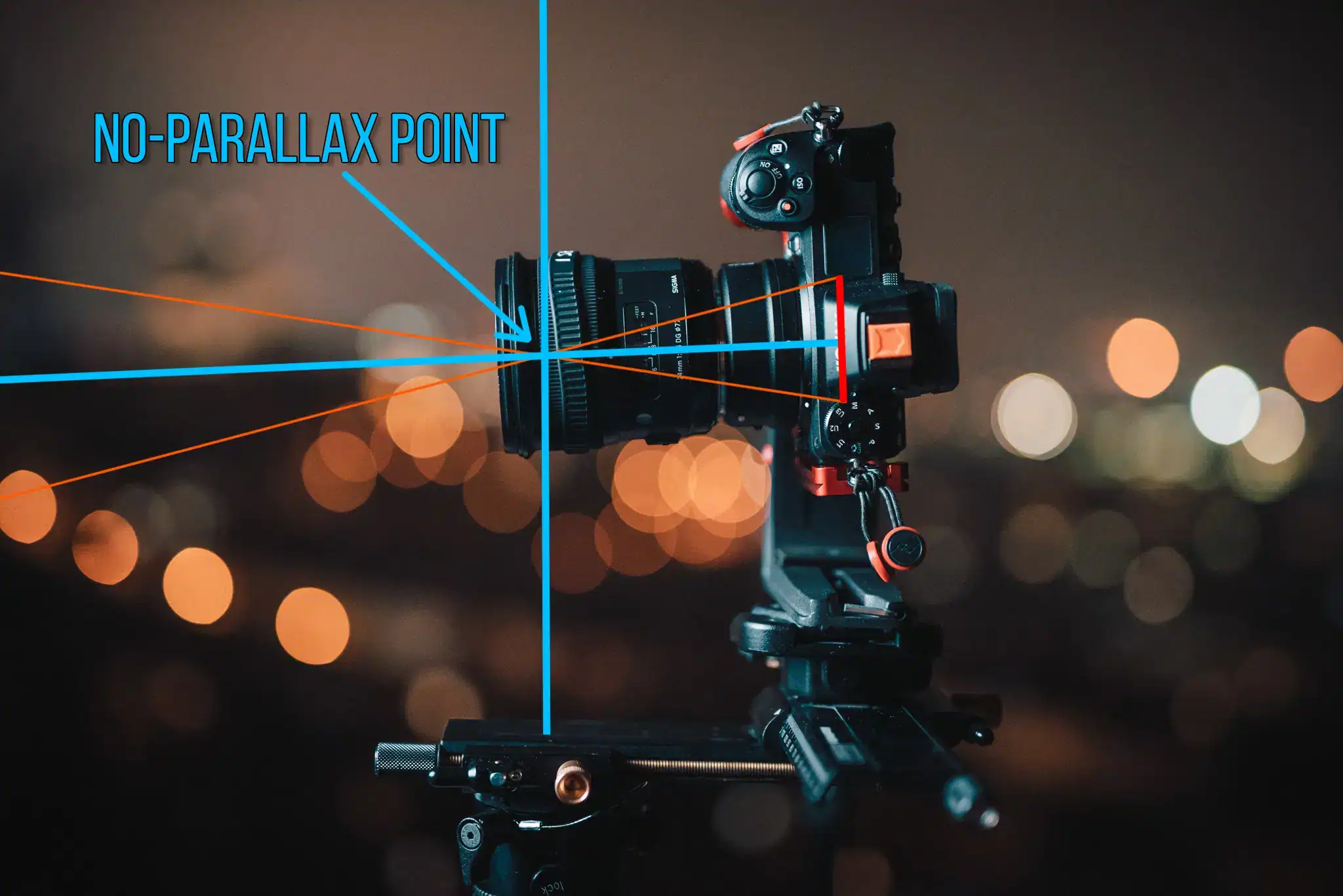
- Panoramic head: a multi‑row panoramic head lets you rotate around the lens’s no‑parallax (entrance pupil) point. This eliminates parallax shifts between foreground and background, producing clean stitches.
- Stable tripod with leveling base: a leveling base speeds setup and prevents accumulated pitch/roll errors when you rotate rows.
- Remote trigger or app: fire the shutter without touching the camera to avoid vibrations; use a 2-sec self-timer if you lack a remote.
Optional Add-ons
- Pole or car mount: great for elevated or moving shots. Safety first—use tethers, check wind loads, and avoid overhead lines.
- Lighting aids: small LED panels or bounced flash for dim interiors; avoid mixed color temps or gel to match ambient.
- Weather protection: rain cover, microfiber cloths, and silica packs to manage condensation during dawn/dusk.
For a deeper primer on panoramic heads and why nodal alignment matters, see this panoramic head tutorial. Panoramic head basics and setup
Step-by-Step Shooting Guide
Standard Static Scenes
- Level and lock: level the tripod via the leveling base, then set the pano head’s rotator to your step angle (e.g., 60–65° for 6 shots around with a 21mm on 44×33).
- Align nodal point: sliding rail forward/back until a near vertical object and distant background maintain alignment during yaw. Mark this position on the rail for your lens.
- Set manual exposure and white balance: meter a mid‑tone; lock exposure and set a fixed white balance (daylight/tungsten/custom). Consistency is key for seamless stitching.
- Focus: switch to manual focus, set near the hyperfocal distance at your chosen aperture (f/8–f/11). Use magnified live view to confirm sharpness.
- Shoot sequence: capture the first row (e.g., 6 shots around), then tilt up ~30–40° and repeat the circle. Capture a dedicated zenith shot by tilting up to 90°. Finally, shoot a nadir plate by raising the camera and/or offsetting the tripod, or capture a clean patch to clone later.
HDR / High Dynamic Range Interiors
- Bracket ±2 EV (3–5 frames): keep aperture constant (e.g., f/8), vary shutter speed, and keep ISO low (ISO 100–200) to preserve highlight detail in windows and lamp fixtures.
- Lock white balance: mixed lighting can vary by frame; a fixed WB minimizes color shifts that complicate HDR merges and stitching.
- Quiet intervals: wait for people to pause before firing brackets to reduce ghosting within HDR stacks.
Low-Light / Night Scenes
- Use tripod and remote: the X1D has no in‑body stabilization; prioritize base ISO (100–200) and slower shutters. A 2–10 sec shutter at f/4–f/5.6 is common for night cityscapes.
- Wind watch: hang a weight from the tripod, shield the camera from gusts with your body, and pause between shots for vibrations to settle.
- Avoid star trailing unless desired: keep exposure per frame under ~20–30 seconds for wide angles, or plan star‑tracked sky plates to blend later.
Crowded Events
- Two passes strategy: first pass quickly for safety, second pass patiently to catch gaps in foot traffic.
- Shorter step angle/higher overlap: gives your stitcher more control points to handle moving subjects.
- Mask in post: plan to use masked control points or selective layers to remove duplicates and ghosts.
Special Setups (Pole / Car / Rooftop)
- Pole work: keep rotations smooth, use a safety tether, and avoid extended pole heights in strong winds. Plan for higher overlap since positioning isn’t as precise as on a tripod.
- Car‑mounted: recheck fasteners at each stop; vibrations dictate quicker shutter speeds (1/250+ when moving) or stop-and-shoot intervals.
- Rooftops: maintain a safe distance from edges, secure your bag and accessories, and avoid mounting poles near drop zones.
Field‑tested Case Studies
- Indoor real estate (bright windows): X1D at ISO 100, f/8, bracket ±2 EV, two rows with XCD 21mm. Expect 14–16 frames. Stitch HDR stacks first, then merge panorama for the cleanest tonal blending.
- Outdoor sunset landscape: ISO 100, f/8–f/11, 1/60–1/250 sec depending on light. Single row plus zenith if clouds are dramatic; consider a second upper row to avoid warped cloud tops.
- Event crowds: ISO 200–400, f/5.6–f/8, 1/200 sec to freeze motion. Double‑pass capture to gather clean plates for stubborn moving subjects.
- Rooftop/pole: ISO 100–200, f/8, aim for 1/200+ if there’s vibration. Overlap 30–35% to absorb any slight alignment errors from non‑level rotations.
A solid visual refresher on setting up a panoramic head before shooting complex multi-row 360s.
Recommended Settings & Pro Tips
Exposure & Focus
| Scenario | Aperture | Shutter | ISO | Notes |
|---|---|---|---|---|
| Daylight outdoor | f/8–f/11 | 1/100–1/250 | 100–200 | Lock WB (Daylight); meter for mid-tones |
| Low light/night | f/4–f/5.6 | 1/10–10s | 100–400 | Tripod + remote; favor base ISO for clean stitches |
| Interior HDR | f/8 | Bracket ±2 EV | 100–200 | Merge HDR stacks before panoramic stitching |
| Action / moving subjects | f/5.6–f/8 | 1/200+ | 200–800 | Two passes to manage motion |
Critical Tips
- Manual focus at or near the hyperfocal distance for f/8–f/11 to keep the entire scene sharp.
- Nodal point calibration: use a near vertical edge and a distant background; adjust rail until there is no relative shift when panning. Mark your rail for each focal length you use.
- White balance lock: set fixed WB to avoid color casts across frames—especially under mixed lighting.
- RAW capture: 16‑bit color on the X1D gives superior flexibility for HDR and color grading; avoid JPEG for critical work.
- Stabilization: the X1D lacks IBIS; if using adapted lenses with optical stabilization, turn it off on a tripod to prevent micro‑blur during long exposures.
Want a concise industry perspective on why PTGui remains a top choice for complex panoramas? Read this review. PTGui: a powerful panorama stitching tool
Stitching & Post-Processing
Software Workflow
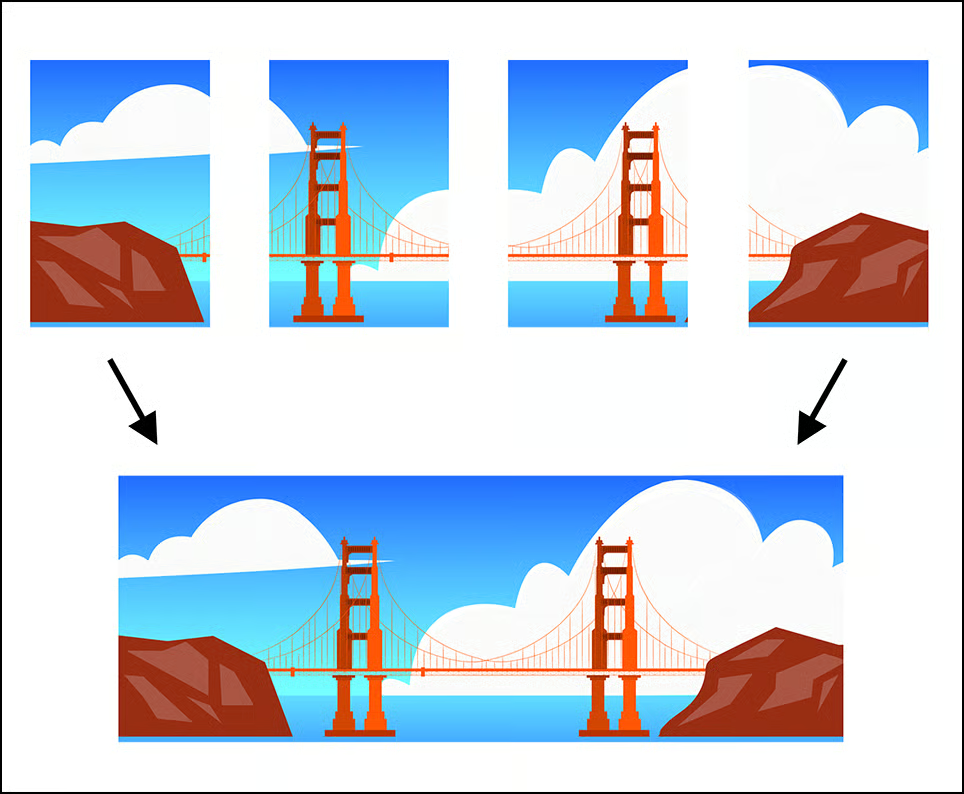
Typical pipelines: PTGui for multi‑row control and HDR merges, Hugin for open‑source flexibility, or Lightroom/Photoshop for simpler single‑row stitches. Rectilinear lenses usually require more frames than fisheye but give cleaner architectural lines and fewer defish artifacts. Aim for ~25–30% overlap with rectilinear setups; increase overlap in low‑contrast scenes. For HDR interiors, first merge your exposure brackets for each viewpoint, then stitch the merged exposures into the final panorama for consistent tonality.
Cleanup & Enhancement
- Nadir patch: capture a clean ground plate and patch with AI‑based tools or manual clone/heal.
- Color correction: even with locked WB, local tweaks may be needed for mixed lighting; use selective HSL and curves.
- Noise reduction: apply on the luminance channel after stitching; avoid over‑smoothing textures.
- Leveling and orientation: set the horizon and adjust yaw/pitch/roll so the viewer’s horizon feels natural in VR.
- Export: equirectangular 2:1 aspect, 12k–16k wide for high‑end tours. Save master TIFF/EXR; deliver JPEGs as needed.
If you’re new to high‑end 360 workflows with mirrorless/DSLR systems, Meta’s guide is a helpful complement to this tutorial. Using a mirrorless camera to shoot and stitch a 360 photo
Useful Tools & Resources
Software
- PTGui (Multi‑row, HDR, masking)
- Hugin (Open source alternative)
- Lightroom / Photoshop (Color, finishing, simple stitches)
- AI tripod/nadir removal tools (Masking/clone speed‑ups)
Hardware
- Panoramic heads: Nodal Ninja, Leofoto, Really Right Stuff
- Carbon fiber tripods with leveling bases
- Wireless remote shutters or app control
- Pole extensions / car mounts with safety tethers
Disclaimer: brand names for search reference—check official sites and manuals for compatibility and current specs.
For a broader Q&A style overview of DSLR/mirrorless virtual tour gear, this primer is worth a read. Virtual tour camera & lens FAQ
Common Mistakes & How to Avoid Them
- Parallax error → Always rotate about the lens’s entrance pupil; mark your rail positions and recheck when changing focal lengths.
- Exposure flicker → Manual exposure, fixed aperture, and locked WB; avoid Auto ISO in stitched sequences.
- Tripod shadows / footprints → Shoot a nadir plate or capture extra ground frames to patch later.
- Ghosting from movement → Time your frames during lulls; plan two passes and mask in post.
- High-ISO noise → The X1D is clean at ISO 100–400; favor longer exposures on a tripod instead of pushing ISO.
- Inconsistent overlap → Use the pano head’s click‑stops; target 25–30% overlap minimum for rectilinear lenses.
Frequently Asked Questions
-
Can I shoot handheld panoramas with the X1D‑50c?
Yes for short, single‑row stitches in bright light. For 360×180 spheres or low light, use a tripod and pano head; the X1D lacks IBIS, and precise nodal rotation is crucial to avoid parallax and stitching artifacts.
-
Is the Sony FE 12–24mm f/4 G wide enough for single‑row 360s?
On full‑frame, 12mm is extremely wide and can manage small single‑row spheres with extra zenith/nadir frames. However, that lens isn’t practically usable on the X1D. On the X1D, use the XCD 21mm or 25mm and plan two rows plus zenith/nadir for full coverage.
-
Do I need HDR for interiors with bright windows?
Often yes. Bracket ±2 EV (3–5 frames) at ISO 100–200 and f/8. Merge brackets per viewpoint, then stitch. The X1D’s dynamic range helps, but HDR preserves window detail and balanced interiors.
-
How do I avoid parallax issues with this setup?
Use a calibrated multi‑row panoramic head and align the lens entrance pupil over the rotator. Confirm with a near/distant alignment test. Once you find the correct rail offsets for your lens, mark and log them.
-
What ISO range is safe on the X1D in low light?
ISO 100–400 is exceptionally clean; ISO 800 is usable with careful noise reduction. Prefer tripod‑based longer exposures over pushing ISO, especially for multi‑row stitches.
If you want a community‑driven checklist of techniques beyond this article, this thread is a good reference point. Techniques to take 360 panoramas
Safety, Limitations, and Honest Advice
Lens compatibility: The Sony FE 12–24mm f/4 G does not natively mount to the X1D‑50c. Practical panoramic shooting with this camera requires native XCD lenses or carefully chosen adapted lenses that cover 44×33 mm and allow aperture control—always test for coverage and vignetting first.
Handling and weather: Medium‑format bodies and panoramic heads are heavier than compact mirrorless rigs. In wind or on rooftops, keep a low profile, tether your gear, and avoid extending center columns. For pole/car setups, use redundant safety lines and never operate near power cables or high pedestrian traffic.
Data integrity: Shoot duplicate passes, back up cards on‑site to two locations, and keep a simple slate of your nodal marks and exposure settings per scene. This saves hours later if a stitch reveals a missing frame or misalignment.
For a step‑by‑step primer on setting up a panoramic head for high‑end 360 photos, this guide is clear and methodical. Set up a panoramic head for perfect 360 photos