
Why This Camera & Lens Are Great for Panoramas
The Fujifilm X-T5 paired with the Sigma 8mm f/3.5 EX DG Circular Fisheye is a nimble, high-resolution combo for fast 360° capture. The X-T5’s 40.2MP APS-C X-Trans CMOS 5 HR sensor (approx. 23.5×15.6 mm, ~3.0 µm pixel pitch) delivers excellent resolving power with around 13+ stops of usable dynamic range at base ISO, so you can confidently push shadows and tame highlights in panoramic scenes. Its in-body image stabilization (IBIS) up to ~7 stops helps for handheld or pole work, while the EVF and focus peaking make manual focus simple and repeatable.
The Sigma 8mm f/3.5 EX DG is a circular fisheye for full-frame systems. On APS-C, its circular image is cropped, giving a very wide, “diagonal-like” fisheye coverage that’s still ideal for spherical panoramas—just plan a few more frames around. This fisheye perspective reduces the number of shots compared to rectilinear lenses and is extremely forgiving for stitching, especially when you align the nodal point correctly on a panoramic head. The bulbous front element and strong fisheye projection demand careful handling and thoughtful composition to manage flare and edge CA, but the payoff is speed and reliability in the field.
Quick Setup Overview
- Camera: Fujifilm X-T5 — APS-C (23.5×15.6 mm), 40.2MP X-Trans CMOS 5 HR, base ISO 125, ~13+ stops DR, 14-bit RAW, 7-stop IBIS.
- Lens: Sigma 8mm f/3.5 EX DG Circular Fisheye — circular fisheye on full frame; on APS-C it behaves like a very wide fisheye crop. Sharp from f/5.6–f/8; typical lateral CA toward edges; no filter thread; large front element.
- Estimated shots & overlap (field-tested):
- Conservative: 8 around at 45° yaw + zenith + nadir (very safe overlaps indoors/outdoors).
- Efficient: 6 around at 60° yaw + zenith + nadir (works well outdoors and most interiors).
- Pole/car quick pass: 6 around, slight upward tilt (+5–10°) and patch the nadir later.
Expect ~30–40% overlap; increase to 45–50% if crowds or close foreground dominate.
- Difficulty: Intermediate (easy to shoot once nodal point is calibrated; care needed for indoor parallax control).
Planning & On-Site Preparation
Evaluate Shooting Environment
Before you start, scan the scene for moving subjects (people, trees, traffic), reflective surfaces (glass, polished floors), strong backlight sources (sun, street lamps), and tight spaces. If shooting through glass, place the front element as close as safely possible (1–2 cm) to reduce reflections, and shade stray light with your body. Watch for flare—fisheyes see everything, including the sun just outside the frame. In interiors, note the distance to nearby objects; close foregrounds amplify parallax errors if the nodal point isn’t aligned.
Match Gear to Scene Goals
For how to shoot panorama with Fujifilm X-T5 & Sigma 8mm f/3.5 EX DG Circular Fisheye, you’re leveraging high resolution with a very wide perspective. The X-T5’s DR handles mixed lighting well; bracket if windows blow out. Indoors, safe ISO ranges are ISO 125–800 on tripod; if you need handheld shots, the X-T5’s IBIS buys shutter speed but still try to stay at ISO 160–800 for optimal quality. The fisheye’s advantage is fewer frames and robust control point matching in PTGui/Hugin. The trade-off is strong distortion near edges—keep critical verticals away from frame margins if you plan to output rectilinear views later.
Pre-shoot Checklist
- Power & storage: 2–3 batteries; high-speed UHS-II cards. The X-T5’s 40MP RAWs are big—carry extras.
- Optics: Clean lens and sensor; avoid touching the fisheye’s front element; bring a soft blower/cloth.
- Support: Leveling base and calibrated panoramic head; confirm nodal point mark for this lens.
- Camera setup: RAW, manual exposure, locked WB, manual focus; turn IBIS off on tripod.
- Safety: Weight your tripod; watch wind loads on rooftops and poles; tether gear on elevated or car-mounted rigs.
- Backup plan: Shoot a second safety round (especially indoors or at sunset) for insurance.
Essential Gear & Setup
Core Gear
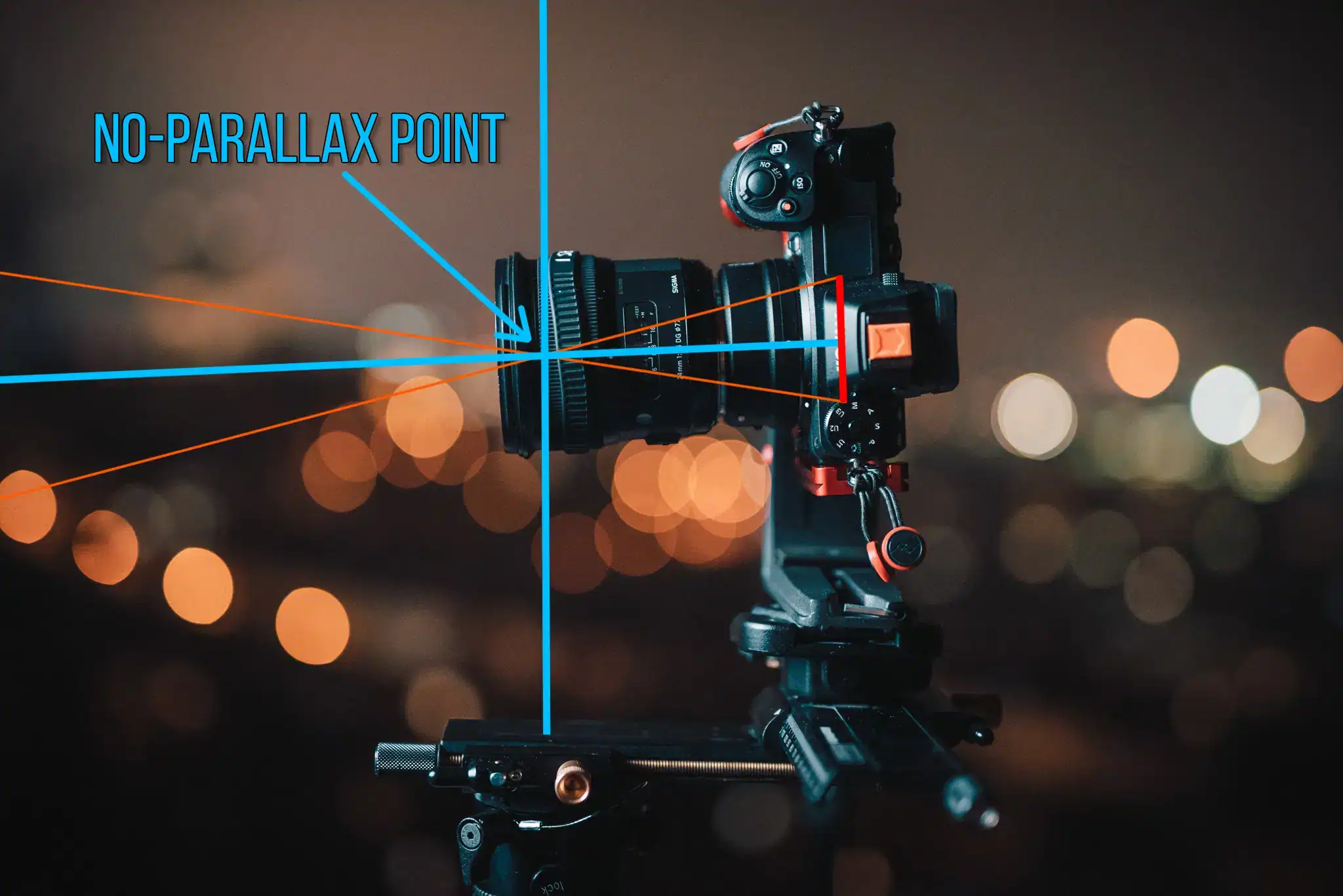
- Panoramic head: Enables rotating the camera around the lens’s entrance pupil (nodal point) to minimize parallax. This is critical for interiors with nearby furniture, railings, or door frames.
- Stable tripod with leveling base: A leveling base speeds setup and prevents tilt drift as you rotate.
- Remote trigger/app: Use a wired remote (e.g., RR-100) or the Fujifilm Camera Remote app to avoid vibrations. Enable 2s timer if you must touch the shutter.
Optional Add-ons
- Pole/car mount: Great for elevated viewpoints. Always use a safety tether; watch wind and avoid overhanging power lines and traffic.
- Lighting aids: For dim rooms, low-power LED fill or bounce cards can tame contrast and reduce HDR needs.
- Weather covers: Fisheye fronts collect everything; use a rain cover, microfiber, and lens hood shade techniques to mitigate spray and flare.
Step-by-Step Shooting Guide
Standard Static Scenes
- Level and align: Level the tripod via the base. On the pano head, slide the camera so the lens’s entrance pupil sits exactly over the rotation axis. A practical method: place two light stands (near and far) in overlap and rotate—adjust fore/aft until the near stand doesn’t shift relative to the far one.
- Camera settings: Manual exposure (M), manual focus, locked white balance (Daylight, Tungsten, or Custom). Turn off auto ISO. On tripod, disable IBIS to avoid micro-shifts.
- Focus: With fisheyes, set manual focus near the hyperfocal distance. At f/8, focus around 1–1.2 m; verify with the X-T5’s focus peaking and depth-of-field scale.
- Capture sequence: Use 6 shots around at 60° yaw intervals for efficiency, or 8 around at 45° for maximum overlap. Add one zenith shot (tilt up ~60–90°) and one nadir shot (tilt down ~60–90°). Record frame numbers or use a tickmark to avoid missing angles.
- Nadir for tripod removal: If your head allows, offset the arm and shoot a clean floor plate after rotating away from the tripod footprint, or plan to patch later in post.
HDR / High Dynamic Range Interiors
- Bracket: Use AE bracketing ±2 EV, 3–5 frames per view. The X-T5’s 40MP RAW gives room to recover highlights, but bright windows still benefit from HDR.
- Consistency: Lock white balance and keep shutter/aperture sequence consistent across the entire panorama. Avoid auto WB/auto ISO; they create exposure flicker that complicates stitching.
- Order: Complete one bracket set before rotating to the next yaw position to simplify batch processing.
Low-Light / Night Scenes
- Exposure: Use f/4–f/5.6, ISO 125–800 on tripod; select shutter speeds as long as needed (1–10s is fine). For artificial light, prefer mechanical shutter to avoid banding.
- Stability: Remote release or 2s timer. Shield the lens from stray streetlights to reduce flare; consider a small flag (your hand or a card) just outside the frame.
- Noise planning: The X-T5 is clean through ISO 800–1600; if you must go higher, expose to the right and apply noise reduction in post.
Crowded Events
- Two-pass method: First pass for complete coverage; second pass to catch frames when the nearest subjects move away. Later, mask in the cleaner areas.
- Faster yaw step: Use 8-around at 45° to increase overlap and make masking easier when people are moving unpredictably.
Special Setups (Pole / Car / Drone)
- Pole: Keep the pole vertical, use a safety tether, and rotate more slowly to let vibrations settle. Use 6-around and patch the nadir later.
- Car mount: Avoid highways and high winds; secure with suction plus safety lines. Stop the car to capture each frame—don’t rotate while moving.
- Drone note: This lens is not for drones; if you adapt a similar workflow, ensure CG balance and legal compliance.
Recommended Settings & Pro Tips
Exposure & Focus
| Scenario | Aperture | Shutter | ISO | Notes |
|---|---|---|---|---|
| Daylight outdoor | f/8–f/11 | 1/100–1/250 | ISO 125–200 | Lock WB (Daylight); avoid clipping highlights; IBIS off on tripod |
| Low light/night | f/4–f/5.6 | 1/30–multi-sec | ISO 125–800 | Tripod + remote; use mechanical shutter under artificial light |
| Interior HDR | f/8 | Bracket ±2 EV | ISO 125–400 | Balance window highlights; keep WB locked across brackets |
| Action / moving subjects | f/5.6–f/8 | 1/200+ | ISO 400–800 | Freeze motion; consider 8-around for easier masking |
Critical Tips
- Manual focus at hyperfocal: With the 8mm fisheye, set f/8 and focus ~1–1.2 m to keep everything sharp. Verify with magnified live view.
- Nodal point calibration: Start with the camera slid forward so the entrance pupil sits roughly 6–7 cm in front of the mount (varies by adapter). Fine-tune using near/far object alignment; mark your rail for repeatability.
- White balance lock: A fixed WB prevents color stitching seams—use a preset or custom Kelvin.
- RAW over JPEG: 14-bit RAW from the X-T5 preserves DR and color latitude for HDR blending and color correction.
- IBIS on/off: Turn off IBIS on a solid tripod. For handheld or pole work, IBIS can help at higher shutter speeds; don’t rely on it for long exposures.
- Mechanical vs electronic shutter: Under mixed artificial light, use mechanical to avoid banding. Electronic is fine in daylight or where flicker is controlled.
Stitching & Post-Processing
Software Workflow
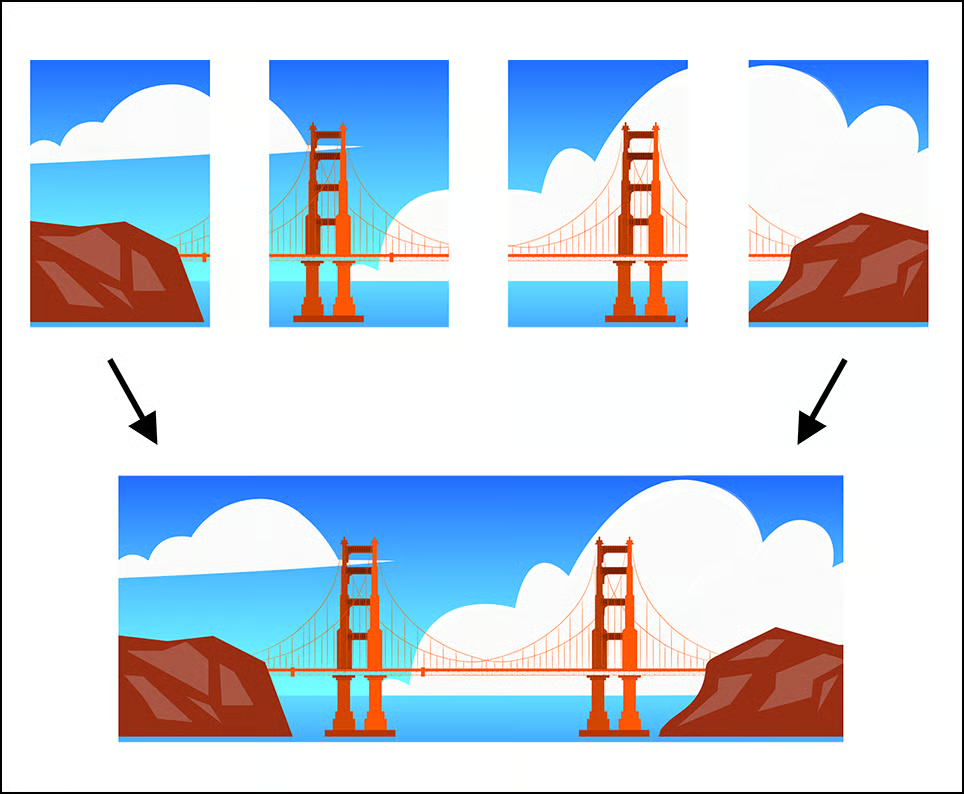
For this fisheye workflow, PTGui shines: import the images, set lens type to “fisheye” (projection close to equisolid-angle for many Sigma fisheyes), and let PTGui estimate the field of view from control points. If your frames show very wide coverage but not a full circle, that’s normal on APS-C with a circular fisheye—PTGui will still solve it. Hugin is an excellent open-source alternative. As a rule of thumb, overlap 25–30% for fisheyes and increase to ~40% if objects are very close to the camera or people are moving. After stitching, export equirectangular at the target pixel size (e.g., 12–20k on the long edge) for virtual tours and VR platforms.
PTGui also handles exposure fusion and HDR merges per viewpoint, then stitches. Alternatively, pre-merge bracketed sets in Lightroom/Camera Raw, then stitch the tonemapped images. Both are valid; with the X-T5’s 40MP RAW, maintaining bit depth and merging in PTGui often yields cleaner highlight transitions. For detailed PTGui evaluations and pro workflows, see this review of PTGui’s panorama capabilities at the end of the section. In-depth PTGui review and tips
Cleanup & Enhancement
- Tripod/nadir patch: Capture a dedicated floor plate or use an AI-based patch in post. Clone-stamp in Photoshop to blend textures naturally.
- Color & noise: Apply global color balance to harmonize mixed lighting. Use moderate noise reduction on shadow regions; the X-T5 remains clean if you expose well.
- Horizon leveling: Use pitch/roll/yaw controls in PTGui or Hugin to level the horizon and straighten verticals.
- Export formats: Equirectangular JPEG/TIFF (8–16 bit) for VR. For Meta/Oculus workflows, follow their 2:1 equirectangular guidelines. Oculus creator guide for DSLR 360 photos
For foundational technique on setting up your head and eliminating parallax before you ever open software, this panoramic head guide is a great reference. Panoramic head alignment tutorial
Useful Tools & Resources
Software
- PTGui panorama stitching
- Hugin (open source)
- Lightroom / Photoshop for RAW and retouching
- AI tripod removal/patch tools
Hardware
- Panoramic heads (Nodal Ninja, Leofoto)
- Carbon fiber tripods with leveling base
- Wireless or wired remote shutters
- Pole extensions / car mounts with safety tethers
Disclaimer: product names are for reference; check official sites for current specifications and compatibility, especially adapters for the Sigma to Fuji X.
Real-World Scenarios & Field Notes
Indoor Real Estate
Use 6-around + zenith + nadir, f/8 at ISO 125–200, and bracket ±2 EV. Place the camera near room center for even coverage. Avoid placing furniture right against the camera due to parallax sensitivity; if unavoidable, ensure perfect nodal alignment and increase overlap to 8-around. Mixed lighting? Lock WB to a neutral preset and correct any tint in post globally before stitching.
Outdoor Sunset
Meter highlights and expose to protect them, then plan to lift shadows in RAW or use a mild bracket (±1–2 EV). Flare management is key; rotate your sequence to shoot the sun position last so you can shade the lens more carefully on that frame. The X-T5’s DR lets you retain cloud gradations—watch your histogram and avoid clipping.
Event Crowds
Go 8-around for redundancy. Use 1/200 s or faster at f/5.6–f/8, ISO 400–800. Shoot two full passes and mask the cleanest people positions. If someone walks very close to the lens, wait a beat and re-shoot that direction.
Rooftop or Pole Capture
Stabilize first: hang a weight from the tripod/pole and check wind gusts. Use 6-around with slight upward tilt (+5–10°) and patch the nadir. Keep shutter speeds short (1/125–1/250 s) to mitigate micro-shake. Always tether your gear.
Car-Mounted Panos
Park safely and still. Use suction mounts with secondary safety lines, and avoid windy conditions. Capture each frame with the car stationary; vehicle vibrations ruin control point consistency.
Common Mistakes & How to Avoid Them
- Parallax error → Verify entrance pupil alignment with near/far objects before serious work. Mark your rail settings.
- Exposure flicker → Use full manual mode, fixed WB, and consistent bracketing per viewpoint.
- Tripod shadows/footprint → Shoot a clean nadir or plan a patch. Keep your shadow out of frames near the sun.
- Ghosting from movement → Increase overlap, shoot double passes, mask in post.
- High ISO noise at night → Prefer longer shutters on tripod over cranking ISO; the X-T5 is clean up to ~ISO 800–1600 if exposed well.
- Adapter pitfalls → The Sigma 8mm often needs an electronic adapter (e.g., EF–FX) for aperture control; test AF/EXIF. If aperture control fails, use a lens dock or set-and-lock apron on compatible adapters.
Frequently Asked Questions
- Can I shoot handheld panoramas with the Fujifilm X-T5?
Yes, for quick outdoor scenes. Use IBIS, 1/125–1/250 s, and 6–8-around with generous overlap. Expect minor stitching stress compared to tripod work. Indoors or with close foregrounds, a tripod and pano head are strongly recommended.
- Is the Sigma 8mm f/3.5 wide enough for single-row 360 on APS-C?
Yes, but plan more frames than a full-frame circular fisheye. On the X-T5 (APS-C), 6-around + zenith + nadir is reliable; 8-around is extra safe for interiors.
- Do I need HDR for interiors with bright windows?
Often yes. Even with the X-T5’s ~13+ stops DR, bright windows will clip. Bracket ±2 EV in 3–5 frames and merge before or during stitching to retain both exterior views and interior detail.
- How do I avoid parallax issues with this setup?
Calibrate the entrance pupil on your panoramic head and lock it in. Use the near/far object method before every critical shoot. Increase overlap if objects are very close to the lens. A thorough panoramic head setup guide can help refine your process. Panoramic head setup guide
- What ISO range is safe on the X-T5 in low light?
On tripod, stick to ISO 125–800 and lengthen shutter as needed. For handheld or poles, ISO 400–800 is a good balance. If you must go to ISO 1600–3200, expose to the right to protect shadow quality.
- Can I create custom panorama presets on the X-T5?
Yes. Assign a custom mode with RAW, manual exposure, manual focus, fixed WB, IBIS off (for tripod), and your preferred bracketing. This speeds up on-site setup.
- How do I reduce flare with a fisheye?
Avoid pointing directly at strong light sources; time the rotation so the sun/lamp frame is last and shade the lens with your hand just outside the frame. Keep the front element spotless.
- Which panoramic head works best for this combo?
Look for a compact multi-row head that supports fore/aft and vertical rail adjustment (e.g., Nodal Ninja, Leofoto). The ability to offset for nadir shots is a big plus.
Further Reading & Standards
For a broader DSLR/mirrorless 360 FAQ with gear advice and pitfalls, see this well-known resource. DSLR/Virtual tour FAQ and lens guide
If you’re publishing to VR or building tours, Meta’s DSLR 360 guidelines are a concise reference for equirectangular specs. Using a DSLR or mirrorless camera to shoot 360 photos
Behind-the-Scenes Visuals
Safety, Limitations & Backup Strategy
Limitations to note: The Sigma 8mm f/3.5 EX DG Circular Fisheye is designed for full-frame circular coverage; on APS-C you’ll get a cropped circle that behaves like a wide fisheye. That means you’ll need more shots than a full-frame circular lens, but stitching remains straightforward. Also confirm adapter compatibility—electronic aperture control is preferred; if unavailable, plan an aperture you can set and leave. The bulbous front element is fragile; always keep the cap on until you’re ready to shoot.
Safety: On rooftops or poles, weight the base and tether everything. In wind, avoid tall poles and long exposure times. Around traffic, choose secure positions and use high-visibility gear. For car mounts, use dual safety lines and shoot when parked.
Backup: Shoot a second round, especially for interiors. Keep dual cards or make quick backups to a phone or SSD via a card reader. Note frame counts and positions to spot any missed angles before leaving.