
Why This Camera & Lens Are Great for Panoramas
If you want to know how to shoot panorama with Fujifilm X-T5 & Sigma 14-24mm f/2.8 DG DN Art, you’re pairing a high-resolution APS-C mirrorless body with a pro-grade ultra-wide rectilinear zoom. The Fujifilm X-T5 uses a 40.2MP APS-C X-Trans CMOS 5 HR sensor (approx. 23.5 × 15.6 mm) with a pixel pitch around 3.0 µm and about 13.5 EV of dynamic range at base ISO. That means excellent detail for large virtual tours and enough latitude to handle bright windows and deep interior shadows when bracketed. The body’s IBIS (up to 7 stops) is helpful for handheld frames, though you should turn it off on a tripod for multi-image panoramas.
The Sigma 14-24mm f/2.8 DG DN Art is a full-frame, rectilinear ultra-wide zoom that’s very sharp from f/4–f/8, with well-controlled lateral CA and minimal coma, making it suitable for interiors, architecture, and night scenes. Note on compatibility: the DG DN Art version is made for Sony E and Leica L mounts and does not natively fit Fujifilm X-mount. If you cannot adapt this specific DN version (there is no standard thin adapter to X-mount), consider the optically similar Sigma 14-24mm f/2.8 DG HSM (Canon EF) via a smart adapter like the Fringer EF-FX Pro, or use an X-mount ultra-wide (e.g., Fujifilm XF 14mm f/2.8 or Sigma 10-18mm f/2.8 DC DN). The technique and settings below still apply.
As a rectilinear (not fisheye) design, the Sigma 14-24mm needs more frames than a fisheye to cover the full sphere, but it avoids the fisheye “bulb” look and provides straighter lines with less geometric stretching at the edges—ideal for real estate and architecture-grade virtual tours.
Quick Setup Overview
- Camera: Fujifilm X-T5 — APS-C (1.5× crop), 40.2MP X-Trans sensor, base ISO 125, IBIS up to 7 stops.
- Lens: Sigma 14-24mm f/2.8 DG DN Art — rectilinear ultra-wide zoom; excellent sharpness f/4–f/8; low CA; note mount compatibility considerations for Fujifilm X.
- Estimated shots & overlap (tested, 14mm on APS-C):
- Fast spherical: 6 shots around at 0°, 6 at +45°, 6 at −45° + 1–2 zenith + 1–2 nadir (≈20–22 frames, ~25–30% overlap).
- Quality spherical: 8 around at 0°, 8 at +45°, 8 at −45° + 2 zenith + 2 nadir (≈28–30 frames; safer for interiors and complex scenes).
- Single-row cylindrical (not full 360 sphere): 8–10 frames around with 25–30% overlap.
- Difficulty: Moderate (rectilinear needs careful nodal alignment and multi-row capture).
Planning & On-Site Preparation
Evaluate Shooting Environment
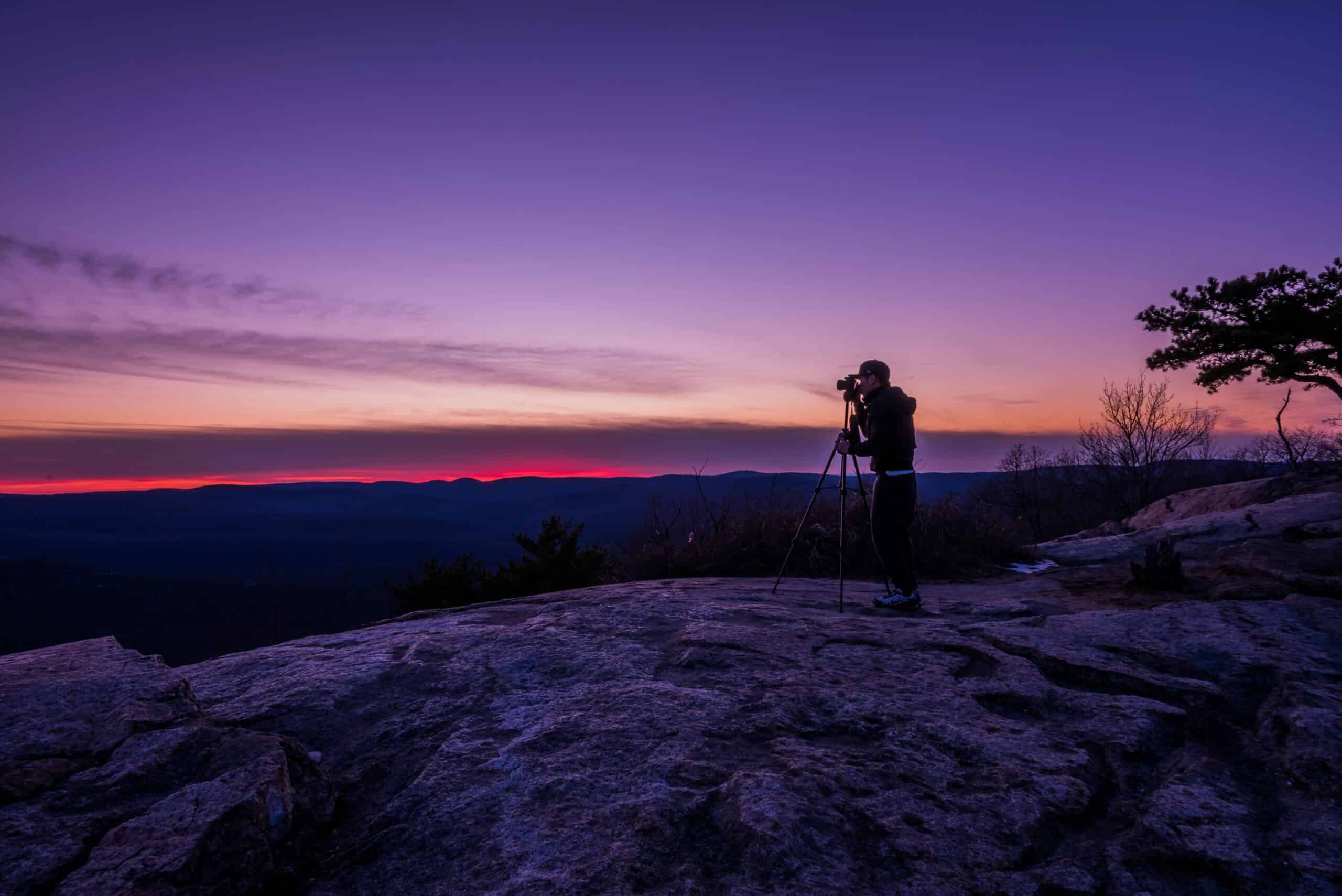
Assess light direction and brightness range (windows, skylights, lamps), reflective surfaces (glass, polished stone, glossy furniture), and motion (people, trees, traffic). For glass, place the lens close (2–5 cm) and shoot slightly off-axis to reduce direct reflections. Keep a microfiber cloth ready for front element smudges—ultra-wides magnify dust and fingerprints, especially against the sky.
Match Gear to Scene Goals
Why the Fujifilm X-T5 & Sigma 14-24mm f/2.8 DG DN Art make sense: the X-T5’s 40MP sensor resolves fine textures, and with bracketed exposures you can handle huge dynamic range indoors. Safe ISO ranges for clean output are ISO 125–800; ISO 1600–3200 is usable with careful noise reduction and later downsampling. The rectilinear Sigma at 14mm (≈21mm full-frame equivalent FoV on APS-C) captures straight lines and minimal distortion, making stitching easier for architecture. It will require more shots than a fisheye but yields a natural perspective that clients often prefer.
Pre-shoot Checklist
- Charge batteries; carry spares. Use fast UHS-II cards; panoramas with bracketing create many files.
- Clean lens and sensor; check for dust spots—sky gradients reveal them during stitching.
- Level your tripod. Calibrate your panoramic head’s nodal point for 14mm and mark it.
- Safety: tie down straps on rooftops; use sandbags in wind; double-check car mounts and tethers.
- Backup workflow: when time allows, shoot a second safety pass with the same settings.
Essential Gear & Setup
Core Gear
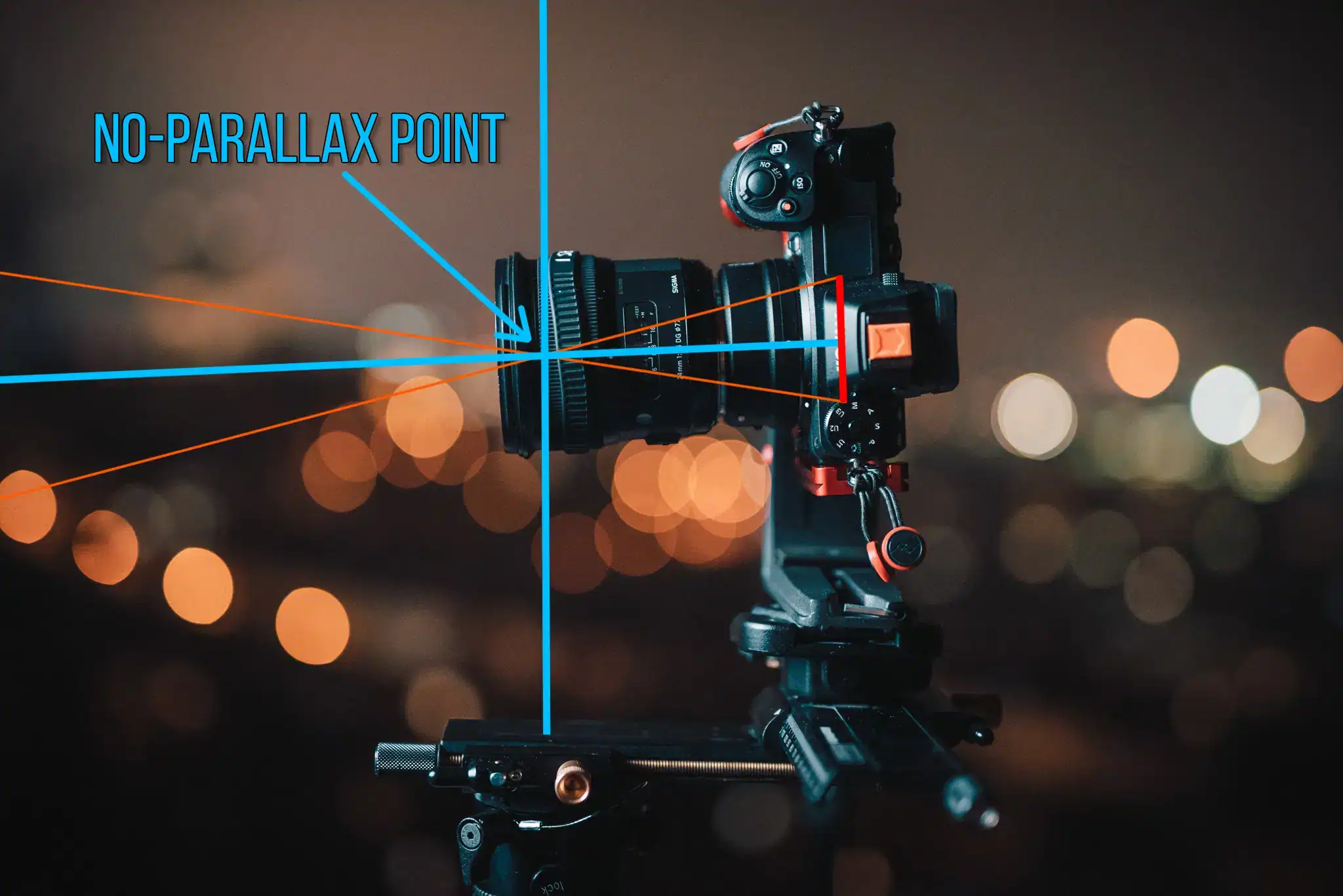
- Panoramic head: Enables rotation around the lens’s no-parallax (entrance pupil) point to eliminate parallax errors between near and far objects.
- Stable tripod with leveling base: A bubble or half-ball leveling base speeds setup and keeps rows aligned.
- Remote trigger or app: Reduce vibration and keep your hands off the camera between frames.
Optional Add-ons
- Pole or car mount: Great vantage points, but mind wind load and vibrations. Use guy-lines and safety tethers; avoid extended poles above crowds or power lines.
- Lighting aids: Small LED panels to lift dark corners; avoid mixed color temperatures if possible.
- Weather gear: Rain cover, microfiber cloths, lens hood to mitigate flare and drizzle.
Finding and Marking the Nodal Point
Place two vertical objects (light stands) at different distances, aligned visually. Rotate the camera on the pano head. If the foreground object shifts relative to the background, adjust the lens forward/backward on the rail. Repeat until there’s no relative shift. Mark this rail position for 14mm. Expect the entrance pupil location to change slightly with zoom; lock your plan at 14mm for consistency. For more background on panoramic head setup, see this panoramic head tutorial for a deep dive at the end of this paragraph. Panoramic head setup guide
Step-by-Step Shooting Guide
Standard Static Scenes
- Level tripod and align the nodal point. Re-check with a quick near/far test if you moved locations or changed focal length.
- Set manual exposure: start with base ISO 125–200, aperture f/8 for edge-to-edge sharpness, and adjust shutter for proper mid-tone. Lock white balance (Daylight for outdoors; Custom or Tungsten/Fluorescent for interiors). Disable IBIS on tripod to avoid micro-shifts.
- Focus: switch to manual focus. Use magnified live view to focus 1–2 meters beyond the nearest subject or set the hyperfocal distance for 14mm at f/8. Turn off AF to keep focus fixed throughout.
- Capture sequence with tested overlap:
- Fast coverage: 6 shots around at 0°, then 6 at +45°, 6 at −45°, plus 1–2 zenith and 1–2 nadir frames.
- High-quality: 8 around per row at 0°, +45°, −45°, plus 2 zenith and 2 nadir frames for robust stitching.
- Take a clean nadir: After the main set, shift the tripod slightly and take a handheld nadir shot with the lens over the tripod footprint for easy patching.
HDR / High Dynamic Range Interiors
- Bracket ±2 EV if windows are bright, or use 5–7 frames at 1 EV steps for smoother tonality. The X-T5’s bracketing can handle multi-frame sequences; RAW is recommended.
- Keep WB locked to avoid shift across brackets. Use a 2–3 s self-timer or remote to prevent vibrations.
- Capture all brackets at each yaw position before rotating to the next position to simplify post-processing batch alignment.
Low-Light / Night Scenes
- Open to f/4–f/5.6 for sharpness; use longer exposures (1–10 s) at ISO 125–400 when possible. If wind or vibration is present, consider ISO 800–1600 with shorter shutter speeds.
- Turn off IBIS on a tripod. Use electronic front curtain shutter to minimize shutter shock; avoid full electronic shutter under LED signage due to potential banding.
- Take duplicate frames for any scene element with flicker or moving lights; keep one for masking later.
Crowded Events
- Shoot two passes per row: first for composition, second while waiting for gaps. Mark your start frame with a clap or a hand-in-frame so you can identify pass boundaries later.
- Keep overlap generous (30–40%) to give the stitcher more flexibility to reject moving objects and reduce ghosting.
Special Setups (Pole / Car / Drone)
- Secure all gear with a safety tether. For poles, reduce sail area (remove straps, use low-profile heads). Rotate slowly and allow vibrations to dampen before each shot.
- For car mounts, shoot at safe, low speeds or stationary. Use higher shutter speeds (1/250–1/500) with ISO 400–800 to counter micro-vibrations.
- Avoid long exposures in wind. Capture a second pass in case motion blur sneaks into one row.
Video: Panoramic Head Setup & Stitching Basics
Visual learners will appreciate a concise walkthrough on setting up a panoramic head and stitching logic.
Recommended Settings & Pro Tips
Exposure & Focus
| Scenario | Aperture | Shutter | ISO | Notes |
|---|---|---|---|---|
| Daylight outdoor | f/8–f/11 | 1/100–1/250 | 125–200 | Lock WB to Daylight; disable IBIS on tripod |
| Low light/night | f/4–f/5.6 | 1/30–10 s | 125–800 | Remote trigger; longer shutter preferred over high ISO |
| Interior HDR | f/8 | Bracket ±2 EV or 5–7 shots at 1 EV | 125–400 | Keep WB locked; shoot RAW for latitude |
| Action / moving subjects | f/5.6–f/8 | 1/200+ | 400–800 | Do two passes; mask movement in post |
Critical Tips
- Manual focus and hyperfocal: At 14mm and f/8, setting focus around 1–1.5 m keeps most interiors sharp front-to-back.
- Nodal point calibration: Mark your rail position for 14mm; re-check if you change the zoom. Tiny errors cause stitching seams in tight spaces.
- White balance lock: Mixed lighting is common; pick a fixed Kelvin that balances most of the frame and correct globally in RAW later.
- RAW over JPEG: The X-T5’s 40MP RAW files offer headroom for highlight recovery and cleaner noise reduction.
- IBIS off on tripod: Prevents subtle shifts between frames. On handheld single-row panos, IBIS can help at 1/60–1/125.
Stitching & Post-Processing
Software Workflow
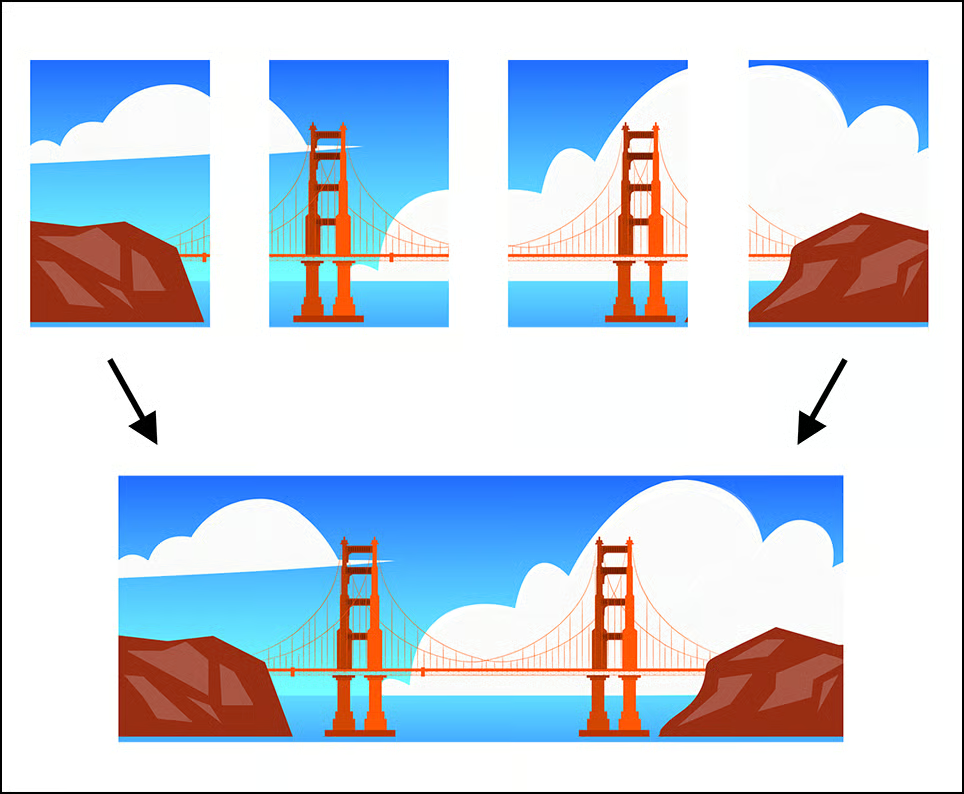
Import RAWs into your editor (Lightroom, Capture One) for basic exposure matching and lens profile correction if available. Export 16-bit TIFFs for stitching. PTGui is an industry workhorse thanks to its flexible control point editor, robust optimizer, and masking workflow; Hugin is an excellent free alternative. With a rectilinear 14mm on APS-C, aim for 25–30% overlap horizontally and vertically. Fisheyes require fewer frames but need “defishing” steps; rectilinear captures more images yet yield straighter lines and natural perspective. For a deeper look at PTGui in a professional context, consider this review: PTGui for high-end panoramas
Cleanup & Enhancement
- Nadir patch: Use PTGui’s Viewpoint Correction or clone in Photoshop. You can also replace with a clean handheld shot aligned via control points.
- Color and noise: Apply global white balance correction and consistent contrast. For X-T5 high-ISO frames (ISO 1600–3200), use luminance NR and downsample slightly to minimize grain.
- Level horizon: In PTGui/Hugin, set verticals/horizon using line constraints; ensure zero roll for VR viewers.
- Export: Output 16k–20k equirectangular JPEG/TIFF depending on your final platform. For VR publishing best practices, review platform guidelines. VR platform export guidance
Note: Every software iteration changes features and UI; check the latest documentation and release notes for current best practices.
If you want a foundational reference on how focal length, sensor size, and resolution affect spherical output, see this classic resource: Panotools spherical resolution
Useful Tools & Resources
Software
- PTGui panorama stitching
- Hugin open source
- Lightroom / Photoshop for RAW development and cleanup
- AI tripod removal and object cleanup tools
Hardware
- Panoramic heads: Nodal Ninja, Leofoto multi-row heads
- Carbon fiber tripods with leveling bases
- Wireless remote shutters
- Pole extensions and vehicle suction mounts (with tethers)
Disclaimer: product names are for research reference—verify specs on official sites before buying.
Common Mistakes & How to Avoid Them
- Parallax error: Always align to the lens’s no-parallax point, especially in tight interiors.
- Exposure flicker: Shoot in manual exposure and lock white balance and focus across the set.
- Tripod shadows or footprints: Capture a dedicated nadir and patch it cleanly in post.
- Ghosting from movement: Shoot two passes or increase overlap; mask people and vehicles during stitching.
- High-ISO noise at night: Prefer longer shutter times on a sturdy tripod over pushing ISO.
- IBIS jitters: Disable stabilization on tripod for consistent frame-to-frame alignment.
Real-World Case Studies
Indoor Real Estate
At 14mm, shoot a three-row set with 8 around per row (+45°, 0°, −45°), f/8, ISO 125, bracket 5 shots at 1 EV to hold window highlights. Keep the camera mid-room to minimize edge stretching; watch for mirrors and glass—stand slightly off-center to avoid your reflection.
Sunset Rooftop
Use f/8, ISO 125–200, and vary shutter between rows as light fades (or better: bracket and unify later). Capture a second “blue hour” pass for cleaner shadows and blend the sky from the brighter pass with the city from the darker pass.
Event Crowd
Use 1/200–1/400 at ISO 400–800 to freeze motion. Increase overlap to 35–40% and shoot two passes. In post, mask stitching seams to eliminate duplicated heads or ghosted hands.
Pole Shot Over a Plaza
Stop down to f/5.6, use 1/250–1/500 at ISO 400–800. Rotate very slowly and let oscillations settle before each frame. Take an extra safety pass at a slightly different yaw alignment to recover any blurred tiles or handrails.
Safety, Limitations, and Honest Notes
The Sigma 14-24mm f/2.8 DG DN Art is not a native Fujifilm X-mount lens. Without a viable thin adapter for DN to X-mount, plan to use either the Sigma 14-24mm f/2.8 DG HSM (EF) via a smart adapter, or an X-mount native ultra-wide. If you can mount the DN version via a third-party solution, expect focus-by-wire behavior and be prepared to use manual focus with magnification for precision. Always verify mechanical clearance and secure your setup before field use.
On rooftops, in wind, or on poles, protect gear with safety tethers and avoid extended exposures that amplify vibration. For car-mounted shots, obey local laws, shoot in safe areas, and consider shooting stationary for best quality. Back up images to two cards or a mobile SSD—panoramas are time-consuming to reshoot.
For further panorama fundamentals (technique and pitfalls) from the broader community, this Q&A thread remains a helpful reference: Techniques to take 360 panoramas
Frequently Asked Questions
- Can I shoot handheld panoramas with the Fujifilm X-T5?
Yes for single-row or partial panos. Use 1/125–1/250, IBIS on, and 30–40% overlap. For full 360×180 spheres, a tripod and panoramic head are strongly recommended to avoid parallax and stitching errors.
- Is the Sigma 14-24mm f/2.8 DG DN Art wide enough for a single-row 360?
On APS-C, 14mm behaves like ~21mm full-frame equivalent FOV. You’ll need multi-row coverage for a full sphere. A single row works for cylindrical panos only, not a complete 360×180.
- Do I need HDR for interiors with bright windows?
Usually yes. Bracket ±2 EV (3 frames) or 5–7 frames at 1 EV. The X-T5’s 40MP RAWs handle merging well, and PTGui can blend exposures per viewpoint for clean results.
- How do I avoid parallax issues?
Use a panoramic head and align the rotation around the lens’s entrance pupil. Calibrate at 14mm and mark the rail. Re-check after transport or height changes.
- What ISO range is safe on the X-T5 in low light?
ISO 125–800 is very clean; ISO 1600–3200 remains usable with good noise reduction and downsampling. Prefer slower shutter speeds on a sturdy tripod over pushing ISO.
- Can I set up Custom Shooting Modes for pano?
Yes. Save a “Pano” preset with manual exposure, WB lock, IBIS off, RAW, self-timer or remote enabled, and focus set to MF. This speeds consistent field work.
- What’s the best tripod head for this setup?
A multi-row panoramic head with fore–aft and lateral rails (e.g., Nodal Ninja, Leofoto) ensures precise nodal alignment. Add a leveling base for fast setup.
Extra Reference: Training and Standards
If you want a structured primer that mirrors professional VR workflows (planning, capture, stitching, output), the panoramic head setup principles published for VR creators are concise and practical. Panoramic head setup principles