
Why This Camera & Lens Are Great for Panoramas
The Fujifilm X‑T5 paired with the Peleng 8mm f/3.5 is a compact, budget‑friendly, and highly capable combo for 360° panoramas. The X‑T5’s 40.2MP APS‑C X‑Trans CMOS 5 HR sensor (23.5 × 15.7 mm, ~3.51 µm pixel pitch) delivers excellent detail and color with strong dynamic range at base ISO 125. Its 7‑stop IBIS helps handheld shooting, while dual UHS‑II SD slots and rugged build make it reliable in the field. The Peleng 8mm f/3.5 is a manual, ultra‑wide fisheye lens. On APS‑C, it behaves like a diagonal fisheye (approx. 180° diagonal FOV) that covers the frame and drastically reduces the number of shots needed for a full sphere. That means faster capture with fewer chances for moving subjects to cause stitching errors.
Because it’s a fisheye, distortion is intentional and well‑understood by stitching software. The Peleng is fully manual (focus and aperture), which is ideal for consistent exposure/focus across a pano set. You will need a proper adapter for Fuji X (e.g., M42‑to‑FX or Nikon F‑to‑FX depending on your Peleng mount). Note that the front element is bulbous (no filters), and the lens can be prone to flare with strong point light sources—both common traits of ultra‑wide fisheyes.
Quick Setup Overview
- Camera: Fujifilm X‑T5 — APS‑C (23.5×15.7 mm), 40.2MP, base ISO 125, ~13+ stops practical dynamic range at base, 7‑stop IBIS.
- Lens: Peleng 8mm f/3.5 — diagonal fisheye on APS‑C, fully manual focus/aperture; sharpest around f/5.6–f/8; moderate CA and flare in high‑contrast scenes.
- Estimated shots & overlap (field‑tested): 6 around (0° tilt) at ~60° yaw increments with ~30% overlap + 1 zenith + 1 nadir. Indoors with tall ceilings add 1 extra zenith for safety.
- Difficulty: Easy to Moderate — fisheye reduces shot count, but precise nodal alignment and clean nadir workflow are key.
Planning & On-Site Preparation
Evaluate Shooting Environment
Assess light direction and contrast (e.g., windows vs. interior shadows), movement (people, leaves, water), and reflective surfaces (glass, cars, polished floors). If shooting through glass, keep the lens as close as possible to minimize reflections and ghosting. Plan the sun’s position for outdoor scenes to avoid harsh flare with the Peleng. Check for tripod shadows and uneven ground that could complicate leveling.
Match Gear to Scene Goals
The X‑T5 & Peleng 8mm combo excels when you want fast capture with high detail. The X‑T5’s dynamic range at base ISO helps preserve highlights in bright exteriors and midtones in interiors. For indoor work, ISO 160–800 is a safe, clean range; ISO 1600 can still be usable with careful noise reduction. The fisheye’s ultra‑wide FOV reduces shot count (fewer chances for people or clouds to move between frames), but you must manage flare and chromatic aberrations in high‑contrast edges. Expect some fisheye distortion in rectilinear exports; equirectangular/VR output handles this naturally.
Pre-shoot Checklist
- Charge batteries, format dual SD cards, clean front element and sensor.
- Level tripod; verify panoramic head calibration (entrance pupil/nodal point alignment).
- Safety checks: wind load (especially with poles), rooftop railing clearance, car mount torque and tethers.
- Backup workflow: shoot a second pass if time allows, or a safety nadir with tripod repositioned.
Essential Gear & Setup
Core Gear
- Panoramic head: Enables precise rotation around the lens’s entrance pupil (often called the “nodal point”) to eliminate parallax—critical for clean stitches in near‑foreground scenes.
- Stable tripod with a leveling base: A leveling base speeds setup; keeping the rotator plane level avoids tilt corrections later.
- Remote trigger or app: Prevents vibrations at slower shutter speeds. On tripod, turn X‑T5 IBIS off to avoid sensor micro‑drift.
Optional Add-ons
- Pole or car mount: Great for elevated or moving scenes; always use a safety tether and avoid high winds. Reduce speed/rotation to limit vibration.
- Portable lights: Low‑power LED panels to fill dim interiors without changing WB per frame.
- Rain covers and lens hood shades: Fisheyes catch stray light easily; a small shade or flag can help if it doesn’t intrude into frame.
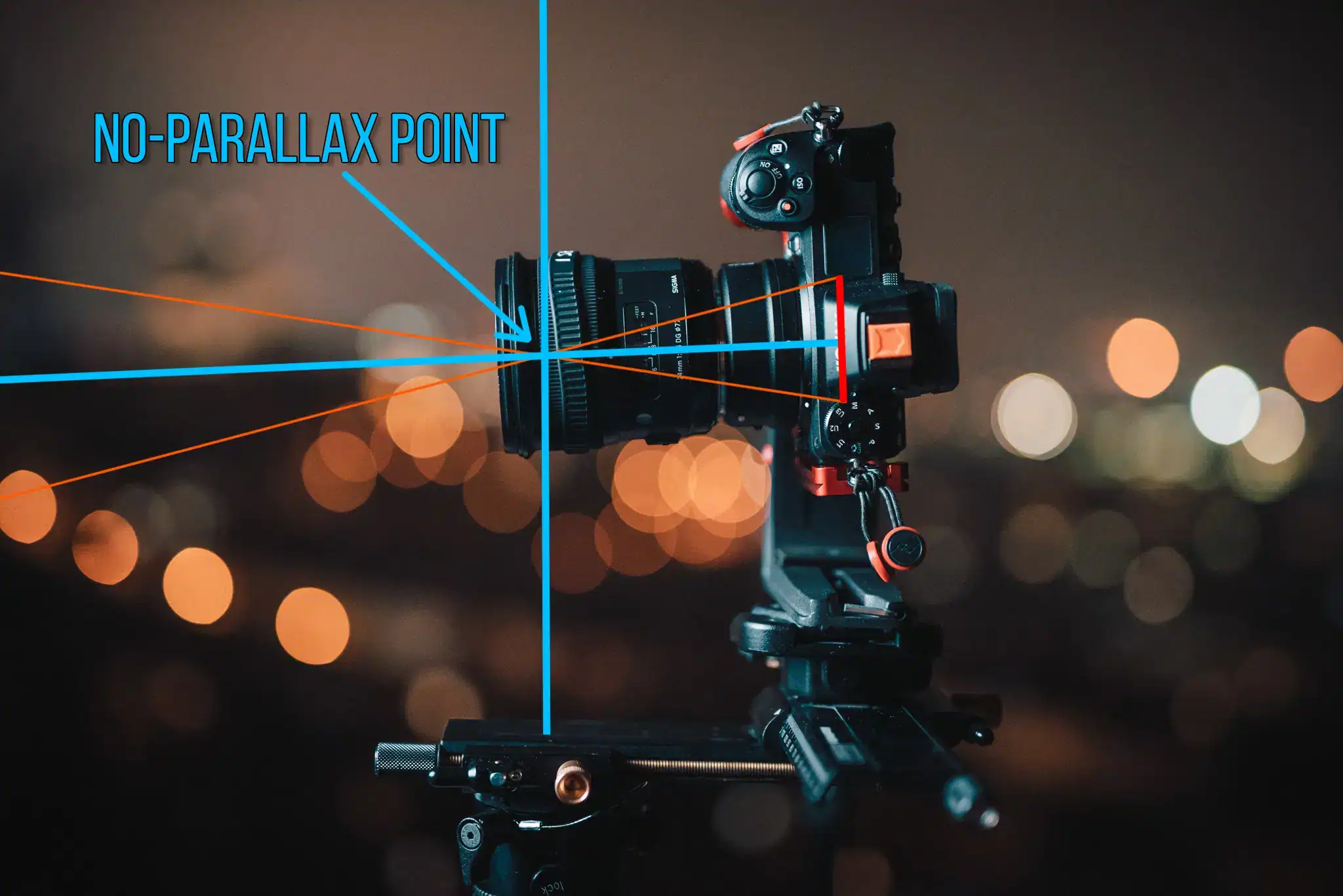
For a deeper look at panoramic head geometry and alignment, see this panoramic head setup guide from Oculus Creator documentation. Set up a panoramic head for high-end 360 photos
Step-by-Step Shooting Guide
Standard Static Scenes
- Level and align: Level the tripod and head. Slide the X‑T5 + Peleng along the rail until the entrance pupil is over the axis of rotation. Quick check: place two vertical objects (one near, one far) in overlap; rotate 30–60°. If their relative position shifts, adjust forward/backward until the shift disappears.
- Manual control: Set the X‑T5 to M mode. Lock exposure, aperture, and ISO. Turn off auto ISO. Set WB to a fixed preset (Daylight, Tungsten, or a custom Kelvin) to avoid color shifts.
- Focus and aperture: Manual focus to hyperfocal; at 8mm, f/8 keeps most of the frame sharp from ~0.5–1 m to infinity. Use focus peaking to confirm.
- Capture order: Shoot 6 images around at 60° steps with 25–35% overlap, then 1 zenith. If the tripod is visible, shoot 1 nadir by tilting down or moving the tripod slightly and shooting a patch shot.
HDR / High Dynamic Range Interiors
- Bracket ±2 EV (3 or 5 frames): The X‑T5 handles AEB well. Keep aperture constant; vary shutter speed. Always lock WB.
- Consistency: Use a remote or 2‑sec timer. Shoot each bracket fully before rotating. Avoid auto ISO or auto WB.
Low-Light / Night Scenes
- Shutter priority towards stability: On tripod, choose f/4–f/5.6; let shutter lengthen (1–8 s as needed). Keep ISO 125–800 for best quality; ISO 1600 is acceptable with noise reduction.
- Disable IBIS on tripod; use remote trigger or app to avoid micro-shake. If shooting handheld panos, IBIS on can help—but expect more stitching challenges.
Crowded Events
- Two-pass strategy: First pass quickly for safety; second pass timing gaps. Ask people near the camera to pause if possible.
- Post masking: In PTGui/Hugin, use masks to select the cleanest people/positions per sector.
Special Setups (Pole / Car / Drone)
- Poles: Ensure the pole’s rated load exceeds the X‑T5 + head weight. Use a tether. Keep shutter 1/125–1/250 to mitigate sway; burst if necessary and choose the sharpest frame per position.
- Car mounts: Avoid highways; smooth roads reduce vibration. Consider shorter exposures (1/250+), higher ISO if needed, and extra overlap.
For more panoramic composition and capture fundamentals, the above video provides a practical visual walkthrough.
Recommended Settings & Pro Tips
Exposure & Focus
| Scenario | Aperture | Shutter | ISO | Notes |
|---|---|---|---|---|
| Daylight outdoor | f/8–f/11 | 1/100–1/250 | 125–200 | Lock WB (Daylight); avoid clipped highlights |
| Low light/night | f/4–f/5.6 | 1/30–2 s (tripod) | 125–800 (to 1600 if needed) | IBIS off on tripod; remote trigger |
| Interior HDR | f/8 | Bracket ±2 EV (3–5 frames) | 125–400 | Balance windows & lamps; keep WB fixed |
| Action / moving subjects | f/5.6–f/8 | 1/200+ | 400–800 | Freeze motion; consider two-pass method |
Critical Tips
- Manual focus at or near hyperfocal distance; use magnified view and focus peaking to confirm.
- Nodal calibration: Mark your rail position for the X‑T5 + Peleng once you dial it in; tape or a paint pen saves time on future shoots.
- White balance lock: Mixed lighting? Use a custom Kelvin or gray card; avoid AWB across the set.
- Shoot RAW: The X‑T5’s 14‑bit RAW maximizes DR. JPEG is fine for speed but limits recovery.
- IBIS: Off on tripod. On for handheld scouting shots or quick single‑row panoramas.
Field-Proven Cases
Indoor real estate
Bracketed 3–5 frames at f/8, ISO 125–200, tripod, WB Tungsten or custom Kelvin. 6 around + zenith + nadir. Watch for mirror and glass reflections—shoot close to glass to minimize parasitic reflections.
Outdoor sunset
Single exposure at base ISO 125, f/8–f/11. Expose for highlights; lift shadows in post. Lens hood/flag the sun to reduce flare; remove the flag between frames or adjust angle to avoid it entering the frame.
Event crowds
Two-pass capture, 1/200–1/400 at f/5.6–f/8 and ISO 400–800. Mask moving subjects in the stitcher. Expect some ghosting; more overlap helps.
Stitching & Post-Processing
Software Workflow
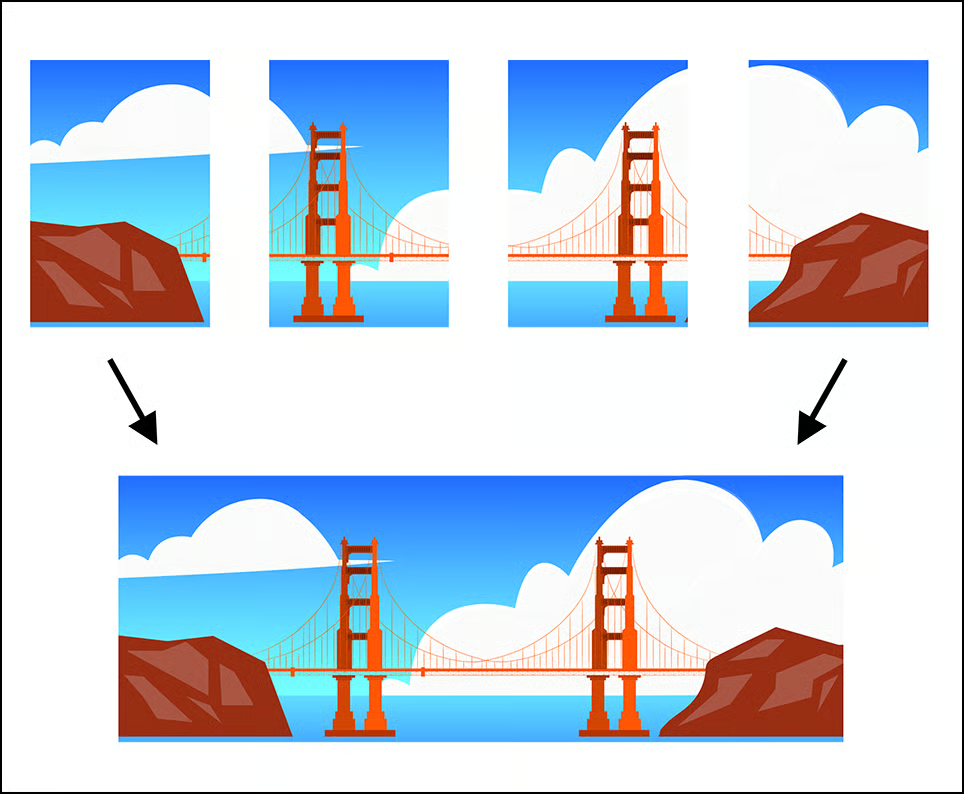
Import your RAWs into Lightroom/ACR for basic exposure and WB consistency (apply sync across the set). In PTGui or Hugin, set lens type to “fisheye,” focal length 8 mm, and sensor crop 1.5× (APS‑C). Use 25–35% overlap for fisheye sequences. For rectilinear lenses, 20–25% is typical, but you’ll take more shots. PTGui’s optimizer and masking tools make quick work of parallax or moving people, while Hugin offers a robust free alternative. Why many pros prefer PTGui for complex panos
Cleanup & Enhancement
- Nadir patch: Shoot a separate nadir or use an AI content‑aware fill. Many virtual tour platforms allow quick nadir patch overlays.
- Color consistency: Fine‑tune WB and HSL. Fix purple/green fringing from the Peleng around high‑contrast edges.
- Noise reduction: For ISO 800–1600, use moderate NR; preserve detail with masking.
- Leveling: Use horizon/vertical guides. Set pitch/roll/yaw so verticals are true in VR.
- Export: Equirectangular JPEG or TIFF at 8K–16K width depending on target. With 6×40MP frames, 12–16K is realistic; see spherical resolution concepts. Understanding spherical resolution
Want a comprehensive background on DSLR/mirrorless 360 workflows for VR platforms? Oculus’s guide offers a clear overview. Using a mirrorless to shoot and stitch a 360 photo
Useful Tools & Resources
Software
- PTGui (fast, masking, HDR fusion)
- Hugin (open source, powerful control)
- Lightroom / Photoshop (RAW + cleanup)
- AI tripod/nadir removal tools
Hardware
- Panoramic heads (Nodal Ninja, Leofoto): sliding rails and indexed rotators
- Carbon fiber tripods: lighter for hikes, stiffer in wind
- Leveling bases: speed and precision
- Wireless remote shutters: reduce shake
- Pole extensions / car mounts: unique vantage points—use tethers
Disclaimer: software/hardware names provided for search reference; check official sites for details.
Common Mistakes & How to Avoid Them
- Parallax error → Always align the entrance pupil; test with near/far objects.
- Exposure flicker → Manual mode and locked WB; avoid auto ISO and AWB.
- Tripod shadows/reflections → Shoot a nadir patch; reposition if needed; watch mirrors/glass.
- Ghosting from motion → Use masks in PTGui/Hugin; consider a faster shutter or two-pass method.
- Night noise and blur → Keep ISO modest (125–800), use a sturdy tripod, remote trigger, and IBIS off.
Safety & Gear Protection
On rooftops or near traffic, prioritize stability: sandbags on tripod legs, keep center column low, and attach a safety tether to the camera when shooting over edges or on poles. In high winds, reduce the profile (no large flags or hanging bags), and avoid extended poles above 3–4 m unless conditions are calm. The Peleng’s bulbous front element is vulnerable—use the cap when moving locations and keep a microfiber cloth ready. Always maintain a backup capture (a second full rotation or at least duplicate frames of critical angles) in case an image is blurred or obstructed.
Frequently Asked Questions
- Can I shoot handheld panoramas with the Fujifilm X‑T5?
Yes, for quick single‑row panos outdoors with lots of distance to subjects. Turn IBIS on, use 1/250+ shutter, and maintain generous overlap (35–40%). Expect more stitching cleanup vs. a tripod/ head workflow, especially with near‑foreground objects.
- Is the Peleng 8mm f/3.5 wide enough for a single-row 360 on APS‑C?
For full spherical 360×180, you still need zenith and nadir. A typical set is 6 around at 0° tilt plus a zenith and a nadir. In open skies with no tall ceilings, you can sometimes cover the zenith with slight positive tilt during the ring, but a dedicated zenith shot is safer.
- Do I need HDR for interiors with bright windows?
Usually yes. Bracket ±2 EV (3–5 shots) to preserve both windows and interior shadows. The X‑T5’s base ISO 125 DR is strong, but windows in midday sun often exceed single‑exposure range.
- How do I avoid parallax issues with this combo?
Mount the X‑T5 and Peleng on a panoramic head with sliding rails. Calibrate the entrance pupil by aligning near/far objects and adjust the lens position until relative motion disappears when rotating. Mark that rail position for repeatability.
- What ISO range is safe on the X‑T5 in low light?
On tripod, keep ISO 125–800 whenever possible to maximize detail and color depth. ISO 1600 remains usable with careful noise reduction, but try to compensate with longer shutter first.
- Can I set up custom modes to speed up pano shooting?
Yes. Assign a custom mode with manual exposure (typical f/8, base ISO), IBIS off (tripod), manual focus, and fixed WB. A second custom mode can store your HDR bracketing settings.
- How do I reduce flare with a fisheye like the Peleng?
Avoid pointing directly at the sun; shield with your hand or a small flag off‑frame. Clean the front element and shoot an extra frame if the sun must be included, then blend the cleanest flare‑free portion in post.
- What panoramic head should I choose?
Look for a compact multi‑row head or a single‑row head with fore/aft rail and indexed rotator (e.g., Nodal Ninja/Leofoto). It must support the X‑T5’s weight and allow precise entrance pupil adjustment.
Extra Visuals & References

If you’re new to pano heads and want an overview from a gear‑first perspective, this guide is handy. Panoramic head tutorial and tips
Troubleshooting Quick Wins
- Patch won’t stitch cleanly: Add more overlap or re‑optimize control points; mask out problematic frames.
- Visible seams: Ensure consistent exposure/WB; increase feathering in your stitcher; fix CA before stitching.
- Soft corners: Stop down to f/5.6–f/8. Check focus; confirm IBIS is off on tripod.
- Horizon not level: Use the optimizer’s vertical/horizon tools; re‑level the tripod on site.
Wrap-up: Why This Setup Works
The Fujifilm X‑T5’s high‑resolution APS‑C sensor paired with the Peleng 8mm fisheye is a proven, efficient route to excellent 360° panoramas. You’ll capture fewer frames, work faster in dynamic environments, and still produce high‑detail equirectangular files suitable for virtual tours and immersive platforms. With careful nodal alignment, locked exposure and WB, and a clear stitching workflow in PTGui or Hugin, your panoramas will be clean, sharp, and production‑ready.