
Why This Camera & Lens Are Great for Panoramas
If you want to learn how to shoot panorama with Fujifilm X-T5 & Fujifilm XF 10-24mm f/4 OIS WR, you’ve picked a versatile, high-resolution combo that excels for both single-row and multi-row 360° work. The X-T5’s 40.2MP APS-C X-Trans CMOS 5 HR sensor delivers superb detail and color with around 13.5 stops of usable dynamic range at base ISO (125), making it ideal for high-contrast scenes and HDR panoramas. Pixel pitch is approximately 3.5 µm, which rewards careful technique and a steady setup for maximum micro-contrast.
The XF 10-24mm f/4 OIS WR is a rectilinear ultra-wide zoom that keeps straight lines straight—critical for architectural and real estate panoramas. At 10mm (15mm full-frame equivalent), it offers a wide field of view with manageable distortion and good corner sharpness once stopped down to f/5.6–f/8. It also has optical image stabilization (OIS), and the X-T5 body adds in-body stabilization (IBIS). While stabilization is helpful handheld, turn OIS/IBIS off on a tripod to avoid micro-blur during long exposures and when stitching. The combination’s X-mount compatibility with modern panoramic heads and L-brackets makes it easy to set precise nodal alignment for clean stitching results.
Quick Setup Overview
- Camera: Fujifilm X-T5 — APS-C (23.5 × 15.6 mm) sensor, 40.2MP, base ISO 125, strong DR and color depth.
- Lens: Fujifilm XF 10-24mm f/4 OIS WR — rectilinear zoom, sharpest around f/5.6–f/8, mild barrel distortion at 10mm, well-controlled CA when stopped down.
- Estimated shots & overlap (field-tested starting points):
- At 10mm: two rows of 8 shots at ±30° pitch (30–35% overlap) + zenith + nadir (≈18 images).
- At 14mm: two rows of 10 shots (25–30% overlap) + zenith + nadir (≈22 images).
- At 18–24mm: two rows of 12–16 shots (20–25% overlap) + zenith + nadir (≈26–34 images).
For single-row partial panoramas, 6–10 shots around at 10–14mm with ~30% overlap often suffices.
- Difficulty: Medium — rectilinear multi-row is precise but rewarding; practice nodal alignment.
Planning & On-Site Preparation
Evaluate Shooting Environment
Assess light direction and contrast (sunset vs overcast), reflective surfaces (glass, polished stone), and movement (people, cars, trees). If shooting near glass, work at an angle when possible and keep the lens hood close to the glass or use a black cloth to reduce reflections. If you must shoot through glass, keep at least a few centimeters away to avoid accidental contact and potential flare/ghosting.
Match Gear to Scene Goals
The X-T5’s high-resolution sensor captures fine texture for detailed panoramas or virtual tours. Indoors, its clean files up to ISO 800–1600 mean you can keep shutter speeds comfortable when bracketing HDR shots. The XF 10-24mm’s rectilinear rendering preserves architectural lines and reduces post-correction work, especially in real estate interiors. While fisheye lenses need fewer shots, the 10-24mm yields more natural perspectives and tighter control over edge distortion—worth the extra frames for professional results.
Pre-shoot Checklist
- Charge batteries; bring spares. Use high-speed UHS-II SD cards; the X-T5’s 40MP files add up quickly.
- Clean front/rear elements and the sensor; smudges multiply across frames and complicate stitching.
- Calibrate and mark your panoramic head for the lens’ nodal point at 10–14mm (common pano focal lengths).
- Level your tripod. A leveling base speeds setup and reduces horizon correction later.
- Safety: weigh down the tripod in wind, tether on rooftops, use safety cables on poles/car rigs.
- Backup workflow: shoot an extra full round (or bracket set) in case of motion or stitching errors.
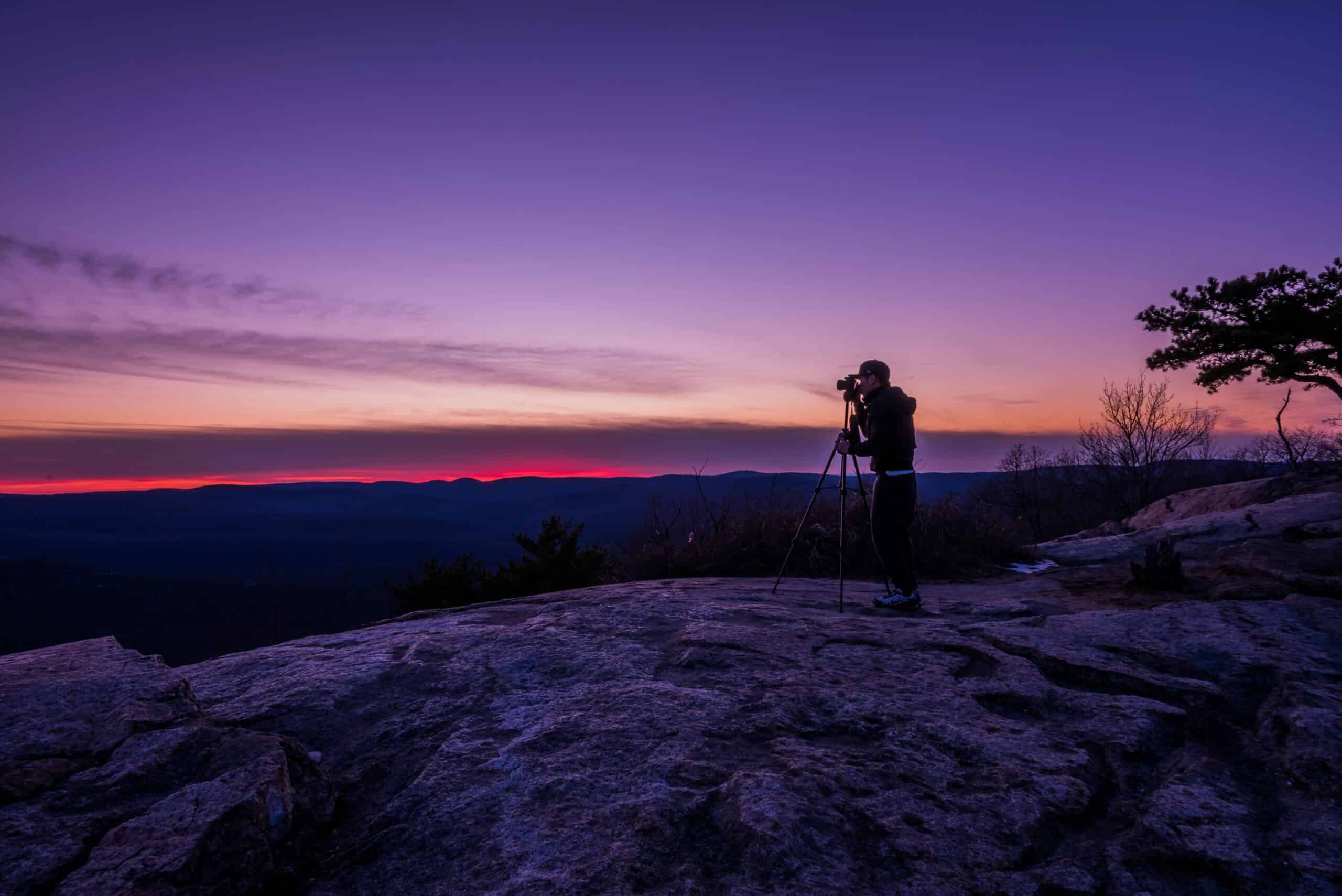
Essential Gear & Setup
Core Gear
- Panoramic head: Use an adjustable pano head that lets you position the entrance pupil (nodal point) over the rotation axis. This minimizes parallax, solving ghosting when stitching foreground and background lines.
- Stable tripod with leveling base: A 2–3 section carbon-fiber tripod with a 60–75 mm leveling half-bowl or base speeds up leveling and reduces creep during long exposures.
- Remote trigger or app: Use a cable release or the Fujifilm Camera Remote app. Self-timer 2s also works if you forget the remote.
Optional Add-ons
- Pole or car mount: Use a rigid pole for elevated views; always tether and watch wind gusts. On vehicles, ensure vibration damping and avoid public roads without proper rigging and permits.
- Lighting aids: Small LEDs for dark corners in interiors (avoid mismatched color temps), or use bracketing instead.
- Weather protection: Rain covers, microfiber cloths, and gaffer tape to secure cables and prevent sway.
Nodal Alignment Primer (Entrance Pupil)
Start with the lens at 10mm. Place two vertical objects (e.g., light stands) at near and far distances. Rotate the camera on the pano head and adjust the rail until the two objects stay aligned relative to each other—this is your no-parallax position. Mark the rail for quick repeatability. As a starting point for the XF 10-24mm on APS-C:
- 10mm: entrance pupil roughly 60 ±5 mm behind the front ring
- 14mm: ~65 ±5 mm
- 24mm: ~70 ±5 mm
These are ballpark values—always verify in the field. Precise alignment dramatically reduces stitching errors and speeds post.
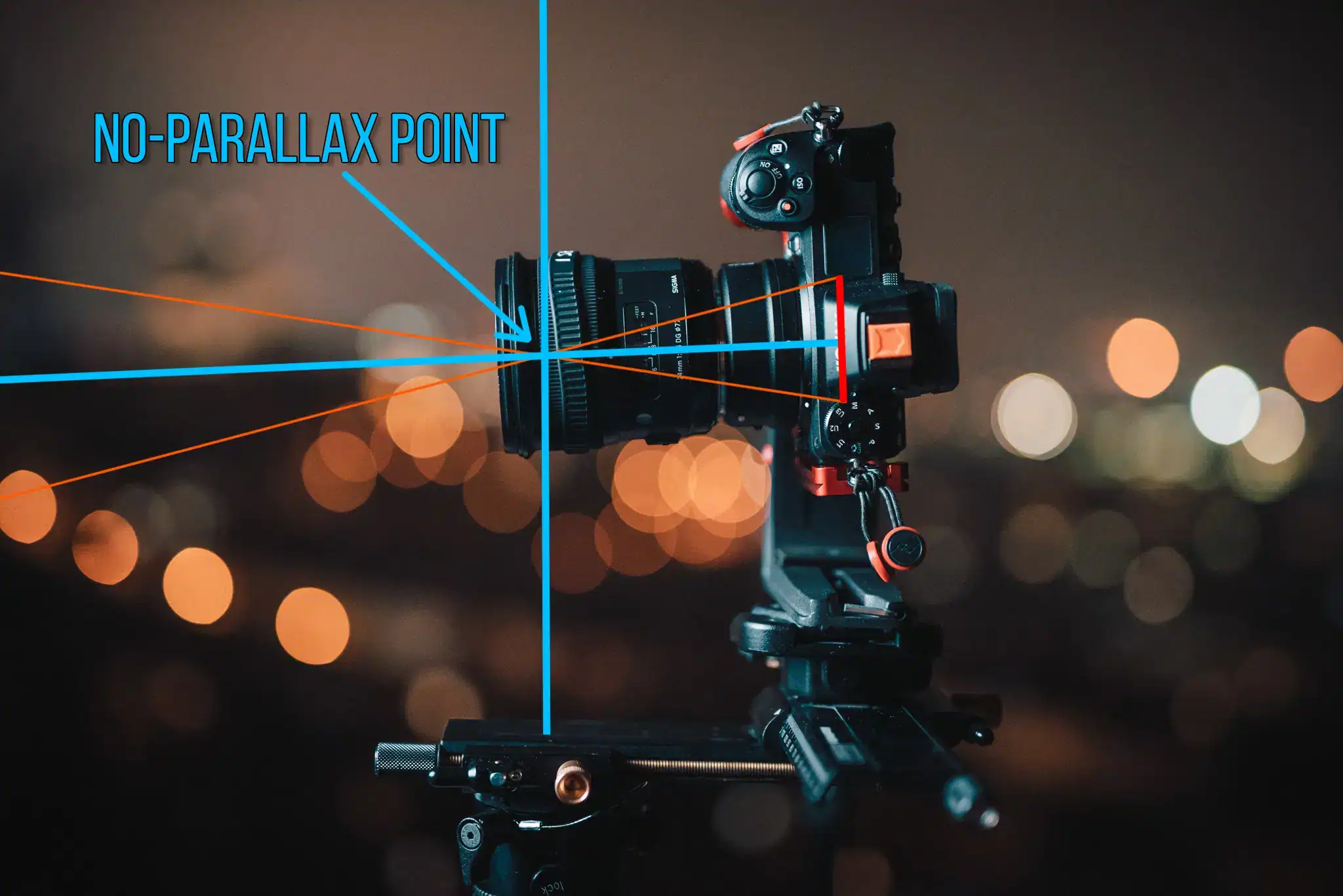
For an in-depth panoramic head primer and setup practice, see this panoramic head tutorial by 360 Rumors. Read the panoramic head tutorial
Step-by-Step Shooting Guide
Standard Static Scenes
- Level the tripod and align the nodal point: Use your leveling base. Set the pano head’s yaw to 0°, then adjust until the bubble is centered. Confirm your lens’ nodal mark from earlier tests.
- Dial manual exposure and lock white balance: Switch to M mode and meter for the midtones. For daylight, start at ISO 125, f/8, 1/125s, WB Daylight. This prevents exposure flicker and color shifts across frames.
- Focus manually at hyperfocal: At 10mm and f/8 on APS-C, the hyperfocal distance is about 0.6–0.7 m. Focus there and switch AF off to keep every frame consistent.
- Capture around with consistent overlap: At 10mm, shoot two rows (pitch +30° and -30°) of 8 frames each with ~30–35% overlap, then shoot a zenith (up) and a nadir (down) frame. Use a systematic rotation pattern (e.g., 45° yaw increments).
- Take the nadir for tripod removal: If possible, take a handheld nadir shot after moving the tripod aside, keeping the nodal point position in mind. Mark the ground to re-align.
HDR / High Dynamic Range Interiors
- Bracket ±2 EV (3–5 frames): The X-T5 supports robust bracketing. For bright windows, try 5 frames at ±2 EV increments (or at least -2/0/+2 EV) for enough shadow and highlight detail.
- Lock WB: Use a fixed Kelvin value (e.g., 4000–4500K for mixed interior lighting), or Daylight if dominant natural light. Consistent color aids stitching and batch editing.
- Use mechanical shutter: To avoid LED banding/flicker under artificial lights, prefer mechanical or EFCS with safe shutter speeds (e.g., 1/50s, 1/100s).
Low-Light / Night Scenes
- Long exposure on a stable mount: Start around f/4–f/5.6, ISO 125–400, and let shutter lengths increase (1–8s). The X-T5 handles ISO 800–1600 well if wind or motion forces you to raise ISO.
- Turn off IBIS/OIS on tripod: Stabilization can introduce micro-movement. Use a remote or 2s timer to eliminate shake.
- Mind hot pixels: Long exposures on high-res sensors can produce hot pixels; enable long-exposure noise reduction if time allows, or map in post.
Crowded Events
- Shoot two passes: First pass for coverage, second pass timed for gaps in foot traffic.
- Use faster shutter: Aim for 1/200s or faster at f/5.6–f/8 and ISO 400–800 to reduce motion blur.
- Mask in post: PTGui/Hugin allow masking to choose the best subject position per area.
Special Setups (Pole / Car / Drone)
- Secure gear & tether: Use a safety cable and verify all locks. Elevated poles magnify wind-induced sway—keep exposures short and rotate slower between frames.
- Vibration control: On car rigs, shoot at low speed or stationary, use shorter shutter times, and consider higher ISO to maintain crispness.
- Legal and safety: Respect no-fly/no-mount zones, private property rules, and traffic regulations.
Recommended Settings & Pro Tips
Exposure & Focus
| Scenario | Aperture | Shutter | ISO | Notes |
|---|---|---|---|---|
| Daylight outdoor | f/8–f/11 | 1/100–1/250 | 125–200 | Lock WB (Daylight); manual focus near hyperfocal |
| Low light/night | f/4–f/5.6 | 1/30–8s | 125–800 (up to 1600 if needed) | Tripod, IBIS/OIS off, remote trigger |
| Interior HDR | f/8 | Bracket ±2 EV (3–5 frames) | 125–400 | Balance window highlights and interior shadows |
| Action / moving subjects | f/5.6–f/8 | 1/200+ | 400–800 | Freeze motion; consider two-pass method |
Critical Tips
- Manual focus at hyperfocal: At 10mm and f/8, about 0.6–0.7 m keeps near to infinity acceptably sharp.
- Nodal calibration: Mark your rail positions for 10, 14, and 24mm to speed setup.
- White balance lock: Mixed lighting varies frame to frame; use a fixed Kelvin or preset for consistency.
- RAW over JPEG: The X-T5’s 14-bit RAW gives better dynamic range and white balance flexibility for HDR and tricky lighting.
- Stabilization: Turn off IBIS/OIS on a tripod; for handheld partial panos, IBIS can help at 1/60–1/125s.
- File management: 40MP files are large; consider lossless compressed RAW and a disciplined folder structure for multi-row sets.
A concise video overview for setting up a panoramic head before you shoot multi-row 360s.
Stitching & Post-Processing
Software Workflow
Import RAWs into Lightroom or Capture One, apply a clean baseline (consistent WB, lens profile correction off or applied uniformly), and sync across the set. Export 16-bit TIFFs or send RAWs directly to PTGui/Hugin. With rectilinear lenses like the XF 10-24mm, aim for 25–35% overlap. PTGui’s control point finder is reliable; Hugin is excellent and free but can be more hands-on. For the X-T5’s 40MP files, consider downscaling previews during layout to speed up interaction, then render final at full resolution. For more on PTGui’s strengths, see this review on Fstoppers. Read a PTGui review for pro panorama stitching
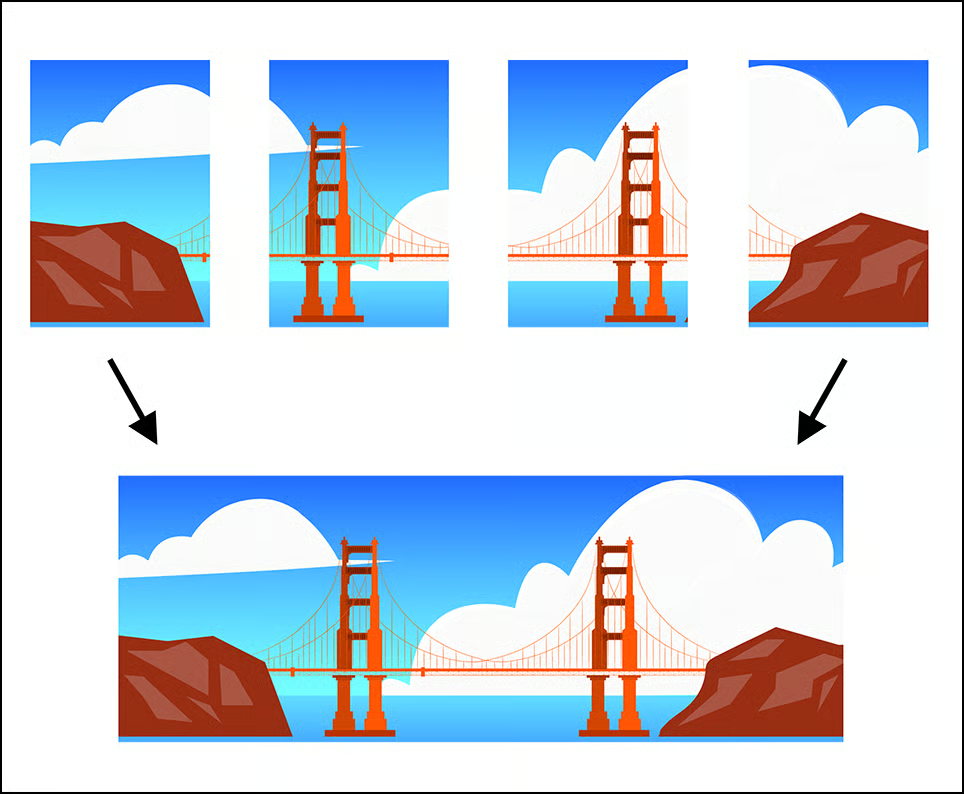
Cleanup & Enhancement
- Nadir patch: Use PTGui’s Viewpoint Correction or export and patch in Photoshop with Content-Aware Fill; AI-based tripod removal tools can speed this up.
- Color and noise: Match color across brackets, apply modest noise reduction (X-T5 RAWs tolerate it well), and correct any mixed lighting casts.
- Level the horizon: Use PTGui’s verticals/horizon tool or fine-tune in Photoshop to correct residual tilt.
- Export formats: For VR, export an equirectangular JPEG/TIFF at 2:1 aspect ratio (e.g., 16000×8000). For web tours, keep under platform limits and consider tiled multi-resolution outputs.
For a platform-oriented overview of shooting and stitching DSLR 360 photos, Meta’s Creator Guide provides practical pointers. Using a mirrorless to shoot and stitch a 360 photo
Useful Tools & Resources
Software
- PTGui panorama stitching (fast and precise control points, masks, and viewpoint correction)
- Hugin (open source, powerful for multi-row if you’re comfortable with manual control)
- Lightroom / Photoshop for RAW prep, tone mapping, and retouch
- AI tripod removal tools (Content-Aware Fill, generative tools)
Hardware
- Panoramic heads (Nodal Ninja, Leofoto, Sunwayfoto) with fore-aft rails for entrance pupil alignment
- Carbon fiber tripods with a leveling base (or bowl) for fast, stable setup
- Wireless remote shutters and intervalometers
- Pole extensions / car mounts with safety tethers for special vantage points
Disclaimer: brand names for search reference; check official sites for current specs and compatibility.
For a broad DSLR/mirrorless lens and workflow overview, this guide is a helpful companion. DSLR/Virtual Tour camera & lens guide
Real-World Scenarios & Field Advice
Indoor Real Estate (Bright Windows)
At 10–12mm, shoot two rows of 8–10 frames with 30% overlap and bracket -2/0/+2 EV (or 5 frames if windows are very bright). Keep ISO 125–400 and f/8 for edge-to-edge sharpness. Watch verticals; keep the camera level to avoid keystone distortions. The rectilinear 10-24mm helps maintain straight lines, reducing post-correction time.
Outdoor Sunset Landscape
Use base ISO (125), f/8–f/11, and vary shutter speed. Consider a 3-frame bracket if the sun is in frame. Flare can happen—shade the lens with your hand or body between frames (avoid casting shadows into the scene). The X-T5’s DR and 14-bit RAW files give more headroom for highlight recovery.
Crowds and Events
Time your rotations during lulls. If movement is inevitable, capture a clean background pass first, then a second pass with people. During stitching, use masks to keep the best subject instances and eliminate duplicates/ghosts. Fast shutters (1/200s+) help, even if you raise ISO to 800–1600.
Rooftop / Windy Conditions
Hook a weight bag to your tripod, lower leg sections, and use a remote. Keep shutter 1/100s or faster if possible; if you must expose longer, shield the rig from gusts and pause rotations until the wind settles.
Pole Shooting
Shorten exposure times by raising ISO (to 800–1600) and use f/5.6–f/8 for edge sharpness. Rotate slowly and stop completely before each frame. Avoid crowded areas and always tether the pole for safety.
Safety, Limitations & Honest Gotchas
- Turn off IBIS/OIS on a tripod: Prevents stabilization-induced blur.
- Watch tripod shadows and reflections: Plan a nadir patch or reposition slightly between shots.
- LED flicker indoors: Prefer mechanical shutter or shutter speeds synced with lighting to avoid banding.
- High-resolution demands: 40MP punishes sloppy technique—use precise nodal alignment, solid support, and consistent exposure.
- Back up on site: The X-T5’s dual UHS-II slots—use backup recording to avoid data loss.

Exporting for the Web and VR
For virtual tours, export an equirectangular 2:1 image. Common sizes are 12000×6000 or 16000×8000 for high-end platforms. Keep JPEG quality around 90–95 to balance quality and size. Many web players support multi-resolution tiles; use them to accelerate loading and maintain crisp details on zoom. If you’re new to VR delivery, Meta’s panoramic head setup guide is a concise overview of high-end capture principles. Set up a panoramic head for high-end 360 photos
Common Mistakes & How to Avoid Them
- Parallax error → Align the entrance pupil (nodal point) precisely; test with near/far objects before critical shoots.
- Exposure flicker → Manual exposure and locked white balance; avoid auto ISO and auto WB.
- Tripod shadows → Note sun direction; capture a separate nadir or patch later in post.
- Ghosting from moving subjects → Two-pass method and stitcher masks; keep shutter speed up when possible.
- Soft corners → Stop down to f/5.6–f/8 on the XF 10-24mm; avoid diffraction at f/16 unless necessary.
- Stabilization artifacts → Turn IBIS/OIS off on tripod; use a remote or timer.
Frequently Asked Questions
- Can I shoot handheld panoramas with the Fujifilm X-T5?
Yes for partial panos; IBIS helps at 1/60–1/125s. For 360° multi-row with the XF 10-24mm, a tripod and pano head are strongly recommended to avoid parallax and alignment issues.
- Is the Fujifilm XF 10-24mm f/4 OIS WR wide enough for a single-row 360?
Not reliably. At 10mm (APS-C), you’ll typically need at least two rows plus zenith and nadir for full spherical coverage. Single-row is fine for cylindrical panoramas but not complete 360×180 spheres.
- Do I need HDR for interiors with bright windows?
Usually, yes. Bracket at ±2 EV (3–5 frames) to capture both window highlights and interior shadows. The X-T5’s DR is strong, but bracketed merges produce cleaner, more natural results.
- How do I avoid parallax issues with this lens?
Use a panoramic head and align the entrance pupil. Start with ~60 mm rail offset at 10mm and refine on site by aligning near/far objects and checking for no relative movement as you rotate.
- What ISO range is safe on the X-T5 in low light?
Aim for ISO 125–800 on a tripod for best quality; push to 1600 if wind or movement demands faster shutters. The 40MP sensor is detailed—prioritize stability and longer exposures when you can.
- Can I create Custom Settings for panorama on the X-T5?
Yes. Save a preset with Manual mode, base ISO, f/8, mechanical shutter, manual focus, OIS/IBIS off, and a fixed WB. This speeds up setup in the field and ensures consistency across frames.
- How can I reduce flare with this rectilinear zoom?
Use the hood, shade the lens with your hand outside the frame, and avoid shooting directly into intense point sources when possible. Shoot a second pass to replace flared frames during stitching if needed.
- Best tripod head choice for this setup?
A two-axis panoramic head with fore-aft and lateral rails (e.g., Nodal Ninja or Leofoto) allows precise nodal alignment. A leveling base beneath it speeds setup and keeps horizons true.
Final Thoughts
Learning how to shoot panorama with Fujifilm X-T5 & Fujifilm XF 10-24mm f/4 OIS WR is about mastering consistent technique: solid support, nodal alignment, manual settings, sufficient overlap, and disciplined post-processing. This high-resolution Fuji combo rewards careful work with crisp, distortion-controlled 360° imagery suitable for professional real estate, landscapes, events, and virtual tours.