
Why This Camera & Lens Are Great for Panoramas
The Fujifilm X‑T5 paired with a rectilinear ultrawide like the Canon RF 15–35mm f/2.8L IS USM gives you a flexible, sharp, and low‑distortion platform for high‑quality 360° and gigapixel panoramas. The X‑T5’s 40.2MP APS‑C X‑Trans CMOS 5 HR sensor delivers fine detail with a pixel pitch of about 3.04µm, strong base ISO dynamic range (~13–13.5 EV at ISO 125), and in-body image stabilization (IBIS) rated up to 7 stops for handheld frames between tripod positions. The Canon RF 15–35mm f/2.8L is a pro‑grade, rectilinear zoom that’s optically robust: sharp from center to edges by f/4–f/8, controlled lateral CA, and excellent flare handling compared to many ultrawides. Being rectilinear, it preserves straight lines—hugely important for architecture and real estate work—at the cost of requiring more shots than a fisheye.
Important compatibility note: Canon RF lenses are not natively adaptable to Fujifilm X mount with full electronic aperture control as of this writing. If you already own the RF 15–35, you’ll typically use it on a Canon RF body. To stay on Fuji X, consider functionally equivalent options such as the Fujifilm XF 10–24mm f/4 R OIS WR or adapting Canon EF ultrawides (e.g., EF 16–35mm) via a Fringer EF‑X Pro II adapter. The techniques below apply directly to any rectilinear ultrawide in the 10–24mm (APS‑C) or 15–35mm (full‑frame) range. Where relevant, I’ll provide focal‑length‑specific shot counts for the RF 15–35 mounted on an APS‑C body (equivalent FOV ~22.5–52.5mm).
Quick Setup Overview
- Camera: Fujifilm X‑T5 — APS‑C (23.5×15.6mm) X‑Trans CMOS 5 HR, 40.2MP, pixel pitch ~3.04µm, excellent base ISO DR (~13–13.5 EV), IBIS up to 7 stops.
- Lens: Canon RF 15–35mm f/2.8L IS USM — rectilinear ultrawide zoom, constant f/2.8, optical IS, very sharp at f/4–f/8, mild barrel at 15mm (correctable), strong flare resistance for an ultrawide.
- Estimated shots & overlap (APS‑C use at 15mm focal length; ~77° HFOV):
- 360×180 spherical at 15mm: 3 rows, about 7 around at 0°, 5 around at +40°, 5–7 around at −40°, plus zenith and nadir (≈19–23 frames total at ~30% overlap).
- At 20mm (HFOV ≈61°): ~9 around per horizontal row; similar vertical scheme (≈25–30 frames).
- At 35mm (HFOV ≈37°): ~14 around per row; multi‑row total can reach 40+ frames for high‑res output.
- Overlap guideline: 25–30% for spherical panos with rectilinear lenses; 30–40% if you plan heavy masking or crowds.
- Difficulty: Intermediate (precise nodal alignment recommended).
Planning & On-Site Preparation
Evaluate Shooting Environment
Survey light direction, contrast, moving people/traffic, reflective surfaces, and wind. For interiors with windows, expect extreme dynamic range; plan HDR brackets. If shooting through glass, keep your front element close (2–5 cm) and shade with a black cloth or rubber hood to reduce reflections. Note potential parallax traps: nearby railings, chairs, lamps, or tree branches—these demand very accurate nodal alignment to avoid stitching ghosts.
Match Gear to Scene Goals
The X‑T5’s high pixel density and strong base ISO dynamic range are ideal for detailed architectural and landscape 360s. On tripod, keep ISO low (125–400) for clean files; the 40MP sensor resolves fine textures for immersive VR output. A rectilinear ultrawide like the RF 15–35mm (or Fuji XF 10–24mm as a native alternative) minimizes distortion of straight lines, crucial for real estate. At f/8 and 15mm, the hyperfocal distance on APS‑C is about 1.4–1.6 m; focusing there keeps near objects reasonably sharp while preserving infinity detail.
Compatibility & FOV Note
If you cannot adapt the RF 15–35 to the X‑T5 with aperture control, use a comparable X‑mount ultrawide (10–24mm) and follow the same focal‑length targets (e.g., set 10–12mm APS‑C to mirror 15–18mm full‑frame FOV). All shot counts and overlap suggestions below map 1:1 to equivalent FOVs.
Pre-shoot Checklist
- Power and media: two fully charged batteries and ample UHS‑II cards; the X‑T5’s 40MP files add up quickly across multi‑row sets.
- Optics: clean front/rear elements and sensor; dust spots are very visible in skies and gradients.
- Support: tripod leveled (use a leveling base), panoramic head calibrated to the lens’s entrance pupil (nodal point).
- Safety: secure rooftop/pole rigs with tethers; avoid placing tripod legs where foot traffic can bump them; mind wind loads on poles.
- Backup: do a second safety pass—especially when crowds or cars move—so you have clean tiles to mask later.
Essential Gear & Setup
Core Gear
- Panoramic head: Enables rotating the camera around the lens entrance pupil to eliminate parallax between near and far objects. Adjustable rails let you slide the camera front‑to‑back and side‑to‑side to find the nodal point.
- Stable tripod with leveling base: A true leveling base speeds setup and keeps your rows consistent. Always level before shooting.
- Remote trigger or app: Use the Fujifilm Remote app or a cable release to prevent vibration, especially for long exposures and brackets.
Optional Add-ons
- Pole or car mount: For elevated or moving shots. Use guy lines and safety tethers; avoid high winds; monitor vibrations to prevent blurry frames.
- Lighting aids: Small LED panels or bounced flash to lift dark interiors—use with care to avoid hotspots between frames.
- Weather protection: Rain cover and microfiber cloths for drizzle or sea spray; consider a lens hood to reduce flare in low sun.
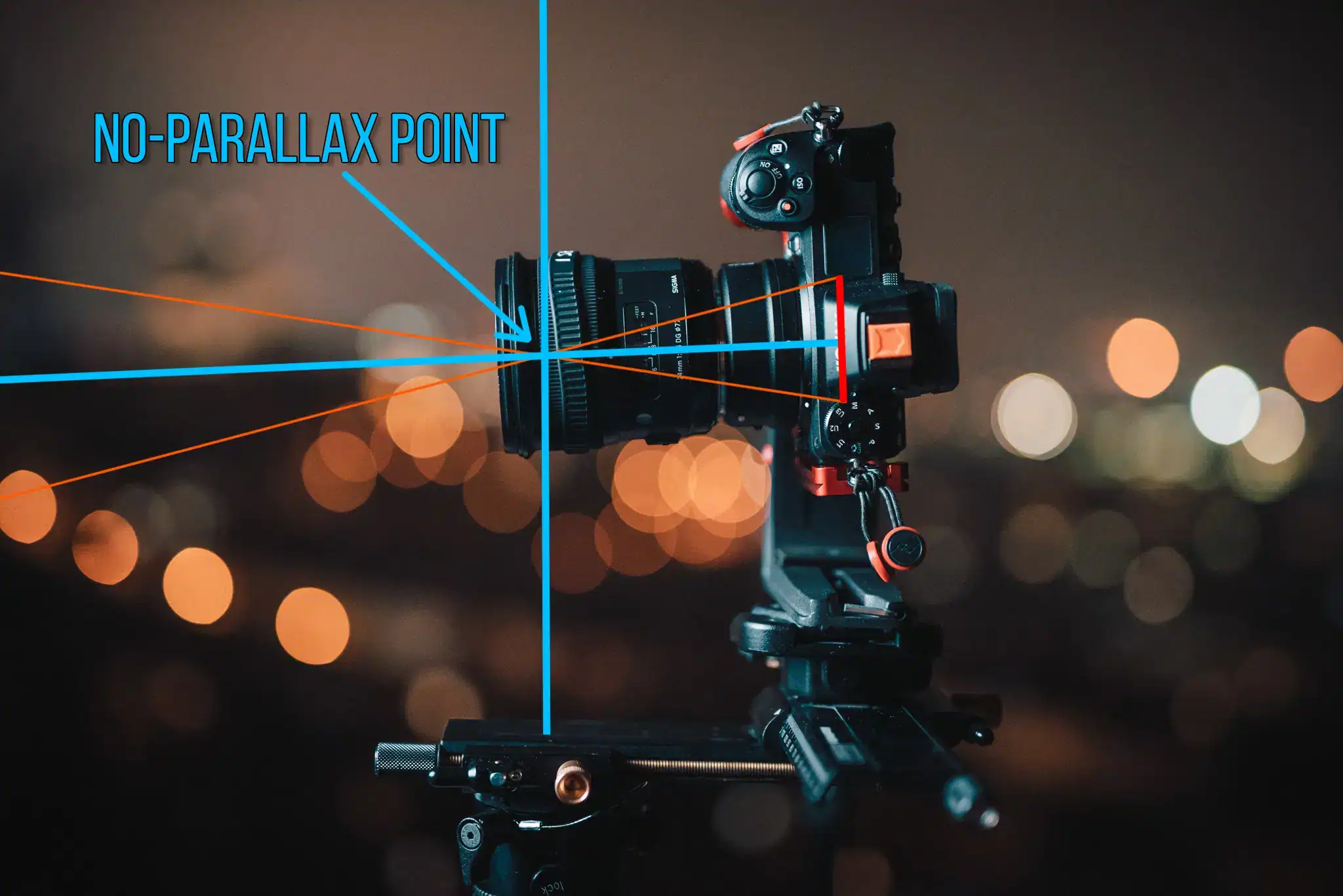
Want a deeper dive on panoramic head setup and why nodal alignment matters? See this panoramic head primer for a step‑by‑step visual walkthrough. Panoramic head tutorial (360Rumors)
Step-by-Step Shooting Guide
Standard Static Scenes
- Level the tripod and align the nodal point. Slide the camera on the pano head so a near vertical object and a far object (both off‑center) do not shift relative to each other as you pan. For a rectilinear ultrawide at 15mm, expect the entrance pupil to sit near the front element; a good starting offset from the sensor plane is roughly 75–85 mm at 15mm and 100–110 mm at 35mm, then fine‑tune.
- Set manual exposure and lock white balance. Meter the scene’s midtones; in tricky light, expose to protect highlights, especially near the sun or windows. Lock WB (Daylight/Cloudy or custom K) to prevent color shifts between frames.
- Focus and lock. Use manual focus; at 15mm, f/8, set focus ~1.5 m (hyperfocal) for front‑to‑back sharpness. Use focus peaking or magnification to confirm.
- Disable stabilizers on tripod. Turn off IBIS and lens IS to prevent micro‑shake blur during long exposures.
- Capture your planned sequence. At 15mm (APS‑C), consider: +40° row (5 shots), 0° row (7 shots), −40° row (5–7 shots), then a zenith and a nadir. Maintain 25–30% overlap; rotate consistently using your head’s degree markings.
- Take the nadir (ground) shot. After the main sweep, tilt down to shoot the tripod area; later, patch or clone‑out the tripod.
HDR / High Dynamic Range Interiors
- Bracket ±2 EV (3 or 5 frames). Interiors with bright windows often need at least three exposures; for very bright exteriors, use 5 frames (−4/−2/0/+2/+4 EV).
- Lock WB and aperture. Keep aperture constant (f/8) across brackets; vary shutter only. This preserves depth of field and lens behavior.
- Shoot all brackets per angle before rotating. Consistency helps batch HDR merge and stitching later.
Low-Light / Night Scenes
- Use longer exposures at low ISO. Start around ISO 125–400 at f/4–f/5.6, adjusting shutter as needed (1–10 s). The X‑T5 files stay clean if you avoid pushing ISO; ISO 800–1600 is usable with good noise reduction.
- Use a remote trigger. Even gentle shutter taps can blur long exposures at ultrawide focal lengths.
- Mind moving lights. Car light trails can be interesting but may complicate stitching; consider a second pass to patch ghosts in post.
Crowded Events
- Two‑pass strategy. First pass for coverage, second pass for “clean plates” as people move out of key areas.
- Shorten overlap to 25–30% only if your stitcher is robust; otherwise, keep 30–40% to give yourself more masking room.
- Later, blend or mask motion. PTGui’s masking tools let you choose the cleanest segments from each pass.
Special Setups (Pole / Car / Elevated)
- Secure gear carefully. Use safety lines, tighten clamps, and avoid gusty conditions. Keep rotations slow to minimize vibrations.
- Short exposures. Aim for 1/250–1/500 s at elevated poles or car mounts to avoid motion blur; increase ISO if necessary but keep it as low as you can.
- Consider fewer, wider shots. At the widest focal lengths, you can reduce the number of frames and shorten total capture time, reducing motion mismatch.
Recommended Settings & Pro Tips
Exposure & Focus
| Scenario | Aperture | Shutter | ISO | Notes |
|---|---|---|---|---|
| Daylight outdoor | f/8–f/11 | 1/100–1/250 | 125–200 | Lock WB (Daylight); protect highlights |
| Low light/night | f/4–f/5.6 | 1–10 s | 125–800 (up to 1600 if needed) | Tripod, remote, IS/IBIS off |
| Interior HDR | f/8 | Bracket ±2 EV | 125–400 | Windows vs shadows balance |
| Action / moving subjects | f/5.6–f/8 | 1/200+ | 400–800 | Freeze motion, shoot two passes |
Critical Tips
- Manual focus at hyperfocal. At 15mm and f/8 on APS‑C, focus ~1.5 m; at 24mm equivalent (≈16mm APS‑C), focus ~2 m. Use MF assist and peaking.
- Nodal calibration: Place a near object ~1 m away and a far object in the same frame off‑center. Adjust the fore‑aft rail so their relative positions don’t shift as you pan.
- Lock white balance. Mixed lighting across frames causes stitching seams; set a fixed Kelvin or custom preset on the X‑T5.
- RAW capture. RAW maximizes recoverable dynamic range for HDR panorama workflows.
- Stabilization etiquette. Turn off IBIS and lens IS on tripod; leave them on only for handheld or pole shots.
Stitching & Post-Processing
Software Workflow
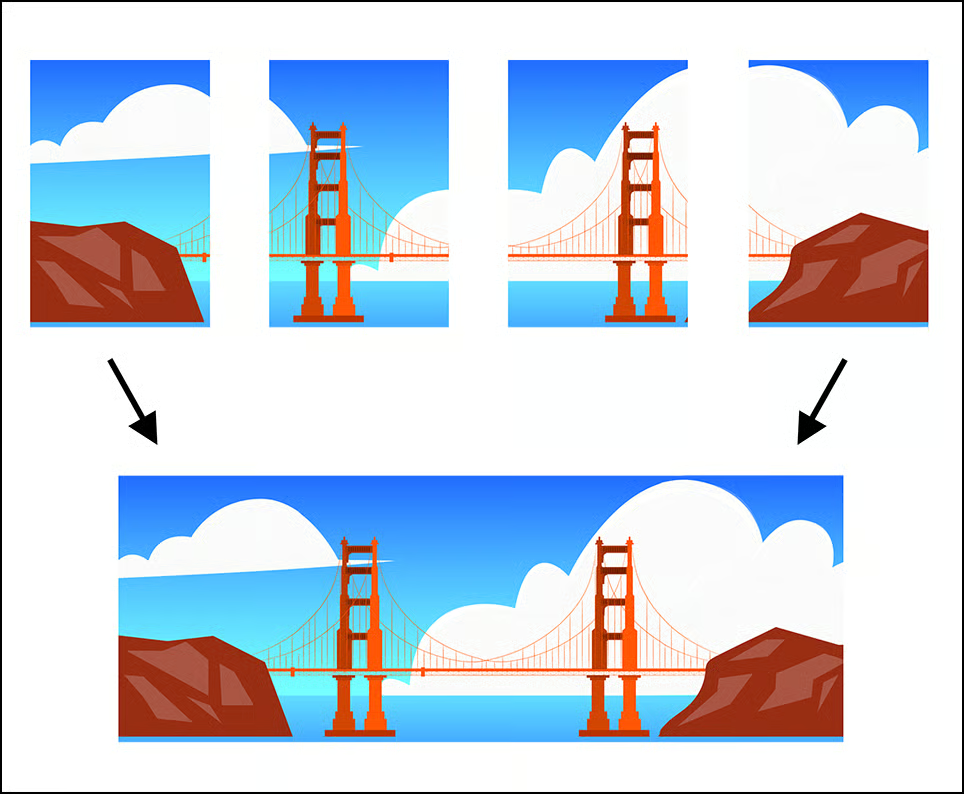
Import and cull in Lightroom or your DAM, synchronize lens corrections if desired (beware over‑correcting ultrawides before stitching), and batch HDR merge first when needed. Then stitch in a dedicated tool: PTGui (industry standard with powerful masking and optimizer), Hugin (capable open source), or alternatives within Photoshop/Affinity for simpler single‑row panos. Rectilinear lenses typically need 20–25% overlap (30% if you want extra safety), while fisheye workflows tolerate 25–30% with fewer frames. For 360×180 output, export equirectangular at the largest resolution your project needs.
PTGui’s control point editor and mask tools are exceptionally useful for crowds, railings, and window seams; if you’re new to it, this review provides a solid overview of why many professionals rely on it. PTGui review and why it excels (Fstoppers)
Cleanup & Enhancement
- Nadir patch: Export a layered panorama to Photoshop; use content‑aware fill or a dedicated AI tripod removal tool to clean the floor.
- Color and noise: Equalize color across brackets, correct mixed lighting casts, and apply luminance noise reduction to night shots.
- Leveling: Set pitch/roll/yaw so horizons and verticals are true; use PTGui’s panorama editor or a VR viewer to check.
- Export: Save an equirectangular JPEG (8–12k wide for most VR platforms) or 16‑bit TIFF master for archival and further edits.
For a practical, end‑to‑end DSLR/mirrorless 360 capture and stitch overview geared to VR publishing, this official guide is concise and reliable. Using a mirrorless camera to shoot and stitch a 360 photo (Meta/Oculus)
Video: See the Process in Action
Watching a full capture-to-stitch walkthrough can accelerate your learning curve. Here’s a solid panoramic demo video to complement the steps above.
Useful Tools & Resources
Software
- PTGui panorama stitching
- Hugin (open source)
- Lightroom / Photoshop or Affinity Photo
- AI tripod/nadir removal tools
Hardware
- Panoramic heads: Nodal Ninja, Leofoto, Sunwayfoto
- Carbon fiber tripods with leveling bases
- Wireless remote shutters
- Pole extensions / car mounts (with safety tethers)
For a broader perspective on camera/lens choices specifically for virtual tours, this field guide is helpful. Virtual tour camera and lens guide (360Rumors)
Disclaimer: software/hardware names provided for search reference; check official sites for details.
Common Mistakes & How to Avoid Them
- Parallax error: Failing to align the entrance pupil leads to double edges and ghosts. Calibrate your pano head for the exact focal length you’ll use.
- Exposure flicker: Auto exposure or auto WB between frames causes visible seams. Lock both early.
- Tripod shadows: For outdoor sunlit scenes, plan the yaw sequence to keep tripod shadows behind the camera or patch the nadir later.
- Ghosting from movement: Shoot two passes and use masks to pick the cleanest subject positions.
- High‑ISO noise: On the X‑T5’s dense sensor, keep ISO as low as possible; use longer shutter speeds on tripod.
Real-World Case Studies
Indoor Real Estate (Bright Windows)
Lens at 15–18mm APS‑C equivalent (10–12mm on Fuji). Shoot at f/8, ISO 125–200, bracket ±2 EV (5 frames if windows are extremely bright). Lock WB at 4000–4500K under mixed tungsten/LED, or create a custom preset per room. Capture three rows + zenith/nadir. In PTGui, HDR‑merge and then stitch; apply masks to windows if you see haloing. Export 10–12k equirectangular for clear details on VR platforms.
Outdoor Sunset Landscape
Set 15–20mm, f/8–f/11, ISO 125. Expose for highlights (sun). Consider a second bracketed set for the foreground. Keep 30% overlap; shoot fast as light changes minute‑to‑minute. In post, pick the earlier or later set consistently, or blend foreground from one set with sky from another using layer masks. Final touch: dehaze and gentle contrast.
Event Crowds
At 20–24mm, 1/200–1/500 s, ISO 400–800. Do two passes: one for structure and one for clean plates with fewer people in critical tiles. In PTGui, enable “viewpoint correction” for slightly shifted handheld tiles if needed, and mask busy areas to keep legs/arms from duplicating across seams.
Rooftop Pole (Elevated 360)
Use the widest focal length to reduce frame count. 1/250–1/500 s, ISO 400–800. Use a short burst per yaw angle to pick the sharpest frame later. Keep rotations slow and watch wind gusts. Safety first—tether everything.
Frequently Asked Questions
- Can I actually mount the Canon RF 15–35mm on a Fujifilm X‑T5?
Not reliably today. There’s no widely available RF‑to‑X adapter with full electronic aperture control. If you need this exact FOV on X‑mount, use a native ultrawide (e.g., XF 10–24mm) or adapt Canon EF glass via a Fringer EF‑X adapter. The techniques and shot counts in this guide map to equivalent FOVs, so you’ll get the same results.
- Is the RF 15–35mm wide enough for single‑row 360°?
For a true 360×180 spherical pano, a single row is rarely sufficient with rectilinear ultrawides. You’ll typically shoot multiple rows at 15–20mm APS‑C FOV to cover the zenith and nadir cleanly. If you need single‑row capture, a fisheye lens is the better tool.
- Do I need HDR for interiors with bright windows?
Usually yes. Bracket ±2 EV (3–5 frames). The X‑T5’s base ISO DR is strong, but window‑to‑interior contrast often exceeds sensor DR. HDR ensures clean window views without noisy shadows.
- How do I avoid parallax issues with this setup?
Use a panoramic head and align the entrance pupil. At 15mm, start with the camera slid forward such that the rotation axis is near the front element—then fine‑tune using the near‑/far‑object test. Record your rail positions per focal length for repeatability.
- What ISO range is safe on the X‑T5 in low light?
On tripod, keep ISO 125–400 for best quality; 800–1600 is usable with careful noise reduction. Because the 40MP sensor has small pixels, it rewards longer exposures over higher ISO whenever possible.
- Can I set up custom modes for faster pano work?
Yes. Use the X‑T5’s custom settings to store Manual exposure, fixed WB, MF with focus peaking, IS/IBIS off, and your preferred drive/bracket settings. This dramatically speeds up on‑site workflow.
- What’s the best tripod head for this?
A two‑axis panoramic head with fore‑aft and lateral rails (e.g., Nodal Ninja, Leofoto) for entrance pupil alignment. Add a leveling base and rotator with degree markings for clean, repeatable steps.
Safety, Limitations & Trustworthy Practices
Limitations: Without a working RF‑to‑X adapter, the specific RF 15–35 + X‑T5 combo isn’t practical. Use a native X‑mount ultrawide or an EF ultrawide with a reputable EF‑X adapter to follow this exact workflow. On tripod, disable all stabilization; during HDR brackets, touch nothing and use a remote; in wind, weigh down the tripod or wait for calmer moments. Back up your files immediately—duplicate your card to a second card or SSD on site and maintain a structured folder system.
If you’re new to high‑end pano head setup, this short fundamentals guide is an excellent companion to the steps above. Set up a panoramic head for perfect high‑end 360s (Meta/Oculus)