
Why This Camera & Lens Are Great for Panoramas
The Fujifilm X‑T5 paired with ultra‑wide optics is a powerhouse for high-resolution panoramic and 360° photography. The X‑T5 uses a 40.2MP APS‑C back‑illuminated X‑Trans CMOS 5 HR sensor with a pixel pitch of ~3.5µm, delivering exceptional resolving power and ~13+ stops of usable dynamic range at base ISO (ISO 125). Its in‑body image stabilization (IBIS) helps hand‑held frames but should be disabled on a tripod to avoid micro‑blur. Color science is consistent and nuanced—valuable when you stitch dozens of frames into a seamless panorama.
The Canon RF 14–35mm f/4L IS USM is a professional, rectilinear ultra‑wide zoom. On a full‑frame RF body at 14mm it provides a diagonal field of view of ~114°, horizontal ~104°, and vertical ~81°. It’s sharp stopped down (f/5.6–f/8), with effective stabilization and controlled chromatic aberration. For panoramic work, rectilinear lenses mean more frames than a fisheye but with straighter verticals—useful for architecture and real estate.
Important compatibility note: the Canon RF 14–35mm cannot be directly mounted on a Fujifilm X‑T5 (RF’s short flange distance and closed protocol prevent practical RF→X adapters). In the field, creators typically take one of two routes: (1) use the X‑T5 with a similar ultra‑wide X‑mount lens (e.g., XF 10–24mm f/4, Laowa 9mm f/2.8, Samyang 12mm f/2) and follow the same panorama technique below; or (2) shoot with the RF 14–35mm on a Canon RF body, then stitch the files alongside X‑T5 projects using the same post‑processing workflow. The shooting principles, nodal alignment, overlap, and stitching steps remain identical.
Quick Setup Overview
- Camera: Fujifilm X‑T5 — APS‑C (1.5× crop), 40.2MP BSI X‑Trans 5 HR, base ISO 125, IBIS up to 7 stops.
- Lens: Canon RF 14–35mm f/4L IS USM — rectilinear ultra‑wide zoom, best sharpness around f/5.6–f/8, strong software-corrected barrel distortion at 14mm, low CA, internal IS. Note: not mountable to X‑T5; use similar X‑mount focal lengths for the same pano method.
- Estimated shots & overlap (rectilinear ultra‑wide):
- On full‑frame at 14mm: 10–12 around (30% overlap) + 1–2 zenith + 2–3 nadir for clean tripod patch; or two rows (8 + 8 around at ±30–45°) + zenith + nadir for robust coverage.
- On X‑T5 with an equivalent FOV (e.g., 10mm on APS‑C ≈ 15mm FF): 10–12 around (25–30% overlap) + zenith + nadir; or dual-row 8 + 8 around for architecture.
- Difficulty: Moderate (easy with a panoramic head; more challenging handheld or in crowds).
Planning & On-Site Preparation
Evaluate Shooting Environment
Assess light, motion, and reflective surfaces. For interiors, mixed lighting (window daylight + tungsten LEDs) creates color shifts—lock white balance and consider bracketing. Near glass, shoot with the lens as close to the glass as possible (1–2 cm) to minimize reflections; shade with your hand or a hood. Outdoors at sunrise/sunset, wind and rapidly changing light affect exposure consistency; lock exposure and work quickly.
Match Gear to Scene Goals
The X‑T5’s 40MP sensor is excellent for detail‑rich panoramas and virtual tours. Expect clean results up to ISO 800; ISO 1600 is usable with good noise reduction, but base ISO 125–400 is ideal for stitching latitude. The RF 14–35mm (when used on an RF body) or a similar X‑mount ultra‑wide is well‑suited for interiors and architecture thanks to rectilinear rendering (straight lines stay straight). Fisheyes reduce shot count but can distort edges and complicate window frames and doorways. For real estate, we recommend rectilinear at f/8 with 25–30% overlap.
Pre-shoot Checklist
- Power & storage: two batteries minimum; dual cards (RAW to Card 1, backup JPEG/RAW to Card 2).
- Optics: clean front/rear elements and the X‑T5 sensor (dust is painfully obvious across dozens of frames).
- Stability: level your tripod; use a leveling base for faster setup.
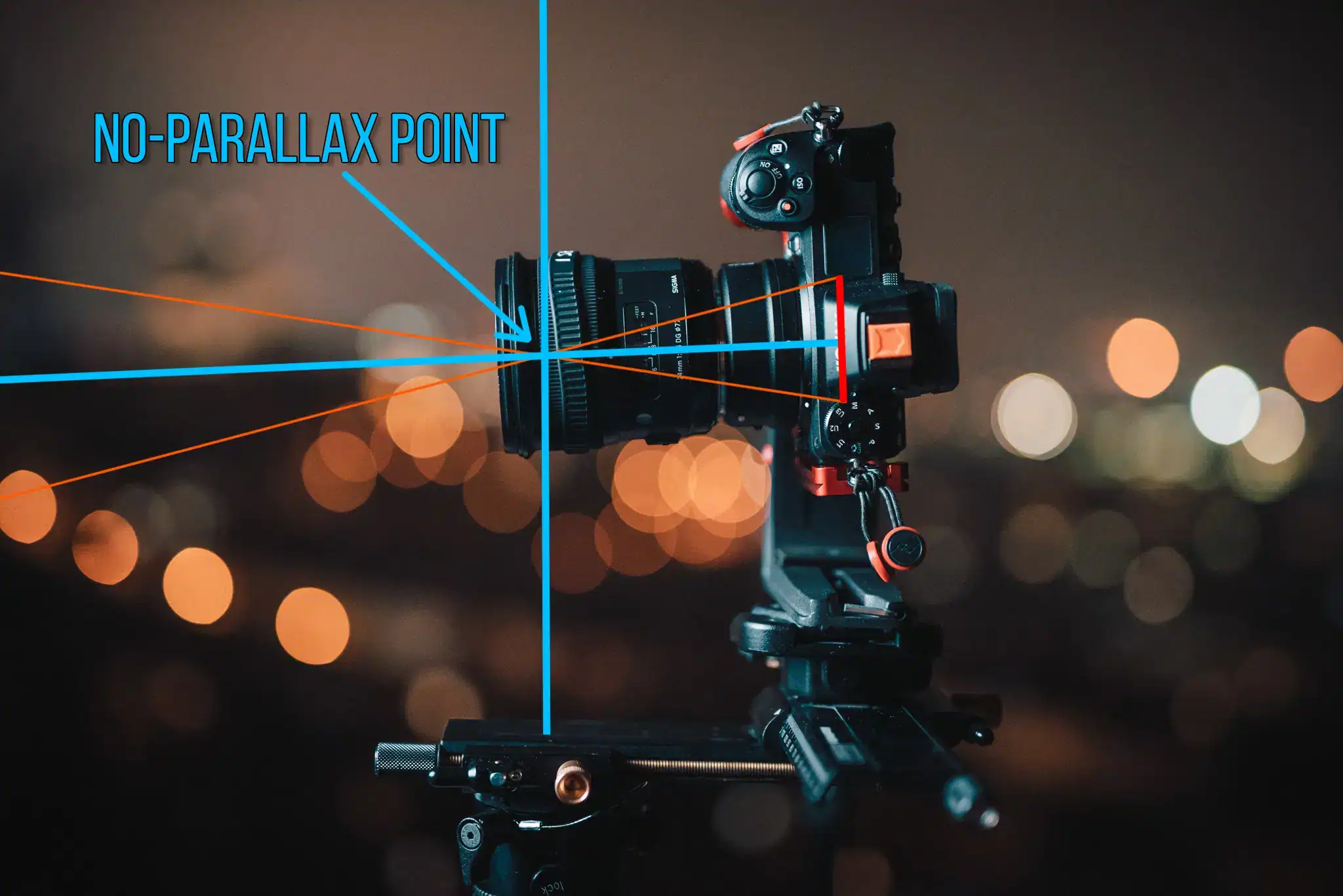
- Panoramic head: calibrate the nodal (no‑parallax) point for your lens/focal length.
- Safety: tether gear on rooftops, watch wind loads on poles, and keep clear of crowds and traffic.
- Backup workflow: capture a second pass in case of stitching issues (especially interiors with mixed light).
Essential Gear & Setup
Core Gear
- Panoramic head: lets you rotate around the lens’s no‑parallax point to eliminate parallax errors during stitching. This is critical for indoor and near‑field subjects (furniture, door frames).
- Stable tripod with a leveling base: ensures a level horizon and consistent overlap between frames. A leveling base speeds up on‑site work.
- Remote trigger/app: use a wired remote, 2‑sec timer, or the Fujifilm Remote app to avoid camera shake.
Optional Add-ons
- Pole or car mount: great for elevated 360s and moving shots, but always tether and watch wind/vibration loads. Rotate slowly to reduce blur.
- Lighting aids: constant lights or small flashes to lift deep interior shadows when HDR isn’t desired.
- Weather protection: lens hood, rain cover, microfiber towels, and silica packs.
Step-by-Step Shooting Guide
Standard Static Scenes
- Level and align: level your tripod via the leveling base. On the panoramic head, set the camera so the rotation axis passes through the lens’s entrance pupil (no‑parallax point). To calibrate, align two vertical objects (near and far), rotate left-right, and slide the camera on the nodal rail until the relative position does not shift.
- Manual exposure & WB: set manual exposure (M mode), lock white balance to a Kelvin value (e.g., 5600K daylight) or a single preset. Disable auto ISO and auto WB to avoid flicker and color shifts between frames.
- Focus: switch to manual focus, use magnification and focus peaking. For ultra‑wides on APS‑C, hyperfocal at 10mm f/8 is about 0.65 m; focusing just beyond that keeps everything sharp from roughly 0.35 m to infinity.
- Capture sequence:
- Single‑row option (faster): 10–12 shots around at ~30° intervals; add 1–2 frames for the zenith; capture 2–3 for the nadir (rotate the rig around the tripod center or offset the camera for a cleaner patch).
- Dual‑row option (safer for ceilings/architecture): 8 shots at +30–45° pitch, 8 shots at −30–45°, plus a zenith and nadir set.
- Mark the nadir: after the main row(s), tilt down and rotate to capture clean floor patches you’ll use to remove the tripod during post.
HDR / High Dynamic Range Interiors
- Bracket ±2 EV (3 or 5 frames) to balance bright windows and interior shadows. On the X‑T5, you can use exposure bracketing or adjust shutter speed manually while keeping aperture and ISO fixed.
- Keep WB locked. Changing WB across brackets makes merging and stitching harder.
- Maintain identical overlap and camera position for all brackets. Consider shooting all base exposures first, then repeat the full round for the over/under exposures to keep a consistent rhythm.
Low-Light / Night Scenes
- Use longer exposures at low ISO. On the X‑T5, ISO 125–400 is optimal; ISO 800–1600 is still usable with careful noise reduction.
- Turn off IBIS and lens IS on a tripod to prevent micro‑jitter. Use a remote release or 2‑sec timer.
- Shield the lens from stray light to avoid flare; consider taking an extra pass for regions near strong light sources.
Crowded Events
- Shoot two passes: one fast pass to secure coverage, a second slower pass to catch moments when people move out of overlap zones.
- Use faster shutter speeds (1/200s+) and slightly higher ISO (400–800) to freeze motion. Mask in post to remove duplicates and ghosts.
Special Setups (Pole / Car / Drone)
- Secure everything with safety tethers and consider wind loads. A small vibration at the pole top can blur long exposures.
- Use higher shutter speeds and avoid IBIS on rigid mounts that may resonate. Rotate slower and shoot more overlap to increase stitching reliability.
Recommended Settings & Pro Tips
Exposure & Focus
| Scenario | Aperture | Shutter | ISO | Notes |
|---|---|---|---|---|
| Daylight outdoor | f/8–f/11 | 1/100–1/250 | 100–200 | Lock WB (daylight/5600K). Turn off IS on tripod. |
| Low light/night | f/4–f/5.6 | 1/30–1/60 (or longer on tripod) | 400–800 | Remote trigger; consider stacking for noise reduction. |
| Interior HDR | f/8 | Bracket ±2 EV | 100–400 | Expose to protect highlights; merge before stitching or use HDR in stitcher. |
| Action/crowds | f/5.6–f/8 | 1/200+ | 400–800 | Double pass to minimize ghosts. |
Critical Tips
- Focus: manual focus at or just beyond the hyperfocal distance for maximum depth of field. Verify with 100% magnification.
- Nodal point: mark the rail position for your favorite focal lengths. Re‑check when changing focal length, as entrance pupil shifts with zooms.
- White balance: lock WB to a preset or Kelvin value; mixed lighting? Consider a custom WB or gel your lights.
- RAW vs JPEG: shoot RAW for dynamic range and color latitude. JPEG fine for quick previews only.
- Stabilization: disable IBIS and lens IS on a tripod. Enable IS when shooting handheld sequences.
Stitching & Post-Processing
Software Workflow
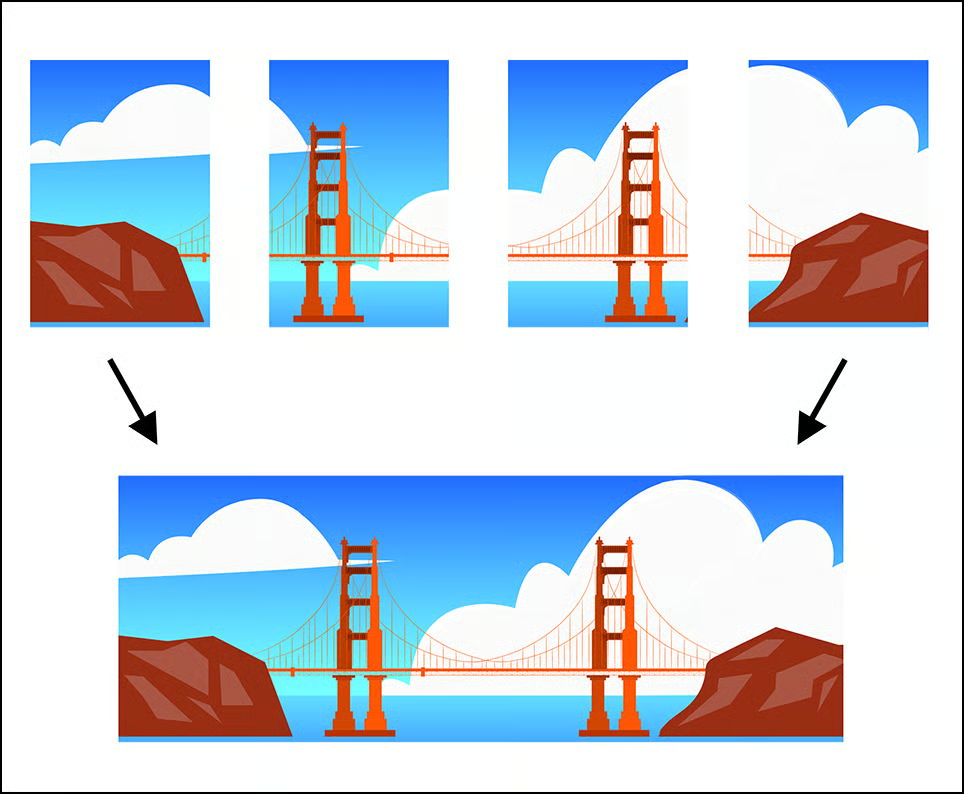
For rectilinear ultra‑wides, stitching is highly reliable if you nail nodal alignment and overlap. PTGui is an industry favorite for speed and control; Hugin is a capable open-source alternative. Light falloff and rectilinear distortion at 14mm (or equivalent) can be corrected either before or after stitching depending on your workflow. Rectilinear lenses typically benefit from 20–30% overlap. For HDR, you can either merge brackets first (per view) then stitch, or stitch with HDR stacks directly in PTGui (fewer seams if done carefully). See a thorough PTGui review for practical insight at the end of this section.
Cleanup & Enhancement
- Nadir patch: capture dedicated floor shots; use content-aware fill, clone/heal, or AI tools to remove the tripod.
- Color cleanup: harmonize color between frames; reduce noise in shadows (use masked NR to keep detail).
- Geometry: level horizon, fix verticals, and adjust yaw/pitch/roll for natural perspective.
- Export: create an equirectangular 2:1 JPEG/PNG/TIFF for VR platforms; keep a layered master for future edits.
For deeper learning on head setup and nodal workflow, review professional panoramic head guides linked below. For stitcher choice and technique comparisons, check the PTGui review. Panoramic head setup guide. PTGui review and tips.
Useful Tools & Resources
Software
- PTGui panorama stitching
- Hugin (open source)
- Lightroom / Photoshop
- AI tripod removal tools (content-aware fill, generative features)
Hardware
- Panoramic heads (Nodal Ninja, Leofoto, and similar)
- Carbon fiber tripods with leveling base
- Wired/wireless remote shutters
- Pole extensions / car mounts (with tethers)
For estimating spherical resolution and frame counts at different focal lengths, see the PanoTools resource. Spherical resolution and coverage.
Common Mistakes & How to Avoid Them
- Parallax error: always align around the entrance pupil; recalibrate when changing focal length.
- Exposure flicker: use full manual exposure and locked WB; avoid auto ISO.
- Tripod shadows and clutter: capture dedicated nadir frames and patch later.
- Ghosting from moving subjects: shoot double passes and mask in post.
- Noise at night: use a stable mount and lower ISO; stack or denoise carefully.
- Inconsistent overlap: use a click‑stop rotator or mark angular increments to maintain 25–30% overlap.
Frequently Asked Questions
-
Can I shoot handheld panoramas with the Fujifilm X‑T5?
Yes, for partial panos and simple stitches. Use fast shutter speeds (1/200s+), IBIS on, and 30–40% overlap. For 360° spheres—especially interiors—use a tripod and panoramic head to avoid parallax and stitching artifacts.
-
Is the Canon RF 14–35mm f/4L wide enough for a single‑row 360?
At 14mm on full frame, a single row often leaves gaps near the zenith/nadir. Plan 10–12 shots around plus dedicated zenith/nadir frames, or shoot two rows (e.g., ±30–45°) for robust coverage. On APS‑C with a similar FOV (e.g., 10mm on X‑T5), the same guidance applies.
-
Can I mount the RF 14–35mm on my X‑T5?
No—RF→X adapters are not practically available due to flange distance and electronic protocol. Use an X‑mount ultra‑wide (e.g., XF 10–24mm f/4, Laowa 9mm f/2.8) for the same panorama techniques, or use the RF lens on a Canon RF body.
-
Do I need HDR for interiors with bright windows?
Usually yes. Bracket ±2 EV (3–5 frames) to preserve both window highlights and interior shadows. Merge to HDR before stitching or use HDR functionality in your stitcher; keep WB locked for consistency.
-
What ISO range is safe on the X‑T5 in low light?
For panoramas, aim for ISO 125–400 on a tripod. ISO 800–1600 is usable with careful noise reduction. Keep aperture around f/5.6–f/8 for sharpness and extend shutter time instead of pushing ISO.
-
How do I avoid parallax issues with a rectilinear ultra‑wide?
Use a panoramic head and calibrate the no‑parallax point. Align a near and a far vertical object; rotate and slide the camera along the nodal rail until the objects don’t shift relative to each other between frames. Re‑check after zoom changes.
-
Can I set up fast recall settings on the X‑T5 for panos?
Yes—add key items (WB, ISO, drive, timer, focus mode) to My Menu and the Q menu for quick access. You can also save custom settings profiles for JPEG parameters; for RAW workflows, the menu shortcuts are the fastest way to lock everything down.
-
Which tripod head is best for this setup?
A dedicated panoramic head with an adjustable nodal rail (e.g., Nodal Ninja, Leofoto) is ideal. It enables precise entrance pupil alignment and click‑stop rotation for consistent overlap.
Real-World Case Studies & Field Advice
Indoor Real Estate (Rectilinear Ultra‑Wide)
Use an X‑mount ultra‑wide on the X‑T5 (e.g., XF 10–24mm at ~10–12mm). Shoot at f/8, ISO 125–200, and bracket ±2 EV. Target 10–12 shots around plus zenith/nadir. Lock WB to ~4000–4500K for mixed tungsten/LED, or set a custom WB. Watch mirror edges and glass tables—any parallax error will show up here, so double‑check nodal alignment.
Outdoor Sunset Landscape
At sunset, meter for the highlights, then expose +0.3 to +0.7 EV if your foreground is dark (or bracket). Shoot f/8, ISO 125–200. If wind is strong, increase shutter speed and overlap slightly more (30–35%) to ensure reliable stitching. Do a quick second pass after the sun dips for a softer sky you can blend later.
Rooftop / Pole Shooting
Mount a lightweight body/lens and tether. Use 1/250s+ shutter and ISO 400–800 as needed. Rotate slowly and capture more overlap (35–40%). Avoid long exposures at height—micro‑vibrations ruin sharpness. Consider three smaller exposure brackets instead of one long exposure bracket to reduce motion blur risk.
For panoramic head concepts, see these solid primers: Panoramic head tutorial (360Rumors).
Safety, Limitations & Backup Workflow
Rooftops and poles demand tethers, sandbags, and awareness of wind loads. Never leave gear unattended on a panoramic head—one gust can topple the entire rig. In crowds, get consent where appropriate and protect your tripod legs from trips.
Limitation to note: RF 14–35mm f/4L IS USM cannot be used on the X‑T5. If you must have that RF lens look, use a Canon RF body or choose an X‑mount lens with similar coverage (XF 10–24mm, Laowa 9mm). For ultra‑low frame counts, a fisheye (e.g., 7.5–8mm APS‑C) can capture a full sphere in 4–6 shots but requires careful defishing and can complicate architectural lines.
Backup: write RAW to both cards if possible or RAW+JPEG to separate cards. After capture, verify a few key seams on the back LCD. If something looks off, shoot a second entire pass. Keep a redundant copy on a portable SSD before leaving location.
Image Examples & Visual Aids
Below is a quick visual summary to reinforce nodal and stitching concepts used in “how to shoot panorama with Fujifilm X‑T5 & Canon RF 14–35mm f/4L IS USM.”
For further reading about focal lengths and coverage math, see: PanoTools spherical resolution reference.
References & Further Learning
Deep-dive techniques, software comparisons, and head setup guides that align with best practices used here: Set up a panoramic head (Oculus Creator), PTGui review (Fstoppers), Panoramic head tutorial (360Rumors).