
Why This Camera & Lens Are Great for Panoramas
If you’re wondering how to shoot panorama with Fujifilm X-T5 & Canon EF 8-15mm f/4L Fisheye USM, you’ve picked a powerful, flexible combo. The Fujifilm X-T5 uses a 40.2MP APS-C X-Trans CMOS 5 HR sensor (approx. 7728×5152 pixels, ~3.0 µm pixel pitch) that delivers crisp detail, excellent color, and about 13 stops of usable dynamic range at base ISO (ISO 125). Pair that resolution with in-body image stabilization (IBIS) rated up to 7 stops and you have a body that’s comfortable in low light and precise on a tripod.
The Canon EF 8-15mm f/4L Fisheye USM is a pro-grade fisheye zoom. On an APS-C body like the X-T5 (via an EF–X mount smart adapter), it becomes a diagonal fisheye that covers a very wide angle with strong edge stretching—exactly what you want for efficient 360 photo capture. At 8–10mm you can cover the full sphere with relatively few shots, while at 12–15mm you can trade a few more shots for slightly higher per-frame detail and less extreme stretch. The constant f/4 aperture is handy for interiors, and the lens is very sharp by f/5.6–f/8 with well-controlled lateral CA.
Compatibility notes: you’ll need a smart EF-to-FX adapter (e.g., Fringer EF-FX Pro II or similar) to control aperture from the X-T5. Autofocus works with many EF lenses on good adapters, but for panoramas we recommend manual focus and a calibrated panoramic head for the no-parallax point. On APS-C you can keep the Canon lens hood attached (it won’t vignette as a circular fisheye), which helps cut flare. If you use a focal reducer (0.71× “speed booster”), you’ll get even wider coverage closer to circular fisheye, reducing shot count further—great for time-sensitive shoots.
Quick Setup Overview
- Camera: Fujifilm X-T5 — APS-C (23.5×15.6 mm) X-Trans CMOS 5 HR, 40.2MP, base ISO 125, 7-stop IBIS.
- Lens: Canon EF 8-15mm f/4L Fisheye USM — fisheye zoom, constant f/4, best sharpness for panos at f/5.6–f/8, low coma/CA for a fisheye.
- Estimated shots & overlap (APS-C):
- 8–10mm: 6 shots around (60° increments) + zenith + nadir (25–30% overlap).
- 12–15mm: 8–10 shots around + zenith + nadir (25–35% overlap).
- With 0.71× focal reducer at ~8mm: 4 shots around + zenith + nadir possible in many scenes.
- Difficulty: Moderate — easy once your nodal point is dialed in; low-light interiors and HDR add complexity.
Planning & On-Site Preparation
Evaluate Shooting Environment
First, read the light and watch movement. For interiors, note contrast between windows and room shadows—this will drive your HDR choices. In glass-heavy spaces, expect reflections; keep the lens as far from glass as possible (30–60 cm or more) and shoot at a slight angle to reduce self-reflections and flare. Outdoors, track the sun or bright point sources—fisheyes catch stray light easily, so mind the sun’s position in every frame. In crowds, anticipate moving subjects and plan a double pass.
Match Gear to Scene Goals
The X-T5’s high resolution and ~13-stop DR at ISO 125 give clean, detailed 360 photos. For interiors, safe ISO ranges are typically 125–800 on this APS-C sensor; use the IBIS and tripod for longer shutter speeds rather than pushing ISO too high. The Canon 8-15mm fisheye minimizes the number of shots, which is excellent for fast capture (events, rooftops, pole work), though it introduces characteristic fisheye stretch you’ll correct via stitching. For ultra-fast coverage, consider the lens at 8–10mm; for maximum per-frame detail and slightly nicer edges, use 12–15mm and increase shot count.
Pre-shoot Checklist
- Batteries charged, large/fast cards formatted; clean lens and sensor (fisheyes see everything—including dust).
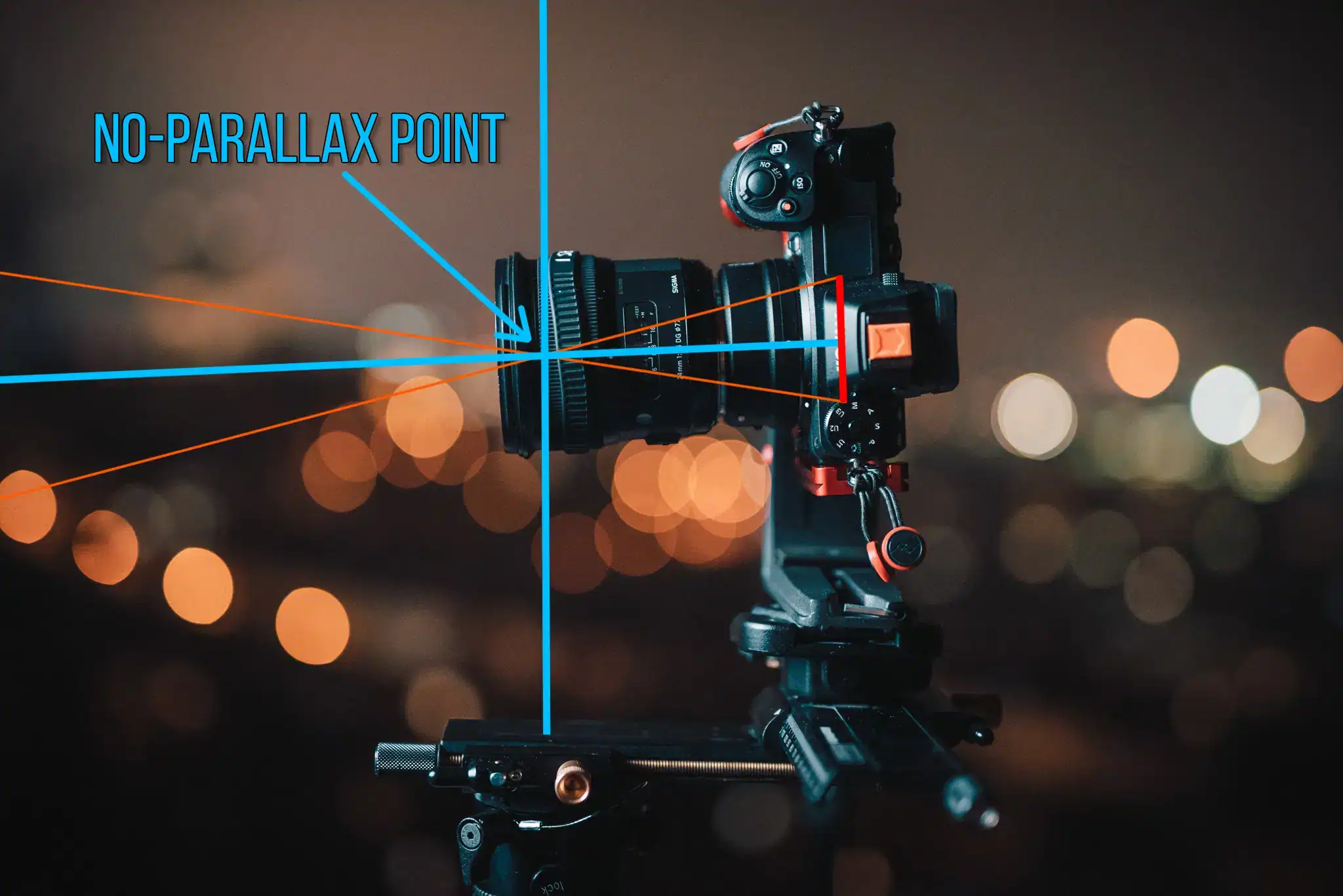
- Tripod leveled; panoramic head calibrated for the lens’ entrance pupil (no-parallax point).
- Safety: evaluate wind loads (especially on rooftops or poles), use a sandbag, tether gear when elevated or over crowds.
- Backup workflow: shoot an extra safety round at the end; if time allows, capture a second exposure set at 1 stop brighter/darker.
Essential Gear & Setup
Core Gear
- Panoramic head: Allows rotation around the lens’ entrance pupil to eliminate parallax. Calibrate the forward/back rail and vertical offset for this lens and mark your settings for 8, 10, 12, 15mm.
- Stable tripod with a leveling base: A leveling base or half-ball lets you level the head quickly without re-adjusting legs.
- Remote trigger or the FUJIFILM Camera Remote app: Fire shots without touching the camera to avoid micro-vibrations.
Optional Add-ons
- Pole or car mount: Great for elevated views or vehicle-based capture. Use a safety tether, limit speed, and avoid high winds. Expect to increase overlap for vibration safety.
- Portable lights/LED panels: For dark interiors, add gentle fill to balance the scene without creating hard shadows.
- Weather protection: Rain covers, lens towels, and gaffer tape keep gear safe; the fisheye front element is vulnerable to droplets and fingerprints.
Watch: Panoramic Head Setup (Video)
Seeing the calibration process once makes it much easier to replicate in the field. The video below demonstrates the core ideas (aligning the rotation axis with the entrance pupil and locking repeatable positions).
Step-by-Step Shooting Guide
Standard Static Scenes
- Level and lock: Level the tripod with a bubble or the X-T5’s electronic level. Lock your panoramic head’s tilt before starting the sweep.
- Align the entrance pupil: Slide the camera on the pano rail until foreground/background elements don’t shift relative to each other as you pan. Mark this position for your chosen focal length (8, 10, 12, or 15mm). Expect the setting to move slightly as you zoom.
- Manual exposure and white balance: Switch to M mode and meter for the mid-tones. Lock WB (Daylight/Tungsten/Kelvin) to avoid frame-to-frame shifts. Use RAW for latitude.
- Focus and stabilize: Use manual focus; at 8–10mm, set focus slightly beyond 1 m at f/8 to cover everything from near to infinity. Switch IBIS OFF on a tripod to prevent sensor micro-adjustments.
- Capture with overlap:
- At 8–10mm: 6 frames around (60° increments) with 25–30% overlap, then zenith (up) and nadir (down).
- At 12–15mm: 8–10 frames around with 25–35% overlap, plus zenith and nadir.
- Nadir shot: Tilt down or offset the camera to shoot a clean ground plate for tripod removal. If time is short, capture at least one clean patch you can clone later.
HDR / High Dynamic Range Interiors
- Bracket ±2 EV (e.g., 3 or 5 frames) at each panning position to balance windows and interior shadows. The X-T5’s self-timer or remote prevents shake.
- Lock WB and exposure settings across the bracketed series; only shutter speed changes. Keep ISO at 125–400 if possible for maximum DR.
- If there are moving people or trees outside windows, consider a faster bracket (shorter interval) to reduce ghosting.
Low-Light / Night Scenes
- Use tripod, IBIS off, and a remote release. Aperture f/4–f/5.6 and shutter 1/5–1 s are common; keep ISO in the 125–800 range on the X-T5 to control noise.
- Turn off flicker-prone lighting when possible. If not, avoid electronic shutter indoors since it can band under certain lighting; use mechanical or EFCS.
- Shoot an extra pass if in doubt; it’s cheaper than a reshoot.
Crowded Events
- Make two passes: a fast coverage pass first (to “lock” a usable stitch), then a second slower pass waiting for openings in the crowd.
- Mask people later in post by compositing the cleaner areas from the second pass. Consider increasing overlap (30–40%) for easier control point generation.
Special Setups (Pole / Car / Drone)
- Pole: Use a lightweight panoramic head and a safety tether. Keep shutter speeds higher (1/125–1/250) and overlap generous (30–40%). Mind wind—the fisheye front element and body create sail area.
- Car: Use suction cups and safety straps. Stop the car to shoot each frame; vibrations lead to misalignment. Use 6–8 around for safety.
- Drone: This lens/camera combo is not drone-friendly; use dedicated drone mapping or 360 workflows instead.
Recommended Settings & Pro Tips
Exposure & Focus
| Scenario | Aperture | Shutter | ISO | Notes |
|---|---|---|---|---|
| Daylight outdoor | f/8–f/11 | 1/100–1/250 | 125–200 | Lock WB (Daylight); avoid polarizer with fisheye |
| Low light/night | f/4–f/5.6 | 1/5–1 s | 125–800 | Tripod & remote; IBIS off on tripod |
| Interior HDR | f/8 | Bracket ±2 EV | 125–400 | Balance windows & lamps; keep WB locked |
| Action / moving subjects | f/5.6–f/8 | 1/200+ | 400–800 | Freeze motion; consider two-pass approach |
Critical Tips
- Manual focus at hyperfocal: At 8–10mm and f/8, a focus just beyond 1 m makes everything from near foreground to infinity sharp.
- Nodal calibration: Start with the camera’s sensor plane aligned over the rotation axis. Slide the rail forward until near/far objects stop shifting. Mark separate positions for 8, 10, 12, 15mm.
- White balance lock: Mixed lighting can break stitches; use a Kelvin preset where possible and keep it fixed across the set.
- RAW capture: Gives you maximum DR and easier color matching across frames. The X-T5’s 14-bit RAWs are robust.
- Stabilization: Turn IBIS off on a tripod to avoid micro-jitters; hand-held pole work can benefit from IBIS on.
- Adapter behavior: With EF–X smart adapters, aperture control is electronic; if the adapter misbehaves, power cycle and check lens contacts.
Stitching & Post-Processing
Software Workflow
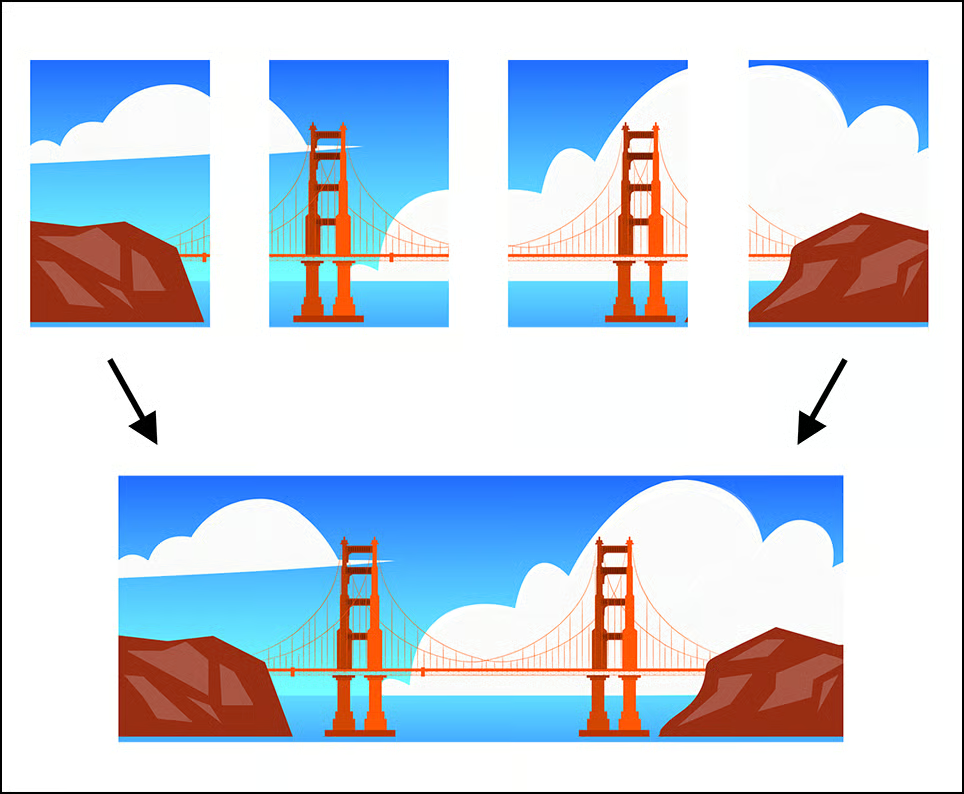
Import your RAWs into Lightroom or Capture One to apply a consistent white balance and exposure baseline. Export as 16-bit TIFFs for stitching. PTGui is an industry workhorse for fisheye panoramas and will auto-detect the fisheye projection and focal length for the Canon 8-15mm. Hugin is a solid open-source alternative. With fisheye capture, fewer frames mean fewer seams and faster alignment; however, corner stretching can be stronger, so keep 25–30% overlap to give the stitcher confidence. Rectilinear lenses often want 20–25% overlap, but for fisheyes, stick to 25–30% as a rule of thumb. See an in-depth review of PTGui’s strengths for complex panos at the end of this section. PTGui in-depth review
Cleanup & Enhancement
- Tripod/nadir patch: Use PTGui Viewpoint Correction or export a layered blend and patch the nadir in Photoshop. There are AI-based tripod removal tools that speed this up for flat floors.
- Color and noise: Apply a gentle dehaze, color equalization across the set, and noise reduction only where needed (night interiors).
- Horizon: Set the verticals and level horizon in the stitcher to avoid tilted rooms; use the panorama editor’s pitch/roll/yaw.
- Export: For VR, export 16384×8192 or 12000×6000 (depending on need). For web tours, high-quality JPEG at 90–95% quality is typical; keep a master TIFF archived.
Want a concise guide to panoramic head setup and DSLR/mirrorless 360 workflows used in VR production? The Meta/Oculus docs are excellent primers. Panoramic head setup for high‑end 360 photos
Useful Tools & Resources
Software
- PTGui panorama stitching
- Hugin open source panorama stitcher
- Lightroom / Photoshop for RAW prep and nadir patching
- AI tripod removal tools (for flat floors and repetitive patterns)
Hardware
- Panoramic heads: Nodal Ninja, Leofoto, and other rail-based systems
- Carbon fiber tripods with a leveling base
- Wireless remote shutters or phone app control
- Pole extensions / car mounts with safety tethers
- EF–X smart adapter (e.g., Fringer EF-FX Pro II) for this lens on X-T5
You can also study a broader DSLR/ML pano tutorial and FAQ for context and gear choices. Panoramic head tutorial and tips
Disclaimer: software/hardware names provided for search reference; check official sites for details.
Common Mistakes & How to Avoid Them
- Parallax error: Not aligning the entrance pupil. Solution: calibrate once, mark the rails, and re-check after zoom changes.
- Exposure flicker: Auto exposure or WB changes between frames. Solution: shoot manual exposure and locked WB; use RAW.
- Tripod shadows/footprints: No clean nadir. Solution: shoot a dedicated nadir and patch; offset the rig for a second plate if needed.
- Ghosting: Moving people/trees between frames. Solution: shoot multiple passes and mask; increase overlap for better blends.
- High-ISO noise: Pushing ISO in dim interiors. Solution: keep ISO ≤800 on the X-T5 when possible; use longer shutter times on a tripod.
Frequently Asked Questions
-
Can I shoot handheld panoramas with the Fujifilm X-T5?
Yes, in a pinch—especially outdoors in bright light at 8–10mm where overlap is generous. Use IBIS ON, faster shutter speeds (1/250+), and 30–40% overlap. Expect more stitching cleanup and potential parallax errors versus a calibrated tripod setup.
-
Is the Canon EF 8-15mm f/4L wide enough for single-row 360 on APS-C?
Yes. At 8–10mm on the X-T5 (APS-C), a single row of ~6 shots around plus zenith and nadir works reliably with 25–30% overlap. With a 0.71× focal reducer, coverage becomes even wider, and many scenes stitch with just 4 around + Z + N.
-
Do I need HDR for interiors with bright windows?
Usually yes. Bracket ±2 EV (3–5 shots) at each position. The X-T5’s base ISO 125 plus bracketing protects highlights and keeps shadow noise in check, giving you clean, realistic window detail.
-
How do I avoid parallax issues with this fisheye?
Use a panoramic head and calibrate the entrance pupil for the specific focal length. Mark the rail positions for 8, 10, 12, and 15mm. Re-check if you change zoom or adapter. A short practice session pays dividends in perfect stitches. For deeper background, see this practical Q&A on pano technique. Techniques to take 360 panoramas
-
What ISO range is safe on the X-T5 for low-light panoramas?
Keep ISO as low as practical—125–800 is a safe working window for high-quality results. On a tripod, favor longer shutter speeds over higher ISO. If you must push, ISO 1600 is usable with careful noise reduction, but aim lower for best texture retention.
-
Can I set custom shooting modes for faster pano work?
Yes. Save a custom mode with Manual exposure, RAW, fixed WB (Kelvin), IBIS OFF (tripod use), and your preferred bracketing pattern. You can create a second custom mode for handheld/pole work with IBIS ON and higher minimum shutter.
-
How do I reduce flare with a fisheye?
Keep the sun just outside the frame when possible, use the Canon hood (APS-C doesn’t vignette at 8mm with the hood), and clean the front element often. Slightly tilt the camera to move hot spots into less critical areas you can mask later.
-
What’s the best tripod head for this setup?
A rail-based panoramic head (e.g., Nodal Ninja or Leofoto) with precise fore-aft and vertical adjustments. Look for engraved scales, a rotator with click stops (60°/45°), and a leveling base for speed. This is the most reliable path to stitch-perfect images. For a broader DSLR/ML 360 guide, see this overview. Using a DSLR or mirrorless to shoot and stitch a 360 photo
Field-Proven Scenarios with the X-T5 + EF 8–15mm
Indoor Real Estate
Use 8–10mm, 6 around + Z + N, f/8, ISO 125–200. Bracket ±2 EV. Keep the camera level to protect verticals. Turn off ceiling fans and dimmable LEDs if they flicker the exposure. Patch the nadir with a second offset shot or a simple logo plate.
Outdoor Sunset Lookouts
Work at 10–12mm to keep per-frame detail high. Meter for the sky and bracket ±2 EV to save shadow textures. Watch for flare—use the hood and block the sun with your hand if it’s near the frame edge (move hand between exposures). Take a second pass 5 minutes later for cleaner sky color options.
Event Crowds
Go fast at 8–10mm, 6 around + Z + N, 1/200–1/500, ISO 400–800. Make two passes: first for coverage, second for cleaner gaps. Use masks in PTGui or Photoshop to eliminate ghosting.
Rooftop or Pole Shooting
Shorten the setup: use click stops, 6 around, higher shutter (1/250). Extra overlap (30–40%) helps when there’s sway. Always tether the rig. Wind safety first—abort if gusts exceed your tripod/pole rating.
Further Reading
If you want to dive deeper into pano resolution trade-offs, coverage math, and projections, the PanoTools wiki remains a helpful technical reference. Spherical resolution basics