
Why This Camera & Lens Are Great for Panoramas
This guide explains how to shoot panorama with Fujifilm GFX 50S / 50R & Tamron 17-28mm f/2.8 Di III RXD, with a practical focus on 360° workflows. The Fujifilm GFX 50S/50R medium-format bodies use a 44×33 mm sensor that delivers approximately 51.4 MP (8256×6192) of resolution with superb dynamic range (~14 EV at base ISO 100), smooth tonality, and color depth. That combination gives you cleaner skies, softer gradients, and more flexible highlight recovery than most smaller-sensor systems—ideal for HDR panoramas, architectural interiors, and sweeping landscapes.
The Tamron 17-28mm f/2.8 Di III RXD is a rectilinear ultra-wide zoom known for high central sharpness even wide open and strong corner performance from f/5.6–f/8, with relatively low chromatic aberration and well-controlled distortion (correctable via profiles). It is also compact and light, which matters when rotating on a panoramic head.
Important compatibility note: the Tamron 17-28mm f/2.8 Di III RXD is a Sony E-mount lens requiring electronic aperture and focus control. There is no widely available, reliable E-to-GFX smart adapter. If you cannot control aperture/focus electronically, you will not be able to use this exact lens on a GFX 50S/50R. Practical workarounds include: 1) using a similar rectilinear ultra-wide that natively mounts to GFX (e.g., GF 20–35mm f/4) or 2) adapting a Canon EF or Nikon F ultra-wide via proven EF-GFX/NF-GFX adapters for a near-identical field of view. If you do have a working E-to-GFX adapter solution and must use 35mm Format Mode to avoid vignetting, you can still follow the steps below (your effective resolution will be ~30 MP in crop mode). Being transparent about this limitation builds trust and avoids field complications.
Quick Setup Overview
- Camera: Fujifilm GFX 50S / 50R — 44×33 mm medium-format CMOS, 51.4 MP, ~5.3 µm pixel pitch, ~14 EV DR at ISO 100, base ISO 100 (excellent color and shadows).
- Lens: Tamron 17-28mm f/2.8 Di III RXD — rectilinear ultra-wide zoom, strong center/corner performance by f/5.6–f/8, low CA, moderate barrel distortion at 17 mm (profile-correctable). Note: Sony E-mount; adapter feasibility is limited—see compatibility note above.
- Estimated shots & overlap (rectilinear on 35mm crop or FF-equivalent FOV):
- At 17 mm: 10–12 shots around (30–35% overlap) + 1 zenith + 1 nadir.
- At 24 mm: 12–14 shots around (30–35% overlap) + zenith + nadir.
- At 28 mm: 14–18 shots around (30–35% overlap) + zenith + nadir.
For gigapixel detail, add a second row pitched up ~30–45°.
- Difficulty: Intermediate (requires nodal alignment and careful exposure control; plus adapter complexity if using the Tamron on GFX).
Planning & On-Site Preparation
Evaluate Shooting Environment
Assess light direction, shadow length, reflective surfaces, and movement. Interiors with glass or polished floors demand strict parallax control and exposure consistency. When shooting near glass, place the lens as perpendicular as possible and keep 30–60 cm distance to reduce reflections; use a rubber lens hood or cloth flag to block stray light. Outdoors, watch for moving clouds, vegetation, or water—shoot faster shutters or time your rotation between gusts.
Match Gear to Scene Goals
The GFX 50S/50R’s dynamic range helps retain window highlights and interior shadows in one HDR sequence, simplifying post. The sensor tolerates ISO 100–800 with very clean results; ISO 100–400 is ideal for maximum DR. The Tamron 17–28 provides flexible framing: 17 mm minimizes shot count; 24–28 mm increases sharpness across the frame at the expense of more frames. Since the Tamron is a rectilinear lens (not fisheye), expect more shots than fisheye-based workflows but cleaner lines with less defishing distortion—great for architecture and real estate.
Pre-shoot Checklist
- Charge batteries and bring spares; the GFX 50S/50R can be power-hungry during long HDR sequences.
- Format cards, enable 14-bit RAW, and bring redundancy (dual cards if available or carry extras).
- Clean lens front/rear elements and the sensor; dust is magnified in blue skies.
- Level the tripod and verify panoramic head calibration for this camera-lens combo.
- Safety checks: wind conditions, rooftop edges, railing clearance, and any car/pole mounts must be tethered with safety lines.
- Backup workflow: shoot an extra safety pass, especially for commercial jobs or fast-changing light.
Essential Gear & Setup
Core Gear
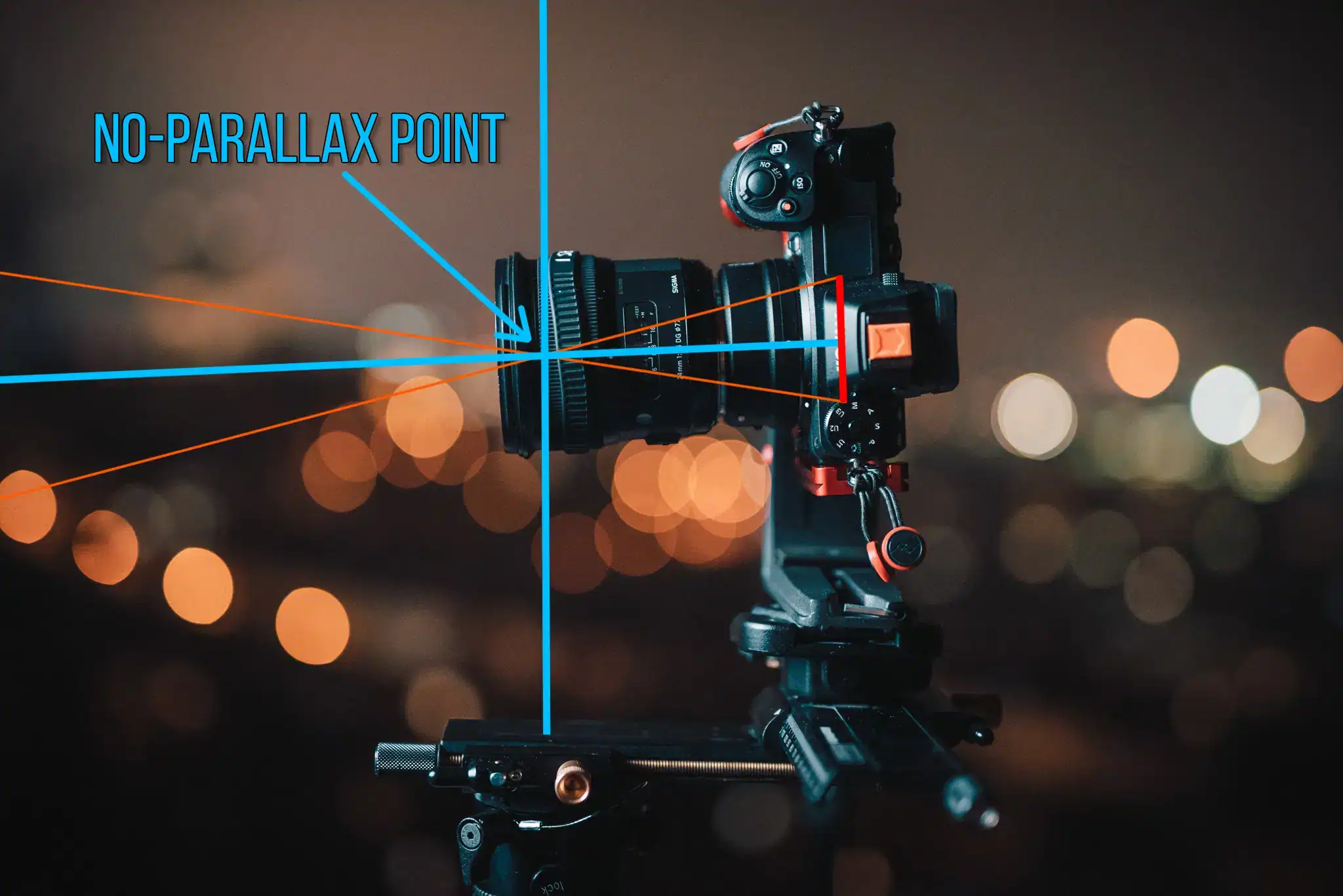
- Panoramic head: Allows precise rotation around the lens’s no-parallax (entrance) pupil. Calibrate fore-aft and lateral offsets until near and far objects remain aligned while panning.
- Stable tripod with leveling base: A bowl-leveling base or half-ball saves time aligning the head so that yaw rotation stays level.
- Remote trigger or phone app: Any touch reduces sharpness; a 2-sec self-timer is the minimum fallback.
Optional Add-ons
- Pole or car mount: Great for elevated views or drive-by sequences. Always tether gear, watch wind load, and plan your rotation slowly to minimize vibrations.
- Lighting aids: Small LED panels or strobes can lift dark corners for interiors. Keep lighting consistent across frames.
- Weather protection: Rain covers, lens hoods, and microfiber cloths for mist, sand, or light rain.
Step-by-Step Shooting Guide
Standard Static Scenes
- Level & align: Level the tripod using the leveling base. On the pano head, adjust the fore-aft plate so nearby verticals remain aligned against distant background while panning—this is your nodal point match for the Tamron at your chosen focal length.
- Manual exposure & WB: Set Manual mode and lock white balance (Daylight, Cloudy, or a custom Kelvin). Disable auto ISO. This prevents exposure flicker and color shifts across frames.
- Focus: Use manual focus at or near the hyperfocal distance. On GFX 50S/50R, magnify and use focus peaking. With adapted electronic lenses, confirm that manual focus works before the shoot.
- Capture sequence: Rotate in equal increments using the head’s detent ring. For 17 mm, plan 10–12 shots around with 30–35% overlap. Add 1 zenith shot (tilt up) and 1 nadir shot (tilt down at ground). For architectural precision, you can shoot a second top row at +30° for extra coverage.
- Mark transitions: A hand wave or lens cap tap between rows helps you later organize frames.
HDR / High Dynamic Range Interiors
- Bracketing: Use ±2 EV or even ±3 EV if windows are extremely bright. A 3–5 frame bracket is typical; keep it consistent for every yaw position.
- Lock WB and aperture: Set WB to a fixed value and keep aperture constant (e.g., f/8) so depth of field and color don’t vary between frames.
- Shutter only: Adjust exposure via shutter speed in manual mode, or use auto-bracket (AEB) with fixed aperture and ISO.
Low-Light / Night Scenes
- Use tripod discipline: The GFX 50S/50R bodies do not have IBIS; enable electronic first-curtain shutter to reduce vibration. Use a remote release. Typical settings: f/4–f/5.6, ISO 100–800, shutter 1/4–10 s depending on ambient light.
- Long exposure strategy: If objects are moving (cars, people), consider shorter exposures at higher ISO (up to ~1600 if needed). On GFX 50 generation sensors, ISO 100–800 yields the cleanest files for pano blending.
Crowded Events
- Two-pass method: Shoot one complete sequence quickly to lock composition, then a second pass waiting for gaps to minimize ghosting.
- Masking later: In PTGui or Hugin, use masks to keep the best version of each area and remove moving subjects.
Special Setups (Pole / Car / Drone)
- Secure everything: Use safety tethers and verify clamps. Balance the rig to reduce oscillation. Wind can induce blur—use faster shutter speeds.
- Rotation technique: Rotate slower, give the rig time to settle between exposures, and increase overlap to 40% for safety in high-vibration environments.
Recommended Settings & Pro Tips
Exposure & Focus
| Scenario | Aperture | Shutter | ISO | Notes |
|---|---|---|---|---|
| Daylight outdoor | f/8–f/11 | 1/100–1/250 | 100–200 | Lock WB (Daylight); consider CPL only if reflections demand it |
| Low light/night | f/4–f/5.6 | 1/4–1/60 | 100–800 | Tripod + remote; EFCS on; avoid ISO >1600 unless necessary |
| Interior HDR | f/8 | Bracket ±2 EV | 100–400 | Balance windows and ambient; keep WB fixed |
| Action / moving subjects | f/5.6–f/8 | 1/200+ | 400–800 | Freeze motion; double-pass capture for masking |
Critical Tips
- Manual focus at hyperfocal distance to keep the entire scene sharp; re-check when changing focal length.
- Nodal calibration: At 17, 24, and 28 mm, the entrance pupil shifts slightly. Calibrate each focal length and mark the rail with tape for quick recall.
- White balance lock: Prevent color shifts across frames, especially under mixed light (tungsten + daylight).
- RAW over JPEG: Use 14-bit RAW for maximum dynamic range and color fidelity when blending and stitching.
- Stabilization: GFX 50S/50R lack IBIS; if you ever use a body with IBIS, turn it off on a tripod to avoid micro-blur during exposure.
- Lens profiles: For rectilinear lenses like the Tamron 17–28, apply distortion and vignetting correction consistently across frames before stitching if your software workflow calls for pre-conversion.
Stitching & Post-Processing
Software Workflow
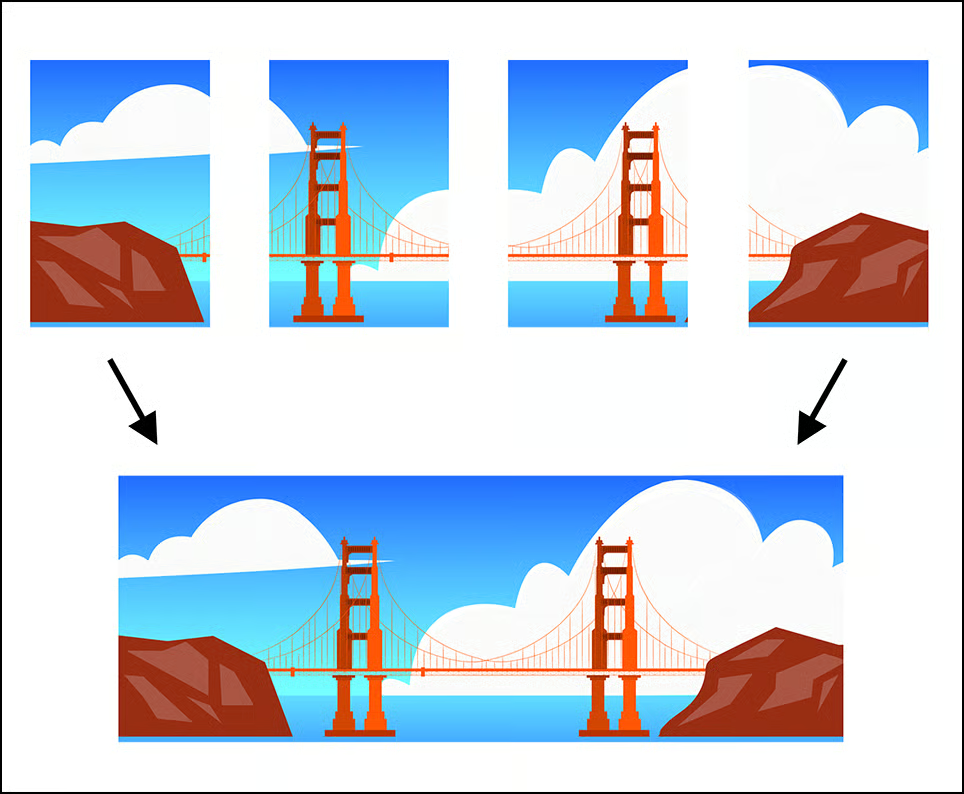
Import RAWs into Lightroom or Capture One. If you shot HDR brackets, first merge to HDR DNGs per yaw angle (consistent tone mapping), then export to PTGui/Hugin. Rectilinear lenses need slightly more frames than fisheyes but produce straighter lines—ideal for architecture. Maintain 30–35% overlap when shooting; software typically recommends ~20–25% for rectilinear minimum, but extra overlap increases control point reliability and reduces edge stretching. Tools like PTGui handle complex blends, masked edits, and nadir patching efficiently. For a deeper review of PTGui’s capabilities and speed, see this PTGui overview by Fstoppers at the end of this paragraph. PTGui review and best practices
Cleanup & Enhancement
- Nadir patch: Shoot a clean ground frame and patch in PTGui or Photoshop. AI tools can help clone out the tripod for seamless floors.
- Color polish: Apply global corrections first, then local adjustments. Use lens profiles consistently across the set if not done pre-stitch.
- Noise reduction: Apply moderate NR to low-light HDRs; avoid plastic-looking textures by masking NR selectively.
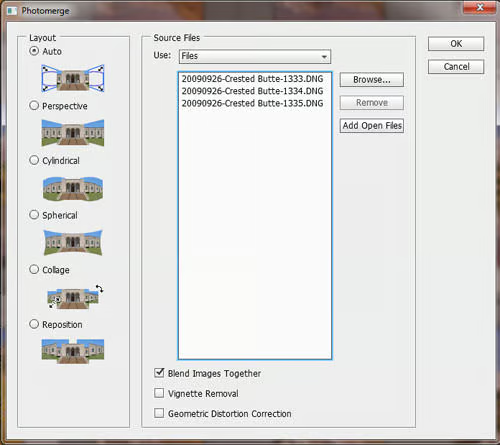
- Leveling: Use horizon/vertical controls in PTGui or Hugin to correct roll/pitch/yaw for true level output.
- Export: For 360 viewers/VR platforms, export an equirectangular 2:1 image (e.g., 12000×6000 px or higher as your detail demands). For VR publishing guidelines, see the Oculus creator notes linked at the end of this paragraph. Oculus guide to shooting and stitching 360 photos
Video: Panoramic Head Setup
Watching a precise nodal calibration once often saves hours of trial and error. The video below walks through key concepts you’ll use with the GFX and an ultra-wide rectilinear lens.
Useful Tools & Resources
Software
- PTGui panorama stitching
- Hugin open-source panorama tool
- Lightroom / Photoshop for RAW and retouching
- AI tripod removal tools (e.g., generative fills) for nadir cleanup
Hardware
- Panoramic heads (Nodal Ninja, Leofoto, Sunwayfoto)
- Carbon fiber tripods with bowl-leveling bases
- Precision rotators with click-stops
- Wireless remote shutters or intervalometers
- Pole extensions / car suction mounts with safety tethers
For an excellent visual primer on panoramic head setup and technique, this tutorial offers practical demonstrations. Panoramic head step-by-step tutorial
Disclaimer: product and software names are for search/reference; verify current specs and compatibility on official sites.
Common Mistakes & How to Avoid Them
- Parallax error: Always align the entrance pupil for the chosen focal length; don’t change zoom after calibrating.
- Exposure flicker: Use manual exposure and fixed white balance; don’t let auto features vary between frames.
- Tripod shadows: Shoot a dedicated nadir frame or move the rig slightly and patch later.
- Ghosting from movement: Take a second pass and mask in post to keep a single version of moving subjects.
- High-ISO noise: Prefer long exposures at low ISO on a tripod; only raise ISO when absolutely necessary.
- Adapter surprises: If using an E-to-GFX adapter, test aperture and manual focus on location before the paid shoot.
Field-Proven Scenarios
Indoor Real Estate
At 17–20 mm, shoot 12 frames around plus zenith/nadir. Use ±2 EV brackets to hold windows. Set WB to a custom Kelvin to minimize mixed-light surprises. The GFX sensor’s DR lets you compress highlights smoothly and retain shadow texture in wood floors and cabinetry.
Outdoor Sunset Overlook
Use f/8–f/11, ISO 100–200, and 1/60–1/200 s. Consider a 2–3 frame bracket if the sun is in frame. Rotate faster to keep sky gradients consistent. Check flare by shielding the front element with your hand or a flag between shots if the sun is near the frame edge.
Event Crowds
Increase shutter speed to 1/200–1/500 s at f/5.6–f/8, ISO 400–800. Two-pass capture works best. Expect to mask moving hands, flags, or signage in post.
Rooftop / Pole Shooting
Use a lightweight pano head and minimize sail area. Increase overlap to 40% for safety and shoot at 24–28 mm to reduce edge stretching in high winds. Tether the rig and keep people clear of the drop zone.
Car-Mounted Capture
Mount on a sturdy suction platform with guy lines. Use 1/250–1/1000 s shutter, higher ISO if needed. Expect to patch the nadir area where the mount appears. Plan routes and keep rotations to safe, brief stops.
About the GFX + Tamron 17–28 Compatibility
Because the Tamron 17–28mm f/2.8 Di III RXD is an E‑mount lens with electronic aperture/focus, it typically cannot be used on GFX 50S/50R without a specialized smart adapter, which is uncommon and not widely supported. If you do manage a working E-to-GFX adapter and avoid mechanical vignetting by using 35mm Format Mode on the GFX, you’ll get roughly 30 MP output per frame and the same effective FOV as a full-frame camera. Otherwise, use a native or easily adapted ultra-wide rectilinear lens (e.g., GF 20–35mm f/4, Canon EF 16–35mm via EF–GFX adapter) to follow this exact workflow with nearly identical framing and shot counts.
For wider context on DSLR/mirrorless 360 workflows and lens choices, this guide summarizes standards and expectations from setup through stitching. High-end 360 photo setup principles
Frequently Asked Questions
- Can I shoot handheld panoramas with the GFX 50S/50R?
You can, but success depends on generous overlap (40–50%), fast shutter speeds, and avoiding close foregrounds. For critical work, use a tripod and pano head to avoid parallax and exposure flicker.
- Is the Tamron 17–28mm wide enough for a single-row 360?
For full 360×180 coverage, you still need zenith and nadir frames. At 17 mm rectilinear, plan 10–12 around plus top/bottom. For super-high resolution, add a second tilted row.
- Do I need HDR for interiors with bright windows?
Usually yes. Bracket ±2 EV (3–5 frames) to retain window detail and interior shadows, then merge to HDR DNGs before stitching. The GFX sensor blends these gracefully with minimal noise.
- How do I avoid parallax issues?
Calibrate the entrance pupil for your exact focal length on a panoramic head. Align near and far objects while panning; adjust the fore-aft rail until they no longer shift.
- What ISO is safe on the GFX 50 generation in low light?
ISO 100–800 is the sweet spot for panoramas. You can push to ~1600 when needed, but prioritize tripod stability and longer shutter speeds first.
- Can I save pano settings as a recall preset?
Yes. Save a custom mode with manual exposure, fixed WB, RAW, EFCS on, and your typical aperture (e.g., f/8). This speeds up on-site setup.
- What’s the best tripod head for this setup?
A multi-row panoramic head with fore-aft and lateral adjustments (e.g., Nodal Ninja, Leofoto) so you can nail entrance pupil alignment for different focal lengths.
Safety, Data Integrity, and Trustworthy Workflow
- Wind and edges: Weigh down the tripod, tether the camera on rooftops, and keep bystanders clear. Never leave the rig unattended.
- Weather: Use rain covers; water on the front element ruins frames and stitching.
- Redundancy: Shoot a second full pass, especially for paid shoots or fast-changing light. Back up cards immediately after the session.
- Documentation: Note your pano head offsets (in mm) per focal length; tape markings on the rails save time and reduce errors.
If you want a concise list of proven techniques from the broader community, this Q&A thread is a good checklist buddy after you learn the fundamentals. Best techniques to take 360 panoramas