
Why This Camera & Lens Are Great for Panoramas
The Fujifilm GFX 50S / 50R is a 51.4MP medium-format mirrorless body with a 43.8 × 32.9 mm sensor, delivering expansive dynamic range (~14 stops at base ISO 100), excellent color depth, and a pixel pitch of ~5.3 µm. Those physics translate to cleaner shadows and more malleable files—gold for 360 photos, HDR panoramas, and low-light shooting where you need to push shadows without banding or ugly color noise. Paired conceptually with the Sony FE 12–24mm f/4 G (a sharp, rectilinear ultra-wide zoom), you get coverage that minimizes vertical banding and keeps straight lines straight—ideal for architecture and interior 360s.
Important compatibility note: the Sony FE 12–24mm f/4 G is a Sony E-mount lens designed for full-frame bodies and is not mountable on GFX 50S/50R without an optical adapter (none practical for this combo). The guidance below treats the FE 12–24mm as your “target focal-length behavior.” On the GFX, you’ll use an equivalent rectilinear ultra-wide (for example, the Fujinon GF 23mm f/4 R LM WR, which gives an ~18mm full-frame equivalent, or other adapted rectilinear glass that covers the GFX image circle). The field-proven shot counts and overlap given for 12–24mm full-frame translate directly to similar FOVs on the GFX.
Quick Setup Overview
- Camera: Fujifilm GFX 50S / 50R — 51.4MP, 43.8×32.9 mm medium-format sensor, ~14 stops DR at ISO 100, pixel pitch ~5.3 µm, base ISO 100.
- Lens: Sony FE 12–24mm f/4 G (rectilinear ultra-wide zoom, sharpest around f/5.6–f/8, moderate vignetting wide open). Note: use an equivalent rectilinear on GFX (e.g., GF 23mm f/4) since FE lens cannot mount to GFX.
- Estimated shots & overlap (tested targets with rectilinear UWA):
- FF 12mm equivalent: 6–8 shots per row, 2–3 rows (+ zenith + nadir) ≈ 20–26 total.
- FF 18mm equivalent (GF 23mm): 6 shots × 3 rows (+ Z/N) ≈ 20 total; for extra margin, 8×3 + Z/N ≈ 26.
- FF 24mm equivalent: 8 shots × 3–4 rows (+ Z/N) ≈ 26–34 total.
- Difficulty: Intermediate (rectilinear requires precise nodal alignment and careful overlap, more frames than a fisheye).
Planning & On-Site Preparation
Evaluate Shooting Environment
Scan the scene for high-contrast light (bright windows vs dark interiors), mirrored or glossy surfaces (glass, polished stone), and moving elements (people, foliage, traffic). If shooting through glass, work perpendicular to the pane, shade the lens with your body or a flag, and keep the front element a few centimeters off the surface to reduce reflections and flare. Avoid harsh backlight at ultra-wide angles unless you intend to bracket for HDR.
Match Gear to Scene Goals
The GFX 50S/50R sensor excels in dynamic range and color. Indoors, you can shoot clean base ISO 100–200 and bracket ±2 EV for bright windows. Outdoors at sunset, the medium-format files hold highlight detail exceptionally well. While the Sony FE 12–24mm f/4 G itself cannot be mounted, choose a rectilinear lens on GFX that provides a comparable FOV (GF 23mm f/4 is a solid workhorse). Rectilinear UWA means more frames than a fisheye but straighter lines—vital for real estate and architecture. Safe ISO on the GFX 50MP sensors: 100–800 for critical quality; 1600–3200 is workable with modern noise reduction if the scene demands it.
Pre-shoot Checklist
- Charge batteries and carry spares; medium-format live view drains fast.
- Use fast, high-capacity UHS-II SD cards; shooting multi-row + HDR inflates file count.
- Clean lens and sensor; dust and smears are pronounced on UWA glass and 50MP files.
- Level your tripod and verify panoramic head calibration (nodal point alignment).
- Safety: for rooftops, poles, or car mounts, tether the camera, monitor wind, and never step outside barriers.
- Backup workflow: shoot a second, faster insurance pass at slightly higher ISO or shorter shutter in case of motion blur.
Essential Gear & Setup
Core Gear
- Panoramic head: Allows rotation around the lens’s no-parallax (nodal) point to suppress parallax errors when stitching. This is essential with rectilinear UWAs and in tight interiors.
- Stable tripod with leveling base: A leveling base speeds setup and keeps rows consistent, especially outdoors on uneven ground.
- Remote trigger or camera app: Prevents vibration during long exposures and reduces the risk of nudging your alignment.
Optional Add-ons
- Pole or car mount: Great for elevated or moving perspectives. Always use safety tethers, check wind load, and avoid high speeds or crowded areas.
- Lighting aids: Small LED panels or bounced flash for interiors when you cannot rely solely on HDR.
- Weather protection: Rain covers and lens hoods help control flare and protect gear in variable conditions.
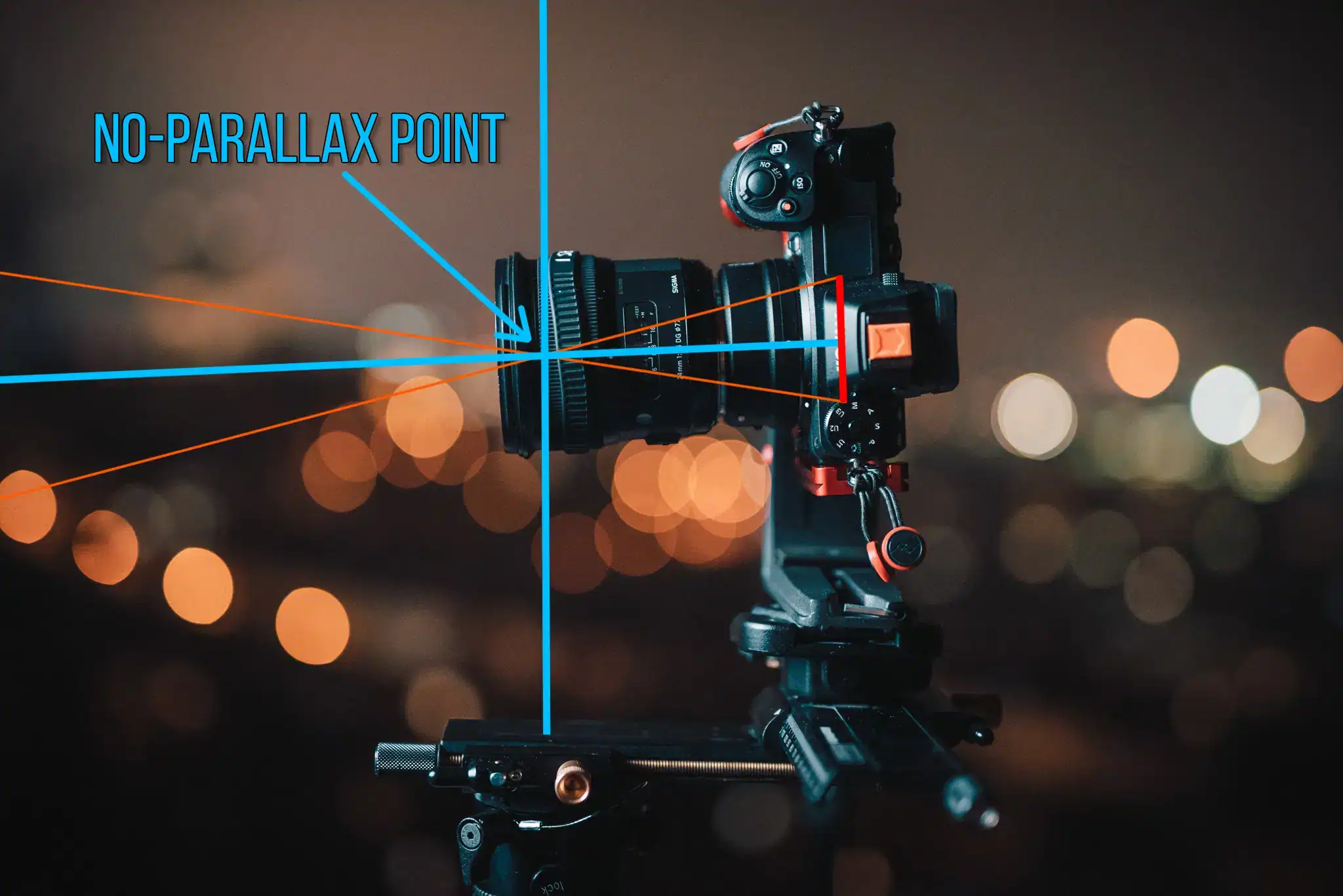
If you’re new to panoramic heads, this detailed panoramic head tutorial is an excellent primer to visualize nodal alignment and workflow. Read the panoramic head tutorial.
Step-by-Step Shooting Guide
Standard Static Scenes
- Level and align: Use a leveling base to set the tripod perfectly level. On the pano head, slide the camera so the lens’s entrance pupil is centered over the rotation axis. To calibrate in the field, place a light stand (near object) and a distant vertical (far object) in line, pan left/right, and adjust the rail until there is no relative shift between them.
- Manual exposure + locked white balance: Switch to Manual mode. Meter the midtones and set a consistent aperture/shutter/ISO for the whole sequence. Set WB to Daylight/Tungsten or a Kelvin value to avoid color flicker between frames.
- Focus: Use manual focus at the hyperfocal distance for your chosen aperture (typically f/8 on GFX with UWA). Magnified live view helps—focus once, then turn off AF.
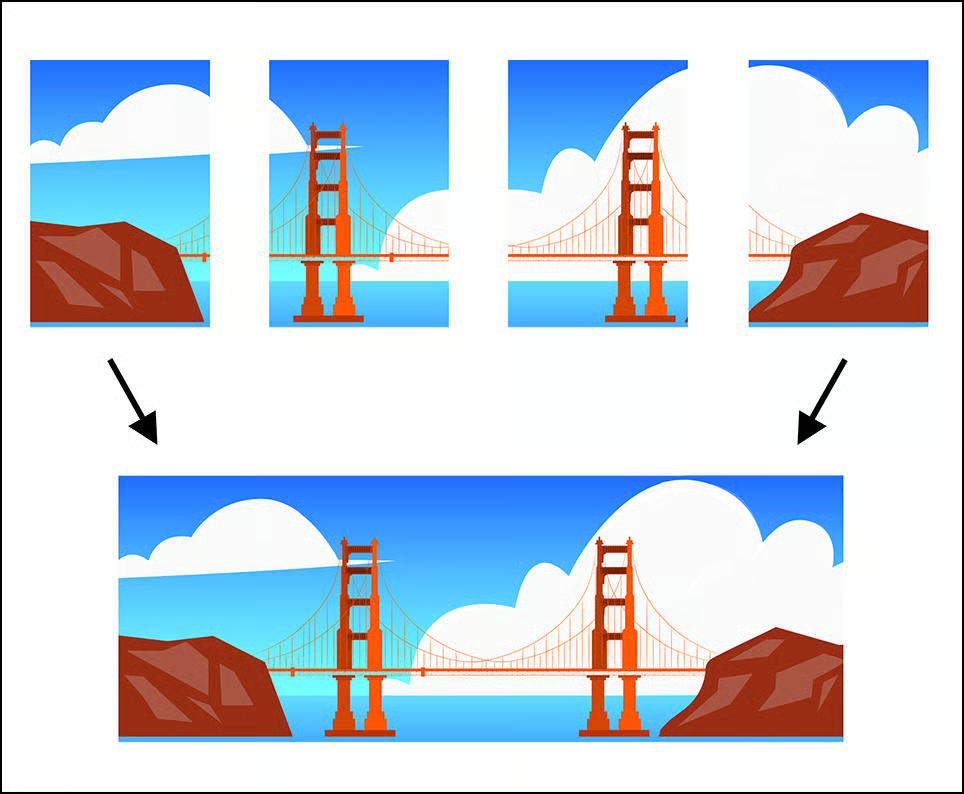
- Capture with overlap: For FF 12mm eq, take 6–8 images around per row with ~25–30% overlap. For GF 23mm (~18mm FF eq), 6 images per row typically suffice; shoot 3 rows (-45°, 0°, +45°) and add a zenith and nadir shot.
- Nadir shot: After the main rows, tilt down to shoot the ground plate for tripod removal in post (or capture a hand-held nadir and patch later).
HDR / High Dynamic Range Interiors
- Bracket for windows: Use ±2 EV (3 or 5 frames per angle, depending on scene contrast). Keep shutter speed as the variable; lock aperture and ISO.
- Keep WB fixed: Changing WB between brackets causes stitching and blending inconsistencies. Set a Kelvin value (e.g., 4000–5000K for mixed interiors) and stick with it.
- Order of operations: You can HDR-merge each angle first, then stitch, or stitch each bracket set and HDR-merge after. For rectilinear UWA, HDR-merge first is often cleaner.
Low-Light / Night Scenes
- Longer exposure, stable mount: Use f/4–f/5.6 and keep ISO at 100–400 when possible. Don’t be afraid of 5–20 second exposures if the scene is static.
- Safe ISO on GFX 50MP: 100–800 for critical work; 1600–3200 is acceptable with modern noise reduction. Test your tolerance on real jobs.
- Use a remote or self-timer: Prevents micro-shake, which shows up in tight stitches.
Crowded Events
- Two-pass strategy: First pass is fast to capture geometry; second pass you wait for gaps and clean frames.
- Mask in post: Use layer masks to replace moving people with clean plates. Keep overlap generous (30–40%) so you have options for de-ghosting.
Special Setups (Pole / Car / Drone)
- Secure gear: Use rated clamps, safety lines, and extra caution. Always protect bystanders and follow local regulations.
- Vibration management: Shorter exposures reduce motion blur. Consider higher ISO (up to 1600–3200 on GFX) when the mount is moving.
- Slower rotation: Give the system time to settle between frames, especially on poles in wind.
Recommended Settings & Pro Tips
Exposure & Focus
| Scenario | Aperture | Shutter | ISO | Notes |
|---|---|---|---|---|
| Daylight outdoor | f/8–f/11 | 1/100–1/250 | 100–200 | Lock WB (daylight) |
| Low light/night | f/4–f/5.6 | 1/30–multi-sec | 100–800 (1600–3200 if needed) | Tripod & remote; prioritize base ISO when possible |
| Interior HDR | f/8 | Bracket ±2 EV | 100–400 | Balance windows & lamps |
| Action / moving subjects | f/5.6–f/8 | 1/200+ | 400–800 | Freeze motion, use a double pass |
Critical Tips
- Manual focus at hyperfocal: With GF 23mm at f/8, focus a few meters out to keep near-to-far sharpness across the frame.
- Nodal calibration: Mark the rail position for each lens. For rectilinear UWAs, calibration is sensitive—recheck before paid shoots.
- White balance lock: Mixed lighting causes color shifts; pick a Kelvin value and keep it consistent across all angles and brackets.
- RAW over JPEG: The GFX’s 14-bit RAW files provide headroom for highlight recovery and shadow lifting—especially in HDR panoramas.
- Stabilization: GFX 50S/50R have no IBIS; if using a body or lens with stabilization, switch it off on a tripod to prevent micro-jitters.
Stitching & Post-Processing
Software Workflow
Industry workhorses for 360 stitching include PTGui, Hugin, and commercial suites. Rectilinear UWA lenses require more frames than fisheyes but give straighter lines and more natural interiors. A safe overlap target is ~25–30% for ultra-wide rectilinears and ~20–25% for more moderate wides. Align your horizon and ensure EXIF consistency (same focal length metadata) for more reliable control point detection. For a deep dive into pro-grade stitching, the PTGui review outlines why it remains the top choice for power users. Why PTGui is a top-tier panorama tool.
Cleanup & Enhancement
- Nadir patch: Capture a dedicated ground shot and patch with clone/heal or use AI-powered tripod removal tools.
- Color and noise: Correct color casts from mixed lighting, and apply noise reduction selectively to shadows.
- Leveling: Correct yaw/pitch/roll to lock the horizon; PTGui’s optimizer or Hugin’s straightening tools help.
- Export: Save a high-resolution equirectangular in 16-bit TIFF for archiving and an 8-bit JPEG for web/VR. Follow VR platform specs for max dimensions and file size.
Video: Panoramic Head Setup Basics
Visual learners will benefit from a quick tour of panoramic head setup and calibration before their first multi-row session.
For an end-to-end overview using a DSLR or mirrorless for 360 capture and stitching, this creator guide from Meta covers fundamentals that apply equally to the GFX workflow. DSLR/mirrorless 360 photo workflow.
Useful Tools & Resources
Software
- PTGui panorama stitching
- Hugin (open source)
- Lightroom / Photoshop for RAW development and retouching
- AI tripod removal / content-aware fill tools
Hardware
- Panoramic heads (Nodal Ninja, Leofoto, Really Right Stuff)
- Carbon fiber tripods with leveling bases
- Wireless remotes or intervalometers
- Pole extensions / car suction mounts with tethers
Disclaimer: brand names are provided for search convenience; always verify compatibility and specs on official sites.
For a wider panorama FAQ focused on DSLRs and mirrorless, including lens choices and virtual tour considerations, this guide is a helpful complement. DSLR/ML panorama and virtual tour FAQ.
Common Mistakes & How to Avoid Them
- Parallax error: Always align to the entrance pupil; even a few millimeters off causes stitching seams in tight spaces.
- Exposure flicker: Manual mode + fixed WB across the whole sequence.
- Tripod shadow or legs in frame: Capture a clean nadir and plan to patch.
- Ghosting from motion: Take a second pass and mask clean frames during post.
- Night noise: Favor longer shutter over higher ISO when the scene is static.
- Insufficient overlap: Err on the side of 25–30% with ultra-wide rectilinears.
Real-World Scenarios & Field Advice
Indoor Real Estate
Use GF 23mm f/4 (18mm FF eq) to control wall bowing and maintain straight verticals. Shoot 6×3 rows + Z/N at f/8, ISO 100–200, with ±2 EV bracketing for window views. Keep WB on a fixed Kelvin (e.g., 4000–4500K) to tame mixed lighting. Turn off all ceiling fans and wait out moving curtains before each exposure.
Outdoor Sunset
Set to f/8–f/11, ISO 100–200. Meter for highlights and shoot an HDR set if the sun is in frame. For wind, add weight to the tripod or shorten exposure times (raise ISO to 400–800). If flare is strong, shade the front element or reframe slightly to keep the sun near the edge in only one or two frames for easier masking.
Event Crowds
Go faster: f/5.6–f/8, 1/200s, ISO 400–800. Take two passes—the first for geometry, the second for gaps in motion. If you can’t control people flow, accept minor ghosting and plan to blend manually in the busiest sectors.
Rooftop/Pole Shooting
Check wind speed. Use a guy-line (tether) and don’t extend a tall pole in gusts. Shoot at slightly higher ISO (800–1600) to keep exposures short. Spin slowly; wait a beat between frames for vibrations to settle. Safety first: never lean over parapets or put your rig above walkways without spotters.
Car-Mounted Capture
Use rated suction mounts on clean metal/glass, secondary tethers, and avoid high speeds. Shutter speeds 1/500s+ help freeze vibrations. Expect to shoot multiple takes and mask out passing vehicles later.
Frequently Asked Questions
- Can I shoot handheld panoramas with the GFX 50S/50R?
Yes for simple partial panos, but for 360/VR and multi-row work, use a tripod and pano head. The high resolution exposes small alignment errors, and rectilinear UWAs are unforgiving of parallax when handheld.
- Is the Sony FE 12–24mm f/4 G wide enough for a single-row 360?
On full-frame, 12mm rectilinear still needs multiple rows to capture zenith and nadir cleanly. Plan on 2–3 rows plus Z/N. Since that lens can’t mount on the GFX, use a rectilinear UWA with similar FOV on GFX (e.g., GF 23mm); expect 3 rows.
- Do I need HDR for interiors with bright windows?
Almost always. Bracket ±2 EV (3–5 frames per angle). Merge to HDR per view before stitching, or stitch bracket sets and HDR-merge afterward. Keep WB fixed across all brackets for consistency.
- How do I avoid parallax issues?
Calibrate the pano head so the lens’s entrance pupil sits over the rotation axis. Use near/far alignment tests and mark your rail positions for each lens. Even a few millimeters off can create seams in tight spaces.
- What ISO range is safe on the GFX 50S/50R for low light?
ISO 100–800 is the sweet spot. ISO 1600 is still clean for web and moderate prints; 3200 is usable with modern noise reduction. Prefer longer exposures on a tripod when the scene is static.
- Can I set custom modes for pano shooting?
Yes. Save a “Pano” custom setting with manual exposure, fixed WB, RAW, manual focus, and exposure bracketing off/on as needed. It speeds up prep and reduces missed settings.
- How do I reduce flare at ultra-wide angles?
Avoid direct light sources near the frame edges, use your hand or a flag to shade the lens, and shoot a second frame with your hand out of view for blending if needed. Slight reframing so the sun is captured in fewer tiles helps masking.
- What’s the best tripod head for this setup?
Use a dedicated multi-row panoramic head with fore-aft and lateral sliders (e.g., Nodal Ninja, Leofoto, or RRS). For medium-format bodies, prioritize load rating, rigidity, and repeatable scales for nodal marks.
Final Notes on the GFX + Ultra-Wide Workflow
While the Sony FE 12–24mm f/4 G cannot physically mount to the GFX 50S/50R, the FOV behavior and techniques covered here apply directly to comparable rectilinear lenses on the GFX system (GF 23mm f/4, adapted rectilinears that cover the sensor). The medium-format advantage—dynamic range, color depth, and resolution—shines when your capture is consistent: nodal alignment, locked exposure/WB, sufficient overlap, and careful post. Do those well and your 360 panoramas will stitch cleanly and grade beautifully, even in the toughest interiors or low-light scenes.