
Why This Camera & Lens Are Great for Panoramas
Curious how to shoot panorama with Fujifilm GFX 50S / 50R & Sigma 15mm f/1.4 DG DN Diagonal Fisheye Art? This combo brings together the medium-format look of the GFX 50S/50R and the speed and ultra-wide field of view of Sigma’s modern 180° diagonal fisheye. The GFX 50-series’ 43.8 × 32.9 mm, 51.4 MP sensor offers excellent dynamic range (around 14 stops at base ISO 100) and large 5.3 µm pixels for clean tones and low noise. The Sigma 15mm f/1.4 DG DN Fisheye Art delivers a true 180° diagonal field on full frame with exceptional sharpness and well-controlled coma and CA—traits that pay off in night panoramas and indoor HDR work.
Important compatibility note: Sigma’s 15mm f/1.4 DG DN Diagonal Fisheye Art is made for Sony E/L-mount full-frame. There is no native GFX mount, and as of writing, no commonly available active adapter provides aperture/focus control on GFX. Practically, that means two workable approaches: 1) use a compatible full-frame body with this lens for the 360° capture, or 2) if you must use it on the GFX, switch the GFX to 35mm crop mode and use a suitable adapter understanding you may lose electronic focus/aperture control, which is not recommended. In most cases, GFX owners should either use a different, GFX-friendly fisheye (e.g., EF-mount fisheye via Fringer EF–GFX) or capture with the Sigma fisheye on a secondary full-frame body while keeping the GFX for high-resolution stills. The guidance below focuses on best practices for a fisheye-based 360° workflow, with specifics for the GFX 50S/50R sensor and for a 15mm diagonal fisheye’s coverage.
Quick Setup Overview
- Camera: Fujifilm GFX 50S / 50R — 43.8 × 32.9 mm medium format sensor, 51.4 MP, ~14 stops DR at ISO 100, large 5.3 µm pixels; no IBIS on these models.
- Lens: Sigma 15mm f/1.4 DG DN Diagonal Fisheye Art — full-frame diagonal fisheye, approx. 180° diagonal FOV, extremely sharp, low coma/CA, heavy build with tripod foot. Note: E/L-mount only; not natively GFX.
- Estimated shots & overlap (15mm diagonal fisheye on full frame/35mm crop): 4 shots around (90° yaw steps) + zenith + nadir with ~30% overlap. For safety or hand-held, 6 shots around.
- Difficulty: Intermediate — easy capture count, but requires precise nodal alignment and careful exposure/HDR control.
Planning & On-Site Preparation
Evaluate Shooting Environment
Walk the scene and note light direction, reflections, and moving subjects. For interiors, look for reflective glass, polished floors, and mirrors; aim to keep the front element clean and set the camera at least 30–50 cm away from glass to reduce flare and ghosting. Outdoors, watch wind gusts (especially if using a pole), tripod sink in soft ground, and sun angle—the fisheye’s huge FOV makes flare control important.
Match Gear to Scene Goals
The GFX 50S/50R delivers superb tonal gradation and highlight headroom at base ISO 100—great for high-contrast sunsets and interiors. A 15mm diagonal fisheye minimizes the shot count for a 360 photo (4-around + zenith + nadir is common), which speeds up capture in dynamic scenes. Indoors, ISO 100–400 is ideal; the GFX 50 sensor is very clean up to ISO 800–1600 if you must raise sensitivity. The Sigma’s f/1.4 aperture is useful at night and for astro overlaps; for panoramas you’ll typically stop down to f/5.6–f/8 to maximize uniform sharpness.
Pre-shoot Checklist
- Charge batteries and format dual cards; bring spares.
- Clean front element carefully—fisheye curvature magnifies smudges.
- Level the tripod and verify your panoramic head’s nodal calibration for this camera/lens position.
- Safety: tether on rooftops and poles; sandbags in wind; avoid placing legs in walkways.
- Backup: shoot a second pass for insurance, especially with moving crowds or changing light.
Essential Gear & Setup
Core Gear
- Panoramic head: Use a two-axis panoramic head so the lens rotates around its no-parallax (entrance pupil) point. This eliminates parallax shifts and makes stitching predictable.
- Stable tripod with leveling base: A leveling base lets you level the head quickly even on uneven ground—critical for clean horizon lines.
- Remote trigger or app: Minimize vibrations and keep your hands off the rig, especially for multi-second night exposures.
Optional Add-ons
- Pole or car mount: Use a safety tether and keep speed low; wind loads rise quickly with a heavy fisheye. Check permits for aerial/pole work.
- Lighting aids: Small LEDs for dark corners, and flags to reduce flare near windows.
- Weather protection: Rain covers, silica gel, and a microfiber cloth for the fisheye dome.
For a primer on panoramic heads and entrance pupil technique, see this panoramic head setup tutorial. Learn panoramic head setup

Step-by-Step Shooting Guide
Before You Start: Mount Compatibility
If you intend to combine a GFX 50S/50R with the Sigma 15mm f/1.4 DG DN Fisheye, remember: the lens is E/L-mount only. There is no widely available active adapter for GFX that preserves focus/aperture. The practical panorama workflow is either (A) use a supported fisheye on GFX (e.g., Canon EF fisheye via Fringer EF–GFX), or (B) mount the Sigma fisheye on a compatible full-frame body and follow the same capture counts and nodal rules described below. If you run the GFX in 35mm crop mode, the shot counts and overlaps for a 15mm diagonal fisheye remain the same.
Standard Static Scenes
- Level and nodal align: Level your tripod, then adjust the panoramic head so the lens rotates about its entrance pupil. A quick test: place two vertical objects (one near, one far) and rotate—if they “shift” relative to each other, adjust fore-aft until the shift disappears.
- Manual exposure and WB: Set M mode and lock WB (e.g., 5600K daylight or a custom value). Consistent exposure and white balance are critical for seamless stitching.
- Capture sequence: For a 15mm diagonal fisheye, shoot 4 frames around at 0°, 90°, 180°, 270° with 25–30% overlap, plus one zenith and one nadir. In tight spaces or handheld, consider 6 around for more overlap headroom.
- Nadir frame: Tilt down to capture a clean ground plate for tripod removal in post. If possible, shift the rig slightly so the tripod footprint moves and you can content-fill the patch more easily.
HDR / High Dynamic Range Interiors
- Bracket ±2 EV (3–5 frames): Balance bright windows and interior shadows. The GFX 50’s DR is excellent; ±2 EV typically suffices, but very bright windows may need ±3 EV.
- Lock WB across brackets: Avoid color shifts that cause stitching seams. Shoot RAW for more latitude.
- Sequence discipline: Keep the same bracket order per shot (e.g., 0, −2, +2) for rapid batching in PTGui/Hugin.
Low-Light / Night Scenes
- Stop down to f/4–f/5.6 if possible for uniform sharpness; use longer exposures instead of very high ISO. The GFX 50S/50R looks great at ISO 100–400, good at 800, usable at 1600 with careful noise reduction.
- Use a remote/app and a 2 s shutter delay. The 50S/50R lack IBIS, so tripod technique matters. Consider electronic shutter to avoid shutter shock but beware LED banding.
- Mind the sky motion: Keep exposures short enough to limit star trailing if you plan to include the zenith in night skies.
Crowded Events
- Two passes around: First for coverage, second to catch gaps in the crowd. Note positions of moving elements for later masking.
- Higher overlap: Use 6-around to give your stitcher more options to reject moving subjects.
- Faster shutter: Aim for 1/200 s or faster at f/5.6–f/8, ISO 400–800, to freeze motion.
Special Setups (Pole / Car / Drone)
- Secure and tether: On poles or car rigs, use redundant clamps and a safety line. The Sigma fisheye is heavy; double-check every knob.
- Vibration control: Drive slowly and avoid rough surfaces. Use faster shutter speeds (1/250 s+), and increase overlap.
- Spin strategy: Rotate slower between frames to give the rig time to settle before each exposure.
Recommended Settings & Pro Tips
Exposure & Focus
| Scenario | Aperture | Shutter | ISO | Notes |
|---|---|---|---|---|
| Daylight outdoor | f/8–f/11 | 1/100–1/250 | 100–200 | Lock WB (Daylight). Keep 25–30% overlap. |
| Low light/night | f/4–f/5.6 | 1/30–1/60 | 400–800 | Tripod + remote; avoid pushing ISO above 1600 on GFX 50 if you need heavy shadow recovery. |
| Interior HDR | f/8 | Bracket ±2 EV | 100–400 | Balance windows and lamps; consistent bracket ordering. |
| Action / moving subjects | f/5.6–f/8 | 1/200+ | 400–800 | Freeze motion; consider 6-around for overlap. |
Critical Tips
- Manual focus at hyperfocal: For a 15mm on full frame, hyperfocal at f/8 is roughly ~1 m. Focus ~1 m, then lock focus; you’ll get near-to-infinity sharpness.
- Nodal (entrance pupil) calibration: Mark the fore-aft rail position once dialed in. Tape or a paint pen on the rail saves time on every job.
- White balance lock: Mixed lighting will otherwise change hue frame-to-frame—lock a custom WB or Kelvin value.
- RAW capture: Gives you the dynamic range and color flexibility to resolve seams and match tones.
- Stabilization: The GFX 50S/50R have no IBIS; if you’re using any lens with OIS on a tripod, switch OIS off to avoid micro-blur.
Want a deeper dive into capture process and tripod techniques for 360 photos? Oculus’s DSLR/mirrorless 360 guide has a clear, step-by-step overview. Shooting and stitching a 360 photo
Stitching & Post-Processing
Software Workflow
Import your RAWs and pre-process globally (WB, base exposure, lens profile off for fisheyes unless your stitcher requires it). In PTGui or Hugin, set lens type to “full-frame fisheye,” focal length 15 mm, and crop factor 1.0 (also 1.0 for 35mm crop mode). Fisheyes are typically easier to stitch thanks to fewer shots, but they demand accurate lens modeling and nodal alignment. Aim for 25–30% overlap around. Export to equirectangular 2:1 (e.g., 12,000 × 6,000 px or higher) for virtual tour players.
PTGui is a favorite among professionals for speed and control; Fstoppers’ review covers why it’s widely regarded as the power tool for panorama creation. Why PTGui is a top-tier pano tool
Cleanup & Enhancement
- Nadir patch: Use PTGui’s Viewpoint optimization or export to Photoshop for clone/AI fill. Capture a dedicated nadir tile for best results.
- Color consistency: Even with locked WB, interiors with mixed lighting benefit from selective HSL tweaks and subtle split-toning.
- Noise reduction: Apply luminance NR lightly, then mask back details. The GFX 50 files tolerate NR well thanks to big pixels.
- Leveling: Level horizon and correct yaw/pitch/roll with optimizer tools; verify straight verticals for architecture.
- Export: Save a 16-bit TIFF master and a high-quality JPEG equirectangular for web/VR. Keep layered PSDs for future edits.
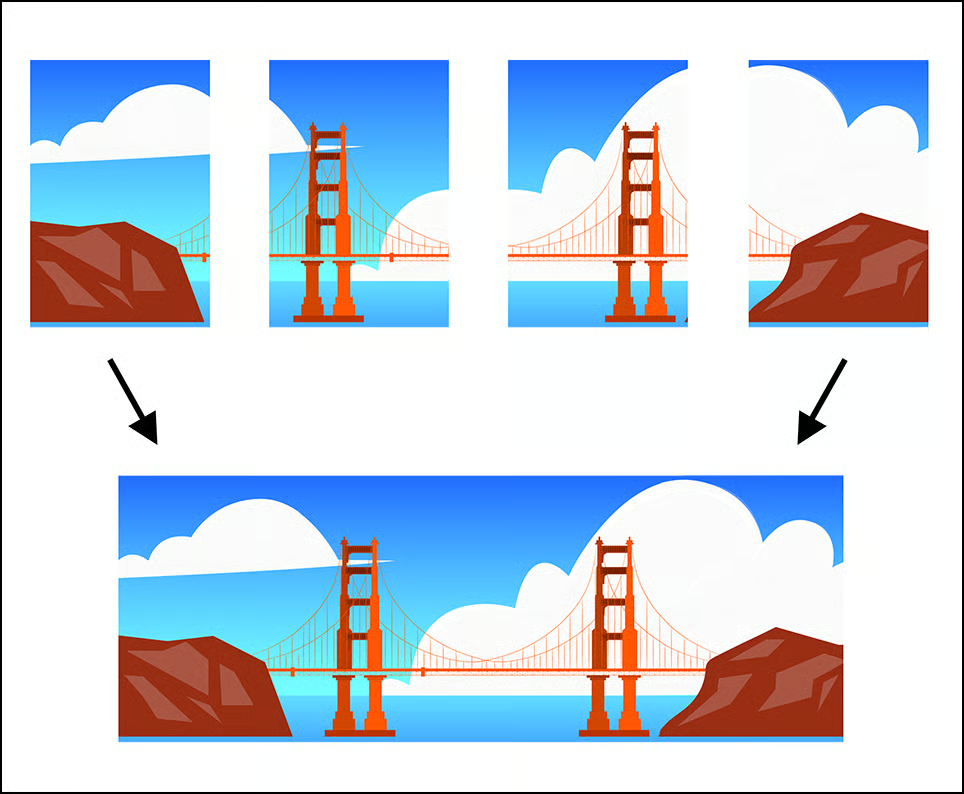
For more background on best-practice pano technique and common pitfalls, this Q&A thread outlines field-tested tips from many shooters. Techniques to take 360 panoramas
Disclaimer: Software evolves—always check the latest PTGui/Hugin docs for current workflows.
Video: Visual Walkthrough
Prefer seeing it done? This video provides a clear, practical overview of panorama capture and stitching concepts that map directly to this workflow:
Useful Tools & Resources
Software
- PTGui panorama stitching
- Hugin (open source)
- Lightroom / Photoshop / Affinity Photo
- AI tripod removal tools (e.g., Generative Fill)
Hardware
- Panoramic heads (Nodal Ninja, Leofoto)
- Carbon fiber tripods with leveling bases
- Wireless remote shutters
- Pole extensions / car mounts with safety tethers
Disclaimer: Names provided for search convenience. Verify specs and compatibility on official sites.
Field Scenarios: What Works and Why
Indoor Real Estate
Use a tripod, panoramic head, and bracket ±2 EV at f/8, ISO 100–200. Keep the camera near room center and slightly below eye level to minimize distortion of ceilings and to make the nadir patch less intrusive. Lock WB to a custom value to avoid mixed-light seams. If using a GFX-compatible fisheye, 4-around + zenith + nadir is plenty. The large GFX sensor preserves highlight detail in bright windows—blend brackets before stitching or let PTGui handle HDR internally.
Outdoor Sunset
Base ISO 100, f/8, 1/60–1/125 s. Use a lens hood shadow with your hand to block the sun from hitting the front element directly during certain frames; fisheyes are flare magnets. Shoot a second pass 1–2 minutes later in case clouds move during the first rotation.
Event Crowds
Capture two passes—one fast, one timed to gaps. For the second pass, wait for people to step aside in critical frame overlap zones. In PTGui, mask in the clean regions. Use 6-around to give the optimizer more room to reject mismatches.
Rooftop/Pole Shooting
Wind is your enemy. Add a sandbag at the base, use guy lines on poles, and keep exposures short (1/250 s+). A fisheye’s low shot count minimizes time aloft. Always tether the rig when over public spaces and follow local regulations.
Car-Mounted Capture
Use an anti-vibration car mount and redundant straps. Drive slowly in a controlled area. Increase overlap and use faster shutter speeds. Expect to do some seam masking for moving cars/people.
Common Mistakes & How to Avoid Them
- Parallax error: Always align the entrance pupil using a rail; even a few millimeters off can cause ghosting.
- Exposure flicker: Manual exposure and locked WB keeps tones consistent between frames.
- Tripod shadows and footprints: Capture a dedicated nadir frame and patch it during post.
- Ghosting from movement: Use higher overlap and mask moving subjects in the stitcher.
- Night noise: Favor longer exposures over high ISO; on GFX 50 stay near ISO 100–800 when possible.
- Flare with fisheyes: Avoid aiming directly into strong light sources; shade the lens and clean the front element.
Frequently Asked Questions
-
Can I shoot handheld panoramas with the GFX 50S/50R?
Yes for simple cylindrical panos outdoors, but for full 360° spheres the large sensor demands precision. Use 6-around with generous overlap and fast shutter speeds, then expect more cleanup. A tripod with a panoramic head remains the reliable route.
-
Is the Sigma 15mm f/1.4 DG DN Fisheye wide enough for single-row 360?
Yes. As a 180° diagonal fisheye on full frame (or GFX in 35mm crop), 4-around + zenith + nadir is standard. In tight spaces, 6-around provides more stitching leeway.
-
Do I need HDR for interiors with bright windows?
Usually. Even with the GFX’s ~14 stops of DR, scenes with sunlit windows often exceed single-shot range. Bracket ±2 EV (3–5 frames) and merge to HDR before or during stitching in PTGui or Hugin.
-
How do I avoid parallax issues?
Mount the camera on a panoramic head and slide the camera fore-aft until near/far objects don’t shift relative to each other during rotation. Mark that rail position for the GFX 50 body and 15mm fisheye setup.
-
What ISO range is safe on the GFX 50S/50R in low light?
Stick to ISO 100–400 for top quality. ISO 800 is still very good; ISO 1600 remains usable with careful noise reduction. Above that, you may lose shadow detail if heavy recovery is needed.
-
Can I set up Custom Shooting Modes for pano?
Yes. Create a custom mode with M exposure, fixed WB, RAW, single AF/Manual focus, and shutter delay (2 s). You’ll be ready to shoot with one dial turn.
-
How do I reduce flare with a fisheye?
Avoid direct light sources near the frame edge, use your hand or a flag just out of frame to shade the element, and clean the front element frequently. Slightly re-angle the zenith shot to keep the sun from striking the glass.
-
What’s the best tripod head for this setup?
Look for a two-axis panoramic head with precise fore-aft and vertical adjustments, an Arca clamp, and engraved scales (e.g., Nodal Ninja, Leofoto). A leveling base speeds setup.
Technical Notes, Limitations, and Trust Tips
- Sensor facts: GFX 50S/50R 51.4 MP, ~5.3 µm pixels, base ISO 100, superb highlight rolloff; mechanical shutter to 1/4000 s, electronic to 1/16000 s (mind LED banding).
- Lens facts: Sigma 15mm f/1.4 DG DN Diagonal Fisheye is built for full-frame E/L. 180° diagonal FOV; excellent coma control; heavy (approx. 1.3 kg); benefits from a solid head/tripod.
- Compatibility honesty: There is no widely used active adapter to run this DN lens with full electronic control on GFX. For a GFX-native panorama path, consider EF-mount fisheyes via Fringer EF–GFX, or multi-row with a rectilinear wide lens. If you own a Sony/L-mount body, use it with the Sigma fisheye for the pano capture and process identically.
- Backup workflow: Always run a second, faster pass. Keep dual card slots set to RAW+RAW or RAW+JPEG. After each location, verify a stitch on a laptop or tablet before leaving.
- Safety: Heavy fisheyes plus panoramic heads raise center of gravity. Keep legs wide, hang a weight from the apex, and never leave the rig unattended in wind or crowds.
If you’re new to virtual-tour capture, this field guide compares camera/lens options and tradeoffs in real-world tours. DSLR/mirrorless virtual tour FAQ
