
Why This Camera & Lens Are Great for Panoramas
The Fujifilm GFX 50S/50R medium-format bodies paired with the Pentax DA 10–17mm f/3.5–4.5 ED Fisheye make an unconventional but very capable panorama kit. The GFX 50S and 50R share a 51.4MP 43.8×32.9 mm sensor (approx. 8256×6192 px) with large 5.3 μm pixels and about 14 EV of dynamic range at base ISO. That big sensor gives clean tonality, robust highlight headroom, and very low noise at ISO 100–800—excellent for high-quality 360 photos and HDR panoramas. The DA 10–17mm is a compact fisheye zoom with a 180° diagonal field of view at 10mm on APS‑C, which means you can cover a full sphere with fewer shots compared to rectilinear lenses.
There are caveats and how to address them: the DA 10–17mm is a Pentax K‑mount APS‑C lens. On the larger GFX sensor it vignettes heavily. The simple solution is to use the GFX’s crop modes (35mm or smaller) or plan to crop in post—either way, coverage for stitching remains excellent. You’ll also be adapting the lens; since the DA 10–17mm has no aperture ring, use a K‑to‑GFX adapter with an aperture control lever so you’re not forced to shoot at minimum aperture. Autofocus will not work—set focus manually, which is ideal for panoramas anyway. With these points handled, you get a lightweight, ultra‑wide fisheye workflow on a superb high‑resolution sensor—perfect for both speed (fewer frames) and quality (clean, detailed stitches).
Quick Setup Overview
- Camera: Fujifilm GFX 50S / 50R — 43.8×32.9 mm medium format, 51.4MP, ~14 EV DR at ISO 100, 5.3 μm pixel pitch; no IBIS on these models, so rely on tripod stability.
- Lens: Pentax DA 10–17mm f/3.5–4.5 ED Fisheye — diagonal fisheye zoom; sharpest around f/5.6–f/8; moderate CA/purple fringing in high‑contrast edges (fixable in post); manual focus via adapter.
- Estimated shots & overlap (tested guidelines at 10–12mm):
- Speed mode: 4 around (90° apart) + zenith + nadir, 30–35% overlap (use 35mm crop mode).
- Safe mode: 6 around + zenith + nadir for busy scenes or tricky interiors.
- At 14–17mm: 8–10 around + Z + N, 30% overlap.
- Difficulty: Intermediate (adapter use, nodal calibration, manual focus/exposure).
Planning & On-Site Preparation
Evaluate Shooting Environment
Walk the location before setting up. Note the primary light directions and sources (sun, windows, lamps) and potential stitching hazards: glass walls, mirrors, tight spaces, and moving people. If shooting near reflective glass, position the camera at least 30–50 cm away and use a lens hood shadow or flag to reduce flare and ghost reflections. For sunsets and high‑contrast scenes, plan an HDR bracket to preserve highlights.
Match Gear to Scene Goals
The GFX 50S/50R’s dynamic range and large pixels shine in controlled‑light interiors and low‑ISO outdoor panoramas. A fisheye like the DA 10–17mm means fewer frames and faster capture—great when crowds are moving or when you’re on a rooftop with wind. The trade‑off is fisheye distortion (easy to manage in stitching software) and the need to shoot in crop mode to avoid extreme vignetting. ISO 100–800 is a safe sweet spot on the GFX 50S/50R; ISO 1600 is usable; ISO 3200 is acceptable for emergency low light if you plan gentle noise reduction.
Pre-shoot Checklist
- Charge batteries, format reliable UHS-II SD cards, clean lens and sensor (fisheyes show dust easily).
- Level your tripod and calibrate your panoramic head so the entrance pupil aligns correctly.
- Safety checks: weigh down the tripod in wind; use a tether/strap for rooftops; verify all clamps and plates are locked.
- Backup workflow: capture a second full round—especially for dynamic scenes or if clouds/lighting change during the first pass.
Essential Gear & Setup
Core Gear
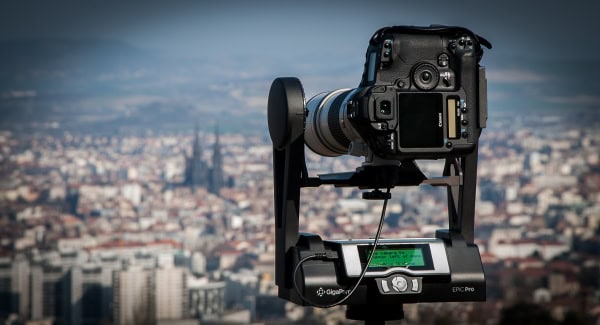
- Panoramic head: Allows rotation around the lens’s entrance pupil (nodal point) to eliminate parallax. Use an L‑bracket for the GFX body and a fore/aft rail to dial in the exact position for the DA 10–17mm at your chosen focal length.
- Stable tripod with leveling base: A leveling base speeds setup and ensures the rotator is perfectly horizontal, preventing horizon drift in stitches.
- Remote trigger or phone app: Fire the shutter without touching the camera. On GFX, enable Electronic Front Curtain Shutter to minimize vibration.
Optional Add-ons
- Pole or car mount: Use only with safety tethers and double‑check clamp torque. Expect more shots/overlap to hedge against vibration.
- Lighting aids: Portable LEDs or bounced flash for dark interiors; keep lighting consistent between frames.
- Weather gear: Rain cover and microfiber cloth for fisheye glass; a single droplet can ruin a set.
Step-by-Step Shooting Guide
Standard Static Scenes
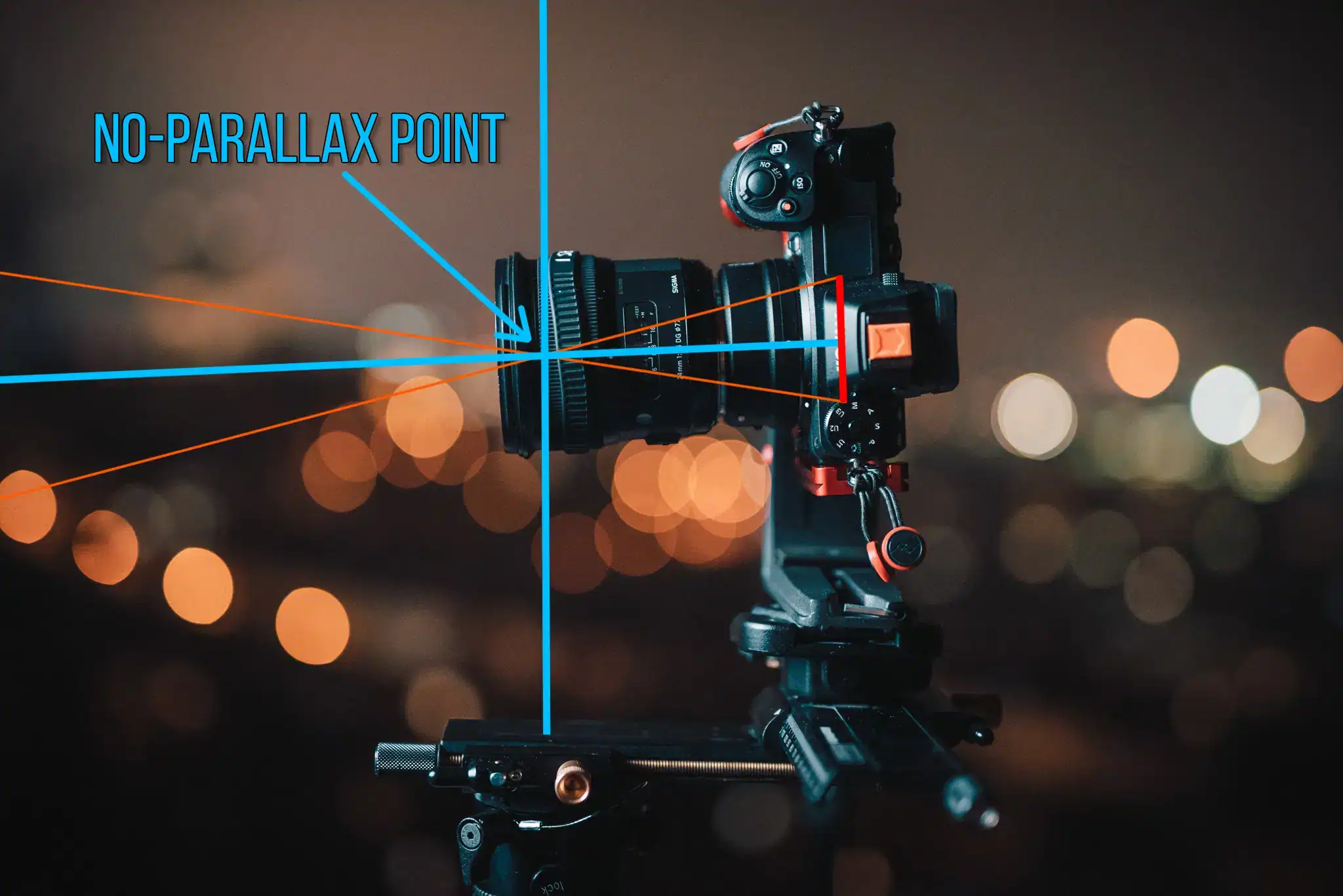
- Level the tripod and align the nodal point. Mount the GFX on the panoramic head. Slide the camera forward/back along the rail while observing a near object against a far object. Pan left/right; adjust until there is no relative shift—this is your entrance pupil alignment. Mark the rail value for 10mm and 12mm to speed future setups.
- Manual exposure and locked white balance. Set M mode, choose ISO 100–200 outdoors (400–800 indoors), and lock WB (Daylight for sun, 4000–5000K for typical interiors) to avoid color mismatch across frames.
- Capture with tested overlap. At 10–12mm, shoot 4 frames around at 90° increments with 30–35% overlap, then a zenith and a nadir. For complex scenes or if in doubt, do 6 around instead of 4.
- Take a clean nadir. After the main round, tilt down to shoot the ground plate, then lift the camera off and hand‑hold a clean floor shot for easy tripod patching later.
HDR / High Dynamic Range Interiors
- Bracket ±2 EV (3 or 5 frames). For windows or bright signage, 5 frames at −4/−2/0/+2/+4 EV provides insurance. Keep ISO at 100–400 to preserve highlight latitude.
- Lock white balance across all brackets and frames. Consistency prevents color shifts that complicate stitching and blending.
Low-Light / Night Scenes
- Use longer exposures with a solid mount. Start around f/5.6–f/8, ISO 200–800, and shutter 1–8 seconds as needed. Enable EFCS to reduce shutter shock.
- Use a remote trigger and delay timer (2s) to avoid touching the camera. Turn off any long‑exposure NR until after the full set so it doesn’t slow the cadence unevenly between frames.
Crowded Events
- Two passes strategy. First pass for coverage, second pass waiting for gaps. Mask in post to remove moving people and duplicates.
- Use the “Safe mode” capture (6–8 around) for more stitching options when subjects are moving unpredictably.
Special Setups (Pole / Car / Drone)
- Secure gear and add a safety tether. For pole work, keep the camera above head level to reduce shadows and tripod removal. Use faster shutter speeds (1/250+) if vibration is evident.
- Plan slower rotation and more overlap. Shoot 8–10 around at 10–12mm to hedge against slight pole sway or vehicle vibration.
Real-World Mini Case Studies
Indoor Real Estate
Use 12mm at f/8, ISO 200–400, bracket ±2 EV, and 6 around + Z + N. Keep the camera near room center to minimize parallax from close furniture. Watch for mirrors and take a second round with you hidden behind a wall for masking.
Outdoor Sunset Overlook
ISO 100–200, f/8, 4 around + Z + N, plus a 5‑frame bracket at the brightest direction for safety. Start the round with the sun just off‑frame to reduce flare and then shoot the sun position last.
Event Crowds
Use 10–12mm at f/5.6–f/8, ISO 400–800, 1/200–1/500 if handheld or pole‑mounted. Do two passes; later, mask people to reduce ghosting.
Rooftop/Pole Shooting
Weight the tripod or guy the pole with a line. Wind amplifies movement—add frames and overlap. Consider shooting 8 around + Z to ensure coverage.
Recommended Settings & Pro Tips
Exposure & Focus
| Scenario | Aperture | Shutter | ISO | Notes |
|---|---|---|---|---|
| Daylight outdoor | f/8–f/11 | 1/100–1/250 | 100–200 | Lock WB to Daylight; EFCS on |
| Low light/night | f/4–f/5.6 | 1/30–1/60 (tripod) or longer | 400–800 | Remote trigger; timer; avoid pushing ISO too far |
| Interior HDR | f/8 | Bracket ±2 EV | 100–400 | Balance windows vs lamps; consistent cadence |
| Action / moving subjects | f/5.6–f/8 | 1/200+ | 400–800 | Freeze motion; consider 6–8 around for flexibility |
Critical Tips
- Manual focus at or near hyperfocal. At 10–12mm, f/8 focused around 0.7–1 m yields sharpness from near foreground to infinity. Use magnified live view to confirm.
- Nodal point calibration: Because adapters vary, set your rail by testing near/far alignment. Typical fisheye zooms end up with the rotation point roughly 60–100 mm forward of the sensor plane; mark your exact value for 10mm and 12mm on your rail.
- White balance lock: Set Kelvin instead of Auto to keep color consistent; 5200K daylight or a custom Kelvin that matches your interior lighting mix.
- RAW over JPEG: With the GFX’s DR, 14‑bit RAW maximizes highlight recovery and clean color gradients across the sky or walls.
- Stabilization: GFX 50S/50R have no IBIS. On tripod, enable EFCS; avoid full electronic shutter for HDR brackets with artificial lighting to prevent banding.
- Adapter choice: Use a K‑to‑GFX adapter that includes an aperture control lever for the DA 10–17mm; otherwise you’ll be stuck at minimum aperture.
Stitching & Post-Processing
Software Workflow
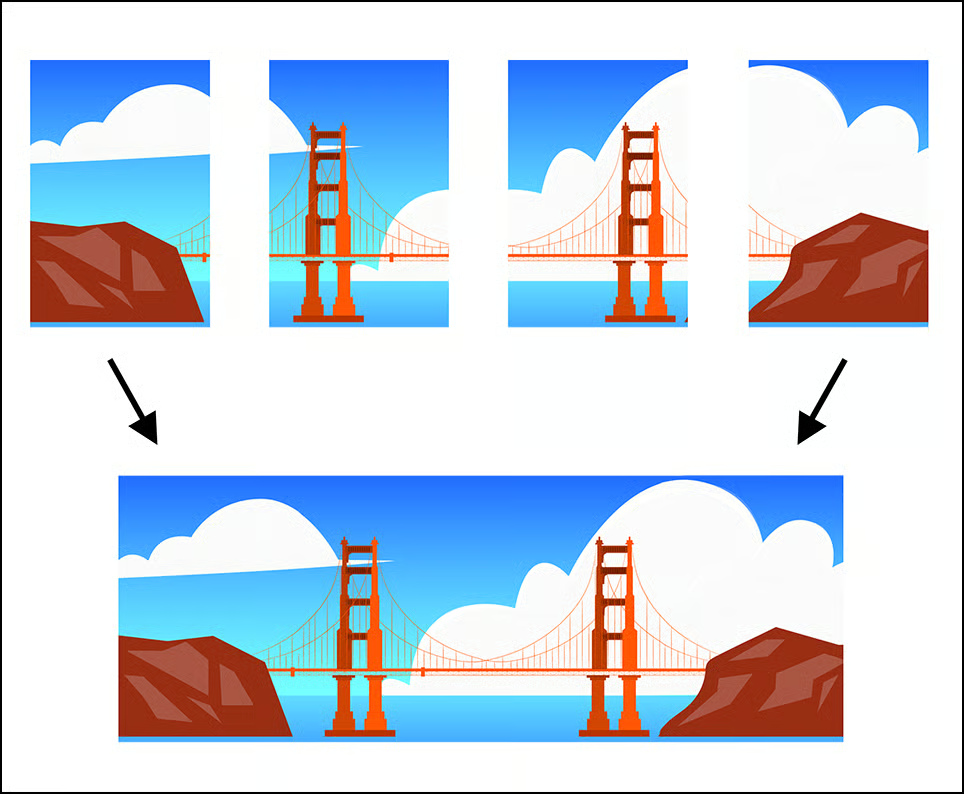
Import RAWs into Lightroom, Capture One, or your preferred RAW processor. Apply lens CA and color corrections, set a consistent white balance, and sync settings across the set. Export 16‑bit TIFFs to a dedicated stitcher such as PTGui or Hugin. Fisheye imagery is generally easier to stitch because of the wide FOV and fewer frames; you may need to “defish” or set the proper lens type in the stitcher. Industry overlap recommendation is about 25–30% for fisheye and 20–25% for rectilinear. PTGui’s automatic control point generation is excellent and its masking tools help with moving subjects and nadir cleanup. For reference on professional stitcher choices, see this review of PTGui’s strengths for high‑end panoramas: PTGui: one of the best tools for creating panoramas.
Cleanup & Enhancement
- Nadir patching: Patch the tripod using PTGui’s Viewpoint correction, Photoshop’s Clone/Healing, or AI tools.
- Color and noise: Apply subtle noise reduction when ISO ≥800. Use HSL to tame strong color casts from mixed lighting.
- Leveling: Use the horizon tool in PTGui/Hugin; fine‑tune roll/yaw/pitch to correct verticals in interiors.
- Export formats: For 360 viewers and VR, export as 2:1 equirectangular JPEG or 16‑bit TIFF if further grading is needed.
New to panoramic heads? This step‑by‑step guide to setup and alignment is a solid foundation: panoramic head setup tutorial. If you want a deeper, VR‑oriented workflow from capture through stitch, Meta’s technical guide is also helpful: set up a panoramic head to shoot high‑end 360 photos.
Video: A concise walk-through of shooting and stitching techniques.
Disclaimer: Always check your software’s latest documentation—interfaces and recommended settings can change with updates.
Useful Tools & Resources
Software
- PTGui panorama stitching
- Hugin (open source)
- Lightroom / Capture One / Photoshop
- AI tripod removal tools (e.g., Generative Fill, third‑party plugins)
Hardware
- Panoramic heads (Nodal Ninja, Leofoto, Sunwayfoto)
- Carbon fiber tripods with leveling base
- Arca‑compatible L‑bracket for GFX
- Wireless remote shutters
- K‑to‑GFX adapter with aperture control lever
- Pole extensions / car suction mounts with safety lines
Disclaimer: brand names for reference only—verify compatibility and specifications on official sites.
Common Mistakes & How to Avoid Them
- Parallax error → Carefully align the entrance pupil on the panoramic head before shooting.
- Exposure flicker → Use manual exposure and locked white balance; avoid Auto ISO for panoramas.
- Tripod shadows and clutter → Take a dedicated nadir shot and patch; reposition slightly if the sun is low.
- Ghosting from moving subjects → Shoot two passes and mask in PTGui or Photoshop.
- High‑ISO noise at night → Keep ISO as low as feasible (≤800 on GFX 50S/50R) and use longer shutter times with EFCS and a remote.
- Adapter limitations → Ensure your K‑to‑GFX adapter controls aperture on DA lenses; test before critical jobs.
Frequently Asked Questions
- Can I shoot handheld panoramas with the GFX 50S/50R?
Yes, for quick single‑row panos outdoors, but the resolution and weight make it harder to keep level. For 360 spheres, a tripod and panoramic head are strongly recommended to avoid parallax and stitching frustration.
- Is the Pentax DA 10–17mm wide enough for a single‑row 360?
At 10–12mm (fisheye), you can do 4 around + zenith + nadir in 35mm crop mode on the GFX. For busy interiors or if you want extra safety, use 6 around. At longer focal lengths (14–17mm), plan for 8–10 around.
- Do I need HDR for interiors with bright windows?
Usually yes. The GFX has excellent DR, but interior scenes with windows often exceed it. Bracket ±2 EV (3 or 5 frames) per camera position to keep clean highlights and shadow detail.
- How do I avoid parallax issues with this lens and adapter?
Use a panoramic head and calibrate the entrance pupil at your working focal length. Because adapter thickness changes the geometry, confirm with a near‑to‑far alignment test and mark the rail for repeatability.
- What ISO range is safe on the GFX 50S/50R in low light?
ISO 100–800 is excellent; ISO 1600 remains usable with light noise reduction; ISO 3200 is a last resort. Prefer longer shutter times on a tripod over cranking ISO.
- Can I store pano settings to speed up setup?
Yes. Save a custom mode with manual exposure, EFCS, RAW, fixed WB, 2s timer, and your preferred ISO/aperture. That way you can switch to “Pano mode” instantly.
- How do I reduce flare with this fisheye?
Keep strong light sources near the frame edge rather than centered, shade the lens with your hand or a flag just outside the frame, and clean the front element frequently. If possible, shoot the sun direction last and mask flares in post.
- What’s the best panoramic head for this setup?
Choose a head with a precise rotator, fore/aft and vertical rails, and clear scale markings (e.g., Nodal Ninja, Leofoto). A leveling base under the rotator significantly speeds up perfectly level rotations.
Safety, Limitations & Trust Notes
Always secure your gear—especially on rooftops, poles, or car mounts. The GFX 50S/50R lack in‑body stabilization, so tripod stability and EFCS matter. The DA 10–17mm is APS‑C; expect vignetting on the full GFX frame—use crop mode or plan to crop in post. For the DA lens, an adapter with an aperture control lever is essential. Keep a redundant capture round and maintain a 3‑2‑1 backup of your files after the shoot. For additional background on DSLR/mirrorless 360 workflows and lens choices, this primer is helpful: DSLR/mirrorless 360 virtual tour guide.