
Why This Camera & Lens Are Great for Panoramas
Wondering how to shoot panorama with Fujifilm GFX 50S / 50R & Olympus 8mm f/1.8 PRO Fisheye? This pairing can deliver ultra-detailed 360 photos if you understand both the strengths and the caveats. The Fujifilm GFX 50S/50R uses a 51.4 MP 43.8×32.9 mm (approx. 44×33 mm) medium-format sensor with 8256×6192 pixels and a generous ~5.3 μm pixel pitch. At base ISO 100, the sensor provides roughly 14 stops of dynamic range, which is excellent for high-contrast scenes such as interiors with bright windows or sunsets. The large photosites keep noise low and color depth high, great for 360° sky gradients and shadow recovery.
The Olympus M.Zuiko Digital ED 8mm f/1.8 Fisheye PRO is an ultra-fast diagonal fisheye designed for Micro Four Thirds. As a fisheye, it captures a 180° field of view across the diagonal, which drastically reduces the number of shots needed for a full sphere compared to rectilinear lenses. Its strengths include edge-to-edge sharpness stopped down and strong coma control for night scenes.
Important mount note: the Olympus 8mm f/1.8 is a Micro Four Thirds lens and does not natively mount to the Fujifilm G (GFX) mount. There are typically no electronic smart adapters for MFT→GFX. Without electronics, this focus-by-wire lens will not reliably focus or control aperture. If you cannot secure a working electronic solution, consider a native or easily adaptable fisheye for GFX (e.g., TTArtisan 11mm f/2.8 Fisheye for GF mount) for a hassle-free workflow. If you do proceed with the Olympus 8mm via a specialty adapter or custom solution, expect a circular image with heavy vignette on the larger GFX sensor; the upside is you can still complete spherical coverage with very few frames.
Quick Setup Overview
- Camera: Fujifilm GFX 50S / 50R — Medium format 43.8×32.9 mm sensor, 51.4 MP (8256×6192), ~5.3 μm pixel pitch, ~14 stops DR at ISO 100.
- Lens: Olympus 8mm f/1.8 PRO Fisheye — Diagonal fisheye (MFT), very fast aperture, strong center-to-edge sharpness when stopped to f/4–f/5.6, relatively well-controlled CA for a fisheye.
- Estimated shots & overlap (with fisheye projection):
- If the Olympus 8mm renders as a near-circular fisheye on GFX: 4 shots around (90° apart) + 1 zenith + 1 nadir (safe overlap ~30%).
- If you use 35 mm crop mode or partial coverage: 6 around (60° apart) + zenith + nadir.
- Difficulty: Intermediate (due to mount adaptation and nodal alignment). With a native GFX fisheye: Easy–Intermediate.
Planning & On-Site Preparation
Evaluate Shooting Environment
Before you set up, scan the scene for reflective surfaces (glass, polished stone), moving subjects (people, traffic, trees), and strong light sources (direct sun, bright windows, neon). For glass viewpoints, keep the front element very close (1–3 cm) to minimize reflections and ghosting. If the sun is in frame, plan your rotation order to control flare and capture a clean sky region for later blending if needed.
Match Gear to Scene Goals
The GFX 50S/50R’s dynamic range helps tame high-contrast interiors and sunsets. Safe ISO ranges for clean files: ISO 100–400 for daylight and tripod work; ISO 800–1600 remains very usable for low light if you expose to the right and apply modest noise reduction. The fisheye’s advantage is fewer frames and faster capture—ideal for windy rooftops, crowds, or quick-change light. The trade-off is classic fisheye distortion and the need for careful nodal alignment to avoid parallax.
Pre-shoot Checklist
- Batteries charged, large UHS-II card or tethered capture; clean lens and sensor (dust shows up easily in skies).
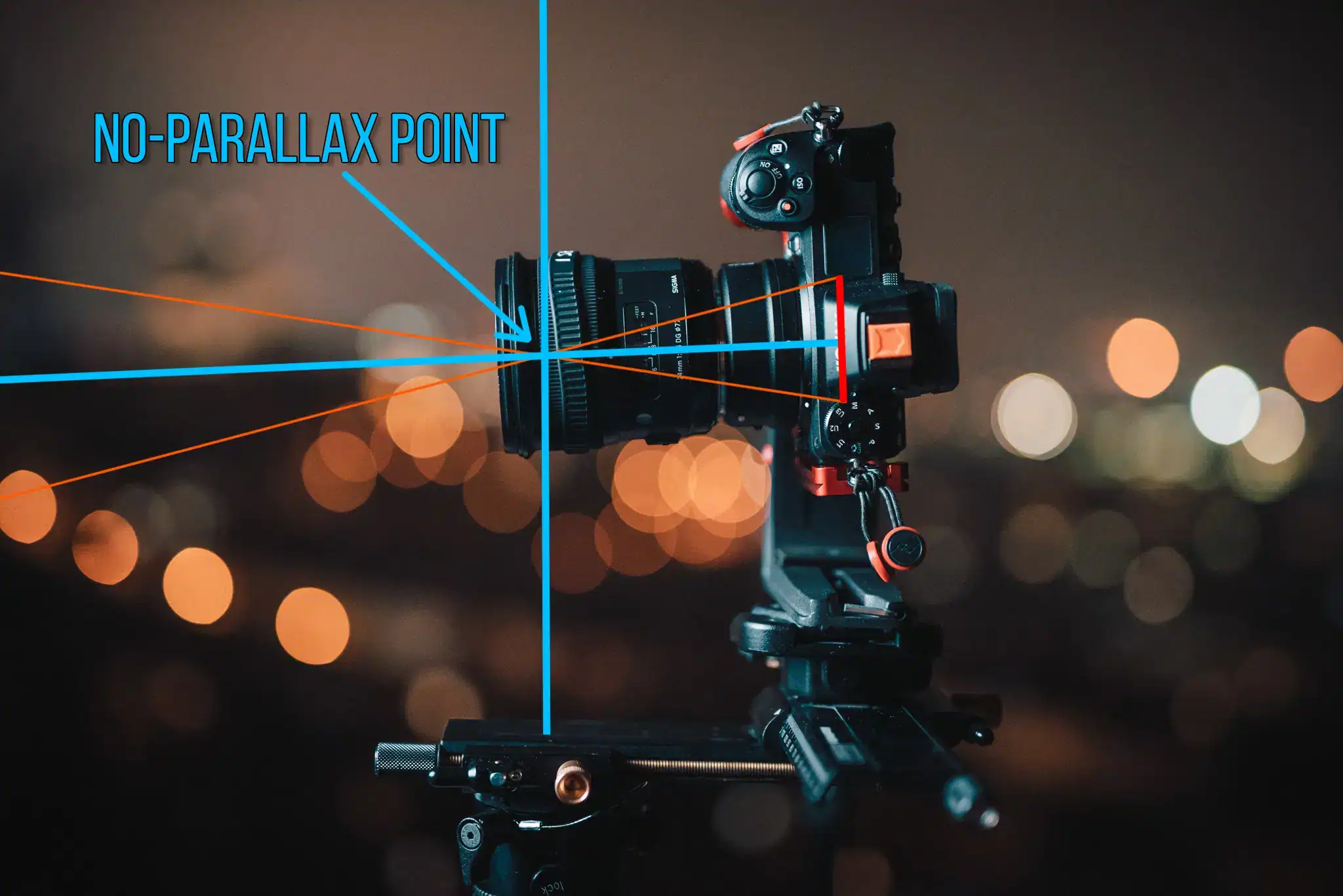
- Tripod leveled; panoramic head calibrated for the no-parallax point of your camera/lens combo.
- Safety: check wind gusts on rooftops, use a tether on poles, secure car mounts with redundant straps.
- Backup: shoot an extra safety round at the end; if HDR, repeat a second bracketed pass.
Essential Gear & Setup
Core Gear
- Panoramic head: Use a multi-row or single-row head with fore-aft and lateral adjustments to align the lens’s entrance pupil (nodal point) over the rotation axis. This eliminates parallax when foreground and background overlap at stitch boundaries.
- Stable tripod with a leveling base: A 75 mm bowl or low-profile leveling base speeds setup and keeps horizons true.
- Remote trigger or camera app: Minimize vibration and maintain consistent framing. Use a 2 s timer if a remote is unavailable.
Optional Add-ons
- Pole or car mount: Use a safety tether, check wind load, and avoid high speeds. For poles, rotate slowly and pause between frames to let vibrations die down.
- Lighting aids: Portable LED panels or bounced flash for dark interiors; keep lighting consistent across frames.
- Weather protection: Rain covers and microfiber cloths; dew heater bands help at night to keep the fisheye clear.
Mount Compatibility Advisory
The Olympus 8mm f/1.8 is an MFT lens with electronic focus and aperture. On GFX 50S/50R, you will need a very specific adapter that provides electronic control; most do not. Without electronics, the lens may be stuck wide open and at an unknown focus position. Practically speaking, a native GF-mount fisheye (e.g., TTArtisan 11mm F2.8 Fisheye) or a well-known adapted fisheye is a safer choice. If you proceed with the Olympus 8mm, test thoroughly to verify focus, aperture stop, and the resulting image circle before mission-critical work. For an excellent primer on pano heads and alignment, see this panoramic head tutorial. Panoramic head tutorial
Step-by-Step Shooting Guide
Standard Static Scenes
- Level the tripod and align the nodal point: Place two light stands (or vertical objects) at different distances in the overlap region; rotate the camera. Adjust the fore-aft slider until there is no relative shift between the near and far object—this is your nodal alignment.
- Set manual exposure and white balance: Meter a mid-tone region; set M mode (e.g., f/8, 1/125, ISO 100–200) and lock WB (Daylight for sun, Tungsten for warm interiors). This avoids exposure flicker and color shifts during stitching.
- Capture with reliable overlap:
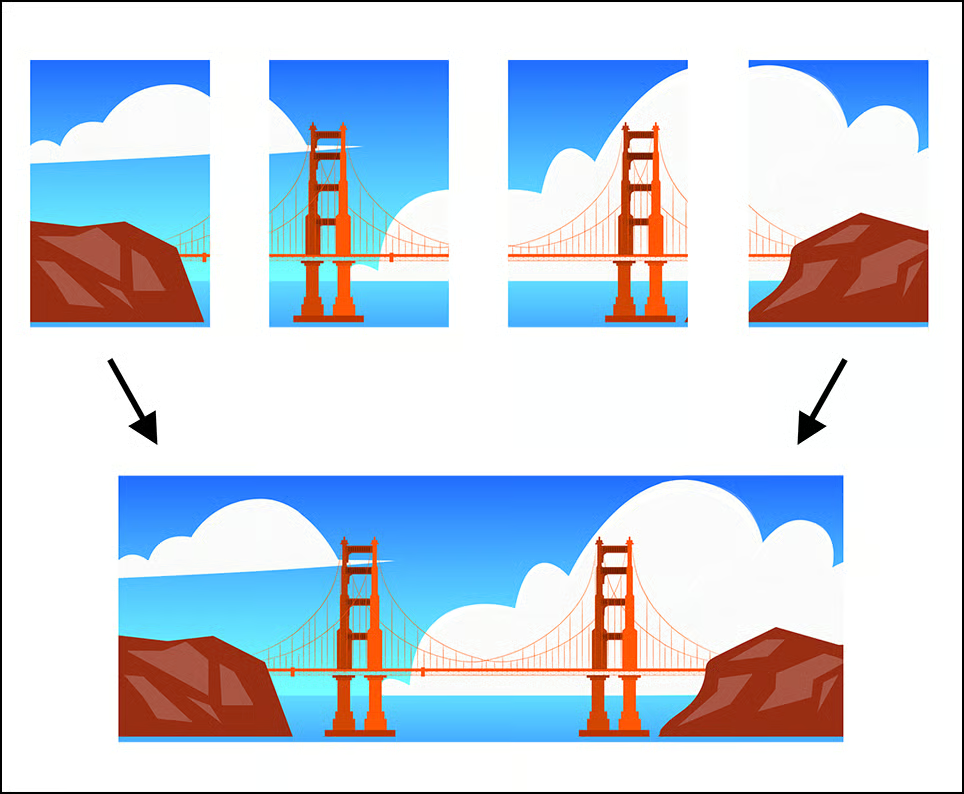
- Circular fisheye coverage on GFX: 4 frames around at 90° increments, plus 1 zenith and 1 nadir. Aim for ~30% overlap between frames.
- Partial coverage/crop mode: 6–8 frames around at 45–60° increments, plus zenith/nadir.
- Take a nadir (ground) shot: Tilt down for a dedicated nadir, or shoot a separate handheld patch frame after moving the tripod away.
HDR / High Dynamic Range Interiors
- Bracket ±2 EV (or ±3 EV if windows are extremely bright): For each angle, capture 3–5 exposures. Keep WB locked.
- Use aperture priority for bracketing only if shutter speed stays well above your motion-blur threshold; otherwise use manual with exposure compensation between brackets.
- Deflicker is easier when ISO and WB are locked; prefer consistent aperture (f/8) across all frames.
Low-Light / Night Scenes
- Use a stable tripod and remote; enable electronic first curtain if available to reduce vibrations. The GFX 50S/50R lacks IBIS, so stability is key.
- Recommended starting point: f/4–f/5.6, ISO 400–800 (1600 if needed), shutter 1–8 s depending on ambient. Expose to the right without clipping highlights to keep noise low.
- Turn off long-exposure NR if shooting many frames quickly; handle noise in post instead to avoid delays between shots.
Crowded Events
- Do two passes: first for coverage, second for clean plates when people move out of overlaps. Ask nearby subjects to hold still briefly if possible.
- Use faster shutter speeds (1/200+) and raise ISO to 800–1600 to reduce motion blur. You can denoise later, but motion blur is hard to fix.
- Mask moving subjects during stitching for ghost-free results.
Special Setups (Pole / Car / Drone)
- Pole: Use a light but stiff carbon pole; tether the camera; rotate slower than usual, pausing briefly before each frame to let oscillations settle.
- Car mount: Use dual-point suction mounts and a safety strap; avoid high speeds; shoot quick 4-around fisheye passes at stoplights.
- Drone: The GFX is too heavy for typical drones; instead, shoot from elevated poles or rooftops for a safe high viewpoint.
Recommended Settings & Pro Tips
Exposure & Focus
| Scenario | Aperture | Shutter | ISO | Notes |
|---|---|---|---|---|
| Daylight outdoor | f/8–f/11 | 1/100–1/250 | 100–200 | Lock WB to Daylight; avoid highlight clipping |
| Low light/night | f/4–f/5.6 | 1/30–8 s | 400–800 (up to 1600) | Tripod + remote; expose to the right for cleaner shadows |
| Interior HDR | f/8 | Bracket ±2 EV | 100–400 | Protect windows; keep WB locked |
| Action / moving subjects | f/5.6–f/8 | 1/200+ | 400–800 | Two passes; mask in post |
Critical Tips
- Manual focus: With a fisheye, setting focus near hyperfocal (e.g., ~1 m at f/8) keeps everything sharp. If your adapted Olympus 8mm lacks electronic focus, test a fixed distance and stop down as much as diffraction allows.
- Nodal point calibration: Mark your rail settings for this combo. Reuse the markings next time to speed setup and maintain repeatability.
- White balance: Lock WB to a fixed preset or Kelvin value to avoid stitching seams from color shifts.
- RAW over JPEG: The GFX sensor’s DR shines in RAW. You’ll have more headroom for sky gradients and interior window pulls.
- Stabilization: The GFX 50S/50R has no IBIS—turn off lens IS (if any) on tripod to prevent micro-drift during exposures.
Stitching & Post-Processing
Software Workflow
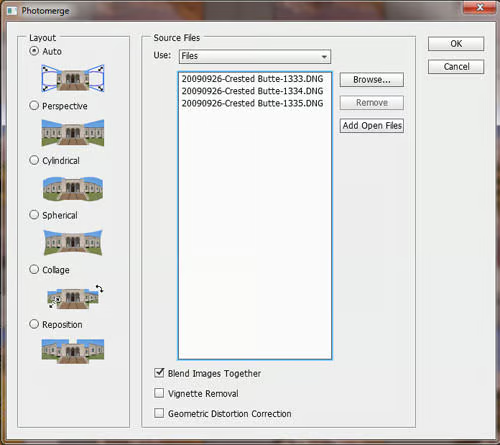
Fisheye panos stitch very reliably in PTGui and Hugin. After importing, set lens type to “Fisheye” and use automatic control points; adjust yaw/pitch/roll to level the horizon. For fisheye, plan 25–30% overlap; for rectilinears, 20–25% is typical. PTGui’s masking tools make ghost removal easy and its template system streamlines batch workflows for real estate or multi-location shoots. For a deeper overview of PTGui in practice, see this review. PTGui review and workflow insights
Cleanup & Enhancement
- Nadir patch: Use a dedicated patch frame or clone tools. AI content-aware fill and 360-aware retouching can save time.
- Color and noise: Apply a consistent color grade after stitching; use moderate noise reduction on shadow zones for night panos.
- Leveling: Use vertical line constraints or horizon tools to correct roll and maintain architectural fidelity.
- Export: Save a 2:1 equirectangular at 8K–16K (long side) for VR. Keep a 16-bit TIFF master; export JPEG for web delivery.
For an end-to-end overview of DSLR/mirrorless 360 capture and stitching, the Meta/Oculus guide is concise and up-to-date. Using a mirrorless camera to shoot and stitch a 360 photo
Recommended video: practical demonstration of pano capture and stitching techniques.
For additional viewpoints on pano head setup and field technique from another expert source, see this guide. Virtual tour camera/lens guide and FAQs
Useful Tools & Resources
Software
- PTGui panorama stitching
- Hugin (open source)
- Lightroom / Photoshop
- AI tripod/nadir removal tools
Hardware
- Panoramic heads (Nodal Ninja, Leofoto, Sunwayfoto)
- Carbon fiber tripods
- Leveling bases
- Wireless remote shutters
- Pole extensions / car mounts with safety tethers
Disclaimer: product names are for search reference; verify specs and compatibility on official sites.
Common Mistakes & How to Avoid Them
- Parallax error: Always align the entrance pupil precisely over the pano head’s pivot.
- Exposure flicker: Manual exposure and locked white balance throughout the set.
- Tripod footprint: Shoot a dedicated nadir or plan to patch with a clean plate.
- Ghosting: For crowds or moving foliage, capture clean plates and mask in PTGui/Hugin.
- Night noise: Keep ISO moderate (≤1600), use longer shutters on a stable tripod, and denoise in post.
Real-World Scenarios
Indoor Real Estate
Use ISO 100–200, f/8, and HDR bracketing ±2 EV at each angle. Lock WB to a Kelvin value (e.g., 4000–4500K) to balance mixed lighting. With a fisheye, you’ll finish a room in seconds. Close blinds slightly if direct sun streaks cause flare and capture an extra frame shielding the sun with your hand for potential sky replacement.
Outdoor Sunset
Start at ISO 100–200, f/8, 1/125 s and switch to ±2 EV bracketing as the sun dips. The GFX’s DR helps, but a bracketed panorama ensures clean highlights and foreground detail. Shoot your sky panels first if clouds are moving fast, then finish the ground.
Event Crowds
Use the 4-around method with a fisheye to minimize time. Go 1/250 s at ISO 800–1600, f/5.6–f/8. Do a second pass for clean plates; in post, mask people into a single position or remove them where needed.
Rooftop / Pole Shooting
Wind is the main enemy. Keep the rig compact, shoot 4-around quickly, and use a 2 s timer to damp vibrations. If your Olympus 8mm adaptation is sensitive, test at home to ensure focus/aperture are where you expect before risking a rooftop capture.
Car-Mounted Capture
Only shoot when stationary or at very low speeds on closed roads. Use redundant suction mounts and a safety strap. Four frames around at 1/250–1/500 s keeps motion blur manageable; consider multiple passes at different traffic gaps for clean masking.
Frequently Asked Questions
-
Can I shoot handheld panoramas with the GFX 50S/50R?
You can in bright light, especially with a fisheye and fast shutter (1/250+). However, the lack of IBIS on the 50S/50R and the precision needed for parallax-free stitches mean a tripod and pano head are strongly recommended for consistent results.
-
Is the Olympus 8mm f/1.8 wide enough for single-row 360?
Yes, as a fisheye it provides near-180° coverage. On GFX with a non-native projection you’ll likely get a circular image; 4-around plus zenith and nadir is typically sufficient. If using a crop mode or partial coverage, plan 6–8 around.
-
Do I need HDR for interiors with bright windows?
Usually yes. Even with the GFX’s strong DR, a ±2 EV (or ±3 EV) bracket prevents clipped windows and noisy shadows. Keep WB locked and aperture fixed for consistent merges.
-
How do I avoid parallax issues?
Calibrate the entrance pupil on your pano head. Use foreground and background alignment checks and adjust the fore-aft rail until there’s no relative motion when rotating. Mark your rails for repeatability.
-
What ISO range is safe on the GFX 50S/50R in low light?
ISO 100–400 is ideal on tripod. ISO 800–1600 remains very usable with correct exposure and light noise reduction. ISO 3200 is workable if you must freeze motion, but expose carefully to control shadow noise.
-
Can I set up Custom Shooting Modes for pano?
Yes, use custom banks to store manual exposure, fixed WB, RAW, and your preferred bracketing settings. This speeds up on-site work and reduces setup errors.
-
How do I reduce flare with a fisheye?
Slightly adjust your rotation order and use your hand or a flag to shade the sun for one frame (keep it out of the lens FOV). Remove the hand in post by masking from a clean adjacent frame.
-
What pano head should I use for this setup?
A compact multi-row head with precise fore-aft adjustment (e.g., Nodal Ninja/Leofoto) works well. Ensure it supports the GFX’s weight and can set the camera so the entrance pupil sits over the rotation axis.
Safety, Limitations & Trusted Practices
Because the Olympus 8mm f/1.8 is an MFT lens, adapting it to the GFX 50S/50R requires careful testing to ensure focus and aperture control. If you can’t verify these functions, consider a native GF fisheye to avoid focus drift, unknown apertures, and inconsistent image circles. Always tether gear on rooftops and poles, verify tripod stability, and shoot an extra safety pass. Document your workflow and maintain checksum-verified backups when working professionally.