
Why This Camera & Lens Are Great for Panoramas
If you want maximum detail, tonal smoothness, and print-ready resolution, the Fujifilm GFX 50S / 50R is a powerhouse for panoramic photography. Its medium-format 44×33 mm CMOS sensor (51.4 MP, ~5.3 µm pixel pitch) offers clean microcontrast, excellent highlight headroom, and nuanced shadows—an ideal foundation for high-resolution 360 photos and gigapixel panos. The Canon RF 15–35mm f/2.8L IS USM is a modern, rectilinear ultra‑wide zoom known for strong edge sharpness, low coma, and robust weather sealing—attributes that benefit multi-row panos shot in varied environments.
Important compatibility note: as of writing, there is no fully functional RF-to-GFX electronic adapter that allows aperture control, autofocus, or IS with the Canon RF 15–35 on the GFX 50S/50R. Practically, you have three workable options:
- Use an equivalent ultra‑wide on GFX (e.g., GF 23mm f/4, GF 32–64mm f/4) and follow the technique below.
- Adapt a Canon EF ultra‑wide (e.g., EF 16–35mm) using a Fringer/Fotodiox EF‑to‑GFX adapter (supported and proven), then apply the same workflow.
- Use the RF 15–35 on a Canon RF body to capture, and apply the same panoramic method and stitching workflow described here.
In short: this guide teaches how to shoot panorama with Fujifilm GFX 50S / 50R & Canon RF 15–35mm f/2.8L IS USM from a technical, field-proven perspective. Where mount limitations apply, we’ll call them out and show practical workarounds so you can still achieve professional results.
Quick Setup Overview
- Camera: Fujifilm GFX 50S / 50R — 44×33 mm medium format, 51.4 MP, base ISO 100, ~14 stops DR at base (excellent highlight recovery), CDAF focusing.
- Lens: Canon RF 15–35mm f/2.8L IS USM — rectilinear ultra‑wide zoom; sharp across frame when stopped to f/5.6–f/8; well-controlled CA; fast AF on native RF bodies.
- Mount/coverage: No native RF-to-GFX control; if adapted in theory, expect full coverage only in 35mm crop mode (~30 MP) with potential mechanical/optical constraints. Recommended alternative: GF 23mm or EF 16–35 via EF–GFX adapter.
- Estimated shots & overlap (rectilinear, 30% overlap, on FF-equivalent coverage):
- At 15mm: typically 8–12 shots per row, 2–3 rows + zenith + nadir (≈ 22–36 total).
- At 24mm: 12–16 shots per row, 3 rows + Z/N (≈ 38–50 total).
- At 35mm: 16–20 shots per row, 3 rows + Z/N (≈ 50–62 total).
- Difficulty: Intermediate — requires nodal alignment and multi‑row technique.
Planning & On-Site Preparation
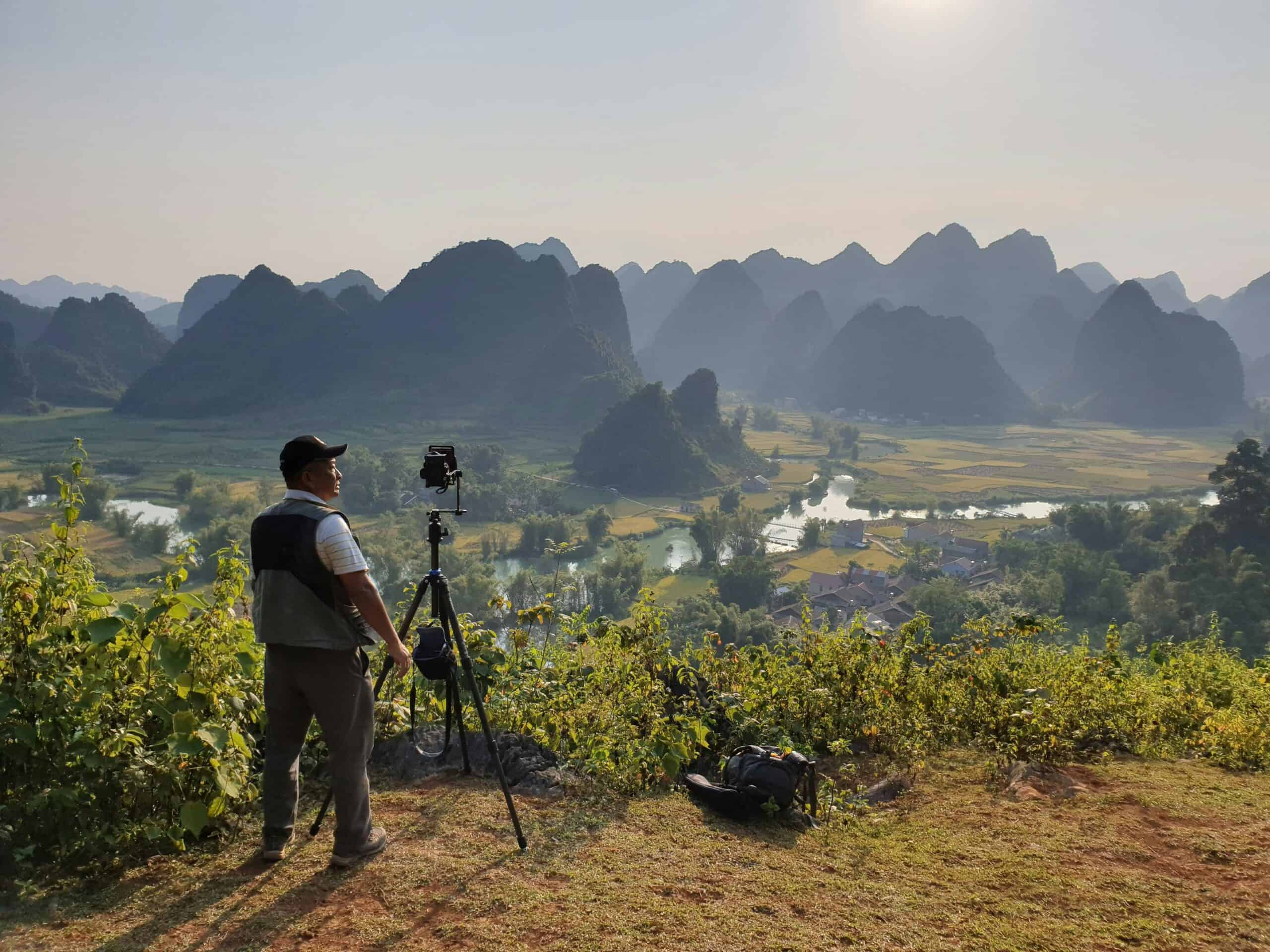
Evaluate Shooting Environment
Survey your location for moving elements (people, cars, leaves), reflective and refractive surfaces (glass, polished stone, water), and mixed lighting. Movement causes ghosting if frames overlap poorly in time; reflections exaggerate parallax issues. If working near windows, shoot at a slight angle to reduce reflections and keep the lens 10–20 cm off the glass to minimize flare and smudges.
Match Gear to Scene Goals
The GFX 50S/50R’s high dynamic range and large photosites are ideal for high-resolution 360 photo work, especially in high-contrast sunset scenes or interiors with bright windows. It also tolerates ISO 800–1600 gracefully with careful exposure, making low-light panoramas viable with longer shutter speeds. The RF 15–35 is a superb rectilinear ultra‑wide; however, due to the current lack of RF-to-GFX electronic adapters, plan to use a GFX-native or EF-adapted equivalent to get the same field-of-view results. Fisheye lenses can reduce shot counts dramatically, but rectilinear glass preserves architectural lines and yields more natural perspectives for real estate and landscape work.
Pre-shoot Checklist
- Power: Fully charged batteries (the GFX 50 bodies are fine but not the most frugal). Carry spares.
- Storage: High-speed cards; panoramas create many frames quickly—use UHS-II or faster.
- Clean optics and sensor: Dust shows up in skies and gradients; clean both before critical jobs.
- Tripod leveling and pano head calibration: Bring a leveling base; verify nodal alignment before the shoot.
- Safety: For rooftops/poles/cars, use tethers and sandbags; avoid high winds and unsecured edges.
- Backup workflow: Shoot an extra “safety pass” at the same settings in case of motion/blur on a frame.
Essential Gear & Setup
Core Gear
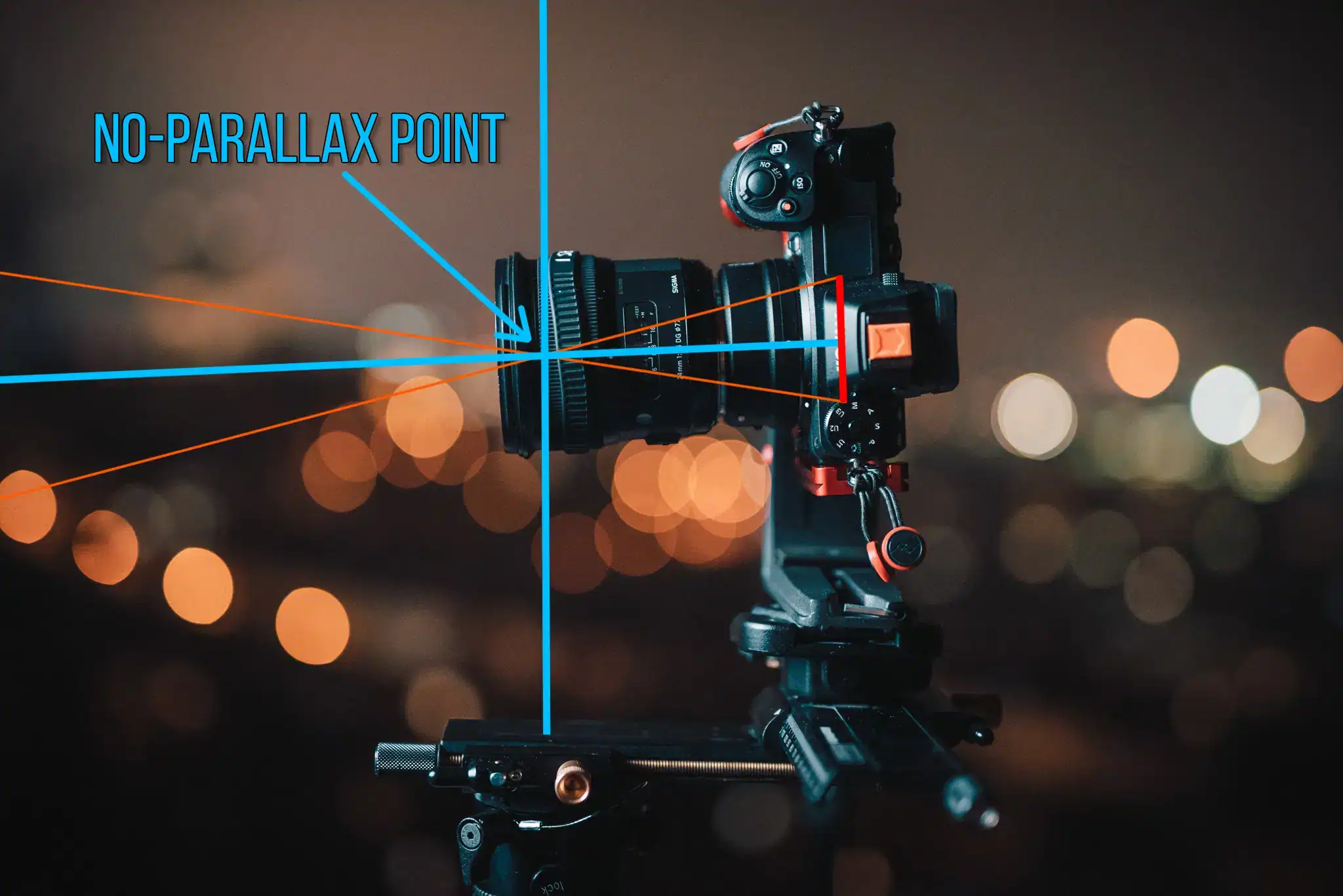
- Panoramic head: Enables precise yaw/pitch increments and alignment over the lens’s no‑parallax (nodal) point to eliminate parallax errors. This is critical for stitching rectilinear ultra‑wide rows cleanly.
- Stable tripod with leveling base: A leveling base speeds setup and keeps your rows parallel to the horizon.
- Remote trigger or camera app: Minimizes vibration for tack-sharp frames. Use a 2s timer if you have neither.
Optional Add-ons
- Pole or car mount: Capture elevated or moving sequences. Use safety tethers and avoid strong winds; vibration can ruin whole rows.
- Lighting aids: Small LEDs or flash for dim interiors. Bounce or diffuse to avoid hotspots and color shifts.
- Weather protection: Rain covers and lens hoods; medium-format sensors are unforgiving of flare and drips.
For step-by-step panoramic head setup fundamentals, this concise tutorial is a solid primer at the end of reading: panoramic head basics on 360Rumors.
Step-by-Step Shooting Guide
Standard Static Scenes
- Level the tripod: Use the leveling base. Verify with both the head’s bubble and the camera’s electronic level.
- Align nodal point: Slide the camera along the rail until near and far objects do not shift relative to each other during a small yaw. Mark this position for your Fujifilm GFX 50S/50R + lens combo.
- Manual exposure and white balance: Set M mode and lock WB (Daylight/Cloudy or a Kelvin value). This prevents exposure/WB flicker across the pano.
- Focus: Use manual focus at or near hyperfocal distance (e.g., f/8 on 15–24mm equivalent). Magnify to confirm edge detail.
- Capture sequence:
- At 15mm (rectilinear): Shoot 3 rows at roughly +45°, 0°, −45°. Use 8–12 positions around each row (≈ 26–38 frames) plus zenith and nadir.
- At 24mm: Plan for about 12–16 shots per row, 3 rows + Z/N (≈ 38–50 frames).
- At 35mm: 16–20 shots per row, 3 rows + Z/N (≈ 50–62 frames).
- Nadir shot: Tilt down and take one or two additional frames to patch out the tripod in post.
HDR / High Dynamic Range Interiors
- Bracket ±2 EV (3–5 frames): The GFX sensor has fantastic DR, but bracketing smooths complex lighting like windows vs. interior shadows.
- Lock WB and manual exposure base: Keep consistent color across brackets; HDR merges are much cleaner when WB is fixed.
- Quiet interval: Allow a brief pause between brackets to avoid tripod vibrations, especially on wooden floors.
Low-Light / Night Scenes
- Use tripod and remote: Long exposures are the norm. The GFX 50 sensors remain clean at ISO 100–400; ISO 800–1600 remains usable with careful exposure.
- Shutter speed: 1/15–30s is common at f/4–f/5.6. Turn off stabilization if on a tripod.
- Noise reduction: Prefer exposure correctness over high ISO—this preserves shadow color and microcontrast for cleaner stitching.
Crowded Events
- Two-pass method: First pass for coverage, second pass to catch gaps in moving crowds.
- Masking later: In PTGui or Photoshop, use masks to keep the clean areas from the second pass, minimizing ghosts.
Special Setups (Pole / Car / Drone)
- Secure everything: Use safety lines, tighten clamps, and rehearse rotation before elevating. Avoid gusty wind.
- Shoot slower rotations: Allow motion to settle between frames; consider faster shutter speeds to fight vibration.
- Plan overlap generously: 35–40% overlap can save sequences when alignment suffers from vibration.
Recommended Settings & Pro Tips
Exposure & Focus
| Scenario | Aperture | Shutter | ISO | Notes |
|---|---|---|---|---|
| Daylight outdoor | f/8–f/11 | 1/100–1/250 | 100–200 | Lock WB (daylight); maximize edge-to-edge sharpness |
| Low light/night | f/4–f/5.6 | 1/15–1/60 | 400–800 (up to 1600) | Tripod & remote; expose to protect highlights |
| Interior HDR | f/8 | Bracket ±2 EV | 100–400 | Balance windows, lamps, and wall colors |
| Action / moving subjects | f/5.6–f/8 | 1/200+ | 400–800 | Freeze motion; use two-pass strategy |
Critical Tips
- Find and mark the no‑parallax point: Use a near and a far vertical line; rotate the camera and adjust the rail until the foreground line doesn’t shift against the background. Mark the rail for your GFX + lens position.
- Manual focus at hyperfocal: Medium format sensors reveal focus errors quickly. Use focus magnification and peaking.
- RAW capture: The GFX 50 files grade beautifully; RAW is strongly preferred for HDR panoramas and color consistency.
- Stabilization off on tripod: Turn off IS/IBIS to avoid micro-blur from stabilization drift during long exposures. (The 50S/50R does not have IBIS; if using an IS lens on another body, disable it.)
- Use 35mm crop mode if adapting 35mm-only coverage: On GFX, this yields ~30 MP—still ample for VR tours and prints.
Stitching & Post-Processing
Software Workflow
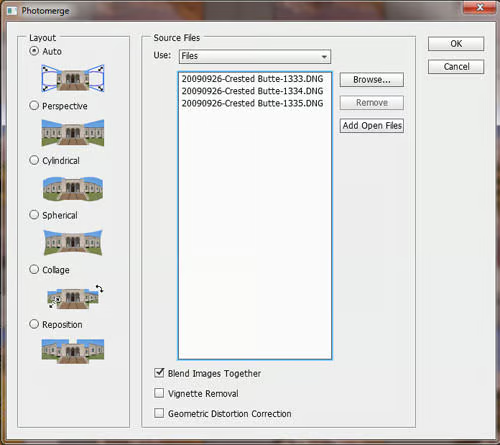
Ingest RAW files into Lightroom or Capture One, apply uniform white balance and lens corrections (if available for your lens/body), and export 16-bit TIFFs for stitching. PTGui is the workhorse for complex multi-row rectilinear sequences, with robust control point detection and masking tools. Hugin is a capable open-source alternative with a learning curve. Rectilinear ultra‑wides generally require more images than fisheyes but preserve straight lines (great for architecture). Aim for 25–35% overlap to give your stitcher plenty of data for control points. For a balanced overview of PTGui’s strengths, see this practical review: PTGui for serious panoramas.
Cleanup & Enhancement
- Nadir patching: Export a nadir-view tile and clone/patch the tripod. Some AI tools can remove it in one click, but manual clone/heal often looks more natural.
- Color and noise: Apply gentle noise reduction for night sequences; be consistent to avoid seams.
- Level horizon & set north: Correct yaw/pitch/roll so the panorama feels natural in a headset or web viewer.
- Export: Save an equirectangular JPEG/TIFF at 8k–16k width for VR platforms or virtual tours. Verify your viewer’s limits.
For a step-by-step panorama head setup and capture flow geared to professional 360 output, this guide is excellent: Oculus: set up a panoramic head for high-end 360 photos.
Useful Tools & Resources
Software
- PTGui panorama stitching
- Hugin (open source)
- Lightroom / Photoshop for RAW prep and retouching
- AI tripod/nadir removal tools (various)
Hardware
- Panoramic heads: Nodal Ninja, Leofoto, Sunwayfoto
- Sturdy carbon fiber tripods
- Leveling bases (3/8”)
- Wireless remotes
- Pole extensions / suction car mounts with safety tethers
Disclaimer: software/hardware names provided for search reference; verify specs and compatibility on official pages. For a deeper dive into spherical resolution math, see the Panotools wiki: DSLR spherical resolution explained.
Real-World Scenarios & Settings
Indoor Real Estate (Window Views)
Mount the GFX 50S/50R on a panoramic head, set f/8, ISO 100–200, and run a 3–5 shot bracket at ±2 EV. Lock white balance around 5000–5600K to keep room colors consistent. Shoot 3 rows at ~8–12 positions per row with a rectilinear 15–24mm equivalent. In PTGui, HDR-merge before stitching or stitch bracketed stacks with “Align to each other” enabled. Mask out moving people or curtains. This setup produces crisp detail and balanced exposures without halo artifacts when processed carefully.
Outdoor Sunset Landscape
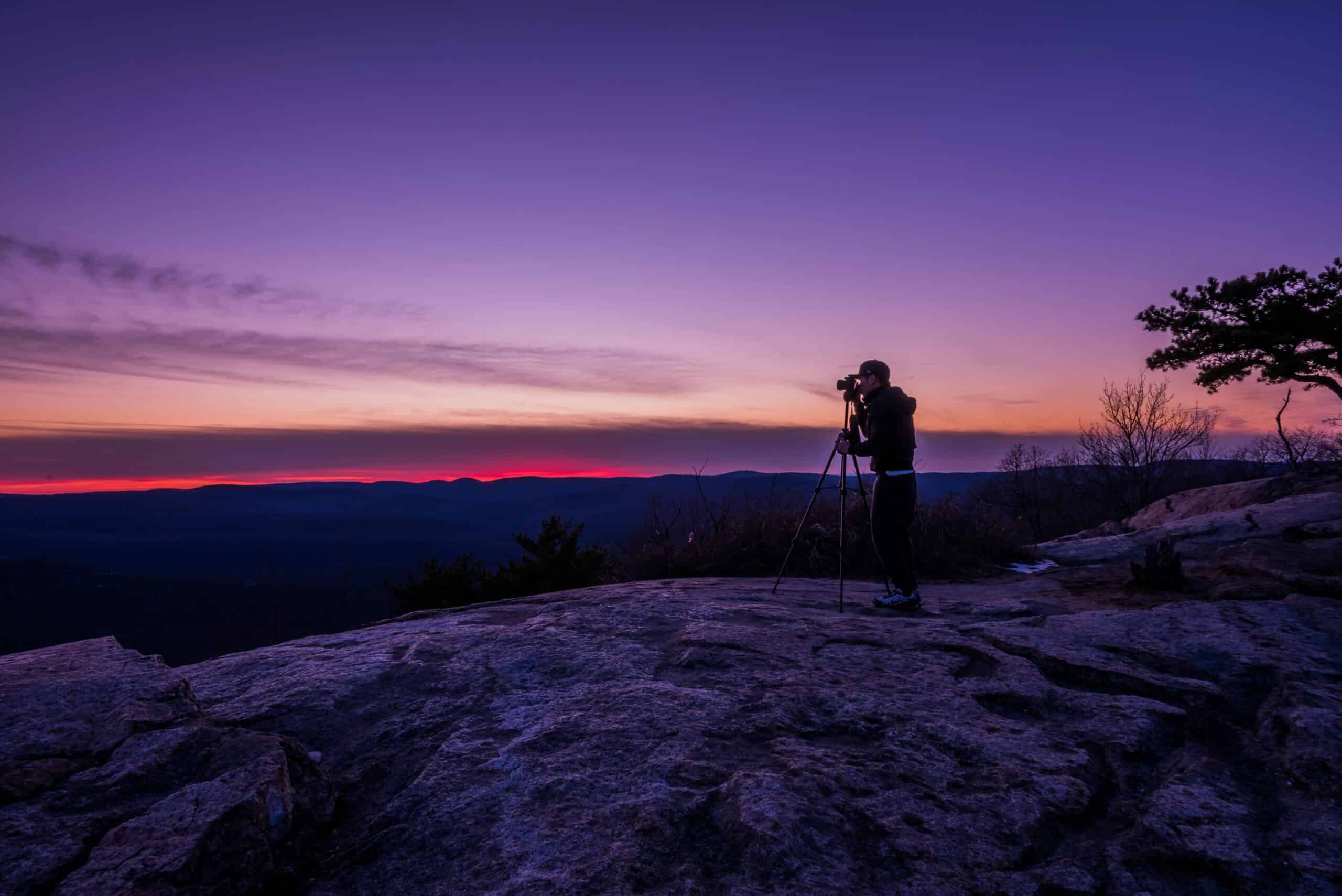
Base ISO 100, f/8–f/11 for optimal sharpness. Meter for the brightest sky to preserve color, and if needed, bracket ±2 EV. Work quickly through the rows as light changes; shoot the sun-facing row first, then the opposite. If wind moves foliage, take a second pass and blend the calmest frames. The GFX dynamic range lets you pull up shadows without banding if exposure is consistent.
Crowded Event
Use faster shutter speeds (1/200–1/500) at f/5.6–f/8, ISO 400–800. Execute two full passes: the first for geometry, the second for “clean plates” when people step away. In post, mask to keep the clean areas from the second pass, minimizing ghosts.
Rooftop / Elevated Pole
Keep the camera height stable, use a safety tether, and avoid gusts. Increase overlap to 35–40% to help the stitcher overcome minor vibrations. Consider 1/250s or faster at f/5.6–f/8 (ISO 400–800) to counter movement. If using a car mount, test alignment at a safe location first and avoid traffic/wind hazards.
About Using Canon RF 15–35mm on GFX 50S/50R
As of now, there is no fully functional RF-to-GFX adapter that provides electronic aperture control and AF. The RF 15–35 requires electronic control even for manual focusing (focus‑by‑wire). Therefore, pairing it directly with the GFX 50S/50R is not practical in the field. Practical alternatives:
- Use a native Fujifilm GF lens (GF 23mm f/4, GF 30mm f/3.5, GF 32–64mm f/4). They deliver superb coverage and metadata support.
- Adapt Canon EF lenses with a proven EF–GFX adapter (Fringer/Fotodiox) and use EF 16–35mm or EF 11–24mm. This keeps the rectilinear look and similar framing.
- If you must use the RF 15–35, capture with a Canon RF body and apply the same panoramic approach described here. The stitching and exposure workflow remains identical.
For general DSLR/mirrorless 360 workflows regardless of brand, this foundation article is helpful: Using a mirrorless/DSLR to shoot and stitch a 360 photo.
Common Mistakes & How to Avoid Them
- Parallax error: Always align over the no‑parallax point. Practice with a simple near/far alignment test and mark your rail.
- Exposure flicker: Manual mode and locked WB only. Don’t leave Auto ISO on.
- Tripod shadows and footprints: Capture a nadir patch and clone/patch later.
- Ghosting from movement: Use two-pass capture and masking. Prioritize the “busy” row first.
- Night noise and color shifts: Keep ISO modest (100–800 if possible) and expose long; avoid pushing shadows aggressively later.
Frequently Asked Questions
- Can I shoot handheld panoramas with the Fujifilm GFX 50S/50R?
Yes for simple single-row panos, but for 360×180° with a rectilinear ultra‑wide, a tripod and panoramic head are strongly recommended. The large sensor magnifies alignment errors, and handheld parallax makes stitching inconsistent, especially indoors.
- Is the Canon RF 15–35mm wide enough for single-row 360?
No. Rectilinear lenses at 15–35mm need multiple rows to cover the full sphere. Expect 2–3 rows plus zenith and nadir shots. Fisheye lenses can achieve full coverage with fewer frames but at the cost of distortion management.
- Do I need HDR for interiors with bright windows?
Usually yes. Bracketing ±2 EV (3–5 frames) maintains window detail and interior tonality. The GFX sensor has excellent DR, but HDR is still the most reliable path to natural-looking interiors.
- How do I avoid parallax issues?
Mount the camera on a panoramic head, slide the camera until near and far lines don’t shift during yaw, and mark that rail position. Keep the camera centered over the rotation axis throughout the shoot. This is the biggest difference-maker in clean stitches.
- What ISO range is safe on the GFX 50S/50R for low light?
Base ISO 100 delivers maximum DR. ISO 400–800 is generally safe with minimal quality loss; ISO 1600 can still look good if properly exposed. Prefer longer shutter speeds on a tripod rather than pushing ISO excessively.
- Can I create custom modes for pano work?
Yes. Save a “Pano” setup with manual exposure, fixed WB, RAW, self‑timer or remote, and MF at a known focus distance. This speeds up repeatable results in the field.
- What panoramic head should I pick for this setup?
Look for an L‑bracket capable head with precise fore/aft and lateral rails, indexed detents, and a sturdy vertical arm. Brands like Nodal Ninja, Leofoto, and Sunwayfoto offer reliable solutions for medium-format loads.
Extra Visual Aids
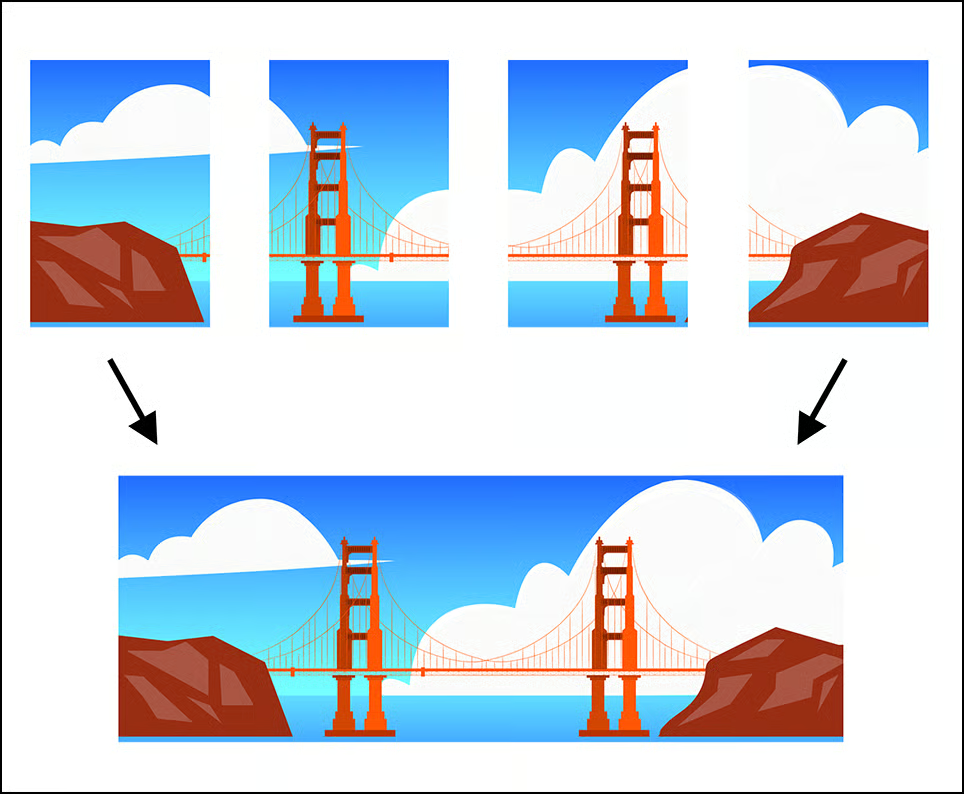
For a broader Q&A style overview that compares lens options and practical capture constraints for virtual tours, this guide is worth bookmarking: DSLR/mirrorless virtual tour FAQ.