
Why This Camera & Lens Are Great for Panoramas
If you’re researching how to shoot panorama with Fujifilm GFX 50S / 50R & Canon RF 14-35mm f/4L IS USM, you’re aiming high. The GFX 50S/50R medium-format sensor (43.8 × 32.9 mm, ~51.4 MP, pixel pitch ~5.3 μm) offers superb dynamic range (≈14 EV at base ISO) and color depth that make complex 360 photos, HDR panoramas, and large-format prints look stunning. The Canon RF 14-35mm f/4L IS USM is a lightweight, sharp, rectilinear ultra‑wide zoom prized for low distortion, reliable corner sharpness stopped down, and a constant f/4 aperture.
Important compatibility note: there is no common, fully functional adapter to mount an RF lens on a GFX body. The RF 14-35mm is designed for Canon RF mount full-frame bodies, and even if an experimental mechanical adapter existed, the image circle typically won’t cover the 44×33 mm GFX sensor at the wide end. To apply the guidance below, use one of these practical paths:
- Use the GFX 50S/50R with a comparable rectilinear ultra-wide (e.g., GF 23mm f/4, GF 30mm f/3.5, or an adapted Canon EF 16-35mm via a reputable EF–GFX adapter). Technique and settings are the same.
- Or, use the Canon RF 14-35mm f/4L IS USM on a Canon RF body to capture the pano set, then stitch as described. The capture workflow is lens‑driven and translates directly.
Either way, you get the benefits of rectilinear rendering (straight lines stay straight), predictable overlap, and excellent corner detail at f/8–f/11—ideal for professional panoramas and virtual tours.
Quick Setup Overview
- Camera: Fujifilm GFX 50S / 50R — 44×33 mm medium-format sensor, ~51.4 MP (8256×6192), 14-bit RAW, excellent DR at ISO 100–400, clean up to ISO 800 for pano work.
- Lens: Canon RF 14-35mm f/4L IS USM (rectilinear zoom) — constant f/4, 77 mm filters, very good center-to-corner sharpness stopped down, mild barrel distortion at 14 mm (well-corrected in software), low CA.
- Estimated shots & overlap (rectilinear ultra‑wide, 30% overlap target):
- At 14 mm (full-frame): 2 rows × 10 around (≈36° steps) + zenith + nadir. For critical interiors, 2×12 is safer.
- At 20–24 mm (full-frame): 2 rows × 12 around + zenith + nadir.
- At 35 mm (full-frame): 3 rows × 12–14 around + zenith + nadir (highest detail).
- Difficulty: Intermediate (requires panoramic head nodal calibration and consistent exposure control).
Planning & On-Site Preparation
Evaluate Shooting Environment
Scan for moving subjects (crowds, traffic, trees in wind), reflective surfaces (glass, mirrors, polished floors), and dynamic range challenges (bright windows, sun in frame). If shooting near glass, keep the lens at least 15–30 cm away and shade the front element to minimize reflections and flare. For interiors, note mixed lighting (tungsten, LED, daylight) and plan to lock white balance to reduce color shifts across frames.
Match Gear to Scene Goals
GFX 50S/50R shines when you want ultra‑clean, high‑DR 360 images, large prints, and robust shadow recovery. Base ISO 100 delivers maximum dynamic range; ISO 200–800 remains very usable. The RF 14-35mm (or a similar rectilinear ultra‑wide) provides flexible framing and consistent corners—perfect for architecture and real estate where straight lines matter. Rectilinear lenses require more shots than fisheyes but avoid fisheye defishing artifacts and typically stitch with less distortion on walls and ceilings.
Pre-shoot Checklist
- Charge batteries; carry a spare. Medium-format bodies consume more power with live view.
- Empty and format cards; use fast UHS-II or CFexpress (if your workflow transitions to a Canon body) for quick bursts and bracketing.
- Clean lens and sensor; dust shows up in skies and walls.
- Level tripod; verify panoramic head calibration (nodal point marks recorded for your focal lengths).
- Safety: weigh down tripod in wind; tether on rooftops or poles; avoid vehicle vibration hotspots.
- Backup: shoot a second pass or a safety nadir; redundancy saves edits later.
Essential Gear & Setup
Core Gear
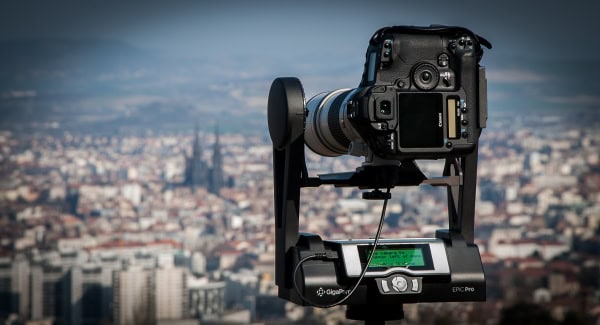
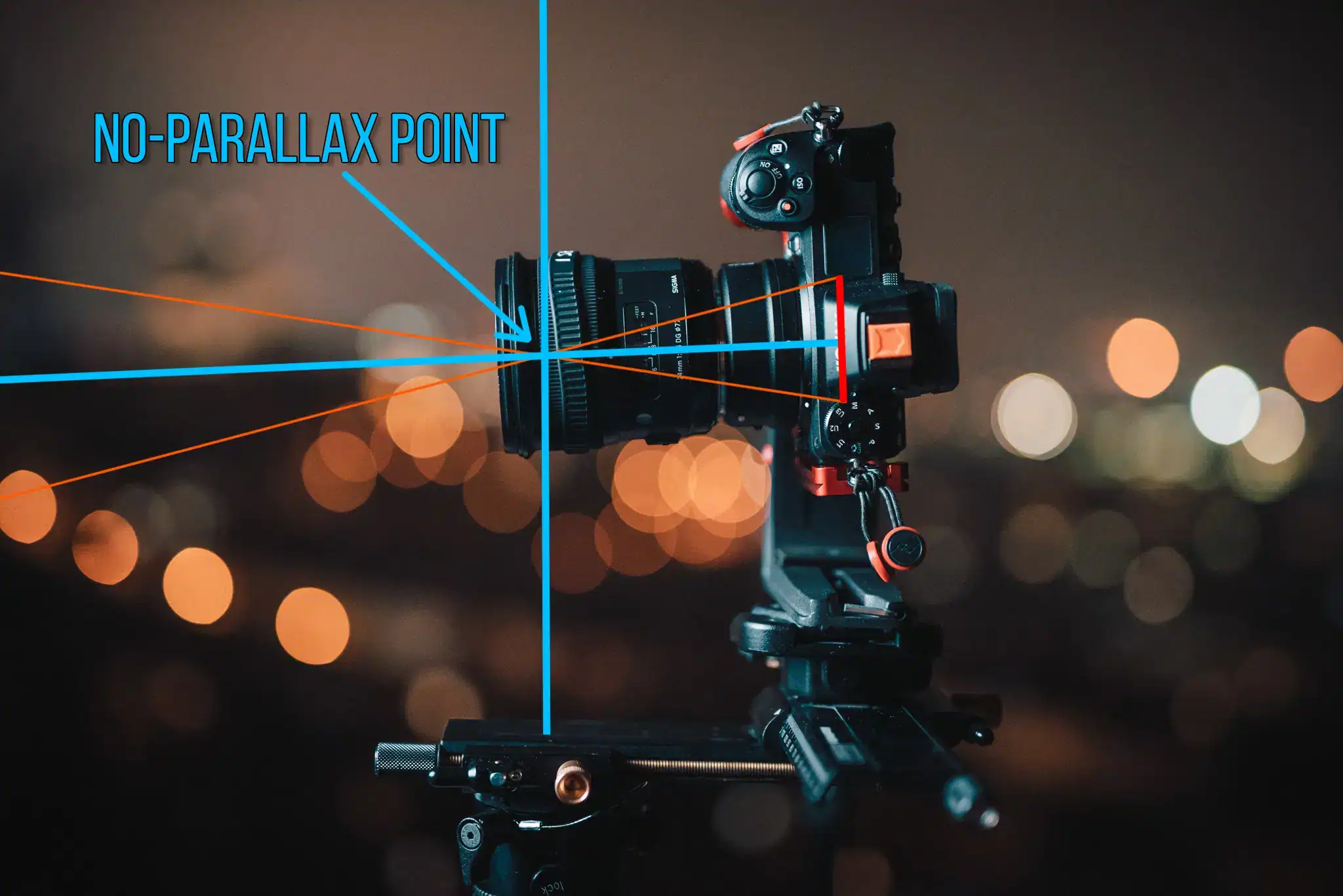
- Panoramic head: Lets you rotate around the lens’s entrance pupil (nodal point) to eliminate parallax between foreground and background. This is critical for stitching clean lines indoors and out.
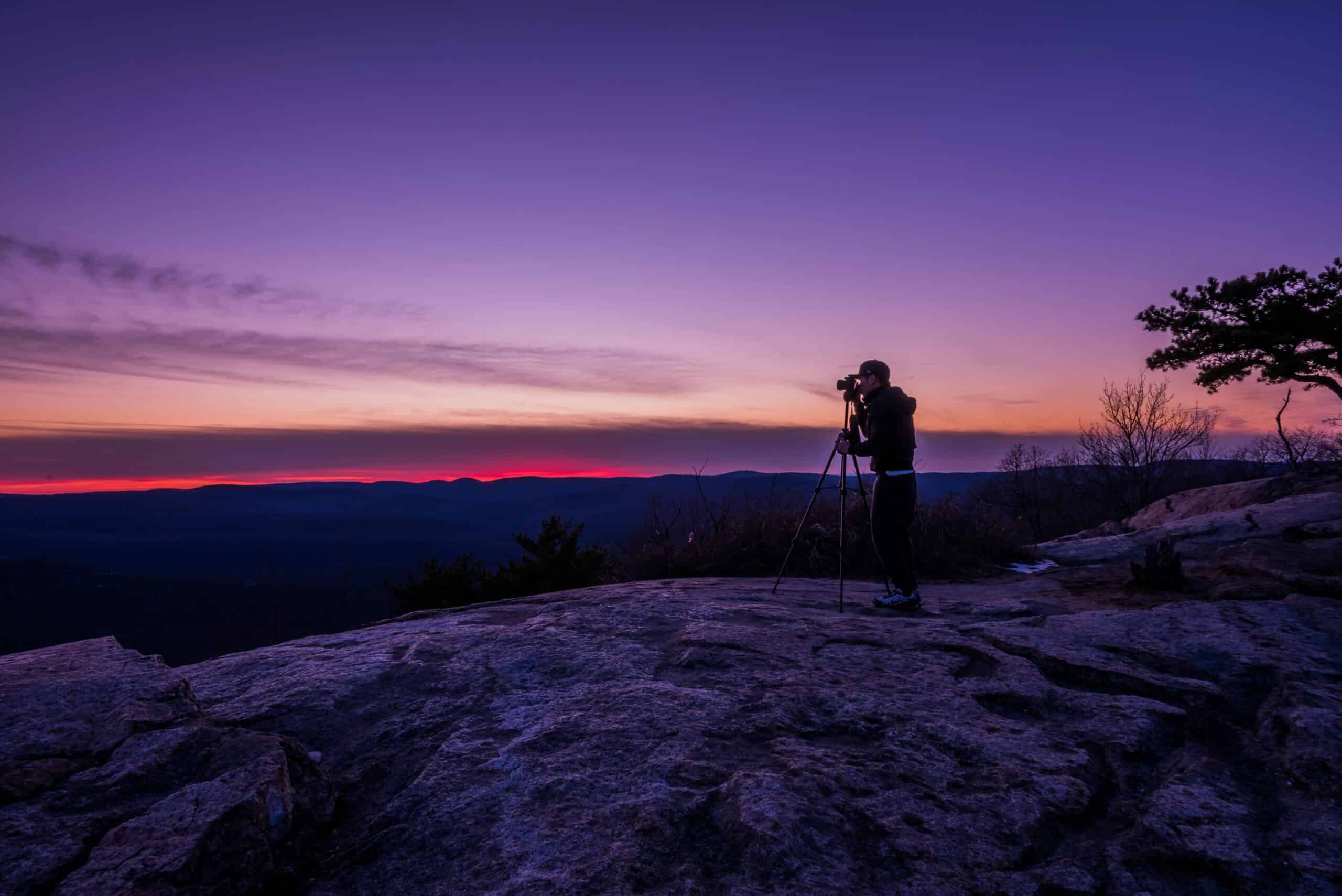
- Stable tripod with leveling base: Speeds setup and ensures consistent horizons. A 75–100 mm bowl with a half-ball or a dedicated leveling base is ideal.
- Remote trigger or camera app: Prevents micro-shake; use a 2 s timer if a remote isn’t available.
Optional Add-ons
- Pole or car mount: For elevated or vehicle-mounted captures; use a safety tether and monitor wind. Reduce speed/rotation to avoid blur.
- Lighting aids: Small LED panels for dark corners; avoid mixed color temperatures unless you plan to gel or correct in post.
- Weather protection: Rain covers, silica packets, and lens hoods for flare control.
Step-by-Step Shooting Guide
Standard Static Scenes
- Level and center: Level the tripod with a leveling base. Set your panoramic head’s vertical rail so the lens rotates around the entrance pupil; note your calibrated measurements for 14, 20, 24, and 35 mm positions.
- Manual exposure + WB: Meter the brightest frame you’ll encounter (e.g., near the sun or a bright window), then set manual exposure. Lock white balance (Daylight/Cloudy/Tungsten) to avoid frame-to-frame color shifts. Shoot RAW.
- Focus: Switch to manual focus, focus on a distant mid-contrast detail, then stop down to f/8–f/11 for best sharpness and depth of field.
- Capture sequence:
- At 14 mm FF: 2 rows of 10 frames, pitch +35° and −35° (or 0° and +/−35° with extra zenith), then add 1 zenith and 1 nadir.
- At 24 mm FF: 2 rows of 12, then zenith and nadir.
- At 35 mm FF: 3 rows of 12–14, then zenith and nadir.
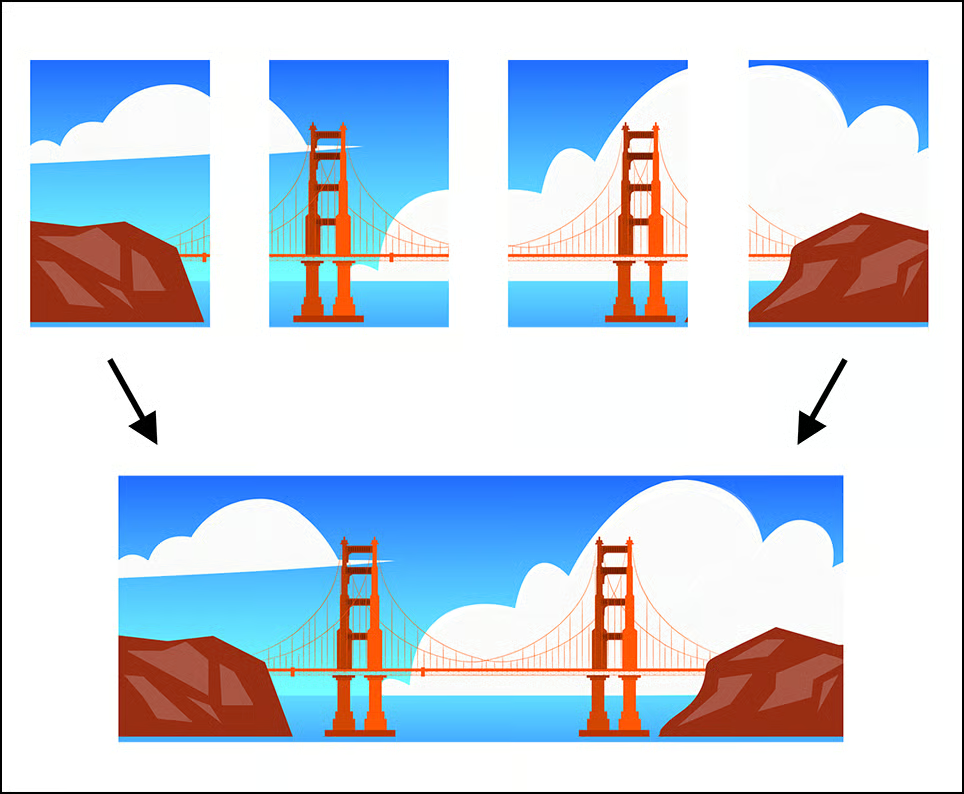
Rotate consistently (e.g., 30–36° per click) with 25–35% overlap. Use a consistent pattern so you never miss a slice.
- Nadir capture: Either shoot a nadir frame by tilting straight down, or take a handheld offset nadir for easier tripod removal later.
HDR / High Dynamic Range Interiors
- Bracketing: Use ±2 EV brackets (3 or 5 frames) at each pano position to balance windows and shadows. Keep bracketed timing as short as possible to reduce ghosting.
- Consistency: Lock WB, keep aperture fixed, and vary shutter speed only. This keeps depth of field and vignetting consistent across the set.
Low-Light / Night Scenes
- Stable base: Use a solid tripod. On GFX 50S/50R, aim for ISO 100–400; push to ISO 800 if you must. It’s better to lengthen shutter than to crank ISO on medium format.
- Remote/Timer: Use a remote or 2 s timer with electronic first-curtain shutter to minimize vibration. Turn stabilization off when on a tripod.
Crowded Events
- Two-pass technique: First pass for coverage; second pass to capture empty gaps as people move. You’ll mask these in post.
- Faster shutter: Aim 1/200 s or faster and ISO 400–800 at f/5.6–f/8 to freeze motion.
Special Setups (Pole / Car / Drone)
- Pole: Balance the rig; use a guy line and tether. Rotate slower and shoot a bit more overlap (35–40%) to compensate for micro-sway.
- Car mount: Use a vibration-damped suction system, drive slowly, and pre-plan frames. Disable stabilization if it causes jitter during rotation.
Recommended Settings & Pro Tips
Exposure & Focus
| Scenario | Aperture | Shutter | ISO | Notes |
|---|---|---|---|---|
| Daylight outdoor | f/8–f/11 | 1/100–1/250 | 100–200 | Lock WB (Daylight); avoid polarizers at 14–20 mm due to uneven sky |
| Low light/night | f/4–f/5.6 | 1/30–1/60 (or longer on tripod) | 100–800 | Use remote and EFCS; lengthen shutter before raising ISO |
| Interior HDR | f/8 | Bracket ±2 EV | 100–400 | Balance windows and practical lights; keep aperture fixed |
| Action / moving subjects | f/5.6–f/8 | 1/200+ | 400–800 | Two-pass method; mask moving people later |
Critical Tips
- Manual focus and hyperfocal: Focus just short of infinity at f/8–f/11 for maximum consistency across frames.
- Nodal calibration: Place a vertical object near the camera and a distant background line; adjust the rail until the relative position doesn’t shift as you pan. Mark the rail position for your key focal lengths.
- White balance lock: Mixed lighting can shift per frame; a fixed WB keeps color matching manageable in post.
- RAW priority: The GFX’s 14-bit RAW files offer generous recovery; RAW also helps correct mild barrel distortion at 14 mm.
- Stabilization: Switch off IS/IBIS on tripod; leave on only for handheld panos (not recommended for full 360s).
Stitching & Post-Processing
Software Workflow
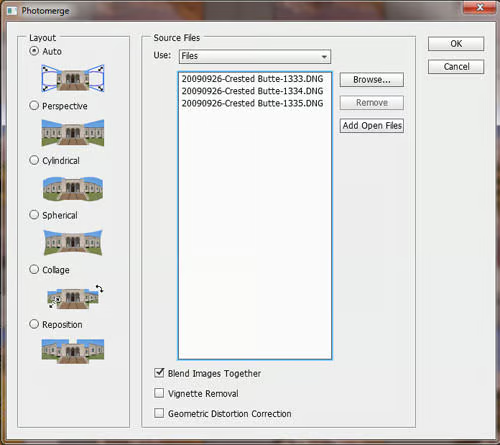
For robust control points and predictable results, PTGui and Hugin are industry standards. Rectilinear ultra‑wide sets need slightly more shots than fisheye, but they avoid defishing and often yield straighter lines in architecture. Aim for ~25–35% overlap. For HDR panos, first merge brackets per view (exposure fusion or HDR) and then stitch the merged set; or use PTGui’s built-in HDR pipeline. After stitching, export an equirectangular panorama for VR or a cylindrical/conical projection for classic wide prints. For an overview of setting up a panoramic head and why parallax matters, see this panoramic head tutorial. Panoramic head fundamentals.
Cleanup & Enhancement
- Nadir patch: Use a dedicated nadir frame or clone/AI fill the tripod area. A consistent floor texture makes this easy.
- Color balance: Match WB across rows, fix casts from mixed lighting, and apply lens-profile vignetting correction before stitching if needed.
- Noise reduction: Apply gentle NR in shadows; the GFX files tolerate lifting shadows but keep texture intact.
- Horizon leveling: Use the optimizer to level yaw/pitch/roll; correct verticals in architectural sets.
- Export: 16-bit TIFF master; then 8-bit JPEG (equirectangular 2:1) for web and VR platforms. Follow platform-specific size limits.
PTGui remains a top choice for speed and reliability; see a practical review for pro workflows. PTGui for professional panoramas.
For full 360 publishing considerations (equirectangular specs, metadata, and viewer tips), the Meta/Oculus creator guide is concise and practical. DSLR/mirrorless 360 capture for VR.
Useful Tools & Resources
Software
- PTGui panorama stitching
- Hugin (open-source) for control-point control
- Adobe Lightroom / Photoshop for RAW and cleanup
- AI tripod/nadir removal tools
Hardware
- Panoramic heads: Nodal Ninja, Leofoto, or equivalent with precise rails
- Carbon fiber tripods with a leveling base
- Wireless remote shutters or camera apps
- Pole extensions and vehicle mounts with safety tethers
Disclaimer: Brand names are for reference; verify compatibility and official documentation before purchase or use.
Common Mistakes & How to Avoid Them
- Parallax errors: Always align the entrance pupil with the rotation axis; re-check after changing focal length.
- Exposure flicker: Manual exposure and locked WB only; never mix auto exposure within the same pano set.
- Missed coverage: Use a repeatable rotation pattern (e.g., 36° per click) and shoot a safety pass.
- Tripod shadows and nadir holes: Capture a dedicated nadir or plan to patch in post.
- Uneven skies with polarizers: Avoid polarizers at ultra-wide focal lengths; skies will band.
- Noise at night: Prioritize longer exposures over high ISO; the GFX files reward clean capture.
Field-Proven Scenarios
Indoor Real Estate (Bright Windows)
Set f/8, ISO 100–200, bracket ±2 EV (3–5 frames) at each pano position. Keep the lens around 16–20 mm (FF) to minimize wall stretch yet keep coverage manageable. Lock WB to a neutral preset and gel mixed lights if possible. Merge HDR first, then stitch. For precise guidance on total image resolution vs. focal length, consult the spherical resolution reference. Spherical resolution and coverage.
Outdoor Sunset (High DR, Flare Risk)
Use f/8–f/11, ISO 100–200. Consider two exposures per view (one for sky, one for foreground) to avoid sun-star flare stacking. Shade the lens with your hand or a flag. Place seams away from the sun to reduce stitching stress.
Crowded Events (People and Motion)
Adopt the two-pass method: a fast baseline sweep, then a second sweep capturing clean gaps. Use 1/200 s at ISO 400–800, f/5.6–f/8. In post, mask moving elements, prioritizing clean edges on verticals.
Rooftop or Pole Shooting (Safety First)
Use a tether, weight the base, and keep overlap at 35–40%. Rotate slower and shoot a zenith if architecture is tall. Avoid gusty winds or reduce the camera’s profile with a smaller head.
About the GFX + RF 14–35mm Combination
Because Canon RF lenses aren’t natively adaptable to Fujifilm GFX with full electronic control, this exact pairing is not recommended in production. If an experimental adapter becomes available, expect heavy vignetting at the wide end and possible mechanical/IB conflict. Practical alternatives:
- GFX + GF 23mm f/4 (≈18 mm FF equivalent): Fewer frames than longer lenses; excellent corner quality.
- GFX + GF 30mm f/3.5 or GF 32–64mm: Flexible framing for interiors; superb sharpness at f/8.
- Canon RF 14–35mm on a Canon RF body: Follow the same shooting grid numbers above.
This guide remains fully applicable to a rectilinear ultra‑wide pano workflow; just match the focal length and follow the overlap and nodal alignment practices.
Frequently Asked Questions
-
Can I shoot handheld panoramas with the GFX 50S/50R?
For simple cylindrical panos, maybe; for 360 × 180 spheres, handheld is risky. Use a tripod and panoramic head to avoid parallax and to ensure consistent overlap—especially critical with a high-resolution medium-format sensor.
-
Is the Canon RF 14–35mm f/4L wide enough for a single-row 360?
Not for a full spherical 360. At 14 mm FF you’ll typically need at least two rows around plus zenith and nadir. Single-row is feasible only with fisheyes or specialized panoramic setups.
-
Do I need HDR for interiors with bright windows?
Yes, bracket ±2 EV (3–5 frames) for each camera angle to retain window detail and clean shadows. Merge brackets first or use a stitching tool with HDR merging. Keep aperture fixed and vary shutter speed only.
-
How do I avoid parallax issues?
Calibrate the entrance pupil on your panoramic head for each focal length you use. Keep the rail marks handy. Re-check if you adjust zoom or focus. A thorough primer on setup techniques is here: Set up a panoramic head for high‑end 360 photos.
-
What ISO range is safe on the GFX 50S/50R in low light?
Base ISO 100 delivers maximum DR. ISO 200–400 is still excellent; ISO 800 remains very usable. Prefer longer exposures over ISO >800—medium-format sensors reward clean capture with tripod support.
Safety, Reliability & Workflow Trust
Wind, heights, and traffic are real hazards. Always tether your rig on rooftops and poles, add weight to the tripod, and avoid rotating during strong gusts. For car shots, plan the route, drive slowly, and use a vibration-damped mount. Build redundancy into your capture: shoot a safety pass, a spare zenith/nadir, and keep a second memory card set. Back up on-site (laptop + SSD) after each location. Finally, test your full workflow end-to-end before paid work to validate rail marks, overlap, and bracketing timing.
For broader context on gear choices and panorama fundamentals, this FAQ-style overview is a helpful supplement. Virtual tour camera and lens guide.