
Why This Camera & Lens Are Great for Panoramas
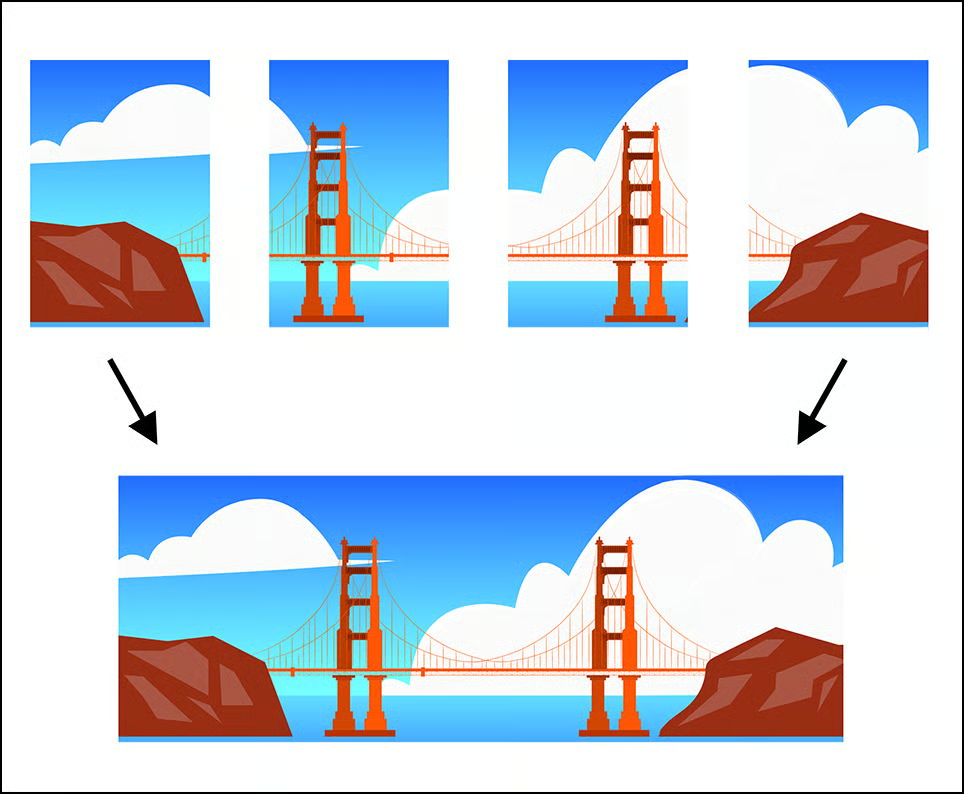
If you want maximum image quality and efficient capture for 360° photos, the Fujifilm GFX 50S / GFX 50R paired with the Canon EF 8–15mm f/4L Fisheye USM is a powerful—if slightly unconventional—combo. The GFX 50-series medium format sensor (43.8 × 32.9 mm) delivers ~51.4 MP of resolution with ~5.3 μm pixels, excellent 14-bit RAW files, and ~14 stops of dynamic range at base ISO. That means cleaner shadows and smoother tonality in challenging HDR panoramas, especially interiors and dusk scenes where you’ll stretch highlights and shadows.
The Canon EF 8–15mm is a professional L-series fisheye zoom. On full frame it gives a 180° circular view at 8mm and a 180° diagonal fisheye at 15mm. On the GFX sensor, you’ll want to enable the GFX’s 35mm Format Mode (full-frame crop) for clean coverage without black corners. In that mode, the lens behaves exactly as intended: 8mm for circular fisheye (minimal shots needed) or 12–15mm for a diagonal fisheye (more coverage per shot vs. rectilinear lenses). Stitching fisheye frames is generally easier because they require fewer images with generous overlap, and modern stitchers model fisheye distortion very accurately.
Compatibility: you will need an EF→GFX smart adapter (e.g., Fringer EF-GFX, Techart, Viltrox) to control aperture reliably. Autofocus is not critical for panoramas (you’ll typically use manual focus at hyperfocal), but aperture control is essential. Note that the GFX 50S/50R bodies do not have in-body stabilization, so tripod work is recommended for critical quality. This system is particularly strong for commercial virtual tours, architectural interiors, and high-resolution landscape 360s where dynamic range and color fidelity matter.
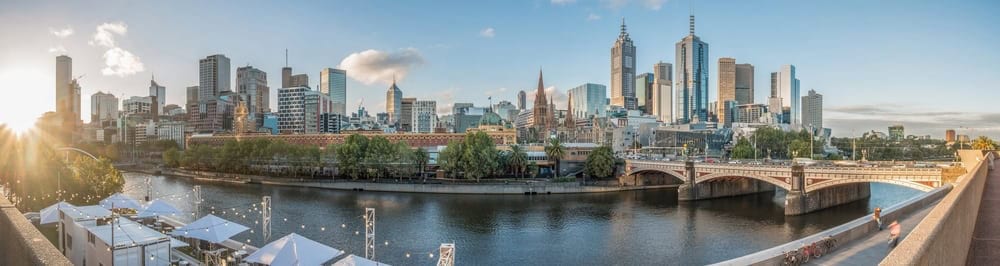
Quick Setup Overview
- Camera: Fujifilm GFX 50S / 50R — 44 × 33 mm medium format sensor, ~51.4 MP, ~5.3 μm pixels, ~14 stops DR at ISO 100.
- Lens: Canon EF 8–15mm f/4L Fisheye USM — fisheye zoom; very good central sharpness stopped down; typical lateral CA (well-corrected in post); robust build. Requires EF→GFX adapter.
- Coverage & shots (using GFX 35mm Format Mode):
- 8mm circular fisheye: 4 shots around (90° apart) + optional zenith + optional nadir.
- 12mm: 5–6 shots around + zenith + nadir.
- 15mm diagonal fisheye: 6 shots around + zenith + nadir. Overlap 30% around is safe.
- Difficulty: Moderate (easy capture; careful nodal setup and crop-mode awareness required).
Planning & On-Site Preparation
Evaluate Shooting Environment
Before you unfold the tripod, scan the scene. Note strong light sources (windows, sun), reflective surfaces (glass, mirrors, polished floors), and potential motion (people, foliage, traffic). If shooting through glass, get as close as possible (1–3 cm) to minimize reflections and ghosting, and shoot slightly off-axis to reduce flare. For outdoor wind, choose a low profile and a weighted tripod to avoid vibration.
Match Gear to Scene Goals
This combo excels wherever you want high dynamic range and crisp detail. The GFX 50’s RAW files are very robust at ISO 100–400, with clean performance up to ISO 800–1600 for night scenes. The fisheye advantage is speed: fewer frames per 360° and easier stitching. If straight lines are critical (tight interiors with lots of geometry), a diagonal fisheye at ~15mm with more frames gives better edge detail and less stretching than a rectilinear UWA that would need many more shots.
Pre-shoot Checklist
- Batteries charged, large fast SD cards, blower/cloth for lens and sensor.
- Enable 35mm Format Mode on GFX to avoid heavy vignetting with this EF lens.
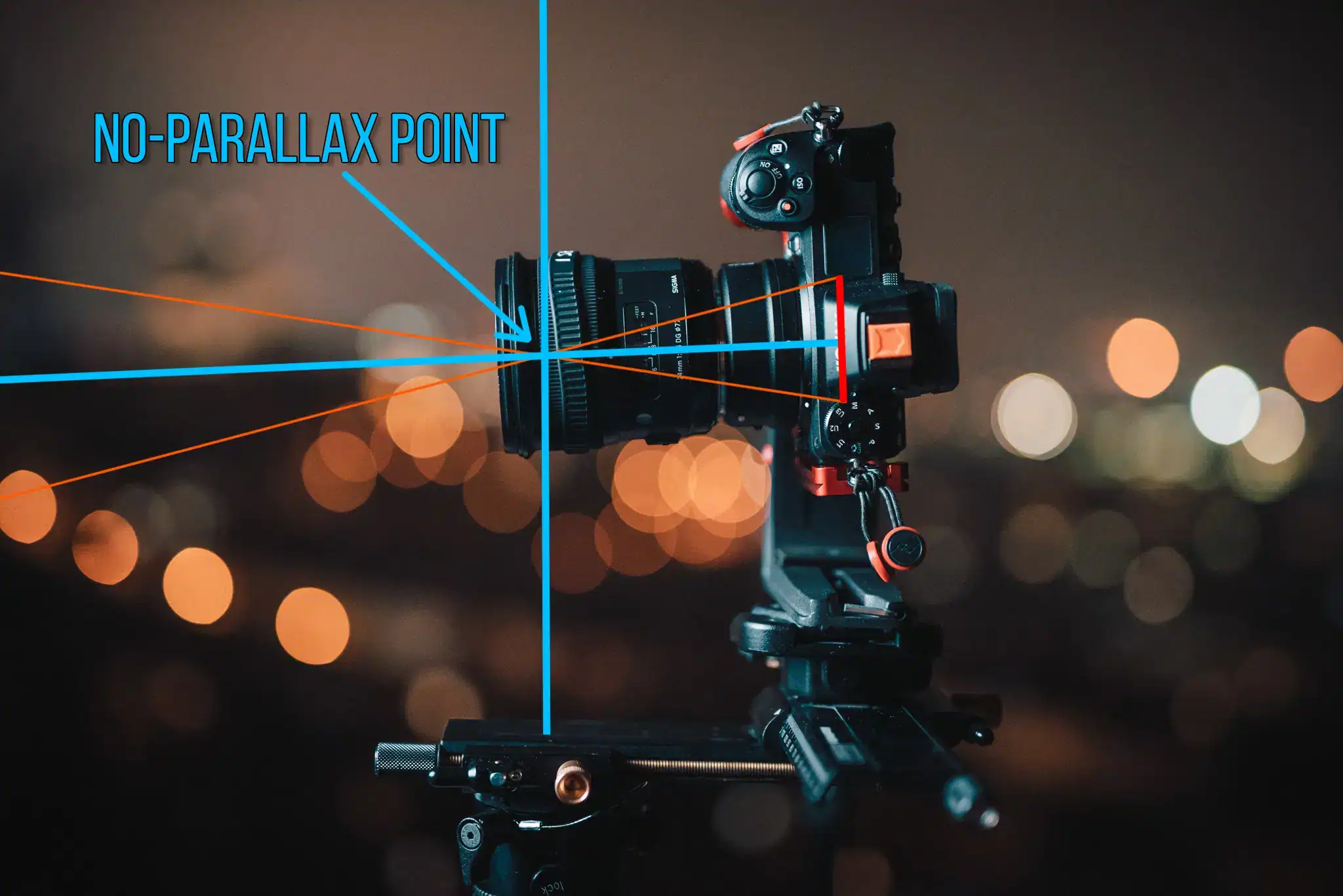
- Tripod leveled; panoramic head calibrated for no-parallax alignment.
- Safety: mind wind, rooftops, and crowds; tether gear on poles or car mounts.
- Backup workflow: if time allows, shoot a second pass (insurance against motion/ghosts).
Essential Gear & Setup
Core Gear
- Panoramic head: Lets you rotate around the lens’s entrance pupil (no-parallax point) to eliminate foreground/background shifts that break stitches. A two-axis head (vertical rail + rotator) makes zenith/nadir shots easy.
- Stable tripod with leveling base: Leveling keeps yaw increments consistent and reduces horizon corrections later.
- Remote trigger or camera app: Minimizes vibration, especially in low light and HDR brackets.
Optional Add-ons
- Pole or car mount: Great for elevated or moving perspectives. Use safety tethers, dampers, and avoid excessive speed/wind. Always prioritize bystander safety.
- Lighting aids: Small LED panels for dark interiors (keep them stationary across shots to avoid stitch inconsistencies).
- Weather protection: Rain covers and microfiber cloths to keep the fisheye front element clean.
Step-by-Step Shooting Guide
Standard Static Scenes
- Level and align:
- Mount the EF 8–15 on the GFX via EF→GFX adapter. Set GFX to 35mm Format Mode.
- Mount on your panoramic head and align the rotation axis through the lens’s entrance pupil. As a starting point for fisheyes, position the camera plate so the rotation axis is roughly 55–70 mm forward of the sensor plane mark (the exact spot varies with focal length and adapter). Fine-tune using the classic near/far alignment test.
- Manual exposure and white balance:
- Switch to full Manual mode. Meter the mid-tones and lock exposure across the entire sweep to avoid flicker.
- Lock White Balance (Daylight for sun, Tungsten/Custom for interior lights) so the stitcher doesn’t fight color shifts.
- Focus:
- Use manual focus at hyperfocal. As a guide: at 8mm f/8, set ~0.3 m; at 15mm f/8, set ~1 m. Check magnified live view for critical subjects.
- Capture sequence:
- At 8mm (circular): 4 shots around at 90° increments. Add zenith if ceilings matter and a quick nadir for a clean floor patch.
- At 12–15mm (diagonal): 6 shots around at 60° increments + zenith + nadir. Aim for ~30% overlap around, plus adequate top/bottom coverage.
- Nadir shot:
- After the around-row, tilt straight down for a nadir frame to help remove the tripod. If space is tight, shoot a handheld nadir plate with the lens positioned over the tripod footprint.
HDR / High Dynamic Range Interiors
- Bracket ±2 EV (3–5 frames) to balance windows and interior shadows. The GFX 50 files merge cleanly with minimal noise at ISO 100–400.
- Lock WB and focus. Use a remote and a 2 s delay to avoid vibration. Keep the bracket count consistent for every yaw angle.
Low-Light / Night Scenes
- Use a sturdy tripod; consider sand/weight bags. Start at f/4–f/5.6, ISO 400–800 (1600 if needed), and shutter 1/15–30 s. The GFX 50S/50R have no IBIS—avoid touching the rig during exposure.
- Use a remote or the camera’s timer. Long Exposure NR off (do noise reduction in post for consistency across frames).
Crowded Events
- Do two passes: first for background geometry, second for people. In post, mask to reduce ghosts. Shorter shutter (1/200+) and ISO 400–800 can help freeze motion.
- Keep your footprint small and visible; warn nearby people before rotating the rig.
Special Setups (Pole / Car / Drone)
- Pole: Balance the rig low, tether the camera, and avoid winds above 10–12 m/s. Rotate slowly and use faster shutter times to reduce blur.
- Car mount: Use suction mounts on clean glass/metal and safety lines. Avoid high speeds; if moving, capture short sequences and stitch carefully with motion-aware tools.
Recommended Settings & Pro Tips
Exposure & Focus
| Scenario | Aperture | Shutter | ISO | Notes |
|---|---|---|---|---|
| Daylight outdoor | f/8–f/11 | 1/100–1/250 | 100–200 | Lock WB (Daylight). Watch for sun flare at 8–12mm. |
| Low light/night | f/4–f/5.6 | 1/15–1/60 | 400–800 (1600 if needed) | Tripod + remote; long exposure OK on GFX 50S/50R. |
| Interior HDR | f/8 | Bracket ±2 EV | 100–400 | Merge to 32-bit before stitching for clean tonality. |
| Action / moving subjects | f/5.6–f/8 | 1/200+ | 400–800 | Short exposures reduce ghosting; do two passes. |
Critical Tips
- Manual focus: Set at hyperfocal; with fisheyes at f/8 you’ll cover near to infinity. Confirm with magnified live view.
- Nodal calibration: Start ~55–70 mm forward of the sensor plane and fine-tune using a near/far target test at 8–15mm. Mark rails for both 8mm and 15mm to switch quickly in the field.
- White balance lock: Prevents color shifts across frames; set a custom Kelvin if mixed lighting.
- RAW capture: 14-bit RAW gives you headroom for HDR merges and color work. JPEG only for fast social previews.
- Stabilization: The 50S/50R lack IBIS; if you use a stabilized lens on another body, switch IS/IBIS off on a tripod to avoid micro-jitter.
Stitching & Post-Processing
Software Workflow
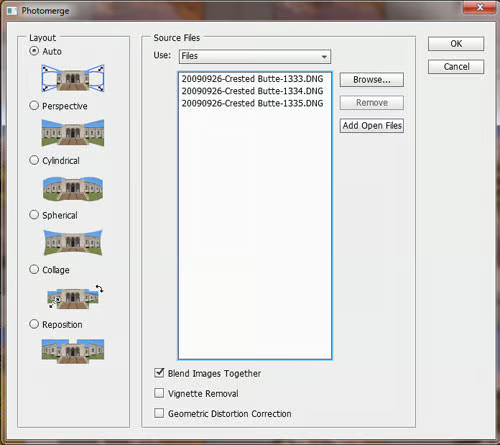
Import RAWs into Lightroom or Capture One for basic corrections (WB consistency, lens CA/fringing reduction, exposure tweaks). If you bracketed, merge to HDR first to a 32-bit DNG or HDR TIFF, then stitch. PTGui is the industry standard for complex 360° work and supports fisheye profiles perfectly; Hugin is a capable open-source alternative. With fisheye panoramas, use ~25–35% overlap around; stitchers will model the fisheye curvature accurately if you set the lens type to full-frame or circular fisheye as appropriate. For final delivery, export equirectangular 2:1 JPEGs or TIFFs at your target resolution (e.g., 12k–16k wide for high-quality VR). For more depth on PTGui’s strengths, see this review of PTGui as a panorama tool. PTGui review and why it’s favored for pro 360s.
Cleanup & Enhancement
- Tripod/nadir patch: Use a separate nadir tile or clone/AI patch tools to remove the rig cleanly.
- Color and noise: Apply consistent color grading; use noise reduction selectively on shadows in night scenes.
- Leveling: In PTGui or Hugin, set verticals and horizon; adjust pitch/roll/yaw to remove tilt.
- Export: Equirectangular 2:1 (e.g., 16384 × 8192) for VR platforms; keep under platform size limits and test on your viewer.
Want a primer on panoramic heads and best practices before stitching? This tutorial is a solid orientation. Panoramic head setup and principles.
Useful Tools & Resources
Software
- PTGui panorama stitching (fast, reliable control points, masking, HDR merge)
- Hugin (open-source, powerful lens modeling)
- Lightroom / Photoshop (RAW prep, retouching, nadir patch)
- AI tools for tripod removal and sky cleanup
Hardware
- Panoramic heads (Nodal Ninja, Leofoto, Bushman): reliable rails and indexed rotators
- Carbon fiber tripods with leveling bases
- Wireless remotes or app control
- Pole extensions / car mounts with safety tethers
Disclaimer: software/hardware names provided for search reference; check official sites for details.
To gauge how focal length impacts spherical resolution and coverage, see this reference. DSLR spherical resolution and lens choice.
Common Mistakes & How to Avoid Them
- Parallax error → Precisely align the no-parallax point; do a near/far test at both 8mm and 15mm and mark rail positions.
- Exposure flicker → Use full Manual exposure and locked WB across all frames (and across brackets).
- Tripod shadows/rig in frame → Take a dedicated nadir shot and patch; plan sun angle outdoors.
- Ghosting from moving subjects → Shoot two passes and mask; use shorter shutter speeds when possible.
- Noise at night → Favor longer exposures at ISO 400–800; avoid pushing beyond ISO 1600 unless necessary.
- Lens hood vignetting at 8mm → Remove the hood for circular fisheye coverage in 35mm crop mode.
- Forgetting 35mm crop mode → On GFX, enable 35mm Format Mode to avoid black corners with EF 8–15mm.
Real-World Use Cases
Indoor Real Estate (Bright Windows)
Mount the GFX with EF 8–15 at 12–15mm to keep verticals more manageable. Shoot 6 around + zenith + nadir. Bracket ±2 EV (or ±3 EV in high-contrast spaces) at ISO 100–200 and f/8. Merge HDR first, then stitch. The GFX 50’s shadow latitude lets you keep window detail and clean interiors without banding.
Outdoor Sunset Landscape
At 8mm circular or 12mm diagonal, use 4–6 around and a single zenith. Lock to ISO 100–200; f/8–f/11 for depth. If the sun enters the frame, block direct rays with your hand just outside the lens for one frame and clone it out later to reduce flare.
Rooftop or Pole Elevated View
At 12mm, do 6 around quickly to minimize sway. Use 1/200 s or faster if windy. Safety first: tether the rig and keep a hand on the pole when rotating. Consider two shorter sequences and blend the sharpest frames per direction.
Car-Mounted Street Capture
Use suction mounts plus a safety strap. Keep speeds low and shoot short sequences at 1/250 s, ISO 400–800, f/5.6–f/8. Expect to mask moving objects in post. This combo’s fisheye coverage reduces the total frames needed—critical in dynamic environments.
Watch: Practical Panorama Workflow
For a concise, practical walkthrough of panorama shooting and stitching principles that apply to this setup, the following video is helpful.
For a deeper dive into setting up a panoramic head precisely, see this step-by-step guide from Meta’s Creator resources. Set up a panoramic head for high-end 360 photos.
Frequently Asked Questions
- Can I shoot handheld panoramas with the Fujifilm GFX 50S/50R?
Yes, but it’s risky. The 50S/50R lack IBIS, and the fisheye’s extreme FOV amplifies parallax if you pivot from your body rather than the no-parallax point. Handheld is fine for quick, non-critical 360s outdoors; for professional results, use a tripod and pano head.
- Is the Canon EF 8–15mm f/4L fisheye wide enough for a single-row 360?
Absolutely. In 35mm crop mode on the GFX, at 8mm (circular fisheye), 4 shots around often suffice (plus optional zenith/nadir). At 12–15mm (diagonal fisheye), plan 6 around + zenith + nadir for clean poles and better edge definition.
- Do I need HDR for interiors with bright windows?
Usually yes. Bracket ±2 EV (3–5 frames) at ISO 100–200 and merge before stitching. The GFX 50’s DR helps, but windows can be several stops brighter than interiors; HDR preserves both without banding.
- How do I avoid parallax issues with this combo?
Use a panoramic head and align the entrance pupil. Start with the rail around 55–70 mm forward of the sensor plane (varies with focal length and the EF→GFX adapter). Do a near/far test at both 8mm and 15mm, and mark the rails for repeatability.
- What ISO range is safe on the GFX 50S/50R in low light?
ISO 100–400 for maximum quality; ISO 800 is still very clean; ISO 1600 is usable with careful noise reduction. Prefer longer shutter times on a sturdy tripod over pushing ISO.
- Can I set up custom shooting modes for panoramas?
Yes. Configure a custom mode with Manual exposure, manual focus, fixed WB, 2 s timer, and your preferred bracketing. This speeds up repeatability when switching locations.
- How do I reduce flare with a fisheye?
Avoid direct sun near the frame edges; slightly shade the lens with your hand (keep it out of the frame) and use a clean front element. Consider an additional frame for the flared direction and blend in post.
- Which tripod head should I choose for this setup?
Look for a two-axis panoramic head with a reliable indexed rotator and enough rail travel for the GFX body plus adapter (Nodal Ninja, Leofoto, Bushman). A leveling base under the head speeds setup significantly.
Safety & Operational Notes
This combo is front-heavy with the adapter and fisheye; ensure your clamp is tight and plates are fully engaged. On rooftops or crowded places, use a safety tether. In wind, lower the center column and add weight to the tripod. For car or pole mounts, double-check every connection and avoid overhead power lines and pedestrian areas. Always prioritize safety over the shot.
Wrap-Up: Mastering How to Shoot Panorama with Fujifilm GFX 50S / 50R & Canon EF 8–15mm f/4L Fisheye USM
The formula is straightforward: enable 35mm crop mode, align the no-parallax point, lock exposure/WB, and use sensible overlap. At 8mm, you’ll get fast, minimal-frame captures; at 15mm, you’ll gain cleaner edges and ceilings with a few more shots. Combine the GFX 50’s excellent DR with disciplined HDR bracketing and you’ll produce clean, high-resolution equirectangulars ready for VR and virtual tours.
Want a broader overview of DSLR/mirrorless 360 options and tradeoffs? This resource is a useful complement to the setup you’re using here. DSLR/mirrorless 360 camera and lens guide.