
Why This Camera & Lens Are Great for Panoramas
The Fujifilm GFX 100 II paired with the Sigma 8mm f/3.5 EX DG Circular Fisheye is an unusual yet extremely capable combo for fast, high-quality 360° capture. The GFX 100 II’s large 43.8 × 32.9 mm medium-format sensor delivers 102 MP resolution with a pixel pitch of about 3.76 μm, excellent per-pixel detail, and class-leading dynamic range near base ISO. Its IBIS helps for handheld scouting frames, and the body’s robust build, big battery, and precise manual controls make it trustworthy in the field.
The Sigma 8mm f/3.5 is a circular fisheye that projects a 180° field-of-view circle. For 360° panoramas, circular fisheyes minimize the number of shots needed—often 3–4 images around are enough—speeding up capture in dynamic environments. On the GFX 100 II, enable 35mm Format Mode (full-frame crop) to capture the entire circular image without clipping. If you remain in full 44×33 mode, the circle will be cropped top and bottom; usable for creative panos, but less ideal for full-sphere stitching.
In practical terms, if you want to know how to shoot panorama with Fujifilm GFX 100 II & Sigma 8mm f/3.5 EX DG Circular Fisheye, this guide distills everything from gear setup and nodal alignment to HDR interiors and stitching in PTGui/Hugin. You’ll also find safety notes for rooftop/pole shots and solid backup workflows for client jobs.
Quick Setup Overview
- Camera: Fujifilm GFX 100 II — Medium format (43.8 × 32.9 mm), 102 MP BSI sensor, pixel pitch ≈ 3.76 μm, excellent DR at base ISO, in-body stabilization (turn off on tripod).
- Lens: Sigma 8mm f/3.5 EX DG Circular Fisheye — Circular fisheye with 180° FOV; sharpest typically around f/5.6–f/8; typical fisheye CA present at edges (easily corrected in post).
- Estimated shots & overlap (35mm Format Mode on GFX):
– 3 around at 120° spacing often covers full sphere (tripod footprint may need nadir patch).
– 4 around at 90° spacing is a safe, industry-standard pattern with solid overlap.
– Optional: extra nadir shot for clean tripod removal. - Difficulty: Easy–Moderate. Very fast capture once nodal alignment is calibrated.
Planning & On-Site Preparation
Evaluate Shooting Environment
Survey light direction, moving subjects (pedestrians, cars, trees in wind), and reflective surfaces (glass, polished floors). With circular fisheyes, flare control is crucial; avoid direct sun in the frame when possible or shield with your hand outside the frame. If shooting through glass, stand as close as possible (1–3 cm) and at a slight angle to minimize reflections and double images. For interiors with mixed lighting, note where color casts may change around the scene.
Match Gear to Scene Goals
The GFX 100 II’s high resolution and strong dynamic range make it ideal for both real estate interiors and high-contrast outdoor sunsets. At base ISO (80–100), expect excellent highlight retention and shadow lift. Practical, clean ranges: ISO 100–800 remains very clean; ISO 1600–3200 is usable with careful noise reduction. The Sigma 8mm circular fisheye means far fewer frames per sphere than rectilinear lenses—excellent where time is critical (events, rooftops, windy conditions). The tradeoff is intentional fisheye distortion, which panorama software uses to map the sphere accurately.
Pre-shoot Checklist
- Charge batteries and carry a spare; format dual cards; set RAW to 14-bit, lossless compressed.
- Clean front element; check sensor; pack a microfiber cloth and rocket blower.
- Level the tripod and confirm panoramic head is calibrated to the lens’s no-parallax (nodal) point.
- Enable 35mm Format Mode on the GFX 100 II for full circular coverage with the Sigma 8mm.
- Safety: on rooftops or poles, tether the camera and mind wind gusts; verify mount torque; keep bystanders clear.
- Backup: when time allows, shoot an extra safety round in case of motion/ghosting in one frame.
Essential Gear & Setup
Core Gear
- Panoramic head: Allows precise control of yaw/pitch and alignment to the lens’s no-parallax point. Correct nodal alignment eliminates foreground/background shifts and makes stitching seamless.
- Stable tripod with a leveling base: A leveling base speeds setup; level before you start rotating to ensure consistent pitch.
- Remote trigger or app control: Avoid camera shake; use 2-second timer if you don’t have a remote.
Optional Add-ons
- Pole or car mount: Use a rigid pole and secure tethers. Check wind loading; reduce rotation speed; consider higher shutter speeds to combat vibration.
- Lighting aids: Small LED panels or bounced flash for dim interiors. Keep lighting consistent across frames.
- Weather protection: Rain cover, microfiber cloth, gaffer tape for unexpected conditions.

Step-by-Step Shooting Guide
Standard Static Scenes
- Level the tripod and align the nodal point. Slide the camera along the pano rail while panning past a near/far vertical (e.g., a light stand in front of a doorway). When parallax disappears, mark that rail position for the Sigma 8mm.
- Set camera to Manual exposure and lock white balance (Daylight/Cloudy/Tungsten as appropriate). Disable IBIS on the tripod to prevent micro-shift blur.
- Focus: switch to MF and set around the hyperfocal. With an 8mm at f/8 on full-frame crop, focusing ≈0.3–0.5 m keeps near to infinity sharp. Take a test frame and magnify to confirm.
- Capture sequence:
– 3 around at 0°/120°/240° for speed, or
– 4 around at 0°/90°/180°/270° for more overlap.
Keep about 25–35% rotational overlap between frames. - Take a nadir (down) shot if you want a clean ground patch. You can offset the tripod or hand-hold the nadir shot with the camera over the tripod footprint.
HDR / High Dynamic Range Interiors
- Bracket ±2 EV (e.g., -2/0/+2) or ±3 EV in extremely contrasty scenes. Keep the same brackets for every yaw angle.
- Lock WB and focus; use a 2s timer or remote. For windows, ensure at least one bracket preserves exterior highlights and one preserves interior shadows.
- If people move, consider two bracket sets and mask later.
Low-Light / Night Scenes
- Use f/4–f/5.6, shutter 1/30–1/60 s, ISO 400–800 as a starting point on the GFX 100 II. For ultra-clean results, keep ISO ≤800 and lengthen the exposure on a solid tripod.
- Turn off IBIS on tripod, use a remote trigger, and enable electronic first curtain or electronic shutter to avoid vibrations.
- Wind management: if the fisheye hood catches wind, keep exposure short and add more frames if necessary.
Crowded Events
- Shoot two passes: first for coverage, second to fill “holes” when crowds shift. Ask a spotter to help clear your immediate foreground if possible.
- Use 4-around capture for extra overlap; it gives you options to mask moving subjects in post.
Special Setups (Pole / Car / Drone)
- Pole: Secure clamps and tether the camera; rotate slowly, keep shutter ≥1/250 s if the pole flexes. Consider 4-around for safer overlap.
- Car mount: Use a low-vibration suction system; plan a quiet location; monitor for rolling shutter if using electronic shutter at speed.
- Drone: This lens is not drone-friendly due to size/weight; instead consider specialized drone workflows.
Recommended Settings & Pro Tips
Exposure & Focus
| Scenario | Aperture | Shutter | ISO | Notes |
|---|---|---|---|---|
| Daylight outdoor | f/8–f/11 | 1/100–1/250 | 100–200 | Lock WB (Daylight); shield lens from direct sun to reduce flare |
| Low light/night | f/4–f/5.6 | 1/30–1/60 | 400–800 | Tripod and remote; turn off IBIS; lengthen shutter for cleaner ISO |
| Interior HDR | f/8 | Bracket ±2 EV | 100–400 | One bracket for windows, one for interior; keep WB locked |
| Action / moving subjects | f/5.6–f/8 | 1/200+ | 400–800 | Freeze motion; capture an extra pass for masking |
Critical Tips
- Manual focus at or near hyperfocal: around 0.3–0.5 m at f/8 with an 8mm circular fisheye in 35mm crop gives front-to-back sharpness.
- Nodal point calibration: Use a pano rail; align until near and far objects maintain alignment when panning. Mark the rail for the Sigma 8mm so you can repeat quickly.
- White balance lock: Avoid mixed color casts across frames; correct the entire panorama consistently in RAW.
- RAW over JPEG: The GFX 100 II’s RAW files give superior highlight/shadow recovery—key for HDR panoramas and low-light work.
- IBIS off on tripod: Prevents tiny sensor shifts between frames. Re-enable for handheld scouting or emergency handheld panos.
- Pixel Shift: Avoid for multi-frame 360° capture because subject/scene changes between frames can break alignment; use single-frame RAW per view instead.
Stitching & Post-Processing
Software Workflow
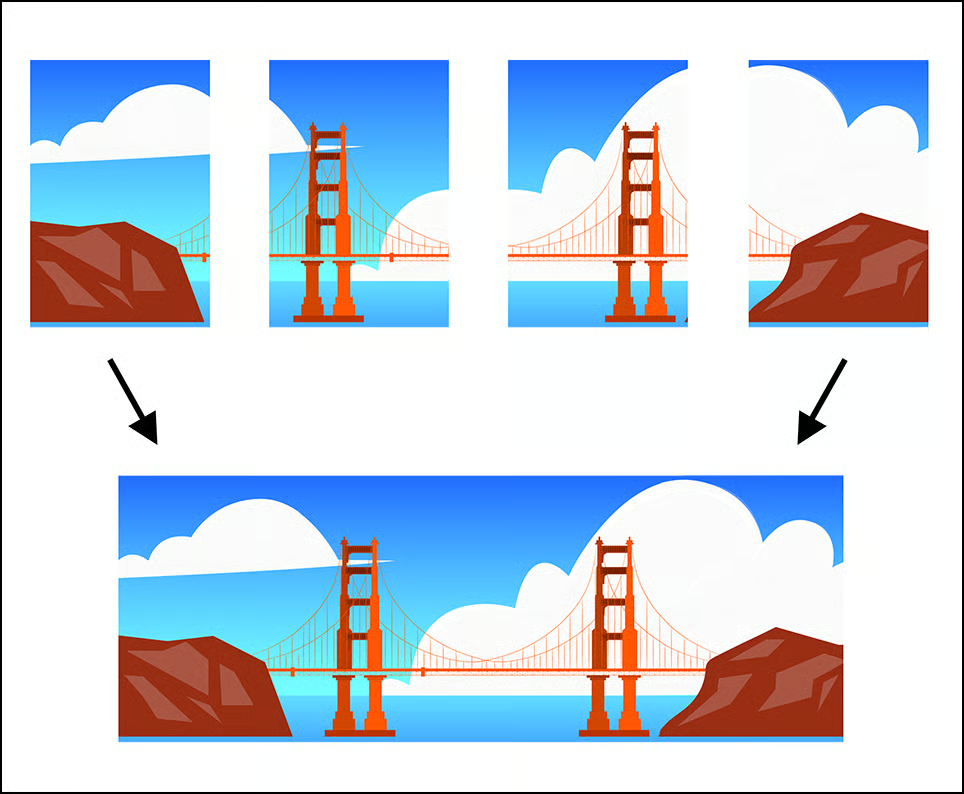
Import RAWs into Lightroom or Capture One; make global, identical adjustments per view (exposure, WB, lens profile off if you’ll let PTGui handle fisheye geometry). For HDR, either pre-merge brackets to 32-bit TIFFs per angle or let PTGui handle exposure fusion/True HDR. In PTGui/Hugin, set lens type to Circular Fisheye with ~180° HFOV, then add control points and optimize. With a circular fisheye, you’ll typically need fewer, stronger control points; use optimizer, inspect RMS error, and fine-tune horizon/roll. Aim for 25–35% overlap between views with fisheyes; rectilinear workflows typically need more shots with 20–25% overlap.
Export an equirectangular projection (commonly 8K–16K wide depending on your target platform). If your deliverable is for VR or virtual tour platforms, export JPEG (quality 90–95) or 16-bit TIFF for further edits. Always check for seams around high-contrast edges and correct horizon before final output. For a deeper dive on stitching best practices and software comparisons, see this PTGui review and workflow discussion at the end of this section. PTGui review and workflow tips
Cleanup & Enhancement
- Nadir patch: Shoot a dedicated nadir frame or use AI-based tripod removal tools and careful cloning/healing.
- Color and noise: Equalize color between frames; apply noise reduction selectively to shadows; avoid over-sharpening edges that cross seams.
- Leveling: Set horizon and correct roll/pitch. PTGui has horizon and vertical line tools—use them.
- Export formats: Equirectangular JPEG for tours; PNG/TIFF for archival and further grading; retain layered PSD when masking people.
Useful Tools & Resources
Software
- PTGui panorama stitching
- Hugin open source
- Lightroom / Photoshop
- AI tripod removal tools
Hardware
- Panoramic heads (Nodal Ninja, Leofoto)
- Carbon fiber tripods
- Leveling bases
- Wireless remote shutters
- Pole extensions / car mounts
For a practical nodal alignment walkthrough and gear basics, this panoramic head tutorial is a solid reference: Panoramic head setup and tips
If your goal is VR publishing, Meta’s DSLR 360 capture primer outlines standards and projections for VR viewers: Using a DSLR or mirrorless to shoot and stitch a 360 photo
To better understand lens choices and perspective trade-offs, this guide on focal lengths and panoramas is helpful: Panoramas, focal lengths & Photoshop guide
Video: Deep-Dive Panorama Techniques
Prefer to watch a walkthrough? This recommended video complements the steps above.
Disclaimer: software/hardware names provided for search reference; check official sites for details.
Common Mistakes & How to Avoid Them
- Parallax error: Always align to the Sigma 8mm’s no-parallax point; recheck after changing quick-release plates.
- Exposure/WB flicker: Shoot manual exposure and locked white balance across all frames.
- Tripod in frame: Plan a nadir shot or use an offset/patch technique in post.
- Ghosting from movement: Take extra passes and mask the clean regions during stitching.
- Night noise: Keep ISO low on the GFX 100 II (ideally ≤800) and lengthen shutter on a stable mount.
- Clipping the circular image: On GFX, enable 35mm Format Mode to capture the full circular fisheye image.
Frequently Asked Questions
-
Can I shoot handheld panoramas with the GFX 100 II?
Yes for quick tests, but tripod + pano head is strongly recommended. The GFX’s IBIS helps, but without nodal alignment you’ll get parallax, especially with near objects. Use handheld only for scouting or wide-open spaces with distant subjects.
-
Is the Sigma 8mm f/3.5 circular fisheye wide enough for single-row 360?
Yes. In 35mm Format Mode, 3–4 images around typically cover 360×180°. Add a nadir shot if you want a clean ground. Many pros use 4-around for safer overlap and easier stitching.
-
Do I need HDR for interiors with bright windows?
Usually yes. Bracket at least ±2 EV to preserve exterior highlights and interior shadows. The GFX 100 II has strong dynamic range, but windows in direct sun often demand bracketing to avoid clipped highlights and muddy shadows.
-
How can I avoid parallax issues with this lens?
Mount the camera on a panoramic head and slide along the rail until near/far lines don’t shift while panning. Mark the rail stop for the Sigma 8mm + your adapter. Keep that setting consistent for repeatable results.
-
What ISO range is safe on the GFX 100 II in low light?
ISO 100–800 is generally very clean; ISO 1600–3200 is workable with quality noise reduction. On a tripod, favor longer shutter times over raising ISO to preserve detail and dynamic range.
Field Notes & Case Studies
Indoor Real Estate
Use f/8, ISO 100–200, tripod, and ±2 EV brackets. Keep lights consistent across views; disable flickery LED panels if they cause banding with electronic shutter. Mark a repeatable camera height and keep it consistent room-to-room to maintain a professional look across a tour.
Outdoor Sunset
Meter for the midtones; ensure one bracket preserves sun-side highlights. The fisheye will include the sun in at least one frame—shield with your hand or time the capture for when the sun is just behind a tree/building to reduce flare and ghosting.
Event Crowds
Shoot 4-around for extra overlap; capture two quick passes and pick/paint the cleanest regions during stitching. This minimizes ghosting of moving arms and faces.
Rooftop / Pole Shooting
Safety first: tether the rig, watch the wind. Use faster shutter speeds (≥1/200 s) if the pole flexes. Consider capturing an extra yaw angle as insurance against vibration-softened frames.
Car-Mounted Capture
Plan a slow, empty road with uniform light. Use a vibration-damped mount, short exposures (≥1/250 s), and test both mechanical and electronic shutters to see which handles road vibration better on your specific mount.
If you want a broader overview of DSLR/mirrorless pano practices and lens choices for tours, this guide is a helpful reference: DSLR virtual tour camera & lens guide
