
Why This Camera & Lens Are Great for Panoramas
If you want to learn how to shoot panorama with Fujifilm GFX 100 II & Pentax DA 10-17mm f/3.5-4.5 ED Fisheye, this guide distills field-tested technique with medium-format quality and a compact fisheye zoom. The GFX 100 II’s 102MP 43.8×32.9 mm BSI CMOS sensor delivers exceptional detail, 16-bit RAW, ~14+ stops of dynamic range, and very clean low ISO files. Its pixel pitch (~3.76 µm) supports crisp micro-contrast, and the camera’s IBIS is excellent for handheld framing and low-light—but should be disabled on a tripod for pano work.
The Pentax DA 10–17mm is a lightweight APS-C diagonal fisheye zoom with characterful rendering and strong coverage at 10mm. On the larger GFX sensor, it does not cover the full frame: expect heavy vignetting/black corners at most focal lengths. That’s not a deal-breaker for 360 photos—software can treat your frames as circular fisheye captures and ignore the corners. With a K‑to‑GFX adapter that includes an aperture control ring, the lens becomes a compact, manual-focus circular fisheye solution that requires comparatively few shots to complete a full spherical panorama.
Why this combo works: you get medium-format tonal latitude for clean shadows and highlight recovery, while the fisheye radically reduces the number of images needed. The trade-offs are predictable: manual aperture/focus via adapter, strong fisheye distortion (managed in stitching), and careful nodal-point calibration to prevent parallax. Done right, you’ll get fast captures with beautiful tonality and extremely high stitch quality.
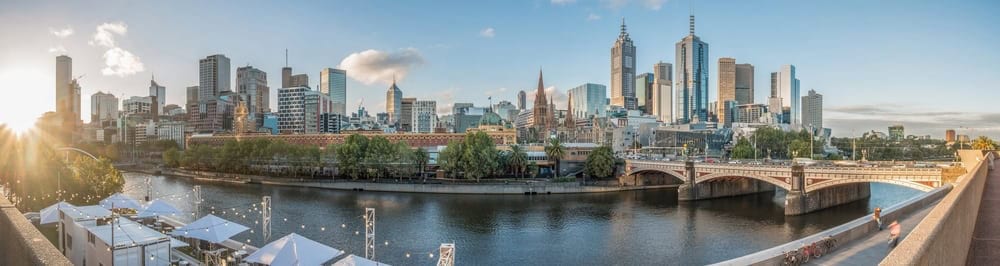
Quick Setup Overview
- Camera: Fujifilm GFX 100 II — 43.8×32.9 mm medium format, 102MP BSI CMOS, 16-bit RAW, base ISO 80, excellent DR (~14+ stops).
- Lens: Pentax DA 10–17mm f/3.5–4.5 ED Fisheye — APS-C diagonal fisheye; best stopped to f/5.6–f/8; moderate lateral CA at edges; requires K→GFX adapter with aperture lever.
- Estimated shots & overlap:
- At 10mm (treated as circular fisheye on GFX): 4 around at 90° + zenith + nadir, 30–35% overlap.
- At ~13mm (still heavy corner falloff): 6 around + Z + N, 30% overlap.
- At 17mm (narrower FOV): 8 around + Z + N, 30% overlap.
- Difficulty: Intermediate (adapter + manual control + precise nodal setup).
Planning & On-Site Preparation
Evaluate Shooting Environment
Scan for moving elements (people, cars, foliage), reflective surfaces (windows, chrome), and strong backlights. For glass, keep your lens as close to the surface as possible without touching to minimize reflections and flare; a rubber lens hood can help. For sunset-to-blue-hour, plan exposure ranges for HDR bracketed panoramas and be aware that light direction changes quickly—work efficiently.
Match Gear to Scene Goals
The GFX 100 II’s large sensor and 16-bit pipeline give you deep recovery latitude—perfect for interiors with bright windows and outdoor high-contrast scenes. Safe ISO range for clean results is ISO 80–800, ISO 1600 still excellent, and ISO 3200 usable when needed. The fisheye advantage of the Pentax 10–17mm means fewer shots per 360, which reduces stitching seams and time on location. The trade-off is fisheye distortion and corner vignetting on GFX, both of which are manageable in PTGui/Hugin with appropriate lens model settings.
Pre-shoot Checklist
- Power/data: Fully charged batteries; fast UHS-II/CFexpress storage; set RAW (14/16-bit).
- Optics: Clean lens and sensor; pack a blower and microfiber cloth.
- Support: Leveling base, panoramic head calibrated to nodal point, stable tripod (weight hook if windy).
- Safety: Wind assessment (especially on rooftops/poles), tether straps for pole or car mounts, keep bystanders away from tripod legs.
- Workflow: Shoot a second safety pass; verify focus/exposure histograms between rotations; keep notes for nodal settings.
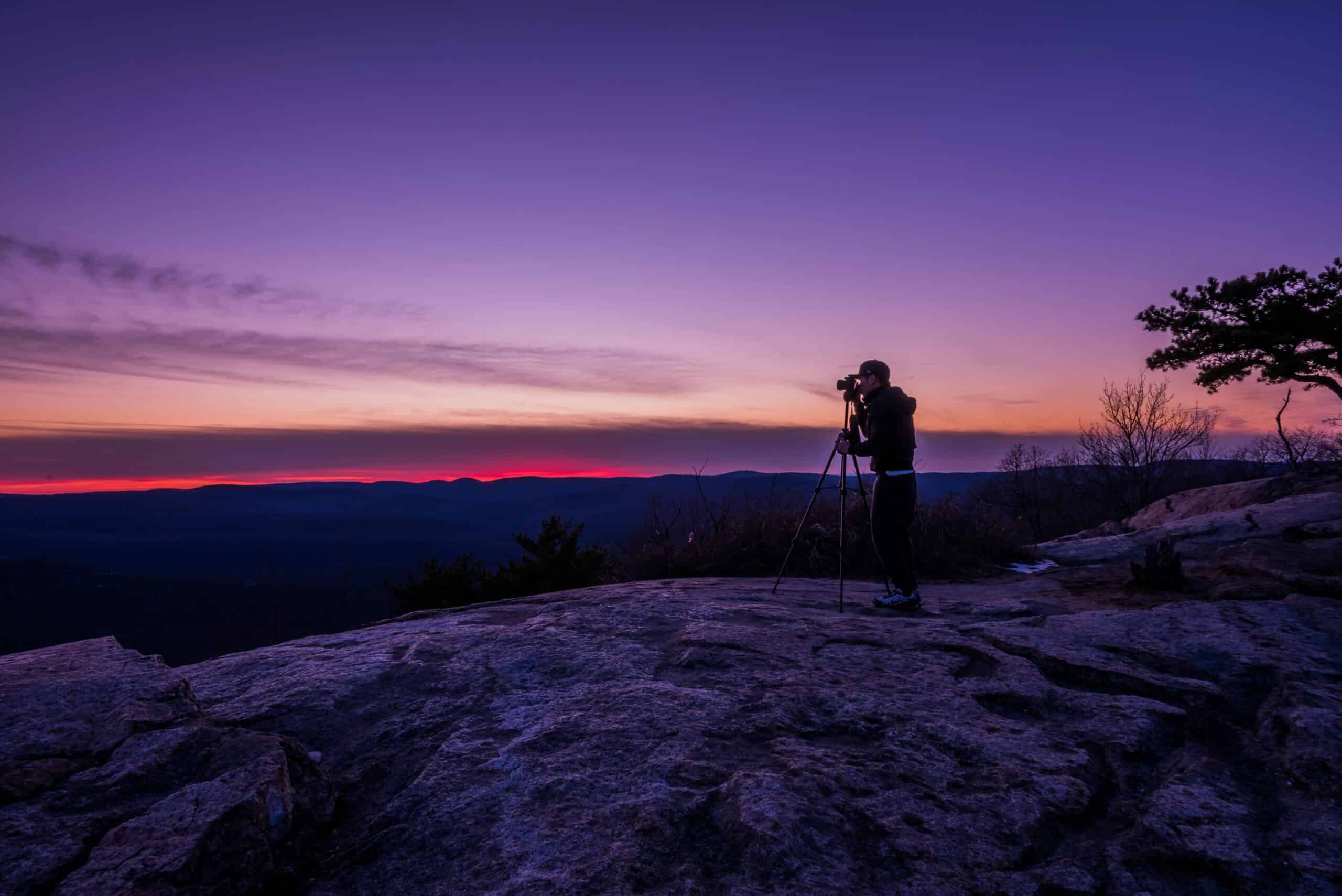
Essential Gear & Setup
Core Gear
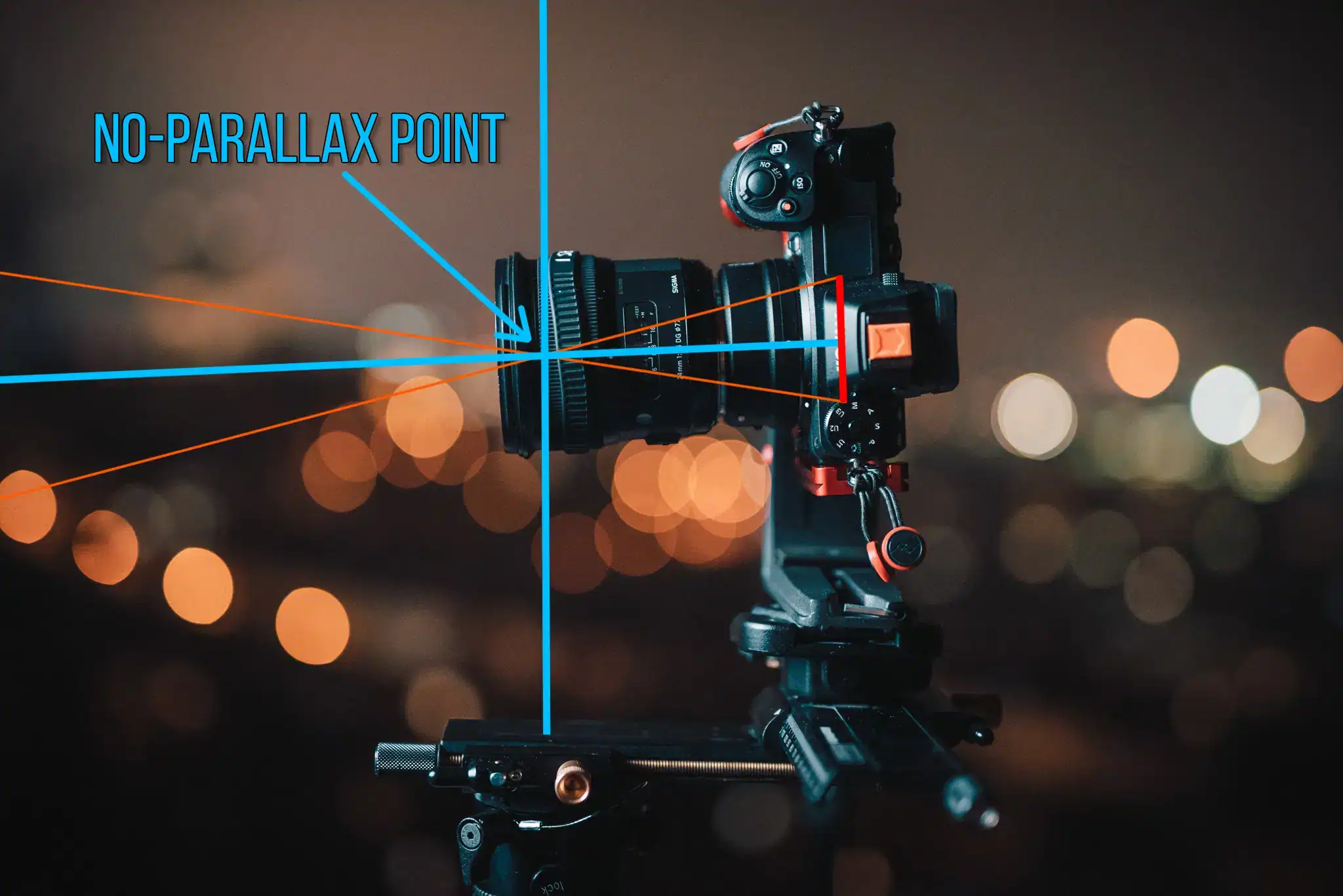
- Panoramic head: Allows precise nodal (no-parallax) alignment and exact yaw increments. This is critical when working with a fisheye on a high-resolution body.
- Stable tripod with leveling base: Keep the rotator perfectly level so your horizon stitches straight and requires minimal post leveling.
- Remote trigger or app: Use the Fujifilm XApp or a wired release to avoid vibrations; set exposure delay to eliminate shutter shock.
Optional Add-ons
- Pole or car mount: Great for elevated or mobile capture. Use a safety tether, observe wind load, and avoid overhanging public footpaths.
- Lighting aids: Small LED panels for interiors; bounce off ceilings to avoid hotspots. Keep color temperature consistent.
- Weather protection: Rain cover and silica packs; tape foam around the adapter to reduce play and dust ingress.
Adapter note: The Pentax DA 10–17 lacks an aperture ring. Use a K→GFX adapter with a mechanical aperture lever to set f/5.6–f/8. You’ll be manual focus only—use focus peaking and magnification.
Step-by-Step Shooting Guide
Standard Static Scenes
- Level and nodal alignment: Level the tripod via the base. On the pano head, slide the camera forward/backward until parallax disappears when panning—use a vertical test object ~1–2 m away against a distant background. Mark your rail position for 10mm and 13–17mm.
- Manual exposure and WB: Switch to M mode. Meter for mid-tones without clipping highlights (use the histogram). Lock white balance (Daylight, Tungsten, or a custom Kelvin) to prevent color shifts across frames.
- Capture sequence and overlap: For 10mm on GFX treated as circular fisheye, shoot 4 frames around at 90° increments, then a zenith and a nadir. Aim for ~30–35% overlap between adjacent images. Use a consistent rotation routine (e.g., North-East-South-West) to simplify labeling.
- Nadir capture: Tilt down and shoot the ground plate to facilitate tripod removal in post. If the tripod obstructs, shoot a handheld nadir at the same spot and orientation for patching.
HDR / High Dynamic Range Interiors
- Bracket ±2 EV (3–5 frames): At each yaw angle, shoot a bracket to hold window highlights and interior shadows. Maintain the same aperture across the set.
- Lock WB and focus: Keep WB fixed and use manual focus at the hyperfocal setting to keep all brackets consistent. Turn off IBIS on tripod.
Low-Light / Night Scenes
- Use longer exposures: f/4–f/5.6 at ISO 80–400 for cleaner files; let shutter time increase (1–8 s as needed). Enable exposure delay (e.g., 1–2 s) or use a remote to avoid vibrations.
- Mind flicker: Avoid electronic shutter under LED lighting. Use mechanical or EFCS to minimize rolling artifacts.
Crowded Events
- Two-pass technique: First pass for clean geometry; second pass timing gaps in the crowd. This gives you clean plates to mask in post.
- Shorter shutter: Use 1/200 s+ and ISO 400–800 at f/5.6–f/8 to freeze motion; accept slightly higher noise over motion blur.
Special Setups (Pole / Car / Drone)
- Pole: Keep rotations slow; secure with guy lines if windy. Use a safety tether from the camera strap lug. Consider 4-around only (skip Z/N) and patch zenith/nadir later to reduce time aloft.
- Car mount: Use a suction rig on clean glass or a roof clamp rated well beyond camera weight. Drive under 30 km/h for capture; avoid sudden acceleration. Use a higher shutter (1/500 s+) and burst modes at each yaw.
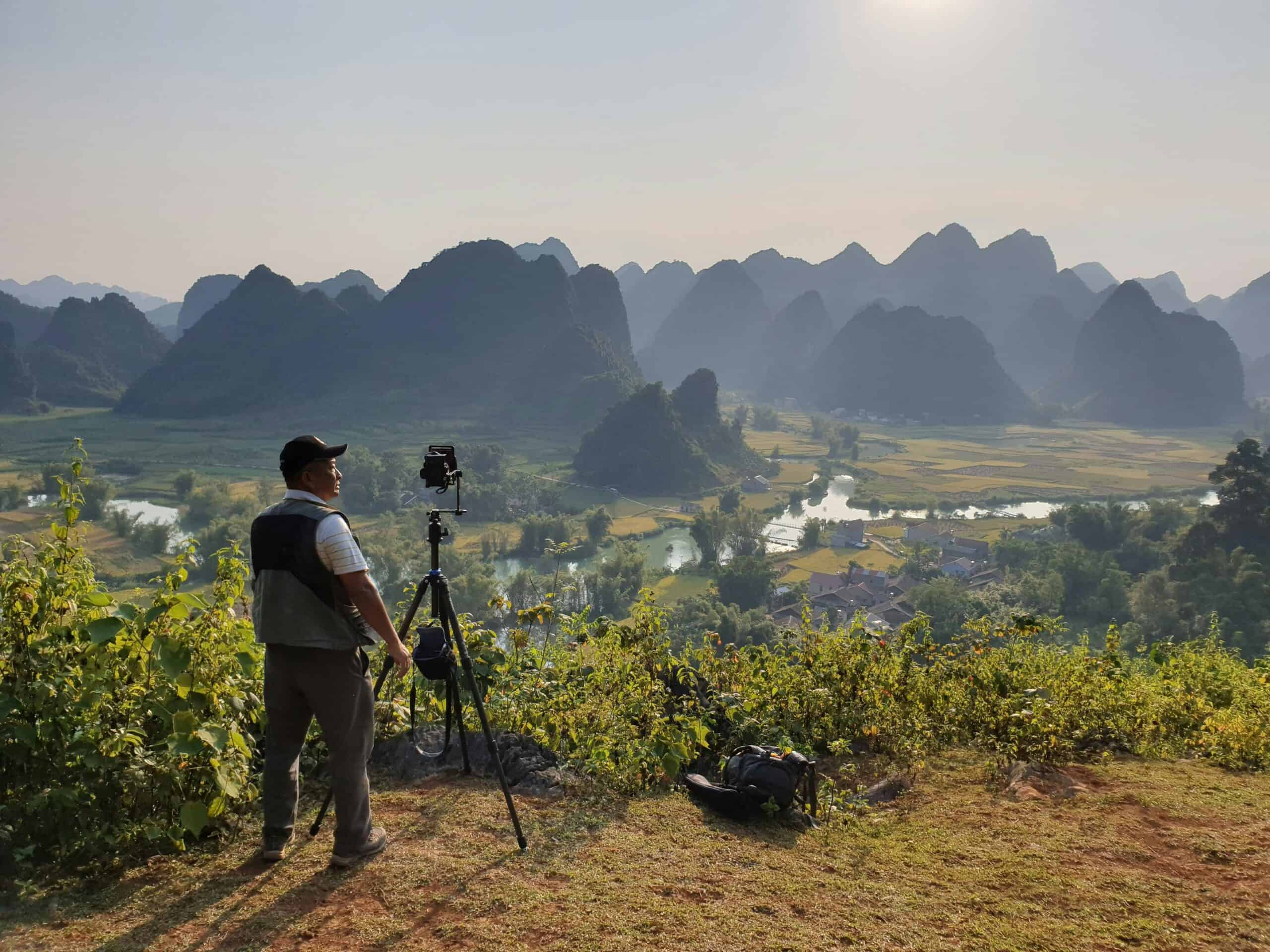
Recommended Settings & Pro Tips
Exposure & Focus
| Scenario | Aperture | Shutter | ISO | Notes |
|---|---|---|---|---|
| Daylight outdoor | f/8–f/11 | 1/100–1/250 | 80–200 | Lock WB (Daylight); maintain 30% overlap |
| Low light/night | f/4–f/5.6 | 1/30–1 s+ | 80–800 | Tripod, IBIS off, use exposure delay or remote |
| Interior HDR | f/8 | Bracket ±2 EV | 80–400 | Expose for windows; blend in PTGui/HDR tool |
| Action / moving subjects | f/5.6–f/8 | 1/200+ | 400–800 | Two-pass capture for clean masks |
Critical Tips
- Manual focus at hyperfocal: At 10mm and f/8, set focus just under infinity. Use magnification to confirm.
- Nodal point calibration: With the Pentax 10–17 around 10mm, expect the entrance pupil to sit slightly behind the front element. Slide on the rail until foreground/background alignment doesn’t shift during panning; record that rail mark.
- White balance lock: Keep a consistent Kelvin value to avoid color mismatch during stitching, especially under mixed lighting.
- RAW over JPEG: 16-bit RAW from the GFX 100 II maximizes tonal latitude and color fidelity for HDR panoramas.
- IBIS and shutter mode: Turn IBIS off on tripod; use EFCS or mechanical to avoid vibration and banding under artificial light.
Stitching & Post-Processing
Software Workflow
Import your RAWs into Lightroom/Camera Raw for basic white balance and exposure consistency, then export to PTGui or Hugin for stitching. With a fisheye, choose the correct lens model—this Pentax/Tokina design behaves close to equisolid-angle. If you shot at 10mm as a circular fisheye, set a circular crop and let the stitcher handle the mapping to equirectangular. Industry guidance suggests ~25–35% overlap for fisheye rows and ~20–25% for rectilinear. PTGui’s optimizer can refine FOV and distortion parameters for best fits. For a review of PTGui’s strengths with complex panos, see Fstoppers’ overview. Read the PTGui review for advanced tips.
Cleanup & Enhancement
- Nadir patch: Use a handheld nadir frame to patch the tripod. PTGui Viewpoint correction or Photoshop’s Clone/Generative tools work well.
- Color and noise: Match color across brackets before stitching if not merging HDR stacks first. Apply gentle NR to shadow regions.
- Leveling: Use the stitching software’s horizon/verticals tool to correct yaw/pitch/roll. Confirm the horizon in a VR viewer.
- Export: Save as 16-bit TIFF master and an 8-bit JPEG equirectangular for web/VR. Follow platform upload specs (e.g., 2:1 aspect, 8–16k width).
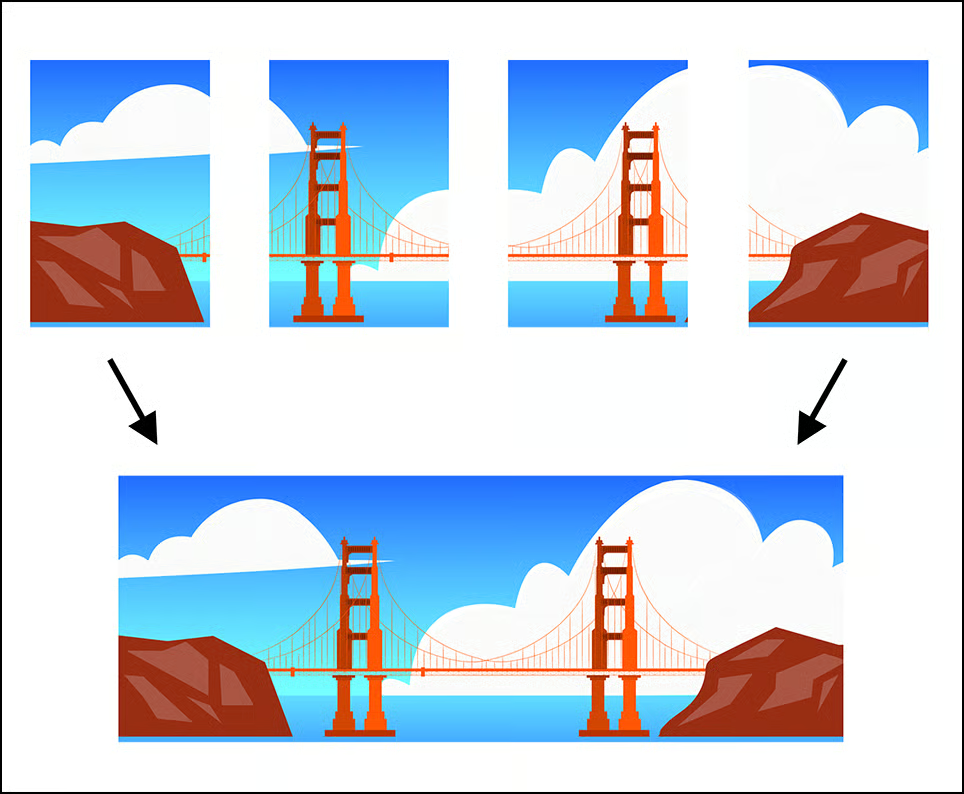
New to panoramic heads and alignment? This illustrated walkthrough helps you nail the fundamentals. Learn panoramic head setup fundamentals.
Useful Tools & Resources
Software
- PTGui for fast, robust fisheye stitching and HDR panoramas
- Hugin (open source) for control point mastery and experimentation
- Lightroom / Photoshop for RAW development and nadir retouch
- AI tripod removal tools for quick nadir cleanup
Hardware
- Panoramic heads: Nodal Ninja, Leofoto, or equivalent rail systems
- Carbon fiber tripods with leveling bases
- Wireless remotes or intervalometers
- Pole extensions / car mounts rated above total kit weight
Disclaimer: software/hardware names provided for search reference; check official sites for details.
For a broader background on DSLR/mirrorless 360 workflows and lens selection, this guide is a solid primer. Explore DSLR/mirrorless 360 capture fundamentals.
Common Mistakes & How to Avoid Them
- Parallax error: Always align the lens’s entrance pupil over the rotation axis; test with a near and far object.
- Exposure flicker: Use manual exposure and locked white balance; avoid auto-ISO for consistent stitching.
- Tripod shadows and nadir gaps: Capture a dedicated nadir frame for clean patching.
- Ghosting from motion: Time your rotations between crowd flows and use masking in PTGui/Photoshop.
- Noise/banding at night: Keep ISO low and use longer shutter on tripod; prefer mechanical/EFCS under artificial lighting.
If you want to estimate theoretical panorama resolution vs. shot count and FOV, Panotools’ spherical resolution page is an excellent reference. Understand spherical resolution trade-offs.
Real-World Use Cases with This Combo
Indoor Real Estate (Mixed Lighting)
At 10mm, shoot 4-around + Z + N with 3–5 shot brackets at ±2 EV. Lock WB around 3500–4200K to balance tungsten/LED with daylight. Use f/8 for edge-to-edge sharpness and ISO 80–200 with longer shutter. Merge HDR stacks per angle first, then stitch to minimize exposure variation.
Outdoor Sunset to Blue Hour
Start at base ISO 80, f/8, and 1/125 s; as light drops, extend shutter first, then increase ISO modestly (to ISO 400–800). Shoot a second pass if the color gradient changes mid-capture; blend where sky is clean to avoid seams.
Event Crowds
Work fast: 4-around reduces missed beats. Use 1/200–1/500 s shutter, ISO 400–800, f/5.6–f/8. Mark feet position and rotate carefully to maintain nodal alignment while navigating people.
Rooftop or Pole Shooting
Wind is the enemy. Shorten the pole, add a guy line, and avoid long exposures. Use a wrist strap on the camera and a secondary tether. Take only the essential frames (4-around) and patch zenith/nadir later.
Car-Mounted Drive-By
Secure a rated suction rig; check seals. Plan a safe, low-speed route and capture at fixed intervals. Use a faster shutter and consider 6-around to help with motion parallax from nearby objects, masking in post as needed.
Compatibility & Limitations to Be Aware Of
- Coverage: The Pentax DA 10–17mm is designed for APS-C. On GFX, it yields a circular/strongly vignetted image, which is acceptable for 360 workflows that crop to the circular area.
- Aperture control: The DA variant lacks an aperture ring. Use a K→GFX adapter with an aperture lever to set f/5.6–f/8, the lens’s sweet spot.
- Focus: Manual only on GFX; enable peaking and magnification. Once dialed at hyperfocal, you won’t need to refocus during the pano.
- Lens projection: In stitching software, choose equisolid-angle for best initial fit, then optimize. Test a short series to confirm.
- IBIS: Turn off when mounted on a tripod. Leave on only if capturing handheld segments—then keep shutter fast and overlap generous.
If you’re new to panoramic heads and want a concise, practical walkthrough with visuals, the Meta/Oculus guide is a strong companion read. Set up a panoramic head for high-end 360 photos.
Frequently Asked Questions
- Can I shoot handheld panoramas with the GFX 100 II?
You can for partial panos, but for full 360s it’s risky. The large sensor resolves small alignment errors; parallax from handheld rotation will cause stitching artifacts. If you must, use very fast shutter speeds, enable IBIS, overshoot overlap (50%+), and expect more time masking in post.
- Is the Pentax DA 10–17mm wide enough for single-row 360 on GFX?
Yes, when used at ~10mm as a circular fisheye. A typical set is 4-around + zenith + nadir. At longer focal lengths (13–17mm), plan 6–8 around plus Z/N for safety.
- Do I need HDR for interiors with bright windows?
Usually yes. Bracket ±2 EV (3–5 shots) per angle, merge brackets first, then stitch. The GFX 100 II’s DR helps, but HDR keeps window detail and clean shadow tones without pushing noise in post.
- How do I avoid parallax issues with this lens?
Calibrate the entrance pupil on your pano head. Use a near object (1–2 m) and a far background, pan left/right, and adjust fore–aft until relative motion vanishes. Mark the rail position for 10mm and for ~15–17mm if you use both.
- What ISO range is safe on the GFX 100 II for low light panos?
ISO 80–800 is essentially pristine; 1600 remains very clean; 3200 is usable with mild noise reduction. Prefer longer shutter on a tripod over jumping to very high ISO.
Pro Checklist Before You Press the Shutter
- Camera in M mode, IBIS off (tripod), EFCS or mechanical shutter
- WB locked; RAW 16-bit; focus set to hyperfocal with peaking
- Tripod leveled; pano head nodal marks set
- Frame order planned (e.g., 0°–90°–180°–270°), then zenith, then nadir
- Extra safety rotation if time permits; quick on-site review of overlaps
Safety & Care
On rooftops, poles, or car rigs, safety is non-negotiable. Always tether the camera, keep a hand on the pole, avoid crowded areas below, and watch wind gusts. On public property, adhere to local regulations and respect privacy. Protect the adapter/lens mount from torque, and check tightness between frames.