
Why This Camera & Lens Are Great for Panoramas
If you want fewer shots, faster capture, and strong stitch reliability, the combo of the Fujifilm GFX 100 II and the Peleng 8mm f/3.5 fisheye is a smart, cost‑effective choice. The GFX 100 II’s 43.8×32.9 mm medium-format sensor delivers 102 MP stills with excellent 14+ stop dynamic range, 16‑bit RAW, base ISO 80, and strong color depth—perfect for HDR panoramas and clean shadows. Meanwhile, the Peleng 8mm f/3.5 is a manual, circular fisheye (≈180° FOV) that allows you to cover the entire sphere with as few as 3–4 shots around, plus a nadir if needed. On the GFX sensor, the Peleng projects a circular image that does not fill the frame—expect heavy black borders. That’s normal and actually useful for efficient 360° capture.
Because the lens is fully manual (focus and aperture), exposure and consistency are easy to lock. The fisheye’s distortion is intentional, and modern stitching apps handle it well. With a calibrated panoramic head and proper nodal alignment, you’ll get clean seams, even in tight interiors with lots of straight lines.
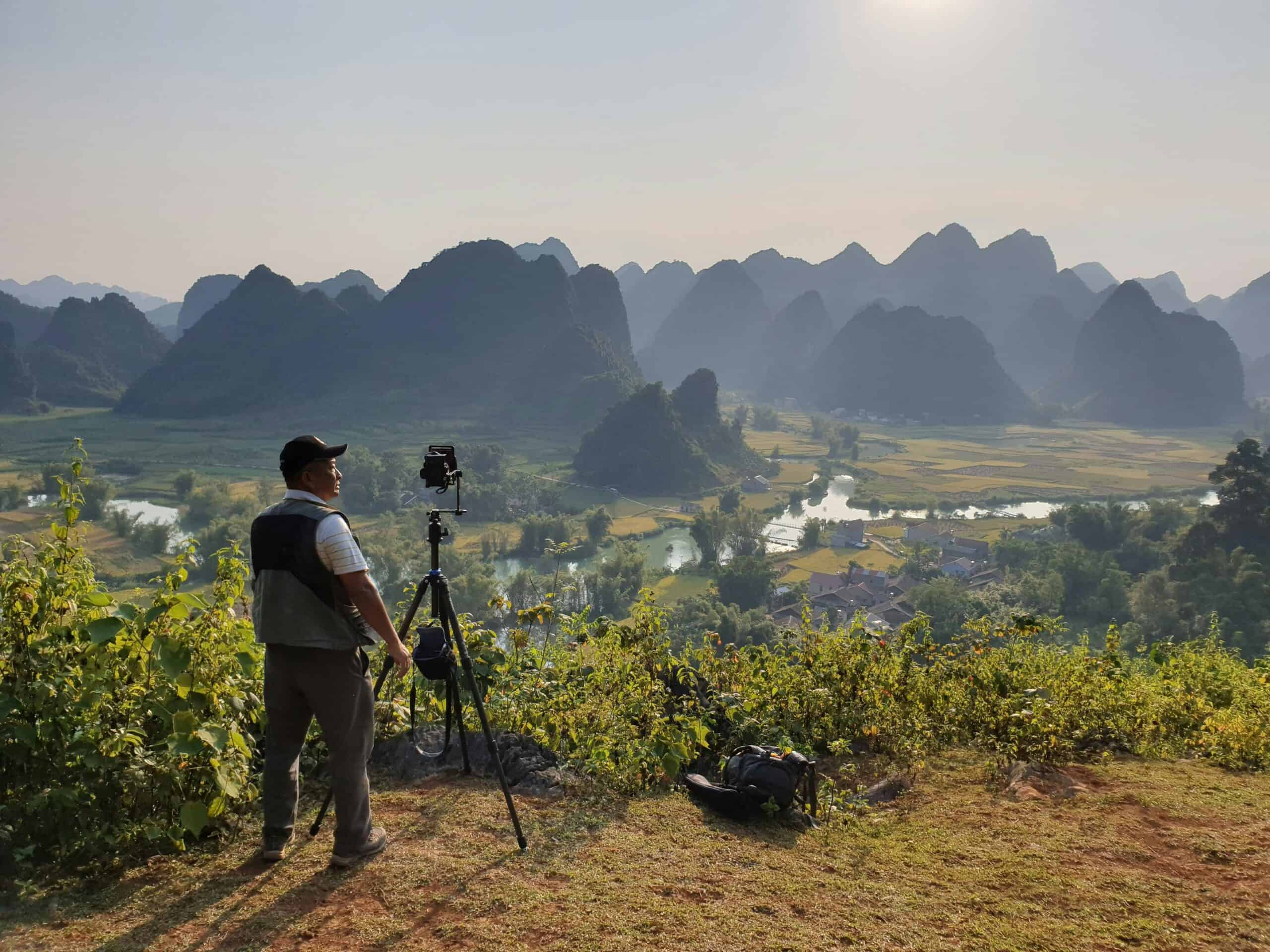
Quick Setup Overview
- Camera: Fujifilm GFX 100 II — 43.8×32.9 mm medium-format sensor, 102 MP, 16‑bit RAW, base ISO 80, IBIS rated up to ~8 stops, pixel pitch ≈3.76 μm.
- Lens: Peleng 8mm f/3.5 — circular fisheye (≈180°), fully manual focus/aperture, noticeable CA toward edges, very strong vignetting by design (circular projection).
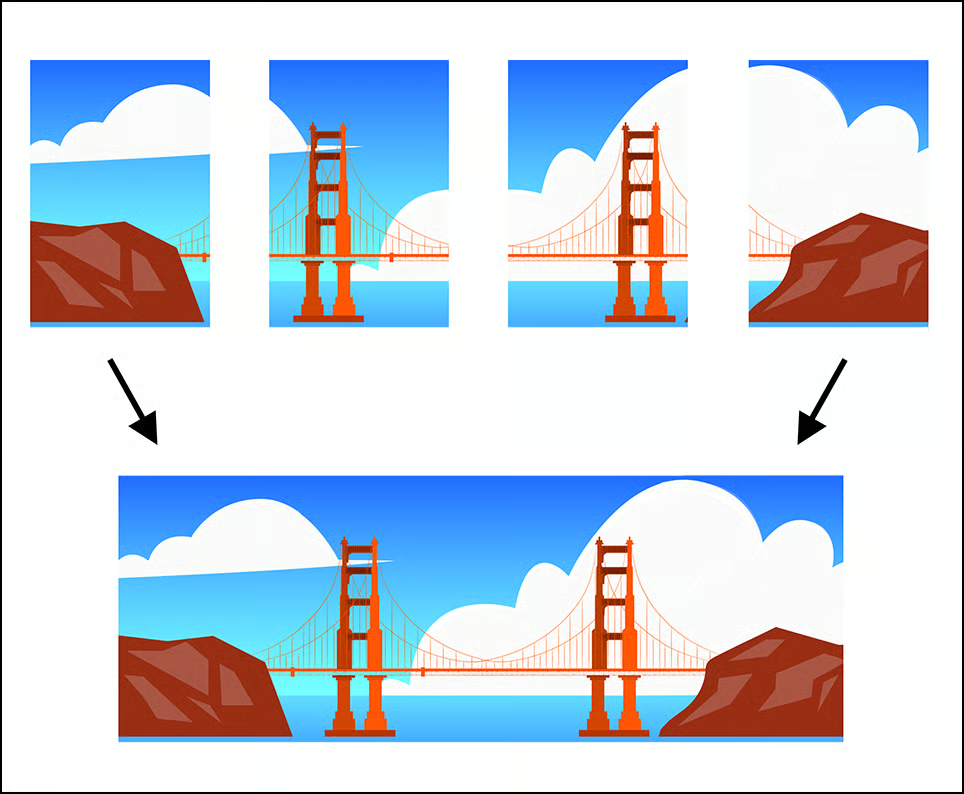
- Estimated shots & overlap (tested): 3–4 shots around at 120°–90° yaw steps with 25–35% overlap; add a nadir for clean tripod removal. Zenith often covered if you keep the lens level and use 4 around.
- Difficulty: Intermediate (easy capture, but requires careful nodal calibration and disciplined exposure/white balance control).
Planning & On-Site Preparation
Evaluate Shooting Environment
Walk the space and note light direction, bright windows, reflective surfaces (glass, polished floors), and moving subjects. If shooting through glass, place the front element within a few centimeters of the pane to minimize reflections and ghosting. In tight interiors, expect more parallax‑critical edges; this is where accurate nodal alignment pays off.
Match Gear to Scene Goals
The GFX 100 II’s dynamic range helps you hold highlight detail (windows, sunset skies) without crushing shadows, especially when paired with 16‑bit RAW. Indoors, ISO 100–800 stays very clean; ISO 1600–3200 remains usable with careful noise reduction. The Peleng 8mm fisheye reduces the number of frames required, which is a big win for moving environments (crowds, traffic) and for quick pole or rooftop work. The trade‑off is the circular projection and fisheye distortion, which are both expected and handled during stitching.
Pre-shoot Checklist
- Charge batteries and carry spares; bring ample storage (102 MP RAW stacks can fill cards quickly).
- Clean lens front/rear elements; use a blower on the sensor to avoid dust spots across the sky.
- Tripod leveling and pano head calibration (check your nodal/entrance pupil marks before you leave).
- Safety: evaluate wind, rooftop edges, and traffic. Tether your gear when elevated or near crowds.
- Backup workflow: shoot a second safety round, especially indoors or at dusk when lighting shifts.
Essential Gear & Setup
Core Gear
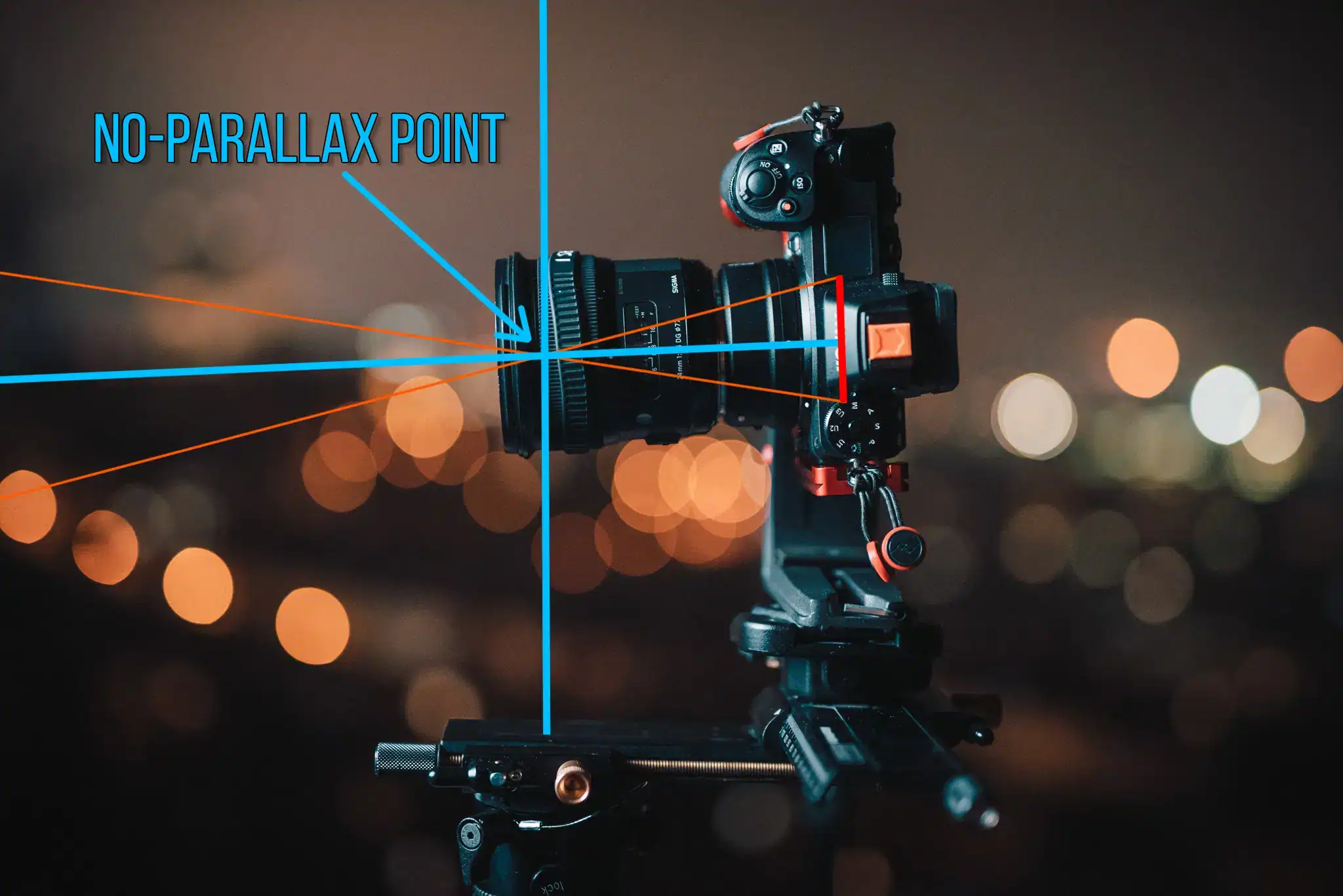
- Panoramic head: A dedicated panoramic head lets you rotate around the lens’s no‑parallax point (entrance pupil). This prevents foreground/background shift and makes stitching dramatically easier.
- Stable tripod with leveling base: Level once at the base, then pan level without chasing the bubble at every shot.
- Remote trigger or camera app: Use a cable release or the Fuji app to avoid touching the camera. Enable Exposure Delay or EFCS to reduce vibration.
Optional Add-ons
- Pole or car mount: Great for elevated views or moving locations. Always use a safety tether, monitor wind load, and minimize rotation speed to reduce motion blur.
- Lighting aids: Small LED panels or bounced flash for flat, dim interiors. Keep lighting consistent per shot.
- Weather protection: Rain cover, microfiber towels, sensor-safe blower; salt spray and dust can ruin a session.
Step-by-Step Shooting Guide
Standard Static Scenes
- Level and align the nodal point: Level your tripod via the leveling base. On your pano head, slide the camera so the rotation axis passes through the Peleng’s entrance pupil. Check with a foreground object and a distant background—pan left/right; if their relative position shifts, fine‑tune the rail until the shift disappears.
- Manual exposure and white balance: Set M mode. Meter for midtones and protect highlights (especially with bright skies). Lock WB (e.g., Daylight or Custom) to avoid color shifts between frames. Shoot RAW (16-bit) for maximum latitude.
- Capture sequence: With the Peleng 8mm on the GFX 100 II, shoot 3–4 frames around at 120° or 90° yaw increments. Use at least 25–35% overlap. If you keep the lens level, 4-around often covers the zenith; plan one extra nadir frame for tripod cleanup.
- Nadir shot: Either offset the camera on the rail to shoot a clean floor or capture a handheld nadir, keeping the lens over the rotation point. This eases tripod removal in post.
HDR / High Dynamic Range Interiors
- Bracket exposures: Use ±2 EV (3–5 frames total) to balance bright windows and dim rooms. The GFX 100 II handles 5–9‑frame brackets well, but 3–5 usually suffice.
- Keep WB and aperture constant: Lock WB and aperture (e.g., f/8) so only shutter changes across brackets. This preserves geometry and color consistency for stitching.
Low-Light / Night Scenes
- Long exposure on tripod: Start at ISO 100–400, f/4–f/5.6, 1–10 s depending on light. The GFX 100 II remains clean up to ISO 800–1600; 3200 is usable with noise reduction.
- Vibration control: Use a remote trigger and enable Exposure Delay or EFCS. Turn IBIS off on tripod to avoid micro‑corrections that can slightly blur long exposures.
Crowded Events
- Two-pass method: First pass for composition; second pass timed to capture gaps in the crowd. Keep your yaw steps consistent so masking is easier.
- Short shutter times: Aim for 1/200 s or faster to reduce subject blur if you want crisp people. Otherwise, embrace motion blur for energy.
Special Setups (Pole / Car / Elevated)
- Secure everything: Use a rated clamp/mount plus a safety tether. For poles, minimize extension in wind and rotate slower to avoid sway.
- Exposure strategy: Use higher shutter speed to combat vibrations; raise ISO within the GFX’s clean range rather than risking motion blur.
Real-World Case Notes
Indoor Real Estate
Use 4-around at f/8, ISO 100, bracket ±2 EV. Place the tripod centered when possible. The circular fisheye means few frames and less chance of people or pets entering multiple shots.
Outdoor Sunset
Meter for the sky and add a bracketed set. Shoot quickly between sun elevations. The GFX’s 16-bit RAW helps blend gradients without banding.
Rooftop or Pole
Favor 3-around to reduce time aloft. Use 1/250 s+ and ISO 200–800. Always tether the rig and watch for wind gusts.
Recommended Settings & Pro Tips
Exposure & Focus
| Scenario | Aperture | Shutter | ISO | Notes |
|---|---|---|---|---|
| Daylight outdoor | f/8–f/11 | 1/100–1/250 | 80–200 | Lock WB (Daylight); prioritize DR for skies |
| Low light/night | f/4–f/5.6 | 1/30–10 s | 100–1600 | Tripod, remote, IBIS off on tripod |
| Interior HDR | f/8 | Bracket ±2 EV | 80–400 | Windows vs. room balance |
| Action / moving subjects | f/5.6–f/8 | 1/200+ | 400–800 | Freeze motion; double pass if needed |
Critical Tips
- Manual focus at or near the hyperfocal distance. With an 8mm on medium format, f/8 gives a hyperfocal of roughly 1.3 m—focus just shy of that and most of the scene will be sharp.
- Nodal point calibration: Use a foreground stick and a distant line; pan left/right and adjust the rail until there’s no relative shift. Mark the rail position for your GFX + Peleng combo.
- Lock white balance: Mixed lighting can cause visible seams. Use a custom or fixed WB across the entire set.
- RAW over JPEG: Shoot 16-bit RAW for clean highlights and flexible color grading, especially for HDR panoramas.
- IBIS behavior: On a tripod, turn IBIS off to avoid micro‑jitter; when handholding single rows, IBIS can help at moderate shutter speeds.
- Effective pixel use: With a circular fisheye on the 44×33 sensor, you’ll use a circular region ≈6.3k px in diameter (roughly 30–35 MP). Multi‑frame stitching still yields very high‑resolution equirectangular output.
Stitching & Post-Processing
Software Workflow
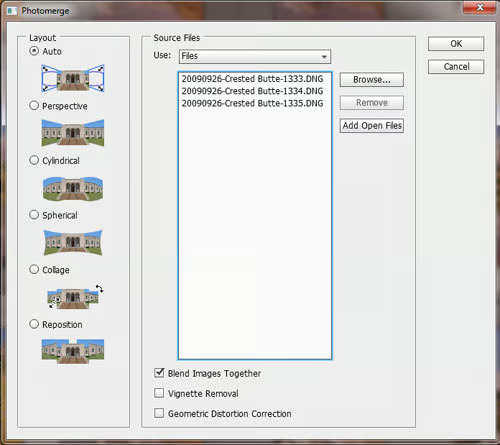
PTGui and Hugin both handle circular fisheye projections well. In PTGui, set Lens Type to Circular Fisheye, focal length 8mm, and define the circular crop precisely. Generate control points automatically, then run the optimizer and check the panorama editor for alignment. Export as 16‑bit TIFF equirectangular for further edits, or JPEG for web/VR. For circular fisheyes, industry guidance targets ~25–35% overlap; rectilinear lenses typically need 20–25% with more frames overall. For VR pipelines, export 2:1 equirectangular in the resolution your platform prefers (e.g., 10–16k for premium tours, lower for web). For a deep PTGui overview, see this review of PTGui’s capabilities at the end of this section.
Cleanup & Enhancement
- Nadir patch: Capture a clean floor plate or use AI/content-aware tools to remove the tripod.
- Color correction: Balance mixed color temperatures (tungsten vs daylight). Apply subtle HSL tweaks for uniformity.
- Noise reduction: Apply luminance NR for high‑ISO interiors and night scenes; don’t over‑smooth textures.
- Leveling: Use horizon and vertical guides in your stitcher, then fine‑tune roll/pitch/yaw.
- Sharpen last: Export high‑res, then apply output‑specific sharpening (web vs print).
Further reading: a practical panoramic head alignment tutorial for no‑parallax setup, and an in‑depth PTGui review and workflow tips. If you’re preparing for VR platforms, Oculus provides a helpful guide on using mirrorless/DSLR for 360 capture and stitching: DSLR/Mirrorless 360 pipeline.
Useful Tools & Resources
Software
- PTGui panorama stitching
- Hugin (open source)
- Lightroom / Photoshop for RAW and finishing
- AI tripod removal tools (e.g., Content-Aware Fill)
Hardware
- Panoramic heads: Nodal Ninja, Leofoto, Sunwayfoto
- Carbon fiber tripods (with leveling bases)
- Wireless remote shutters and L‑brackets
- Pole extensions and secure car mounts with tethers
Disclaimer: Product names are provided for search reference—check the official manuals and specs for your exact model and adapter.
Common Mistakes & How to Avoid Them
- Parallax error → Use a calibrated panoramic head and rotate around the entrance pupil.
- Exposure/WB flicker → Manual mode and locked white balance across all frames.
- Tripod in the frame → Shoot a dedicated nadir or patch with a clean plate.
- Ghosting from movement → Time your shots, do a second pass, and mask in post.
- Night noise and blur → Keep ISO reasonable, use long exposures, remote trigger, and IBIS off on tripod.
- Adapter spacing issues → Use a high‑quality adapter (M42‑GFX/Nikon F‑GFX), and confirm infinity focus before the shoot.
Frequently Asked Questions
- Can I shoot handheld panoramas with the Fujifilm GFX 100 II?
You can for single‑row partial panoramas, but for spherical 360° with the Peleng 8mm, a tripod and pano head are strongly recommended to avoid parallax. If you must go handheld, use IBIS on, fast shutter (1/250 s+), and shoot 4‑around with generous overlap—expect more cleanup in post.
- Is the Peleng 8mm f/3.5 wide enough for single‑row 360?
Yes. As a circular fisheye (~180°), it covers the sphere with 3–4 shots around. On the GFX, it produces a circular image; plan 3×120° or 4×90° around, plus a nadir if you want a perfectly clean floor.
- Do I need HDR for interiors with bright windows?
Usually yes. Bracket ±2 EV (3–5 frames) to keep window highlights while preserving interior shadows. Merge the brackets before stitching or use your stitcher’s HDR workflow if supported.
- How do I avoid parallax issues with this combo?
Use a panoramic head, align the entrance pupil for the Peleng (calibrate once and mark the rail), keep the lens level, and avoid shifting the camera during the sequence. A quick alignment method is explained in many panoramic head tutorials, such as the one linked above.
- What ISO range is safe on the GFX 100 II for low light?
For the cleanest results, stay at ISO 80–800. ISO 1600 remains very good, and ISO 3200 is workable with careful noise reduction. For static scenes, favor longer shutter speeds on a tripod over pushing ISO.
Safety, Limitations & Honest Notes
The Peleng 8mm f/3.5 on GFX will produce a circular image with strong vignetting—this is expected. You’ll crop to the circle in your stitcher. Use a reliable adapter (e.g., M42‑GFX or Nikon F‑GFX), and confirm infinity focus. The GFX 100 II’s high resolution makes dust and flare more obvious; keep optics clean and use a hood or flag the sun when possible to reduce flare with fisheyes. Elevated and car‑mounted captures demand tethers, cautious speed, and conservative shutter speeds.
For further reading on broader DSLR/mirrorless 360 workflows and focal length considerations, see this Q&A resource: best techniques for 360 panoramas.