Why This Camera & Lens Are Great for Panoramas
If you’re researching how to shoot panorama with Fujifilm GFX 100 II & Nikon Z 20mm f/1.8 S, you’re aiming for very high-quality, high-resolution spherical imagery. The GFX 100 II brings a 44×33 mm medium-format 102 MP BSI CMOS sensor (approx. 3.76 µm pixel pitch) with excellent base ISO dynamic range (14+ stops at ISO 80) and 16-bit RAW. That combination yields huge stitchable files with smooth tonality—perfect for 360 photos, gigapixel panos, and detailed virtual tours.
The Nikon Z 20mm f/1.8 S is a rectilinear full-frame prime known for low distortion, minimal lateral CA, and strong edge-to-edge sharpness from f/2.8–f/8. As a rectilinear lens, it preserves straight lines, which helps architectural scenes and interiors look natural after stitching, though it requires more images than a fisheye.
Important compatibility note: as of 2025, there is no widely available smart (electronic) Nikon Z-to-Fujifilm GFX adapter. Without electronic control, the Z 20mm will default to wide-open aperture and have no AF or aperture control on GFX. In practice, that makes this combo challenging. A realistic workaround is to run the GFX 100 II in 35mm crop mode (about 60 MP) and use a different 20–24 mm manual-aperture lens that can be adapted, or consider a native GF wide (e.g., GF 23mm f/4) for the same workflow. If you do secure a verified smart adapter later, the guidance below applies directly to the Z 20mm.
Quick Setup Overview
- Camera: Fujifilm GFX 100 II — 44×33 mm medium format, 102 MP, base ISO 80, 16-bit RAW, powerful IBIS (disable on tripod).
- Lens: Nikon Z 20mm f/1.8 S — rectilinear full-frame prime, very low distortion, excellent sharpness at f/5.6–f/8, well-controlled CA/flare. Note: heavy vignetting on full GFX frame; use 35mm crop mode (~60 MP) or a compatible wide-angle.
- Estimated shots & overlap (rectilinear 20 mm on 35mm crop):
- Quality-first multi-row: 10 shots per row at ±35° pitch (20 total) + 1 zenith + 1 nadir = 22 shots, ~30% overlap.
- Speed-first multi-row: 8 shots per row at ±35° pitch (16 total) + 1 zenith + 1 nadir = 18 shots, ~30–35% overlap.
- Difficulty: Advanced (multi-row capture + nodal calibration; added complexity if adapting the Nikon Z lens).
Planning & On-Site Preparation
Evaluate Shooting Environment
Assess light direction and range (bright windows vs dark interiors), reflective surfaces (glass, polished stone), and moving elements (people, traffic, trees in wind). If shooting through glass, get the front element close (1–2 cm) and square to the pane to minimize reflections and ghosting; shield stray light with a jacket or rubber hood if needed.
Match Gear to Scene Goals
The GFX 100 II’s dynamic range and 16-bit files make it excellent for HDR panoramas in real estate and interiors where window highlights clip easily. Safe ISO ranges for critical quality are ISO 80–800; ISO 1600–3200 remains usable with careful noise reduction for night exteriors. The Nikon Z 20mm f/1.8 S, when used in 35mm crop, offers a clean, straight-line rendering with minimal distortion. It requires more frames than a fisheye but avoids fisheye defish artifacts—great for architecture and straight edges.
Compatibility warning: unless you have a verified smart Z-to-GFX adapter (rare as of 2025), you won’t be able to control aperture on the Nikon Z 20mm. If that’s the case, swap to a manual-aperture wide-angle that can be adapted, or use a native GF lens. The capture and stitching techniques below still apply to a 20–24 mm rectilinear field of view.
Pre-shoot Checklist
- Charge batteries, clear storage, and clean lens and sensor (dust is very visible on sky gradients at 102 MP).
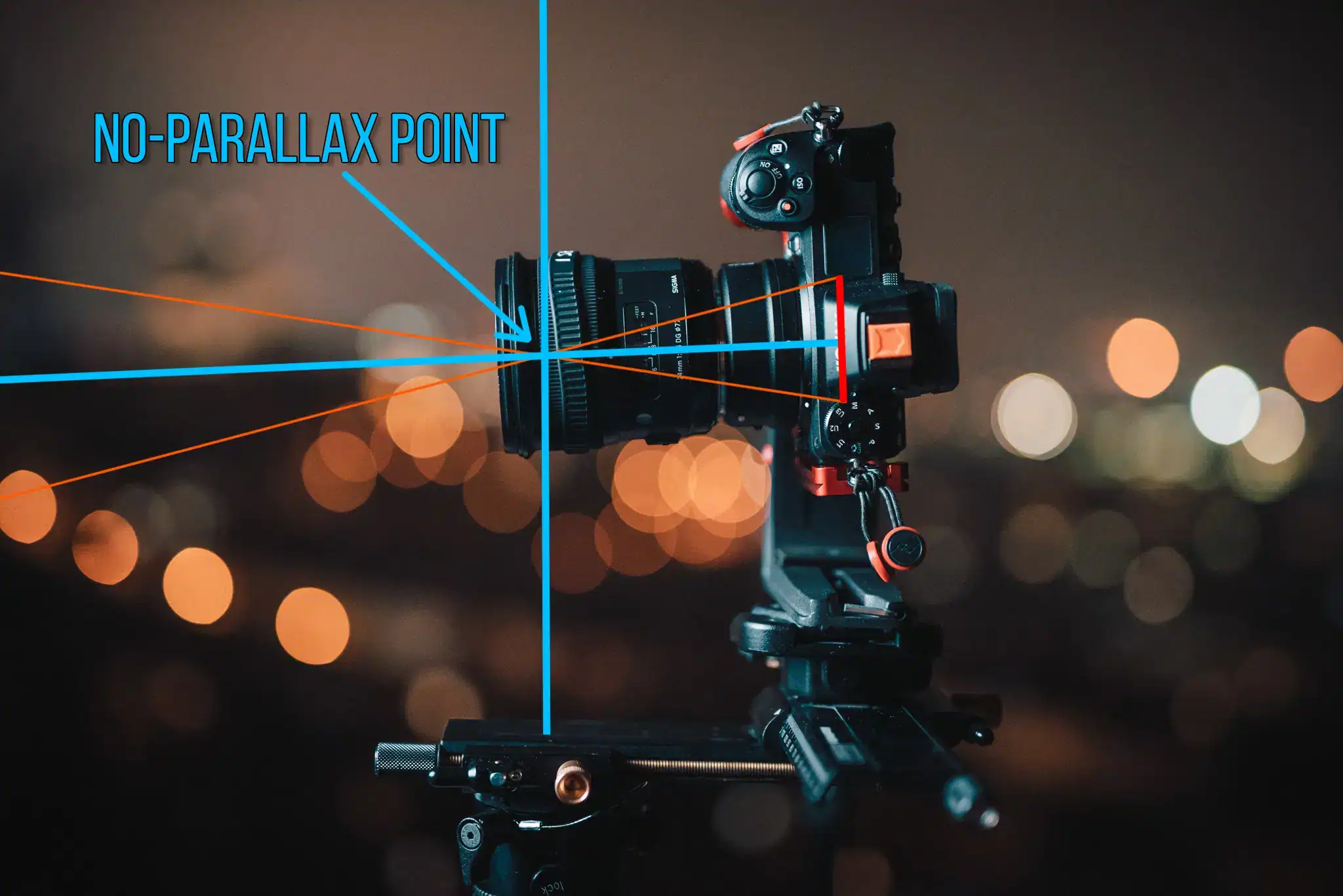
- Level your tripod and pre-calibrate the panoramic head’s nodal (no-parallax) point for your lens height.
- Safety: check wind loads on rooftops; use sandbags, tethers, and avoid close edges. For car mounts, double-safety tethers.
- Backup workflow: perform one extra full round after your main pass; it often saves a panorama if a frame is blurred or blocked.
Essential Gear & Setup
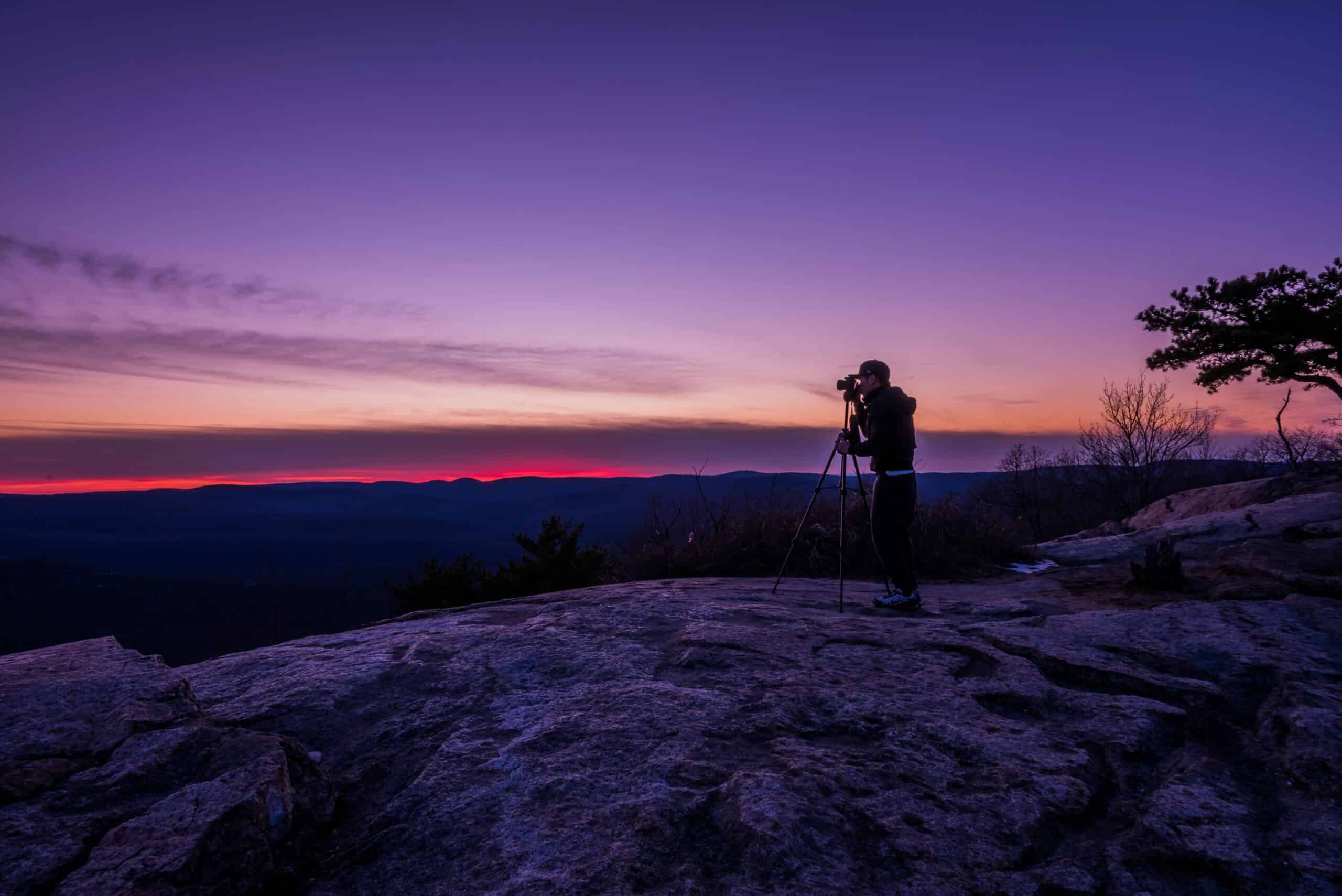
Core Gear
- Panoramic head: A two-axis panoramic head lets you rotate around the lens’ no-parallax point to avoid parallax between foreground and background. This is critical with rectilinear lenses like a 20 mm.
- Stable tripod with leveling base: Leveling saves time in post and keeps rows consistent.
- Remote trigger or app: Prevents vibration and keeps your hands off the camera between frames.
Optional Add-ons
- Pole or car mount: Use only with robust clamps and tethers; account for wind and vibration. Plan shorter shutter speeds and higher overlap.
- Lighting aids: Continuous panels or a bounce flash for interiors; keep lighting consistent across frames.
- Weather protection: Rain covers, microfiber cloths, and silica packs for humidity.
Set up a Panoramic Head (Video)
New to panoramic heads? This short video is a great primer on alignment and workflow.
For a deeper dive, see this panoramic head tutorial after you practice a few sessions. Panoramic head setup guide
Step-by-Step Shooting Guide
Standard Static Scenes
- Level tripod and align the nodal point. Slide the camera along the rail until near objects overlap correctly when panning. Lock the rails and note the markings so you can repeat the setup.
- Set manual exposure and lock white balance. Use a consistent exposure for all frames to avoid flicker and tone mismatches. Set WB to Daylight (outdoor) or a fixed Kelvin for interiors.
- Choose your capture pattern. For a 20 mm rectilinear in 35mm crop:
- Quality-first: +35° row (10 shots, 36° yaw spacing), −35° row (10 shots), plus 1 zenith and 1 nadir.
- Speed-first: +35° row (8 shots, 45° yaw), −35° row (8 shots), plus 1 zenith and 1 nadir.
- Shoot a dedicated nadir frame. Lean the rig aside or use a nadir adapter to remove the tripod footprint later.
HDR / High Dynamic Range Interiors
- Bracket ±2 EV (3 or 5 frames) for each camera position to balance bright windows and interior shadows. Keep the camera perfectly still between brackets.
- Lock WB and keep the same aperture across brackets. Let shutter speed vary to capture the full range.
Low-Light / Night Scenes
- Use a tripod, turn off IBIS, and set longer exposures. On the GFX 100 II, aim for ISO 80–400 when possible; ISO 800–1600 is acceptable with noise reduction. If wind or vibration is present, keep shutter above 1/2–1 s and increase ISO modestly.
- Trigger with a remote or 2 s self-timer to prevent micro-blur.
Crowded Events
- Shoot two passes: a quick pass to capture structure, then a second pass waiting for gaps in the crowd or clean views of key areas.
- In post, blend the clean regions from each pass to reduce ghosting.
Special Setups (Pole / Car / Drone)
- Use safety tethers and redundant clamps. Check torque on all knobs before raising the pole or driving.
- Increase overlap (35–40%) and raise shutter speeds to counter vibration. Expect to do more masking in post.
Recommended Settings & Pro Tips
Exposure & Focus
| Scenario | Aperture | Shutter | ISO | Notes |
|---|---|---|---|---|
| Daylight outdoor | f/8–f/11 | 1/100–1/250 | 100–200 | Lock WB (Daylight); optimal sharpness and minimal diffraction |
| Low light/night | f/4–f/5.6 | 1/2–1/60 | 200–800 (up to 1600 if needed) | Tripod + remote; IBIS off on tripod |
| Interior HDR | f/8 | Bracket ±2 EV | 100–400 | Balance bright windows vs dark rooms |
| Action / moving subjects | f/5.6–f/8 | 1/200+ | 400–800 | Double-pass capture to reduce motion ghosts |
Critical Tips
- Manual focus near hyperfocal: for 20 mm at f/8 (35mm crop), hyperfocal is about 1.6–2 m; focus slightly beyond 2 m and everything from ~1 m to infinity stays sharp.
- Nodal point calibration: place a light stand close and a building edge far, pan left/right; slide the camera on the rail until the foreground and background align without shifting. Mark the rail for repeatability.
- White balance lock: avoid mixed color casts by using a fixed Kelvin or a preset; match all frames.
- RAW over JPEG: the GFX 100 II’s 16-bit RAW preserves highlights and color for smoother HDR merges and stitches.
- IBIS off on tripod: stabilization can introduce micro-shifts during long exposures; leave it on only when shooting handheld.
Stitching & Post-Processing
Software Workflow
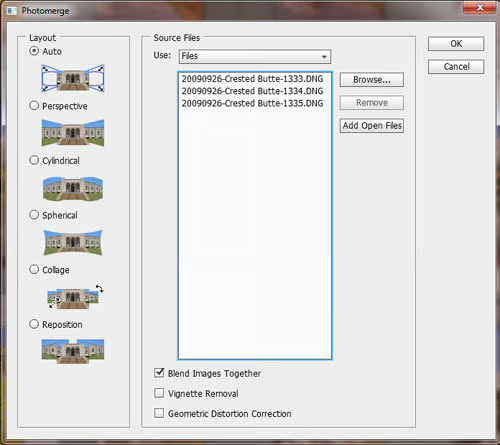
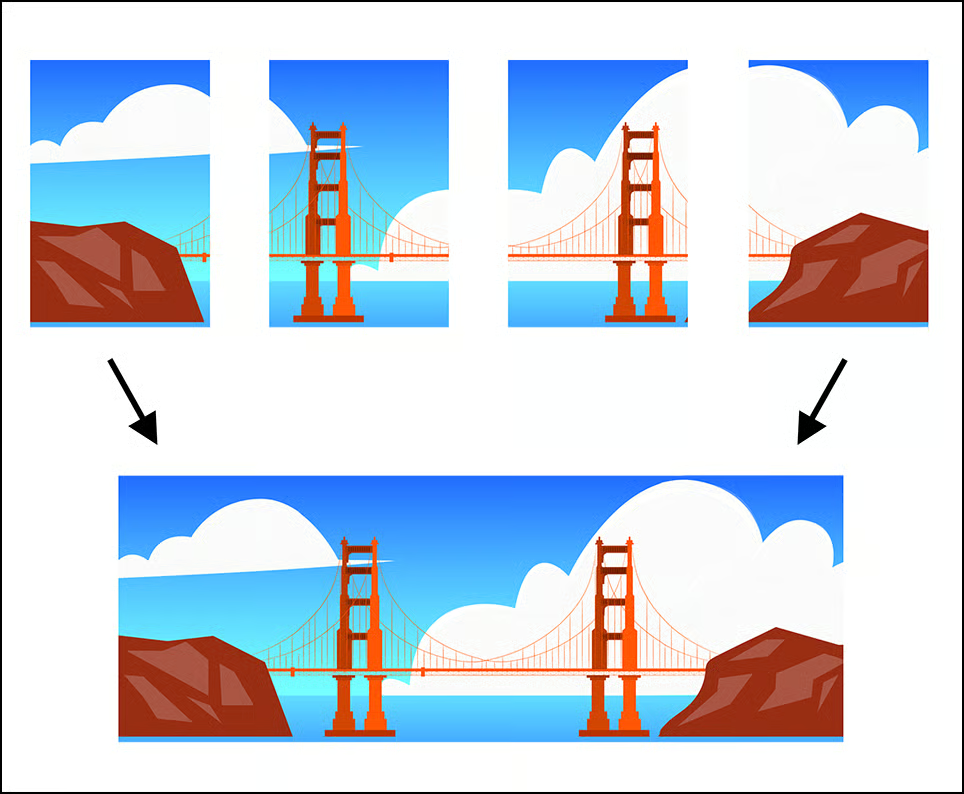
Import and sort by row, run HDR merges (if used), then stitch in PTGui or Hugin. Rectilinear lenses need more frames and consistent overlap (20–30%), but straight lines will look natural. PTGui’s control-point editor and optimizer make it fast to solve multi-row projects, and its masking tools are excellent for removing moving objects. For a quick primer and review of PTGui’s strengths, see this overview. PTGui overview and review
Cleanup & Enhancement
- Nadir/tripod removal: export a layered panorama and patch in Photoshop, or use AI patching tools for speed.
- Global color: balance temperature/tint across the sphere. Apply subtle dehaze, and use selective noise reduction for shadow regions.
- Level horizon: set pitch/roll/yaw so the virtual horizon is perfectly level; this improves VR viewing comfort.
- Export: equirectangular 2:1 JPEG/TIFF at the platform’s max (e.g., 16k–32k wide for VR). For Meta/Oculus publishing, see their DSLR-to-360 guidance. Using a DSLR/mirrorless to shoot and stitch 360 photos
For resolution planning per focal length and sensor, this reference is helpful. DSLR spherical resolution (Panotools Wiki)
Disclaimer: Always check your software’s latest documentation; interfaces and features evolve quickly.
Useful Tools & Resources
Software
- PTGui panorama stitching
- Hugin (open source)
- Lightroom / Photoshop for RAW/HDR and cleanup
- AI tripod removal or content-aware fill
Hardware
- Panoramic heads (Nodal Ninja, Leofoto)
- Carbon fiber tripods with leveling bases
- Wireless remote shutters
- Pole extensions / car mounts with redundant tethers
Disclaimer: brand names provided for research; verify compatibility and specs on official sites.
Real-World Scenarios: What Works
Indoor Real Estate (Windows + Mixed Light)
Run f/8, ISO 100–200, bracket ±2 EV. Keep WB fixed (e.g., 4000–4500 K) to avoid green/magenta shifts from mixed LED and daylight. Capture two-row coverage to ensure ceiling and floor are clean. Use curtains or flags to reduce glare on glossy floors. The GFX 100 II’s 16-bit files pull back window highlights gracefully after HDR merging.
Outdoor Sunset (High DR, Wind)
At dusk, wind can shake the rig. Choose 1/60–1/100 s minimum shutter, ISO 200–800, f/8. Consider a slightly higher overlap (35%) to help the optimizer. Lock WB to “Daylight” for consistent sky tones.
Crowded Event (People Flow)
Do a fast “structure pass” to lock in the environment, then a slower pass waiting for gaps in the crowd. In PTGui, mask to keep only one instance of moving subjects. If necessary, shoot extra tiles of critical areas and patch them in later.
Rooftop / Pole Shooting
Safety first: tether everything, add a counterweight, and keep the center column lowered. Increase shutter speed (1/125–1/250 s) and overlap (35–40%). Expect to do more masking and local warps in post due to flex.
Car-Mounted Capture
Not recommended with a heavy GFX body unless you have a robust, tested rig. If attempted, use dual tethers, dampers, and very short exposures. Plan your route to minimize stops and vibrations.
Compatibility & Practical Alternatives
Because the Nikon Z 20mm f/1.8 S requires electronic aperture control and there is no widely available smart Z-to-GFX adapter (as of 2025), it’s difficult to use this lens properly on a GFX 100 II. If you cannot control the aperture, you’ll be stuck at f/1.8 with shallow depth of field and heavy vignetting—both poor for panoramas. Practical options:
- Use GFX 35mm crop mode with a different 20–24 mm manual-aperture lens that adapts cleanly, or
- Use a native Fujifilm GF wide (e.g., GF 23mm f/4) and follow the same multi-row approach, or
- Use a Nikon Z body with the Z 20mm f/1.8 S, then apply the same shooting patterns and stitching workflow.
The shooting methodology, overlap guidance, and post-processing steps in this article remain valid across those alternatives. For additional system-agnostic advice on DSLR/mirrorless 360 workflows, see this concise guide. Set up a panoramic head for high‑end 360 photos
Common Mistakes & How to Avoid Them
- Parallax error: always rotate around the lens’ no-parallax point; avoid shifting the camera between frames.
- Exposure flicker: use full manual exposure and fixed white balance; don’t let auto modes vary between tiles.
- Tripod shadows at nadir: plan a dedicated nadir frame or patch later with AI/content-aware tools.
- Ghosting from moving people/trees: shoot double passes and use masks to keep only one instance.
- Night noise and blur: keep ISO moderate and use a sturdy, wind-resistant setup with a remote trigger.
Frequently Asked Questions
- Can I shoot handheld panoramas with the Fujifilm GFX 100 II?
It’s possible for simple cylindrical panos, but for full 360×180 spheres, a tripod and panoramic head are strongly recommended. The high resolution makes even tiny alignment errors visible.
- Is the Nikon Z 20mm f/1.8 S wide enough for single-row 360?
No. A 20 mm rectilinear needs multi-row coverage for full 180° vertical FOV. Use two rows at ±35° plus zenith and nadir.
- Do I need HDR for interiors with bright windows?
Yes, typically bracket ±2 EV (3–5 frames) per position. The GFX 100 II’s DR helps, but HDR ensures clean window detail without crushed shadows.
- How do I avoid parallax issues with this setup?
Calibrate the no-parallax point on your panoramic head: align a near object with a far edge and slide the camera on the rail until there’s no relative shift when panning. Record the rail marks for repeatable setup.
- What ISO range is safe on the GFX 100 II in low light?
For critical quality, stay at ISO 80–400; ISO 800–1600 is still solid with modern noise reduction. Only push higher if shutter speed must be fast due to wind or vibration.
- Can I store pano settings as a custom mode?
Yes. Save a custom setting with manual exposure, fixed WB, RAW, IBIS off (for tripod), and a 2 s self-timer or remote trigger to speed your setup.
- Will the Nikon Z 20mm S vignette on the GFX sensor?
On full 44×33 mm, yes—severe mechanical vignetting is expected. Use 35mm crop mode (~60 MP) or a lens that fully covers the GFX image circle.
Visual Aids